Best Credential Verification Software: 10 Platforms Ranked

Why Credential Verification Matters
Anyone can make a certificate look official. A logo, a nice font, a signature graphic, a PDF export, and it passes a quick glance.
Credential verification software fixes that. It ties every certificate or badge to the real record, so an employer or licensing board can trust it without taking your word for it.
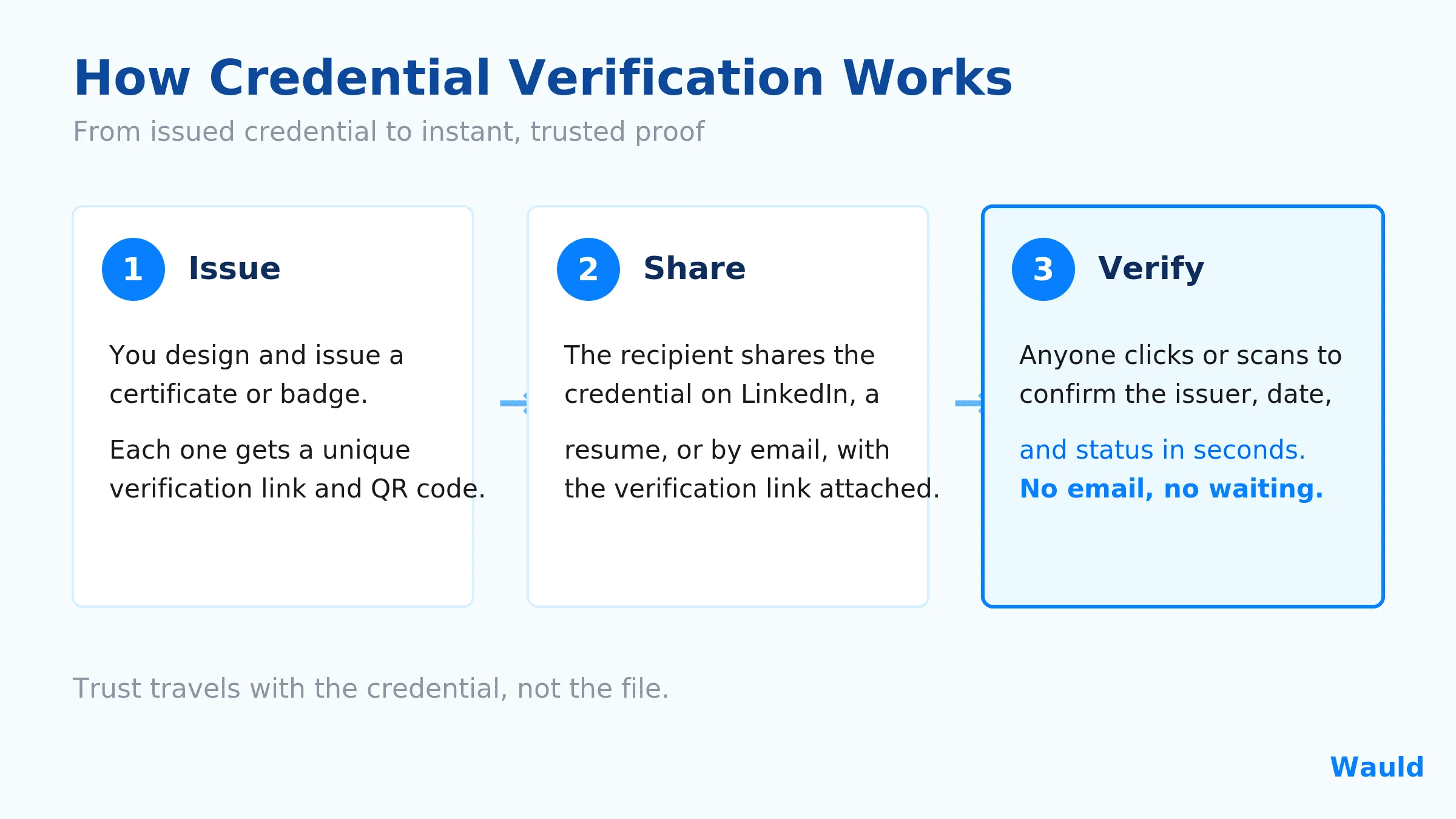
Here is how it works:
- Each credential gets a unique verification link and usually a QR code.
- Anyone clicks or scans and lands on a hosted page you control.
- The page shows the facts: who issued it, who earned it, when, and for what.
- Status stays live. If a credential is revoked or expired, the page says so.
- Forgeries fail. The truth lives on the issuer's page, not in the file.
This guide compares ten platforms people shortlist to verify digital credentials. Wauld comes first, then nine well-known digital credential software tools, each with an honest pros and cons table and a side-by-side comparison. Pricing and features were checked against each platform's own website while writing.
The Problem: Trust Does Not Travel With a File
A certificate is only as trustworthy as the way it can be checked. When credentials live as loose PDFs, three things go wrong:
- Files are easy to fake. Names, dates, and logos can be swapped in a graphics editor. See our guides on how to spot a fake diploma and the risks of fake diplomas.
- Verification becomes manual. Without a link, confirming a credential means emailing the issuer and waiting. That does not scale for thousands of certificates a year.
- Credentials get stuck. A PDF cannot be added to LinkedIn as a verifiable item, cannot be revoked after it is sent, and carries no metadata an employer's system can read.
Good credential verification software fixes all three. It makes each credential provable, checkable in seconds, portable, and revocable. Here are the ten platforms.
The 10 Best Credential Verification Software Platforms
Wauld
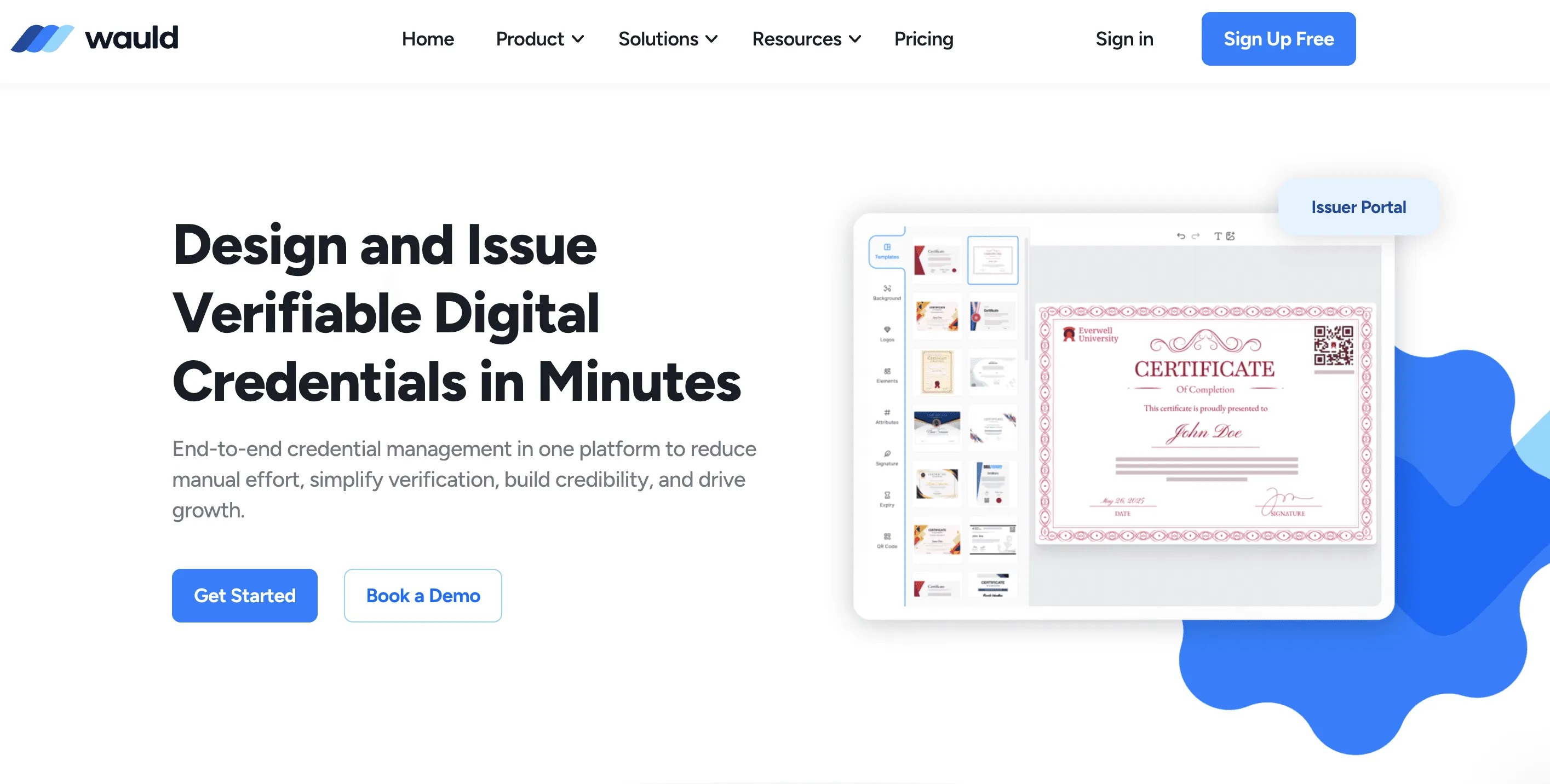
Wauld is a modern digital credentialing platform that covers the full lifecycle: design, issue, track, and verify.
- Verification built in: every certificate or badge gets a unique verification link and QR code on a hosted page you control.
- Open standards: aligns with Open Badges 3.0 and W3C Verifiable Credentials, so credentials stay portable.
- Design and scale: over 1,000 templates, bulk issuance from form responses, and void or reissue from one dashboard.
- Analytics: tracks opens, downloads, shares, and LinkedIn additions.
- Pricing: free to start, no onboarding fee, public self-serve pricing. Named a SourceForge Top Performer for Digital Credential Management.
| Pros | Cons |
|---|---|
| All-in-one: design, issue, track, and verify in one platform | Newer name than a few legacy enterprise incumbents |
| Unique verification link and QR code on every credential | Not a diploma-only, university-specific blockchain vendor |
| Free to start, no onboarding fees, public self-serve pricing | |
| Open Badges 3.0 and W3C Verifiable Credentials support | |
| Over 1,000 templates plus recipient-level analytics |
If you want credentials people can verify and share, not just download, Wauld covers the whole job. You can start free and issue your first verifiable credential here.
2. BCdiploma
BCdiploma is a blockchain-based platform for tamper-proof, lifelong credentials.
- Blockchain-anchored: each credential is written to the Ethereum blockchain for permanent verification.
- Best for institutions: a strong fit for universities and certification bodies, with 250+ institutions referenced.
- Pricing: custom rather than public, which suits enterprise buyers more than small teams.
| Pros | Cons |
|---|---|
| Blockchain-anchored, tamper-proof, lifelong verification | Custom pricing with no public self-serve tier |
| Strong fit for universities and formal diplomas | Oriented to enterprise, less so to small teams |
| Analytics plus LMS and SIS integrations | Setup can be heavier than lightweight tools |
3. Hyperstack
Hyperstack is a blockchain credentialing platform for certificates, badges, transcripts, and diplomas.
- Free plan: 20 recipients a year.
- Paid plans: $350 a year for 1,000 recipients, or $799 a year for full white labeling.
- Standards: Open Badges 2.0 today, with 3.0 alignment on the roadmap.
- Extras: lifetime verification at no added cost, plus many native LMS integrations.
| Pros | Cons |
|---|---|
| Free plan available, clear recipient-based pricing | Open Badges 2.0 today, 3.0 still on the roadmap |
| Lifetime verification at no added cost | Recipient caps on lower tiers |
| Many native LMS and app integrations | White labeling only on the higher tier |
4. POK
POK issues verifiable digital credentials aligned with Open Badges 3.0.
- Free plan: unlimited issuance with public verification.
- Blockchain option: $3,000 a year for up to 50,000 credentials, or $0.30 per credential.
- NFT option: available for organizations that want it.
- No lock-in: no minimum contract or mandatory annual commitment.
| Pros | Cons |
|---|---|
| Free plan with unlimited issuance and public verification | Blockchain and NFT features cost extra per credential |
| Open Badges 3.0 support, no lock-in or minimum contract | Design and template depth is lighter than some rivals |
| Transparent per-credential blockchain pricing | NFT framing may not suit conservative institutions |
5. TruScholar
TruScholar is a blockchain credentialing platform aimed largely at education.
- Pricing: Standard plan from $25 a month for 1,000 credentials.
- Verification: QR-code checks plus a dashboard for issued, pending, verified, and revoked credentials.
- Compliance: supports Indian frameworks (DigiLocker, NEP 2020, Academic Bank of Credits, NAD).
- Best for: universities and events, especially in that market.
| Pros | Cons |
|---|---|
| Low entry price, strong for education and events | Compliance focus is India-centric |
| Blockchain security with instant QR verification | Less known outside its core market |
| Issues degrees, transcripts, badges, and marksheets | Global standards support is less emphasized |
6. Acreditta
Acreditta is a digital certification platform popular across Latin America.
- Standards: blockchain plus Open Badges 3.0 and W3C support.
- Fast acceptance: recipients do not need an account to accept a credential.
- Free account: up to 25 users.
- Extras: customizable PDFs, a custom web domain on all plans, stackable badges, and multi-language support.
| Pros | Cons |
|---|---|
| Open Badges 3.0 and W3C support with blockchain | Strongest presence is in Latin America |
| Recipients accept credentials without an account | Enterprise features need a higher plan |
| Custom domain on all plans, multi-language | Documentation is lighter in some regions |
7. Accredible
Accredible is an established digital badging and certificate platform.
- Pricing: Launch plan from about $45 a month on an annual term.
- Setup fee: third-party reviews report around $1,500, though Accredible's own site says there are no separate setup fees beyond your plan.
- Model: priced by unique recipients, so you can issue many credentials per person per year.
- Features: verification, expiration management, API access, and integrations.
| Pros | Cons |
|---|---|
| Mature platform with strong verification and API | Setup fee reported around $1,500 |
| Recipient-based pricing suits multi-credential programs | Costs get less predictable as recipients grow |
| Expiration, reporting, and integration features | Higher entry cost than free-to-start tools |
8. Credly
Credly is one of the best-known enterprise credentialing networks.
- Reach: widely used by large brands, with a big shared skills directory employers recognize.
- Pricing: about $1,500 a year for 500 badges up to $7,500 a year for 2,500 badges.
- Setup fee: around $2,000, annual contracts only.
| Pros | Cons |
|---|---|
| Large, well-recognized badge network and directory | Setup fee around $2,000, higher overall cost |
| Enterprise-grade issuing and verification | Less accessible for small teams and solo issuers |
| Strong employer familiarity with Credly badges | Design flexibility is more limited |
9. Certifier
Certifier is a certificate and badge platform with a genuinely usable free plan.
- Free plan: 250 credentials a year, no credit card, with QR code and unique URL verification.
- Paid plans: from around $67 a month, adding branded emails, scheduled issuance, and advanced analytics.
- Extras: full template library, bulk issuance, LinkedIn sharing, plus API and Zapier.
| Pros | Cons |
|---|---|
| Free plan with 250 credentials and real verification | Paid tier jumps to around $67 a month |
| QR code and unique verification URL on credentials | Analytics depth reserved for paid plans |
| Bulk issuance, LinkedIn sharing, API and Zapier | Fewer templates than the largest libraries |
10. Sertifier
Sertifier is a digital badge and certificate platform with simple public pricing.
- Standards: Open Badges 3.0 and W3C Verifiable Credentials.
- Verification: unique link and QR code on every credential, plus optional blockchain-backed validation.
- Pricing: free up to 250 unique recipients a year, then $1 per recipient a year.
- Discounts: available for non-profits and startups.
| Pros | Cons |
|---|---|
| Open Badges 3.0 and W3C support, public pricing | Recipient-based pricing can rise with reach |
| Verification link, QR code, and audit logs | Blockchain validation is an add-on |
| Non-profit and startup discounts | Template library is smaller than some rivals |
Side-by-Side Comparison
Here is how the ten platforms compare on the criteria that matter most for credential verification. Wauld sits in the first row.
| Platform | Free to start | Verification link + QR | Standards (Open Badges/W3C) | Onboarding fee | Best for |
|---|---|---|---|---|---|
| Wauld | Yes, no onboarding fee | Yes | Open Badges 3.0 + W3C | None | All-in-one design, issue, track, verify |
| BCdiploma | Custom pricing | Yes (blockchain) | Blockchain-anchored | Custom | University diplomas |
| Hyperstack | Yes, 20/yr | Yes | Open Badges 2.0 (3.0 planned) | None stated | Growing programs |
| POK | Yes, unlimited | Yes | Open Badges 3.0 | None | Free-first, add blockchain |
| TruScholar | Free tier | Yes (blockchain) | Blockchain, India frameworks | None stated | Education in India |
| Acreditta | Yes, 25 users | Yes | Open Badges 3.0 + W3C | None stated | Latin America programs |
| Accredible | Trial | Yes | Open Badges | ~$1,500 | Multi-credential enterprises |
| Credly | No | Yes | Open Badges | ~$2,000 | Large enterprise networks |
| Certifier | Yes, 250/yr | Yes | Open Badges | None | Small to mid teams |
| Sertifier | Yes, 250/yr | Yes | Open Badges 3.0 + W3C | None |
A few patterns stand out:
- Blockchain platforms (BCdiploma, TruScholar, Hyperstack) lean toward institution-grade verification, but often with custom pricing or a regional focus.
- Enterprise networks (Credly, Accredible) offer strong reach, but add setup fees that put them out of reach for smaller issuers.
- Accessible all-rounders (Wauld, Certifier, Sertifier, POK) give you real verification links, standards support, and a free way to start.
The best verification is the kind nobody has to think about. A recipient shares a link, an employer clicks it, and the credential proves itself in seconds.
Want to go deeper? Compare the wider field in our roundups of digital credentialing platforms with features and reviews, certificate management software solutions, and digital certificate platforms for certificate management.
Why Wauld Is the Best Pick for Verification
Most platforms here are good at one part of the job. Wauld brings the whole workflow together, so verification is built into how every credential is created, not bolted on after.
Here is what that looks like in practice:
- Design: Build a branded certificate or badge from over 1,000 templates.
- Issue: Send in bulk from form responses or a spreadsheet.
- Verify: Every recipient gets a credential with its own verification link and QR code.
- Stay accurate: Void or reissue from one dashboard, so the verification page always reflects the truth.
- Share and prove: Open Badges 3.0 and W3C support let recipients add credentials to LinkedIn, a resume, or an email signature.
- Measure: Watch opens, shares, and verifications in your analytics.
- Start free: No onboarding fee and public pricing, so you only pay as you grow.
Conclusion
Choosing credential verification software comes down to what you issue and who needs to trust it:
- University diplomas? A blockchain-anchored specialist may fit.
- A large existing badge program? An enterprise network can make sense despite the setup fees.
- Most other teams? An accessible all-in-one platform wins.
That is where Wauld stands out. It gives every credential a verification link and QR code, supports open standards, includes analytics, and starts free with no onboarding fee. Pick the platform that matches your program, and if that program needs recognition that people can prove, start with Wauld.