Top CE Certificate Software Platforms: 9 Tools Compared

Why the right CE certificate software matters
If you run a continuing education program, you already know the certificate is the part learners actually keep. It is the proof they showed up, did the work, and earned their continuing education units (CEUs). So when the certificate process is clunky, with manual emails, mismatched fonts, and "can you resend mine?" requests months later, it quietly chips away at how professional your whole program feels.
CE certificate software is simply the tool that handles that last, important mile: designing the certificate, issuing it to the right people, tracking what happens next, and letting anyone verify it is real. Get it right and the paperwork disappears into the background. Get it wrong and you spend Friday afternoons fixing name spellings in a PDF editor.
And this is not a small corner of the world. The global continuing education market was worth about $78.6 billion in 2026 and is growing at roughly 11% a year, while over 87% of organizations now mandate annual professional development. More learners, more mandatory credits, and more certificates to issue and prove. The tooling has to keep up. If you want the bigger picture on how credentials are changing, our complete guide to modern digital badges is a good companion read.
Below are nine platforms worth knowing in 2026. We researched each one at the time of writing for current features, pricing, and standards support. We put Wauld first because, for most organizations issuing continuing education certificates, it is the most complete and accessible option. We have also been fair to every tool, because the best choice depends on your setup.
The Problem: Continuing Education Has Outgrown the PDF
Here is the pain that makes this whole category exist. A decade ago, you could get away with a Word template, a mail merge, and a shared drive. Today, that breaks down fast.
- Verification is now expected. Boards, employers, and members want to confirm a certificate is genuine right away, not by calling your office. A flat PDF cannot prove anything about itself.
- Volume has exploded. Issuing 40 certificates by hand is annoying. Issuing 4,000 is impossible without automation.
- Compliance has teeth. In regulated fields, a missing or unverifiable CEU record is not just messy. It can cost someone their license renewal.
- Learners want portability. People expect to add a credential to their LinkedIn profile in one click, not screenshot a PDF.
So the modern question is not "which template looks nicest?" It is "which platform will design, issue, track, and verify my continuing education certificates without turning into a second job?" Let us compare.
Top CE Certificate Software Platforms
Wauld
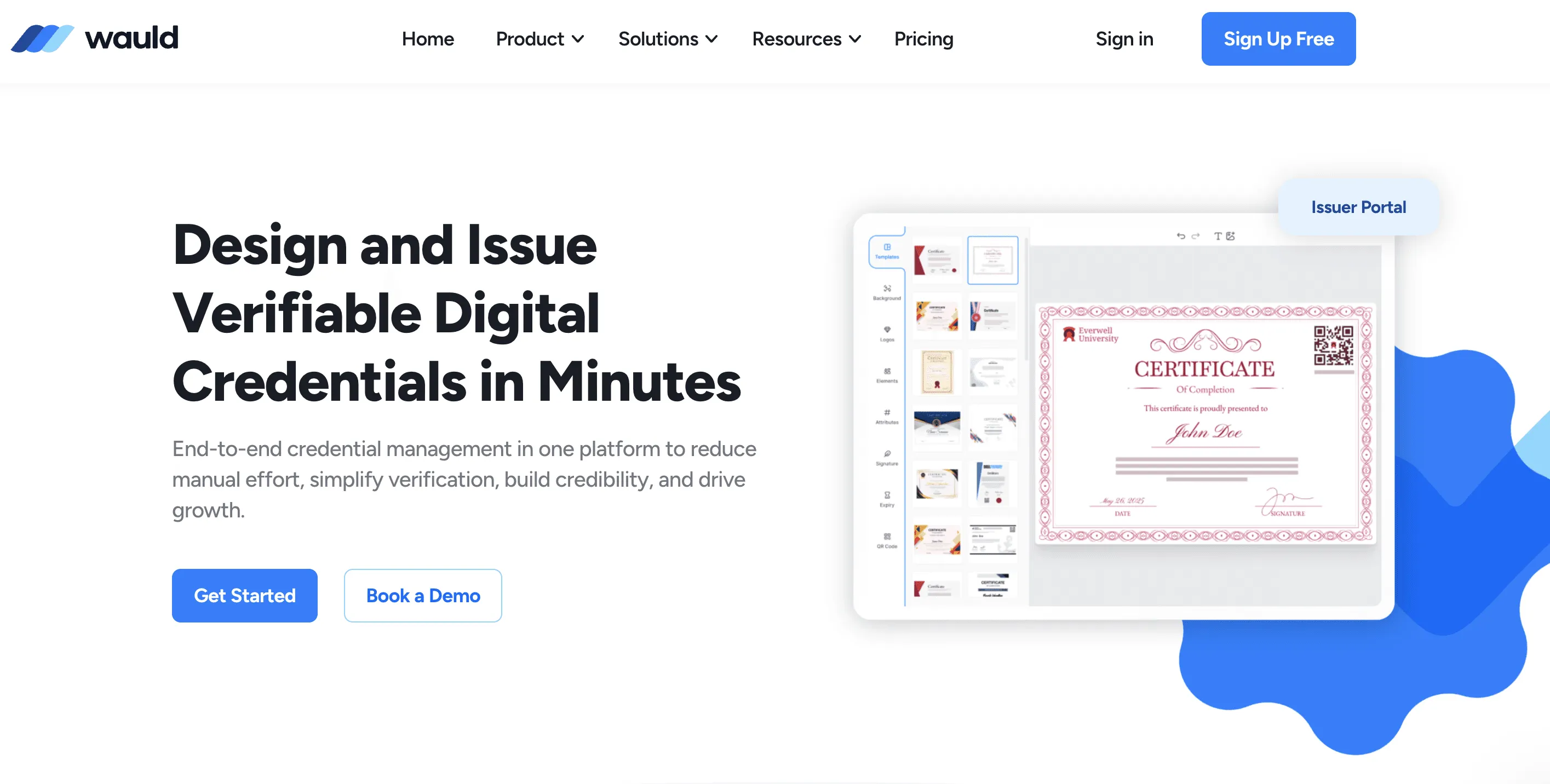
Wauld is a modern, minimal digital credentialing platform built to let organizations design, issue, manage, and verify digital certificates and badges from end to end, in one place. Instead of bolting a certificate tool onto a learning system, Wauld treats the credential itself as the product, with a clean generator, 1000+ customizable templates, and recipient-level analytics baked in.
For continuing education specifically, that combination is hard to beat. You can brand a certificate to match your program, issue it in bulk (for example, straight from Google Forms responses), and then actually see who opened, downloaded, and shared it. Every credential is verifiable through a unique link and aligns with Open Badges 3.0 and W3C Verifiable Credentials, so your certificates stay portable across LinkedIn, employer systems, and other platforms. Wauld was also named a SourceForge Top Performer for Digital Credential Management.
The commercial model is the quiet advantage. Wauld is free to start with no onboarding fees, and its paid Growth plan begins at a public, self-serve price with no mandatory sales call. You can run a genuine CE program on the free tier, prove the value, and scale when you are ready. For a wider view of how it stacks up, see our roundup of the best digital certificate platforms for certificate management.
| Pros | Cons |
|---|---|
| Free to start, no onboarding fees, transparent public pricing | Focused on credentialing rather than being a full course-hosting LMS |
| All-in-one: design, issue, track, and verify in one platform | Newer name than legacy enterprise incumbents |
| 1000+ customizable certificate and badge templates | |
| Recipient-level analytics (opens, shares, LinkedIn adds, verifications) | |
| Open Badges 3.0 and W3C Verifiable Credentials support | |
| Bulk issuance and automation (e.g. from form responses) |
CLE Hero
CLE Hero is continuing education software built specifically for the organizations that create and deliver continuing legal education, though its approach fits other CE providers too. It handles live events, on-demand courses, and multi-state accreditation from one platform, and it is genuinely thoughtful about compliance. It tracks viewing progress, uses inactivity detection to confirm attendees are actually watching, collects evaluations, and then issues certificates automatically the moment requirements are met.
That automation is its real strength. If your CE program lives and dies by accreditation rules, CLE Hero removes a lot of manual follow-up. It is free to start with transparent pricing.
| Pros | Cons |
|---|---|
| Purpose-built for accredited CE, especially legal (CLE) | Narrower focus; less suited to general badge/certificate design |
| Automatic certificate issuance tied to watch-time and evaluations | Strongest fit is the legal niche it was designed around |
| Multi-state accreditation handling in one place | Fewer open-standard badge features than dedicated credentialing tools |
| Free to start with transparent pricing |
Oasis LMS
Oasis LMS was built specifically for associations and nonprofits, with deep association-management-system (AMS) integrations and strong CE/CME capabilities. It automates CE tracking, issues certificates, ensures compliance, and even supports partial CME credit in configurable increments, which is a genuinely useful touch for medical and professional bodies. It integrates directly with Zoom, WebEx, and GoToWebinar, plus major AMS platforms like iMIS, Nimble AMS, and Fonteva.
Pricing is published and tiered, starting around $3 per user on the Starter plan and moving up to $800 and $1,500 per month for higher tiers, so associations can find a fit for their size.
| Pros | Cons |
|---|---|
| Purpose-built for associations, with CE/CME and AMS integrations | Overkill if you only need to issue certificates, not run member education |
| Partial CME credit and detailed compliance tracking | Monthly tiers get expensive as programs scale |
| Direct webinar and AMS integrations | Less focused on modern open-badge portability |
| Transparent, published pricing tiers |
Relias
Relias is a heavyweight in healthcare continuing education. It is an approved CE provider for licensing boards across the country, with modules carrying certificates accepted by bodies like ANCC, AOTA, NAB, CCMC, and NBCC, and a library of thousands of courses built by in-house healthcare experts. When a nurse or clinician completes an approved module, Relias issues a CEU certificate with the license and board-approval details already on it.
If you are in healthcare and need board-accredited content plus certificate issuance in one system, Relias is built for exactly that. It is less relevant if you simply want to design and issue your own certificates.
| Pros | Cons |
|---|---|
| Board-accredited CE content built for healthcare | Pricing is quote-based, not self-serve |
| Certificates carry license and board-approval details | Heavily healthcare-specific |
| Large in-house course library | You are partly buying content, not just a certificate tool |
| Enterprise integrations (HR, payroll, SSO) | Generic completion certificates only without license entry |
Docebo
Docebo is a premium enterprise learning platform used by large organizations, including associations like the UN Global Compact, to deliver continuing education and certifications at scale. Certificates are issued automatically on course or learning-plan completion, and it supports renewal workflows so learners can re-certify through additional courses or by submitting external training for admin approval.
It is powerful, but it is priced like enterprise software. Analysts put it around $7 to $10 per user per month, with typical deployments landing in the mid-five to six figures annually. Great if you need a full LMS, and a lot to buy if you mainly need certificates.
| Pros | Cons |
|---|---|
| Full-featured enterprise LMS with certification renewal workflows | Premium pricing, quote-based, multi-year commitments common |
| Automatic certificates on completion | Far more than most CE certificate needs require |
| Scales to tens of thousands of learners | Steeper setup and administration |
| Strong integrations and reporting |
Absorb LMS
Absorb LMS is a well-regarded enterprise learning system that handles course creation, learning paths, certification tracking, automated renewal reminders, and reporting. Organizations in regulated sectors lean on it to automate certification tracking, which is exactly the compliance backbone continuing education needs.
Like Docebo, pricing is not public. You request a quote, and customer data suggests SMB deployments average around $34,000 and enterprise around $83,000 annually. It is a strong LMS, but it is an LMS first and a certificate tool second.
| Pros | Cons |
|---|---|
| Detailed certification tracking and automated reminders | Pricing hidden behind a sales quote |
| Good fit for compliance-heavy, regulated industries | Enterprise cost for full functionality |
| Mature reporting and integrations | More platform than certificate-only providers need |
| Clean admin and learner experience |
TalentLMS
TalentLMS is one of the friendlier, more affordable learning platforms, and it is a sensible pick for smaller CE providers. It includes certificates from the entry Core plan, plus course building, assignments, mobile apps, and SSO. There is a genuinely usable Free Forever plan (up to 5 users and 10 courses), and paid plans start around $69/month on Core, moving up through Grow, Pro, and Enterprise. White-label options can remove TalentLMS branding from certificates on higher tiers.
It is a capable, budget-conscious LMS. Just note that certificates are one feature among many, rather than the core focus.
| Pros | Cons |
|---|---|
| Affordable, with a real free tier and public pricing | Certificates are a feature, not the platform's core focus |
| Certificates are included in the entry paid plan | White-label certificates require higher tiers |
| Easy to set up and use | Fewer open-badge/verification features than dedicated tools |
| Good fit for small-to-mid CE programs |
Certifier
Certifier is a dedicated certificate-and-badge platform, much closer in spirit to Wauld. It offers branded design tools, a large template library (2,000+), bulk generation, distribution, verification, and analytics, and it can automate issuance from an LMS, CRM, or enrollment data via smart triggers or a REST API. You can set up an account for free and upgrade as you grow, with paid plans starting around $39/month.
Its main caveat for CE is the depth. Certifier's Open Badges support is partial, at 2.0 with some 3.0 features, so if full Open Badges 3.0 and W3C portability matter to you, check the current state before committing. If you are weighing tools in this bracket, our list of top Certopus alternatives and digital certificate platforms covers several head-to-head options.
| Pros | Cons |
|---|---|
| Dedicated certificate/badge tool with free start | Open Badges support is partial (2.0 with some 3.0) |
| Large template library and API-driven automation | Best suited to issuing, not course delivery |
| Verification and analytics built in | Recipient portal and standards depth vary by plan |
| Public, self-serve pricing |
Accredible
Accredible is an established digital credentialing platform with a rich feature set: digital certificates, wallet cards, open badges, a "Certified Professional" directory, and white labeling, plus sharing to 40+ platforms. In January 2026 it expanded support for Open Badge 3.0, W3C Verifiable Credentials, and the ACE extension, which is genuinely strong standards coverage.
The tradeoff is cost and commitment. Accredible carries roughly a $1,500 setup fee and about a $1,000 annual minimum, with per-recipient pricing. It is a polished enterprise option, but not the easy free-to-start path.
| Pros | Cons |
|---|---|
| Deep standards support (Open Badges 3.0, W3C, ACE) | Setup fee plus annual minimum, no free start |
| Wallet cards, badges, and a public certified directory | Per-recipient pricing needs planning |
| Sharing to 40+ platforms | Heavier commitment than smaller providers |
| Mature, enterprise-ready |
Overall Comparison Table
| Platform | Free to start | Templates | Analytics | Standards (Open Badges/W3C) | Best for |
|---|---|---|---|---|---|
| Wauld | Yes, no onboarding fees | 1000+ | Yes | Yes (Open Badges 3.0 + W3C) | All-in-one design, issue, track, verify |
| CLE Hero | Yes | Built-in | Yes | Compliance-focused | Accredited legal/CLE programs |
| Oasis LMS | Starter ~$3/user | Built-in | Yes | SCORM / CE credit | Associations and CME |
| Relias | Quote | Course library | Yes | Board-accredited CE | Healthcare CE with content |
| Docebo | Quote | Built-in | Yes | SCORM / xAPI | Enterprise LMS at scale |
| Absorb LMS | Quote | Built-in | Yes | SCORM / xAPI | Regulated, compliance-heavy training |
| TalentLMS | Free (5 users) | Built-in | Yes | SCORM / xAPI | Small, budget-conscious CE |
| Certifier | Yes | 2,000+ | Yes | Open Badges 2.0 (partial 3.0) | Dedicated certificate issuing |
| Accredible | Setup fee | Templates | Yes | Open Badges 3.0 + W3C | Enterprise credentialing |
A quick way to read this table: the LMS platforms (Relias, Docebo, Absorb, TalentLMS, Oasis) are strongest when you also need to host and deliver the courses. The dedicated credentialing tools (Wauld, Certifier, Accredible) shine when your courses already live somewhere and you just need to issue, track, and verify the certificates beautifully. CLE Hero sits in between, purpose-built for accredited event-based CE.
Why Wauld Is the Best Choice for CE Certificates
If your core need is issuing continuing education certificates that look professional, verify instantly, and travel with your learners, Wauld hits the sweet spot that the other tools miss in one direction or another.
- It is genuinely free to start. No onboarding fee, no mandatory sales call, and public self-serve pricing when you grow. Several strong competitors here are quote-only or carry setup fees before you can issue a single certificate.
- It is all-in-one for the credential lifecycle. Design, issue, manage, track, and verify all happen in one platform. You are not paying for a full LMS just to get good certificates, and you are not bolting three tools together.
- The standards are current. Open Badges 3.0 and W3C Verifiable Credentials mean your CE certificates are portable and verifiable across LinkedIn, employer systems, and other platforms, instead of trapped in a PDF.
- The analytics prove your program works. Seeing opens, downloads, shares, LinkedIn additions, and verifications gives you real evidence to show boards, sponsors, and members.
- 1000+ templates get you branded fast. You can match your program's look in minutes instead of wrestling with a design tool.
For the large majority of organizations whose real question is "how do we issue and verify our CE certificates without the headache?", Wauld is the most complete and accessible answer in 2026. For a closer look at the badge side of the platform, browse our guide to the top digital badge platforms for credential management.
Conclusion
Choosing CE certificate software comes down to one honest question: what is actually slowing you down? If it is hosting and accrediting courses, a full LMS like Docebo, Absorb, Relias, Oasis, or TalentLMS, or a niche tool like CLE Hero, may be the right home. If it is the certificate itself, meaning designing it, issuing it at scale, tracking it, and proving it is real, then a dedicated credentialing platform will serve you far better than an LMS with a certificate feature stapled on.
Across that dedicated group, Wauld stands out for being free to start, all-in-one, standards-aligned, and refreshingly simple to run. Continuing education is only getting bigger and more regulated, and the organizations that make their certificates effortless to earn, share, and verify will be the ones learners remember. Start where the friction is, and let the certificate be the easy part.
Ready to see it for yourself? Create your free Wauld account and issue your first continuing education certificate today.