Top 14 Digital Credentialing Platforms: Features & Pricing

Picking The Right Tool
Picking the right certificate management software is harder than it looks. There are dozens of tools that promise to design, issue, verify, and track digital certificates and badges, and most hide their real pricing behind a sales call. This guide cuts through that. It is written for the people who actually send certificates: coaches, trainers, course creators, schools, training companies, associations, and L&D teams.
You will get an honest, side-by-side look at 14 platforms. For each one you get what it does, who it suits, the key features, a one-line price, and clear pros and cons. We lead with the platform we rate highest overall, then cover the rest fairly so you can match a tool to your budget and your volume. By the end you will know which option fits a solo coach issuing 50 certificates a year and which fits a university issuing 50,000.
What to Look For In Certificate Management Software
Before you compare logos and price tags, get clear on what your program actually needs. These are the criteria that matter most.
- A real free plan, not just a trial. Some tools give you 250 to 300 certificates a year for free, forever. Others give you 3 days. The difference is huge if you issue in bursts.
- Design depth. Look at the template library, the editor, and whether there are AI design tools that draft a layout for you.
- Verification. Check for QR codes and support for Open Badges, an open standard from 1EdTech that makes a credential portable and machine-readable, plus blockchain anchoring if you need tamper-proof records.
- Standards compliance. The current Open Badges 3.0 standard is built on the W3C Verifiable Credentials data model, which makes credentials more secure and interoperable. Confirm a platform supports it if portability matters.
- Certificates and badges. A badge is a small visual credential with skill data baked in. If you want skill recognition, confirm the tool issues both.
- Automation and integrations. Zapier, an LMS connection, and an API let certificates send themselves when someone finishes a course.
- Analytics and pricing transparency. Opens, shares, and LinkedIn adds tell you whether your credentials are working, and self-serve pricing beats opaque annual contracts.
The 14 Best Digital Credentialing Platforms
Wauld: Best overall certificate management software for most teams
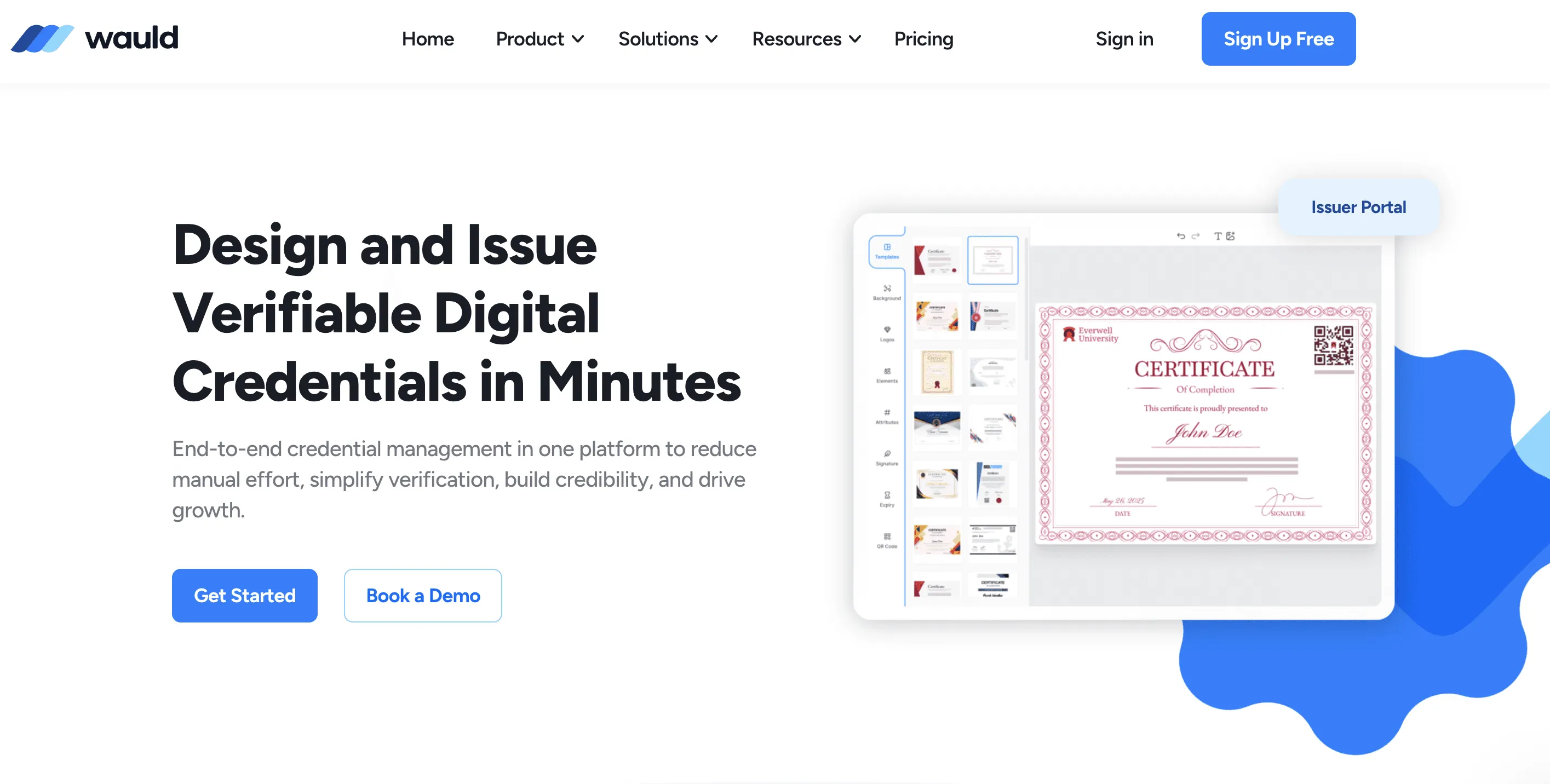
Wauld is a digital credential platform for issuing secure, verifiable certificates and badges. It suits almost everyone on this list, from a solo coach to a growing training company, because it pairs a genuinely useful free plan with features that most rivals reserve for paid or enterprise tiers. It is the strongest all-around pick in 2026.
Key features
- 1,000+ handcrafted certificate and badge templates, so you can issue polished credentials without a designer
- Full white-label branding (your logo, colors, QR codes, and signatures) on every plan
- Open Badge 3.0 compliant, so credentials are portable and verifiable anywhere
- QR code verification on every credential, with no account needed to check it
- Real-time analytics at the individual recipient level: opens, downloads, shares, LinkedIn adds, and verifications
- One-click LinkedIn add straight from the delivery email
- Automation on the free plan: Zapier, webhooks, and event triggers
- Full post-issuance editing of both data and design, plus expiry and revocation
Pricing: The free plan covers 300 credentials a year with analytics and automation included. Growth plan from $39/month, no annual contract.
| Pros | Cons |
|---|---|
| Free plan includes analytics, automation, and AI design, not just a watermark and a trial clock | None |
| Full white-label on every tier, which most rivals lock behind paid plans | None |
| Transparent monthly pricing with no annual contract | None |
If you want a wider view of how credentialing tools stack up for ongoing programs, Wauld's guide to managing certificates at scale is a useful companion read.
Certifier
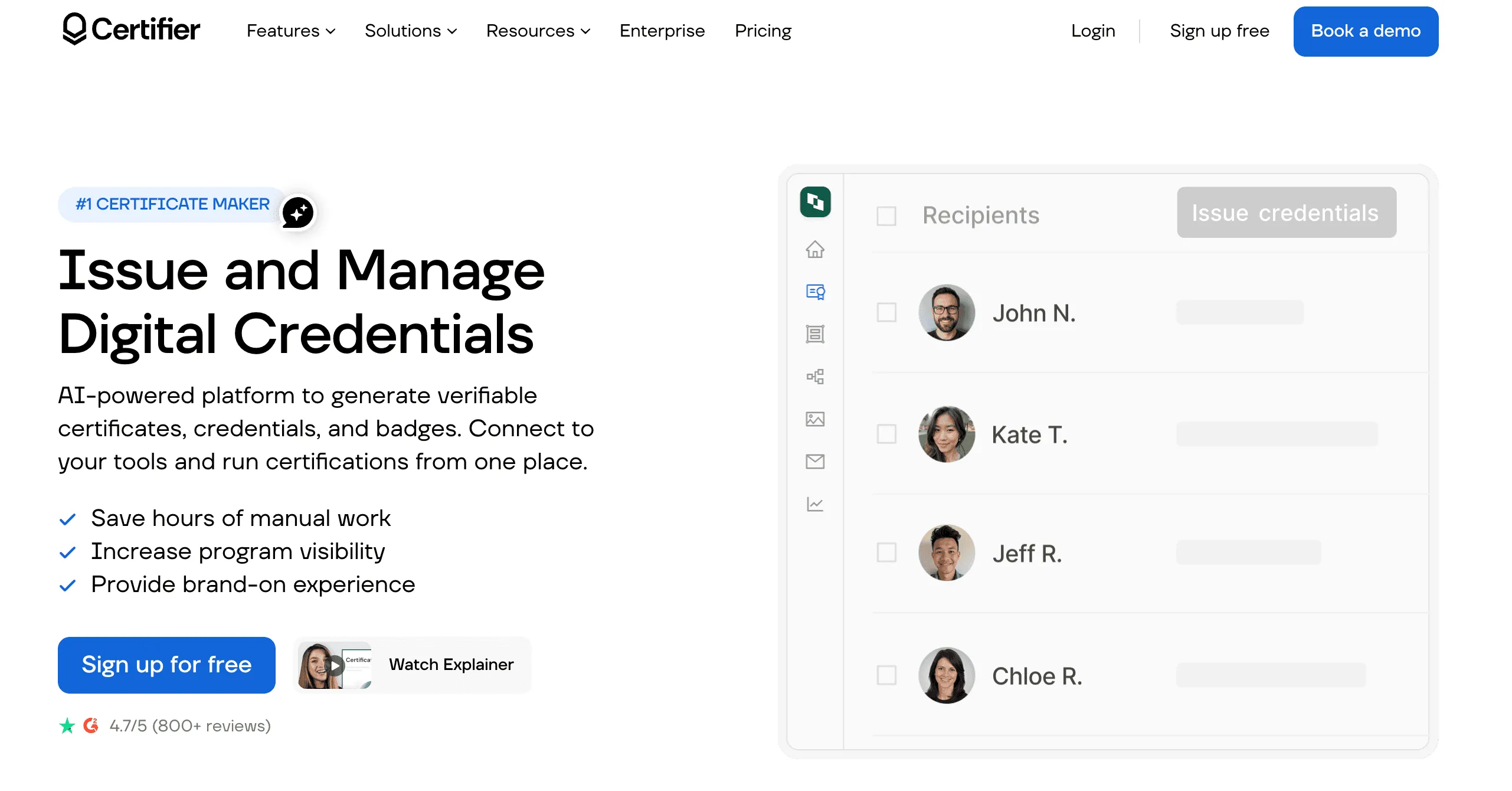
Certifier is a feature-rich platform built around the whole life of a credential: design, issue, manage, and report. It has issued 10 million-plus credentials across 2,000-plus organizations and is a strong fit for teams that want operational control with transparent pricing.
Key features
- Large certificate and badge template library with an AI generator
- Bulk issuance and automated sending
- Full lifecycle management: draft to published to expired, name corrections, post-issuance editing of data and design, revocation
- Detailed analytics: open rates, wallet views, social sharing, per-cohort reporting
- Native integrations with Google Sheets, HubSpot, Salesforce, Airtable, Zoom, Typeform, and LMS platforms
- Open Badge 3.0 applied automatically, plus ISO 27001 certification and custom domains
Pricing: Free plan covers 250 credentials a year. Paid plans from about $39/month, no annual contract.
| Pros | Cons |
|---|---|
| Genuine post-issuance editing of both data and design, which few rivals offer | Entry pricing is quoted inconsistently across sources, so confirm the current tier |
| Broad native CRM and LMS integrations included rather than charged as add-ons | Design-led, so network-scale enterprise programs may prefer a badge network |
| Free plan with no expiry, so you can pilot a real program |
Credly (by Pearson)
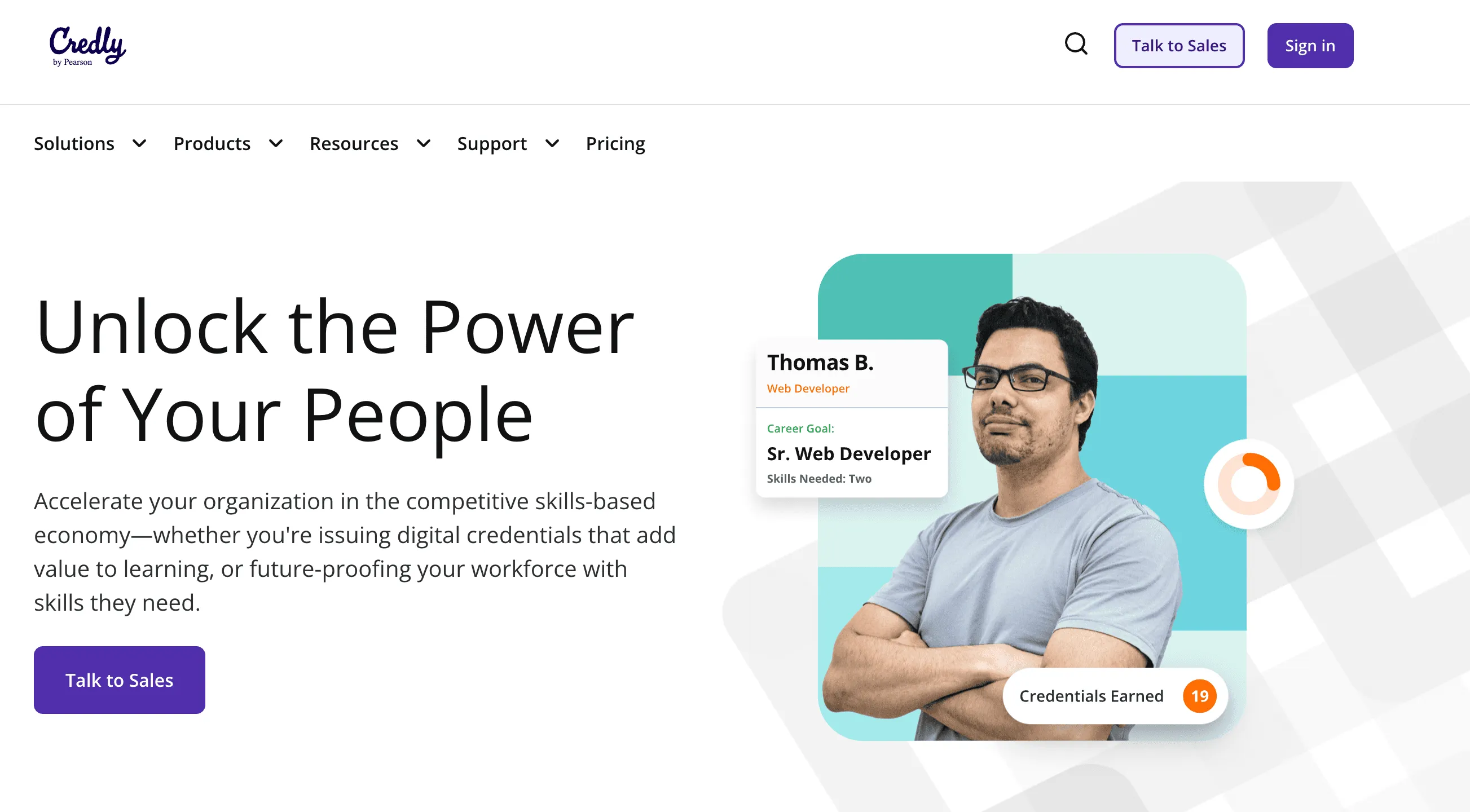
Credly runs the world's largest digital badge network, with 100 million-plus credentials issued (as of early 2025) held by 48 million-plus people. If your main goal is for employers to discover your certified people, rather than just delivering a nice PDF, Credly's reach is unmatched.
Key features
- The largest badge network for credential discovery and employer-facing visibility
- Open Badges standard for portable credentials
- Deep enterprise HR integrations: Workday, SAP SuccessFactors, Oracle
- Workforce analytics for organization-wide skill reporting
- One-click LinkedIn sharing
Pricing: On request. Annual contracts typically from $1,200+/year with a one-time setup fee.
| Pros | Cons |
|---|---|
| A network effect no rival matches: badges are discoverable by employers worldwide | No free plan, limited design flexibility, and a required sales conversation |
| Enterprise-grade HR integrations and strong institutional recognition | High entry cost makes it overkill for smaller programs |
If you are weighing the big networks against lighter tools, this use-case breakdown of the major badge platforms is worth a look.
Accredible
Accredible is a mature, well-regarded enterprise platform (currently rated 4.8 on G2 from around 115 reviews) that has issued more than 170 million credentials to date. It suits large universities, associations, and corporate L&D teams with established LMS infrastructure.
Key features
- Native LMS integrations: Moodle, Canvas, Cornerstone, Workday
- Spotlight directory so employers can find certified professionals
- Digital wallet cards via Apple and Google Wallet
- Learning pathway visualization across multiple programs
- Advanced analytics and email campaigns
- Open Badges compliance and blockchain verification options
Pricing: From about $45/month for 50 recipients annually, rising to roughly $3,000 to $6,000/year for 1,000 credentials. Annual contracts on all plans.
| Pros | Cons |
|---|---|
| Deep LMS integration, learning pathways, and a public certified-professional directory | All plans require an annual contract, with no sustained free plan |
| Strong institutional credibility for enterprise procurement | Post-issuance editing is data only, not design, and reviewers cite steeper setup and rising prices |
Sertifier
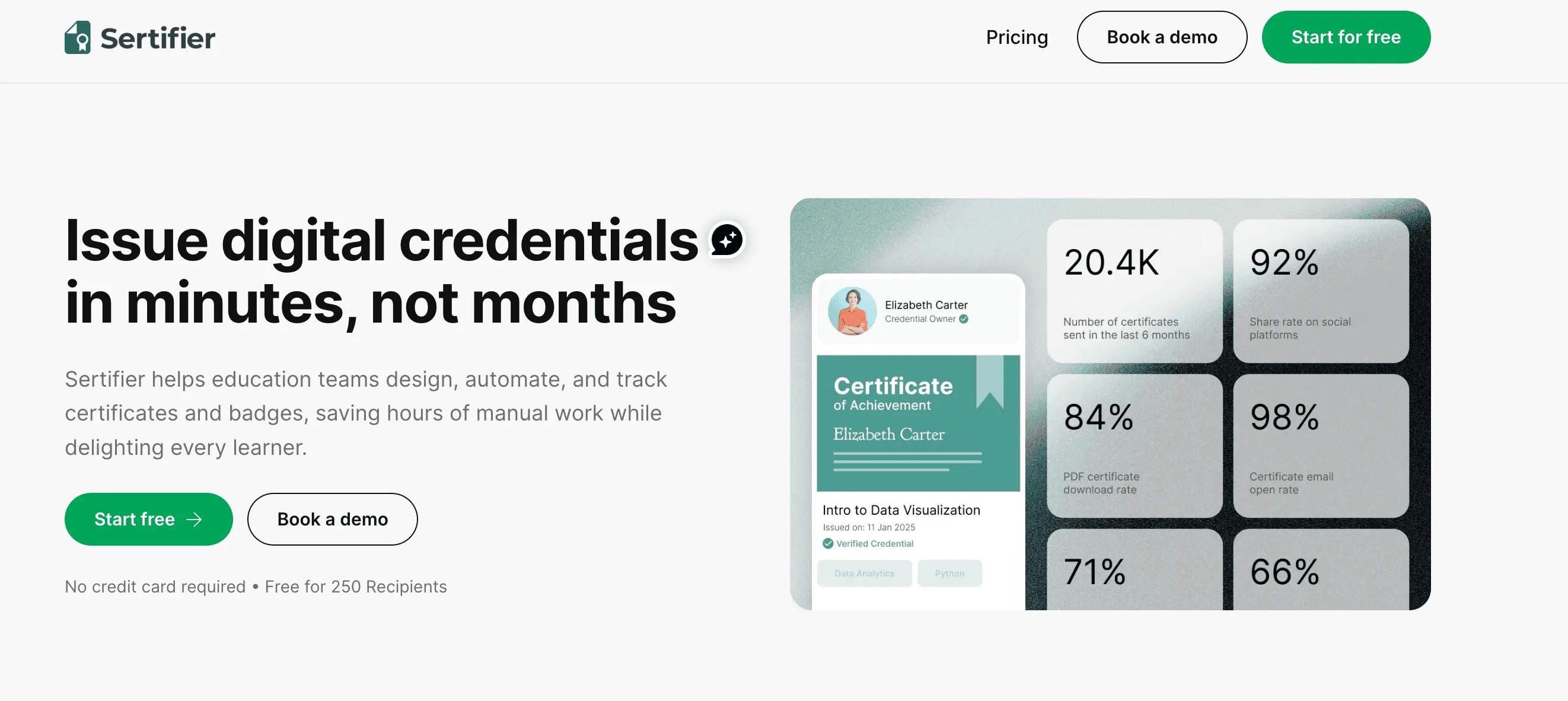
Sertifier is built for L&D teams and higher-education institutions running several programs at once. It is trusted by Harvard, MIT, Cisco, and PayPal and balances broad automation with accessible pricing.
Key features
- 1,000+ templates with a drag-and-drop editor
- Recipient credential wallet that aggregates credentials from multiple issuers
- 100+ native integrations: Canvas, Moodle, Salesforce, Zoom, Zapier
- REST API and webhooks for automated issuance
- Optional blockchain verification
- SOC 2 Type II, ISO 27001, GDPR, and FERPA alignment
Pricing: Free plan covers 250 recipients a year. Pro from about $250/year. Enterprise on request.
| Pros | Cons |
|---|---|
| One of the broadest integration sets here, ideal for complex LMS, CRM, and HR stacks | Full white-label is reserved for the Enterprise tier |
| Strong formal compliance (SOC 2 Type II, ISO 27001) plus a recipient wallet | Less design and AI tooling than the design-led platforms higher up |
CertifyMe
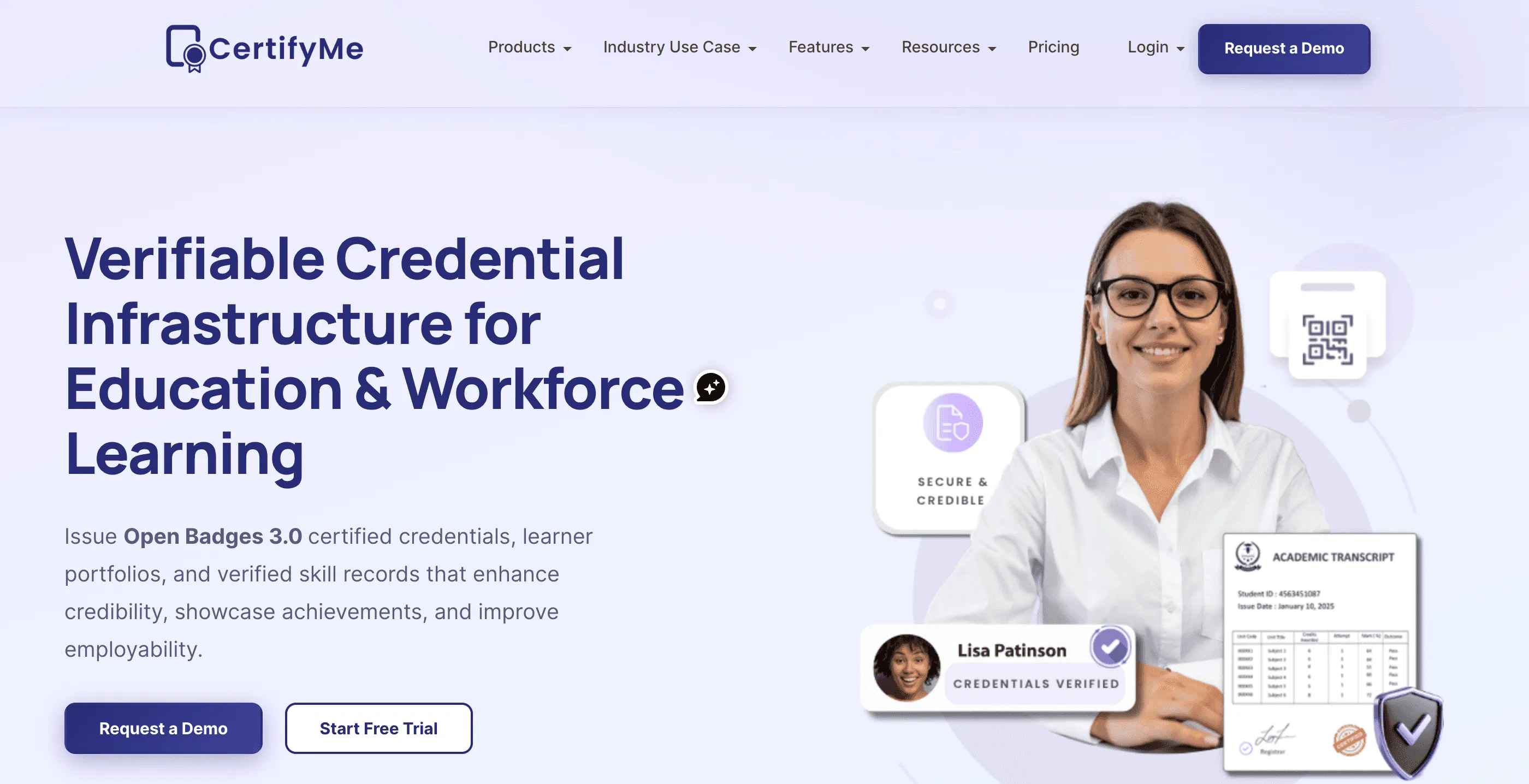
CertifyMe is a dependable platform trusted by thousands of brands, with a high G2 rating across hundreds of reviews. Its standout strengths are responsive support and a fraud-prevention feature that ties credentials to recipient identity documents.
Key features
- Certificate and badge templates with a Canva integration
- Bulk issuance via CSV upload
- Anti-forge identity tagging (linking credentials to a passport or license)
- EduTranscript module for higher-education transcript workflows
- Analytics on views, shares, downloads, and LinkedIn
- LMS, Zapier, API, and SSO support
Pricing: Free trial only (phone verification required). Paid plans are sales-gated and appear to start at roughly $500 to $750/year for around 500 to 750 badges.
| Pros | Cons |
|---|---|
| Consistently praised customer support and a unique anti-forge identity feature | Pricing is not public and per-badge cost is on the higher side |
| EduTranscript module is a real value-add for higher education | No sustained free plan, and some reviewers report CSV and PDF quality issues |
Hyperstack
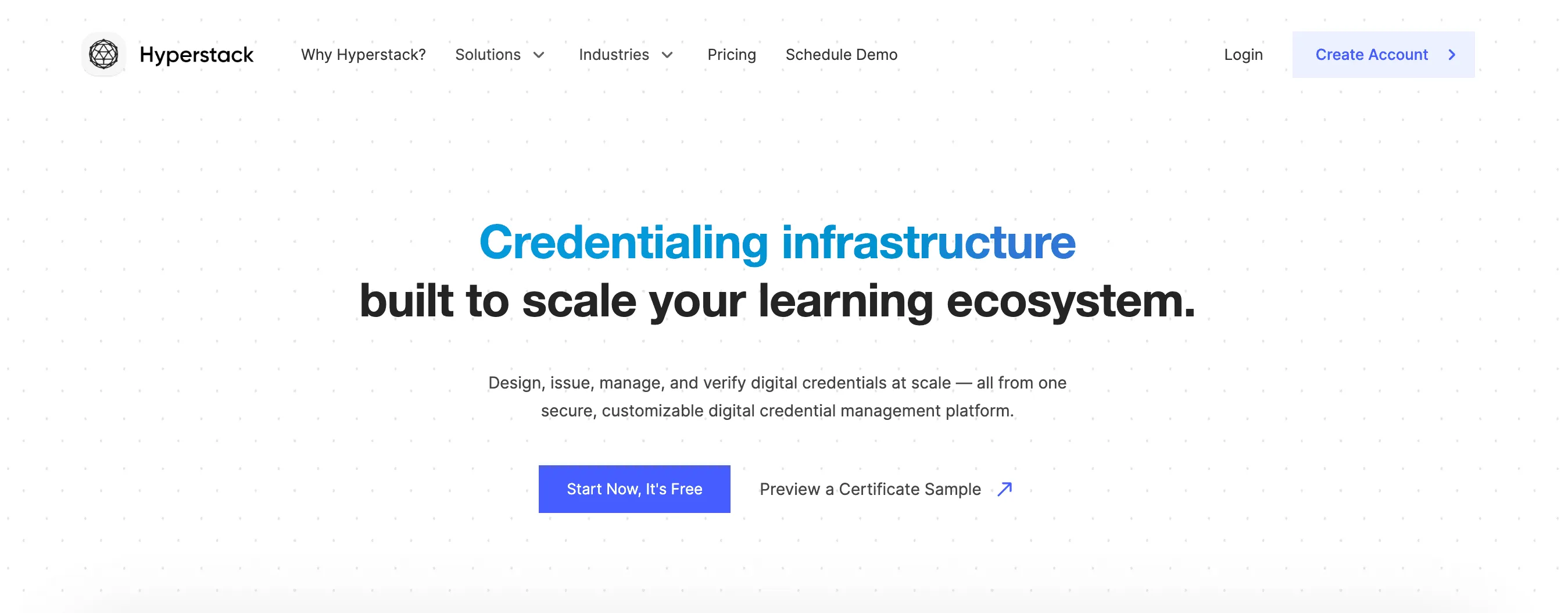
Hyperstack is a blockchain-based platform built on the Hedera Hashgraph public network. It gives you formally documented security and tamper-proof credentials without enterprise-level cost.
Key features
- Hedera Hashgraph anchoring for independently verifiable credentials
- SOC 2 Type 2 and GDPR compliance with formal documentation
- Design Studio with Canva integration
- Bulk issuance via spreadsheet upload
- API access and Zapier integrations
- White-labeling, custom domain, and a student wallet
Pricing: Free plan covers 20 recipients a year. Premium from $24.51/month (250 recipients annually). Enterprise on request.
| Pros | Cons |
|---|---|
| Auditable SOC 2 Type 2 security and blockchain anchoring at an accessible price | The free tier is very small at 20 recipients |
| Transparent self-serve pricing with no annual contract | Analytics sit behind the Premium plan |
BCdiploma
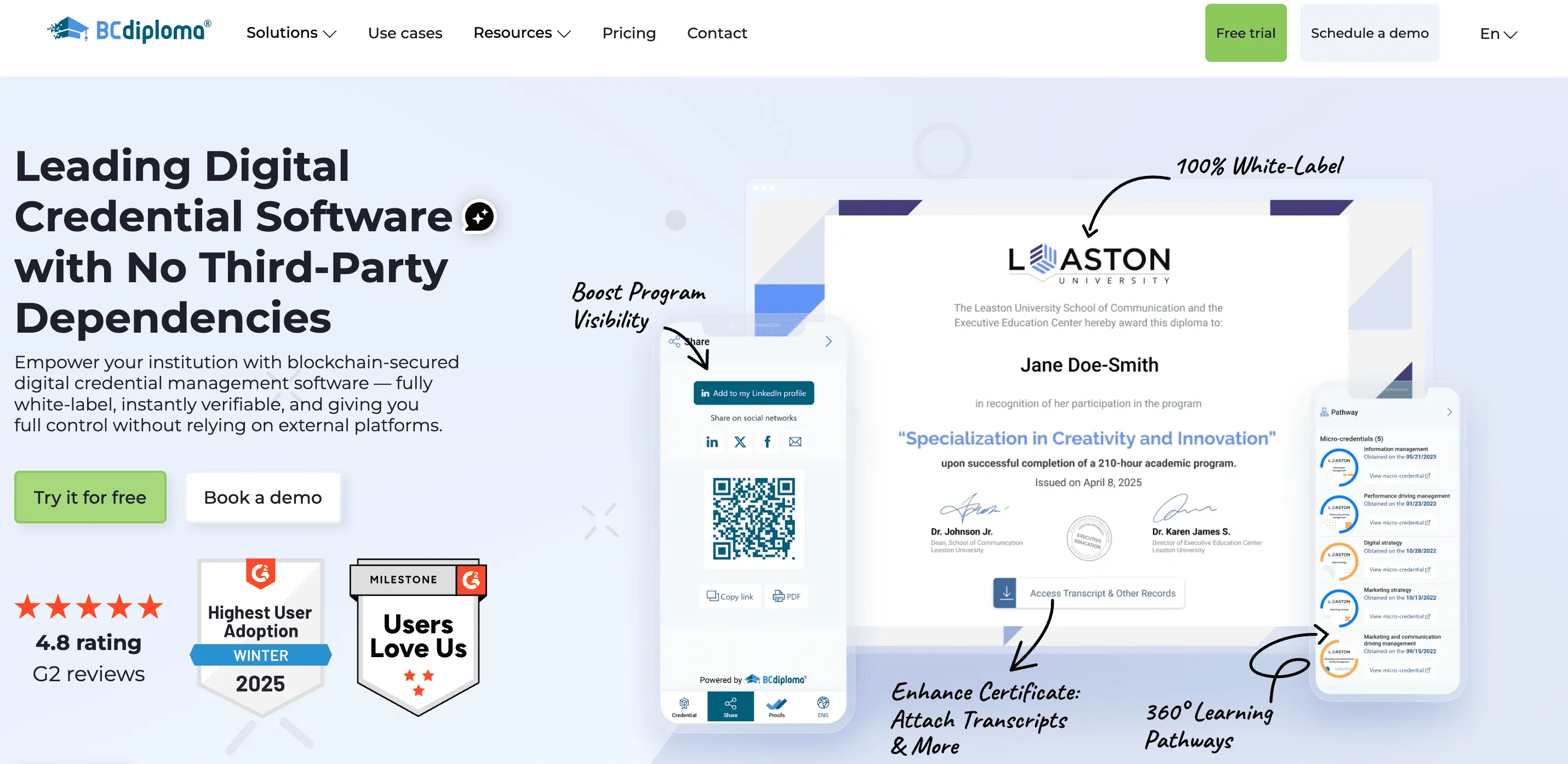
BCdiploma is a blockchain credential platform trusted by Stanford Medicine, the University of Toronto, and the WHO. It is built for institutions where full data ownership and zero platform branding are hard requirements.
Key features
- Blockchain-anchored verification using cryptographic PKI and electronic signatures
- 100% white-label at every tier, with no BCdiploma branding on any credential
- Diplomas, certificates, and badges from one platform
- Multilingual credential support
- Full data sovereignty with EU data residency
- LMS and API integrations
Pricing: Essentials Pack from $1.50/recipient/year. White Label and Enterprise on request. Free trial available.
| Pros | Cons |
|---|---|
| True data sovereignty with EU residency and 100% white-label on every tier | No ongoing free plan, only a trial |
| Independently verifiable blockchain credentials that do not depend on the platform staying online | More institution-focused than SMB-friendly, with a heavier setup |
POK
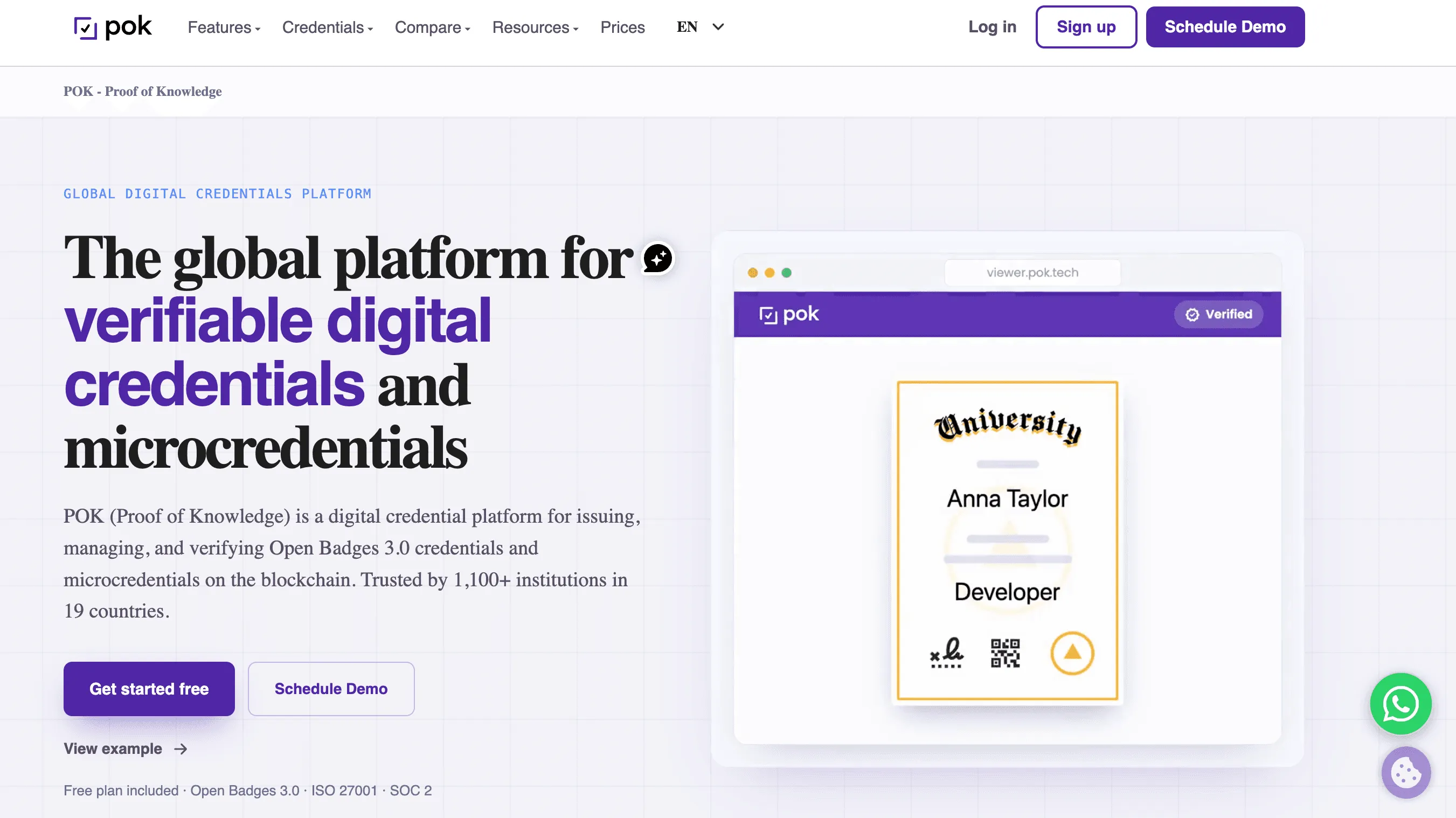
POK (Proof of Knowledge) is a blockchain-first platform used by 1,100-plus institutions across 19 countries, with more than 1.5 million credentials issued. It is certified by 1EdTech for Open Badge 3.0, and holds both ISO 27001 and SOC 2, with the most generous free tier on this list.
Key features
- Unlimited free Web2 issuance: no credential cap, no credit card, no expiry
- NFT credentials on a public blockchain, so recipients keep ownership even if the issuer leaves
- 1EdTech-certified Open Badge 3.0, with ELM/Europass and W3C alignment
- 100% white-label with your own domain
- LMS integrations: Moodle, Canvas, Blackboard, Salesforce, HubSpot
- Institutional credential wallet and real-time LinkedIn analytics
Pricing: Free plan with unlimited credentials, no credit card, no expiry. NFT blockchain credentials from $0.80/credential. $0 setup fee, no annual contracts.
| Pros | Cons |
|---|---|
| Genuinely unlimited free Web2 issuance, the most generous free tier here | The free tier is Web2; blockchain and NFT issuance carry a per-credential cost |
| Strong formal standards: 1EdTech-certified, ISO 27001, and SOC 2 | NFT and blockchain framing can be unfamiliar to non-technical teams |
Certopus
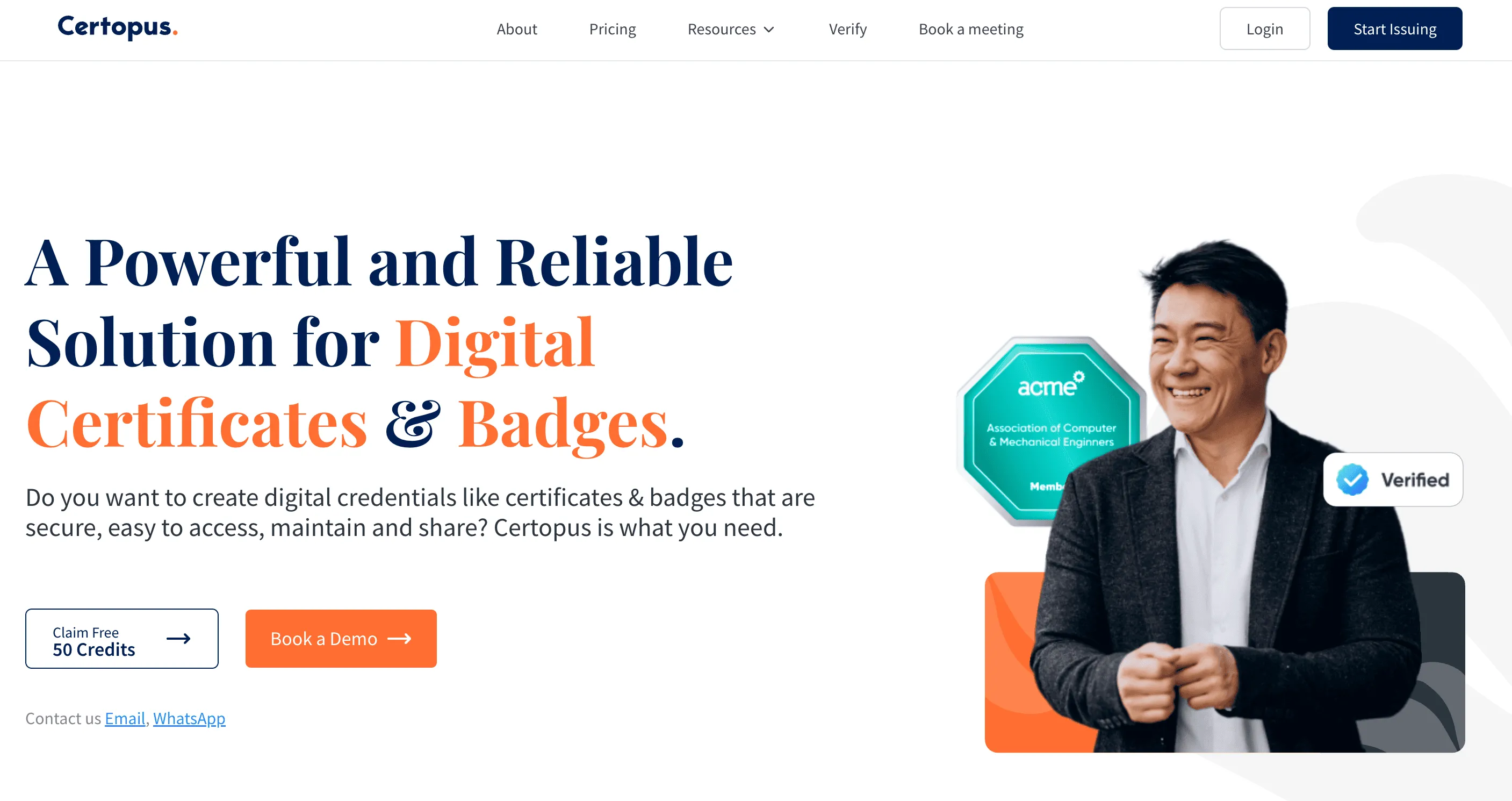
Certopus is a lightweight certificate platform that competes on speed and affordability, with a notably broad automation ecosystem for its price.
Key features
- Visual drag-and-drop certificate designer
- Bulk CSV generation
- QR code verification and verifiable links
- Email delivery to recipients
- Optional blockchain integration via Polygon ID
- Automation across Zapier, Make, Pabbly Connect, and Microsoft Power Automate
Pricing: Free plan available. Paid tiers from $19/month.
| Pros | Cons |
|---|---|
| The widest automation connector range at this price point | Lighter template library and analytics than tools higher on this list |
| Low cost with a functional free plan | Less suited to brand-heavy or enterprise programs |
Give My Certificate
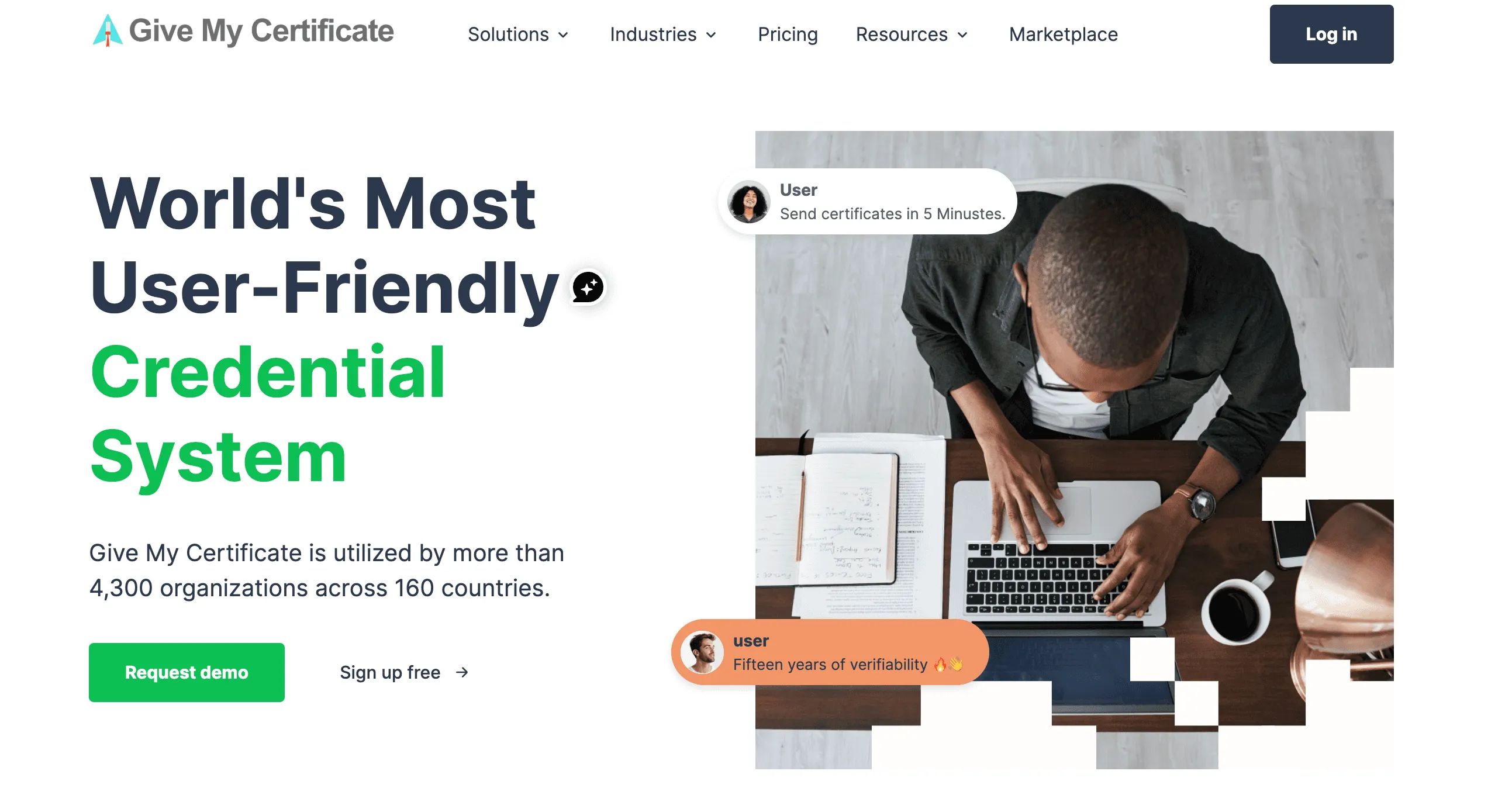
Give My Certificate is built for issuing fast, and is widely praised on review sites for ease of use. It serves 2 million-plus professionals across 160-plus countries.
Key features
- Unlimited certificate and badge designs with a drag-and-drop editor, plus ID cards and degrees
- Bulk issuance of thousands of credentials in under 10 minutes
- Verifiable QR code with 15+ years of verification validity
- One-click LinkedIn add
- Analytics on delivery, shares, and LinkedIn activity
- REST API, custom SMTP, and a white-label plan with custom domain
Pricing: Free plan covers 10 credentials a month. Basic from $129/year (up to 1,000 credentials a year). White Label and Enterprise on request.
| Pros | Cons |
|---|---|
| Among the fastest tools for bulk issuance, ideal for large cohorts | The free plan caps at 10 credentials a month, which is tight for evaluation |
| Long-lived QR verification and an easy, low-training interface | Less depth in advanced analytics and lifecycle management |
TruScholar
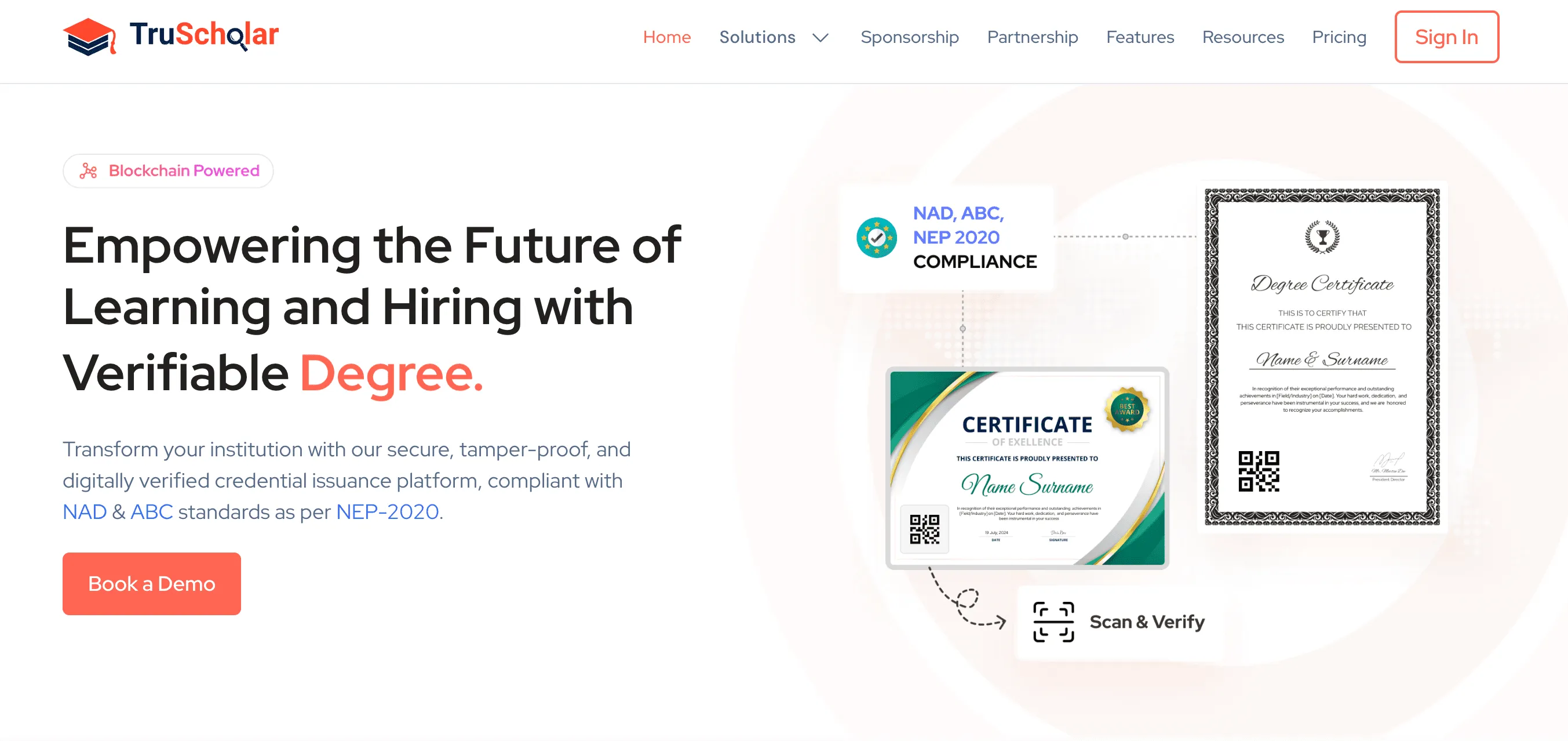
TruScholar is a blockchain credentialing platform built for India's education ecosystem. It runs on Hyperledger Indy and aligns with India's NAD, ABC, and DigiLocker frameworks for NEP 2020 compliance, with 100-plus institutions onboarded.
Key features
- Blockchain-anchored credentials with W3C DID compliance
- Certificates, badges, and academic transcripts
- NAD and ABC integration for Indian compliance
- Bulk issuance with hands-on data-migration support
- One-click verification with no account needed
- Recipient-owned, lifetime-access credentials
Pricing: Free trial and paid plans on request. No public self-serve pricing.
| Pros | Cons |
|---|---|
| Unmatched alignment with Indian academic infrastructure (NAD, ABC, DigiLocker) | The India-specific infrastructure has little value outside India |
| Strong blockchain security and praised onboarding support | Limited analytics, a narrow integration set, and sales-gated pricing |
Acreditta
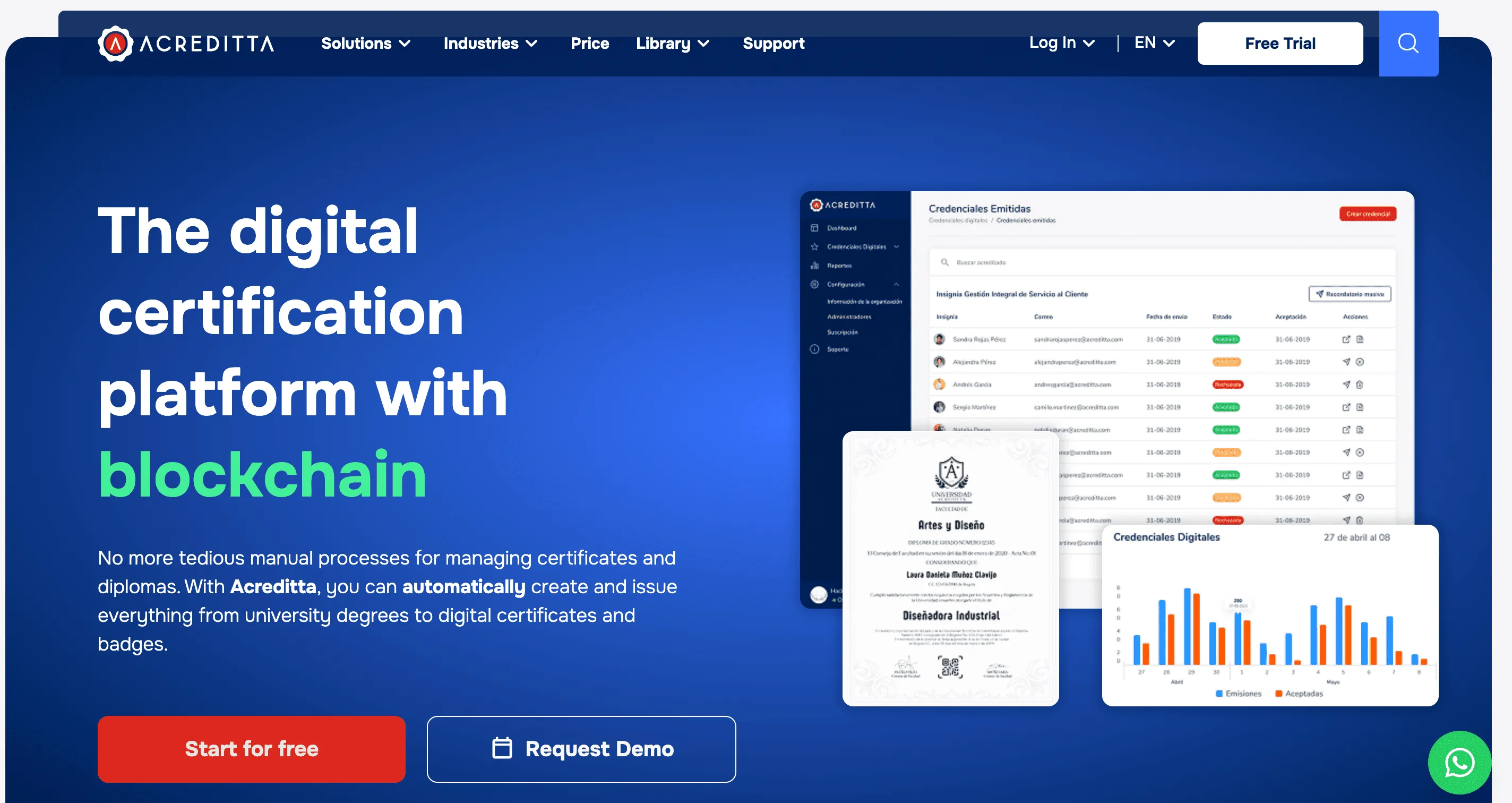
Acreditta is a Latin America-first blockchain platform built in Colombia, with 500,000-plus credentials issued across 92 universities. It runs on LACNet (the region's recognized blockchain), supports Spanish and Portuguese first, and aligns with Open Badge 3.0 and W3C Verifiable Credentials.
Key features
- Badges, certificates, diplomas, and microcredentials
- LACNet blockchain verification with regional credibility
- Microcredential pathways for structured skill routes
- Digital skills wallet for recipients
- Digital signature with national legal standing (Enterprise)
- LMS integrations and API access (Enterprise)
Pricing: Starter is free for up to 249 credentials (no analytics, API, or LMS). Enterprise is custom-priced for 500+ credentials. No self-serve middle tier.
| Pros | Cons |
|---|---|
| Regional infrastructure (LACNet), Spanish-first support, and digital signature under national law | A hard feature cliff: analytics, API, LMS, and white-label all require an Enterprise conversation |
| A free Starter tier for up to 249 credentials | Limited brand presence and template depth outside Latin America |
CertFusion
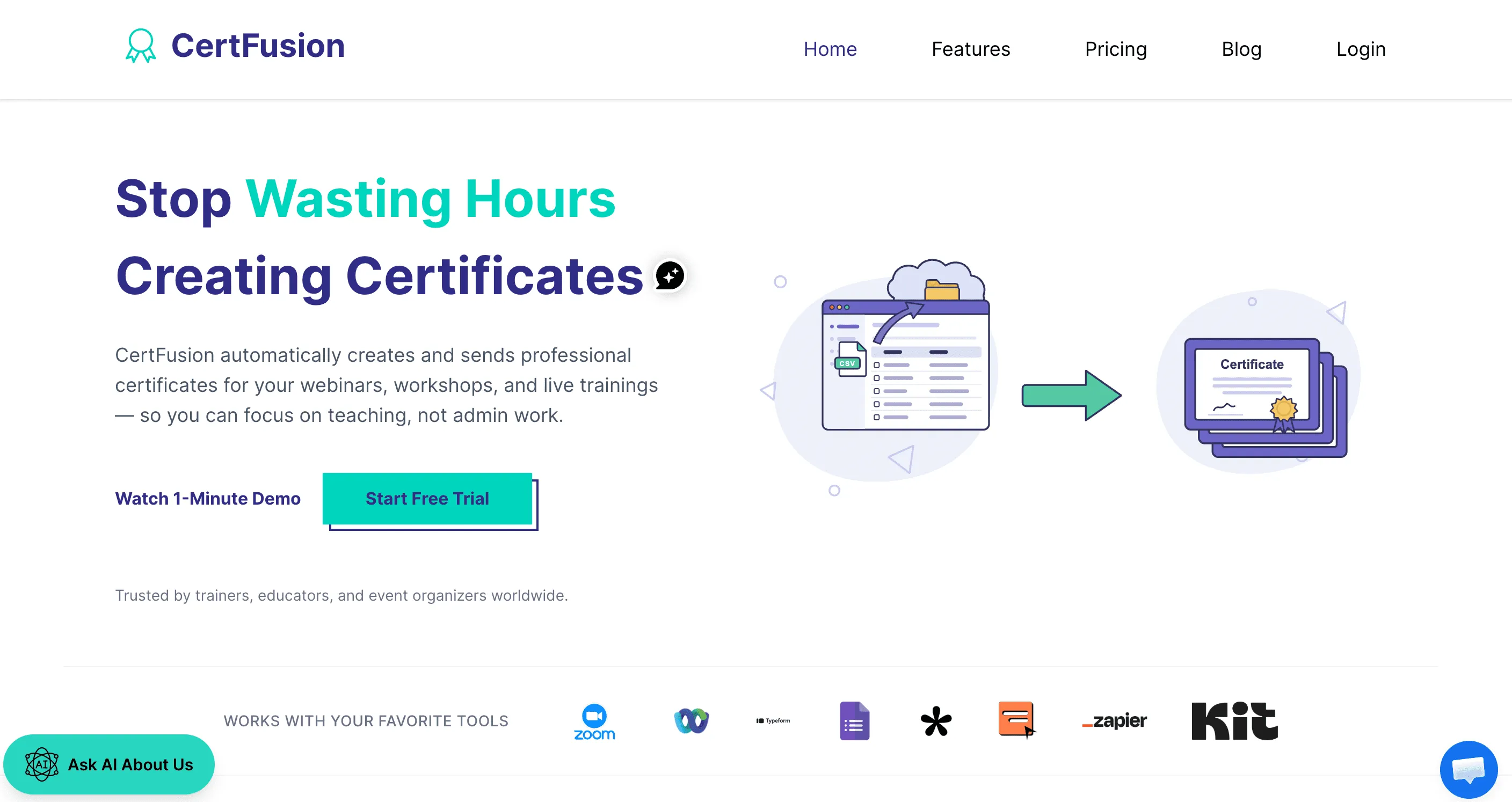
CertFusion is a clean, automation-first certificate tool launched in Singapore in 2025. It is built for webinar hosts, course creators, and CPD/CME providers who want zero post-event admin.
Key features
- 50+ certificate templates with a drag-and-drop editor and custom upload
- Bulk issuance via CSV import
- Native Webex, Zoom, and Typeform integrations
- Email delivery with open, download, and LinkedIn share tracking
- Custom domain and SMTP on higher tiers
- Free CPD/CME calculators and generator tools
Pricing: 3-day trial only. Basic $29/month (1,000 certificates/month), Standard $49/month (5,000/month), Growth $99/month (10,000/month).
| Pros | Cons |
|---|---|
| The fastest path to a first certificate, with strong webinar and event integrations | Certificates only (no badges or Open Badges), and unused monthly quota does not roll over |
| Transparent, affordable entry pricing and useful free CPD/CME tools | Early-stage platform with no sustained free plan and no published SOC 2 or ISO certification |
Certificate Management Software Comparison Table
Here is how the 14 platforms compare on what matters most: free plans, entry price, and the one thing each does best.
| Platform | Free plan | Entry paid price | Standout feature | Best for |
|---|---|---|---|---|
| Wauld | 300/year | $39/month | AI design + analytics free | Most teams overall |
| Certifier | 250/year | ~$39/month | Full lifecycle editing | Lifecycle control |
| Credly | None | $1,200+/year | Largest badge network | Employer discovery |
| Accredible | Trial only | ~$45/month (50) | Spotlight directory | Enterprise/universities |
| Sertifier | 250/year | ~$250/year | 100+ integrations | Multi-program teams |
| CertifyMe | Trial only | ~$500-750/year | Anti-forge ID tagging | Support-led SMBs |
| Hyperstack | 20/year | $24.51/month | Hedera blockchain | Budget compliance |
| BCdiploma | Trial only | $1.50/recipient/yr | 100% white-label | Data sovereignty |
| POK | Unlimited (Web2) | $0.80/credential (NFT) | Unlimited free issuance | Blockchain NFT |
| Certopus | Yes | $19/month | Broad automation | Lowest-cost automation |
| Give My Certificate | 10/month | $129/year | Sub-10-min bulk send | Speed at scale |
| TruScholar | Trial only | On request | NAD/DigiLocker | Indian institutions |
| Acreditta | 249 credentials | Custom (Enterprise) | LACNet + Spanish-first | LATAM institutions |
| CertFusion | 3-day trial | $29/month | Webex/Zoom auto-issue | Event certificates |
How To Choose The Right Platform
The best tool depends less on the feature count and more on who you are and how many certificates you send. Here is how the options map to common situations.
- Solo coach or course creator (under 300 a year). Start free with Wauld for design quality, analytics, and LinkedIn sharing in one place. POK is the pick if you want unlimited free volume and do not mind a per-credential cost for blockchain. Certopus works if you only need simple, cheap automation.
- Small training business (a few hundred to a few thousand). Wauld's Growth plan or Certifier give you transparent pricing, automation, and post-issuance editing without a contract. Give My Certificate is strong if your priority is issuing large cohorts fast.
- School or university. Accredible and Sertifier offer the LMS depth, pathways, and compliance institutions expect. Indian institutions needing NAD or DigiLocker should look at TruScholar; Latin American institutions can compare Acreditta against other regional options in this roundup of badging and credentialing tools for education; data-sovereignty-focused universities should weigh BCdiploma.
- Large L&D team or certification body. Credly leads for employer discovery and network reach. Accredible and Sertifier suit deep LMS and HR integration. Hyperstack and POK fit when blockchain verification is a procurement requirement.
Conclusion
The right certificate management software is the one that fits your volume, your budget, and how much you want to automate, without trapping you in a contract before you have tested it. For most coaches, creators, and training teams, Wauld is the strongest overall starting point: a free plan covering 300 credentials a year, AI design, Open Badge 3.0, analytics, and automation included, with monthly pricing and no annual contract. If your needs are more specialized (enterprise reach, blockchain, or a specific region), the alternatives above each have a clear lane.
If you are starting fresh, you can try Wauld free, issue your first certificates today, and upgrade only when your volume grows. No annual contract, no sales call. For a lighter look at quick design options, Wauld also rounds up free apps for building certificates from scratch.