How to Spot a Fake Diploma: 12 Signs to Look For

Why Diploma Fraud Is a Growing Problem
Every year, thousands of people buy fake diplomas from so-called "diploma mills" and try to pass them off as real academic documents. Whether it's using a fake diploma to land a job or offering fake credentials to misrepresent a qualification, diploma fraud puts employers, recruiters, and institutions at real risk. Knowing how to spot a fake diploma isn't optional - it's part of doing proper due diligence. Below are 12 practical signs, plus tips on how to verify credentials the right way.
More schools are shifting from printed diplomas to digital ones, and that shift cuts both ways. A printed diploma only proves itself through details like paper, ink, and a seal - all things a determined forger can attempt to copy. A digital diploma, by contrast, can be tied to a scannable verification record that either checks out or doesn't. Platforms like Wauld are part of that shift, issuing diplomas with verification built into the credential itself rather than left for an employer to figure out afterward.
Quick tip: Before you even inspect the document up close, ask for the original file or a fresh scan sent directly from the candidate's inbox. A diploma that's already been screenshotted, re-scanned, or forwarded several times is far easier to fake convincingly than one you can trace back to the source.
12 Signs of a Fake Diploma
Below are 12 practical signs, plus tips on how to verify credentials the right way -
1. Suspicious Fonts and Design on a Fake Diploma
Legitimate colleges and universities use consistent, carefully designed fonts and layouts on every original diploma they issue. A fake diploma often uses mismatched fonts, inconsistent spacing, or a typeface that doesn't match the school's official branding. If the lettering looks slightly "off," or the same word is styled two different ways, that's a sign of a fake worth investigating further.
2. Missing or Incorrect Seal on the Certificate
Every official diploma carries the issuing institution's seal, usually embossed or foil-stamped near the signature block. A fake certificate frequently uses a flat, printed seal instead of a raised one, or copies a design that's slightly inaccurate compared to the school's real emblem. Comparing the seal against images on the institution's official website is a quick way to check it against a genuine diploma.
3. Real Diploma vs Fake Degree: How to Spot a Fake Degree in the Paper
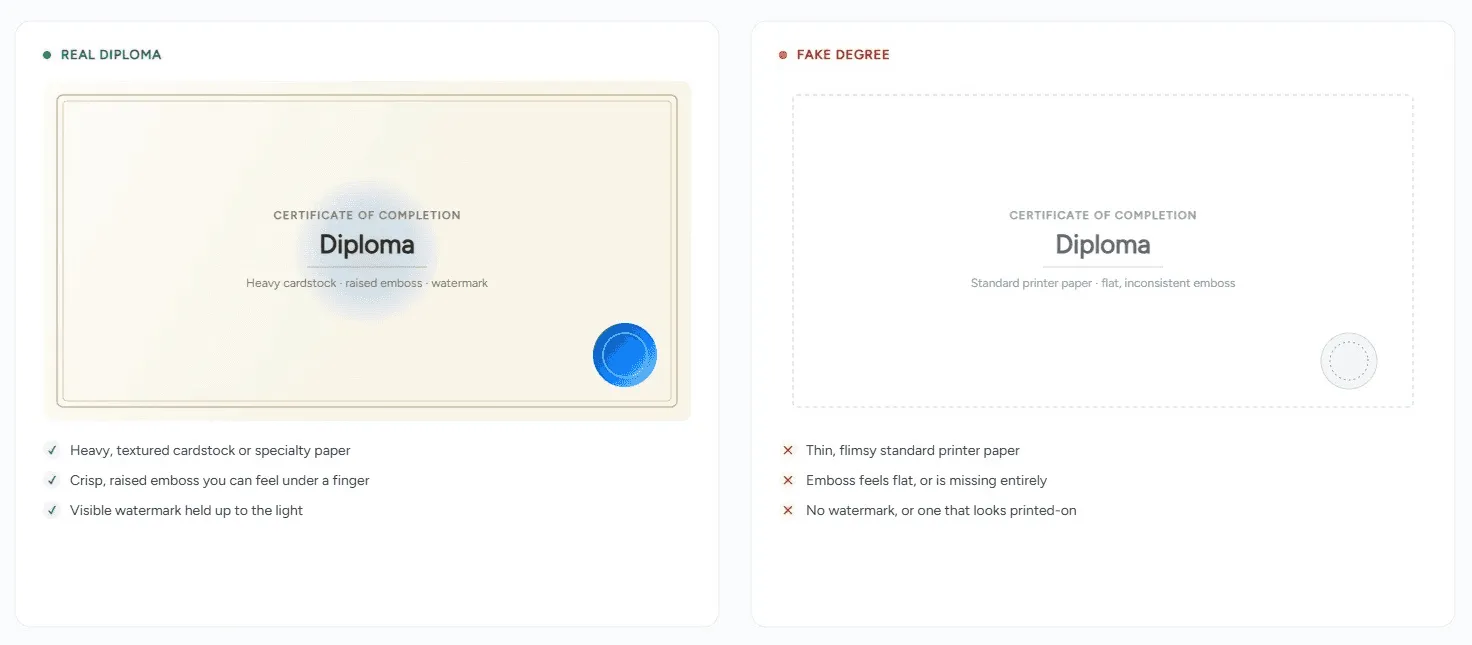
A real diploma is usually printed on heavier cardstock or specialty paper, often with a watermark or raised emboss that's difficult to replicate. If you're wondering how to spot a fake degree at a glance, the paper itself is often the giveaway: a fake degree printed on standard printer paper, or one where the emboss feels flat or inconsistent, is a strong indicator of a forgery.
4. Spelling and Grammar Errors on Fake Degree Certificates
This is one of the easiest ways to spot a fake diploma. Diploma mills churn out fake degree certificates in bulk, and errors slip through - a misspelled degree title, an inconsistent date format, or an awkward phrase like "has complemented the requirements." A real degree certificate from an accredited college will never carry these mistakes.
Did you know? Diploma mills sometimes copy a real university's name with a single letter changed - "Stanfrod University" instead of "Stanford," for example - hoping the typo slips past a quick glance. Type the institution's name out yourself rather than trusting whatever is printed on the document.
5. Verify the Issuing Institution to Spot a Fake Diploma
If you can't find any independent information about the issuing institution beyond its own homepage, treat that as a warning sign. A fake university or fake college often has a slick website but no independent accreditation, no verifiable campus, and no real academic reputation. Search the school's name alongside "reviews" or "accreditation" - this single step is often the fastest way to spot a fake diploma before it gets any further in your process.
6. Check Accreditation Status to Detect Fake Diplomas
Legitimate colleges and universities are listed with recognized accreditation agencies. In the U.S., that means checking the Department of Education's database or the Council for Higher Education Accreditation (CHEA). If the accreditation status of the issuing institution can't be confirmed through any independent database, it's likely a diploma mill - and that's usually all it takes to detect fake diplomas before they cause a problem.
Pro tip: Bookmark the U.S. Department of Education's accreditation database (or your country's equivalent) so it's a 30-second lookup instead of a research project. This one habit catches more diploma mills than any amount of visual inspection.
7. Inconsistent Transcript Details: Diploma or Degree Records Should Match
A fake diploma is sometimes paired with fake transcripts that don't line up - course names that don't match standard curricula, GPA calculations that don't add up, or graduation dates that conflict with other paperwork. Always check the diploma or degree record against the transcript together rather than in isolation; inconsistencies between the two are one of the easiest ways to spot fake diplomas and degrees.
8. Diploma Mill Red Flags: How to Identify Fake Degree Certificates
Diploma mills share common traits: they offer a degree in exchange for a flat fee and little to no coursework, promise a fast turnaround, and use vague language like "life experience credit." Once you know how to identify fake degree paperwork from a mill, the pattern is easy to spot - an unusually quick college degree, or an unfamiliar institution that's hard to research independently.
Worth remembering: A legitimate degree almost never markets itself as fast, cheap, or based on "life experience credit." If a candidate uses any of that language to explain their qualification, treat it as a cue to verify rather than a coincidence.
9. Missing Registrar Signature and the Authenticity of a Diploma
Real diplomas are signed by specific officials - typically the university president, dean, and registrar - often in different ink or with a raised signature stamp. A missing signature, or only one signature where two or three are expected, is one of the clearest ways to question the authenticity of a diploma.
10. Watermark Issues That Spot Fake Diplomas and Degrees
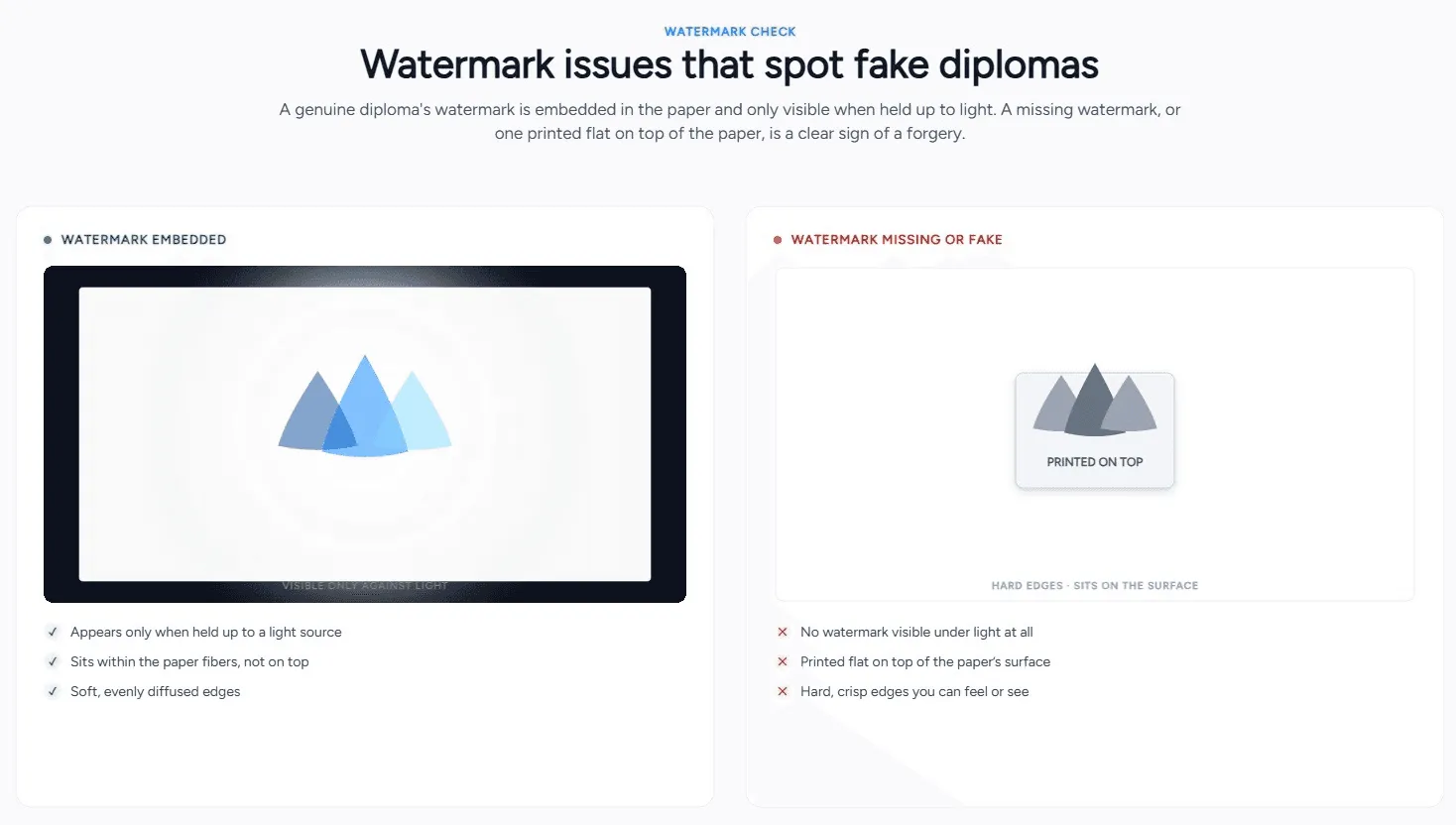
Many institutions embed a watermark into their diploma paper that's only visible when held up to light. If a diploma lacks a watermark entirely, or the watermark looks printed on top of the paper rather than embedded within it, that's one more detail that helps spot fake diplomas and degrees before they're accepted as genuine.
Quick tip: No window handy? A phone flashlight works just as well as natural light for checking whether a watermark is genuinely embedded in the paper rather than printed on top of it.
11. Verify Credentials Directly With the Issuing Institution
The most reliable way to confirm a diploma is real is to go straight to the source. Most colleges and universities have a registrar's office or a designated verification service (like the National Student Clearinghouse) that exists specifically to verify credentials - confirming whether someone actually graduated with a specific degree on a specific date. If the issuing institution has no record, the diploma is fake, regardless of how convincing it looks.
12. Replica Diplomas: Using a Fake Diploma Is Easier to Catch Than You Think
Ironically, some of the best replica diplomas today are almost indistinguishable from the original to the untrained eye - that's exactly what makes diploma fraud dangerous. High-quality fake credentials are sold openly on certain online marketplaces, and people buy fake diplomas more often than most hiring managers realize. Still, using a fake diploma rarely survives formal verification, which is why visual inspection alone shouldn't be the only step in your hiring process.
Real Diploma vs. Fake Diploma: Quick Comparison
| Sign | Real Diploma | Fake Diploma |
|---|---|---|
| Fonts & design | Consistent typeface and spacing throughout | Mismatched fonts, uneven spacing |
| Seal | Raised, embossed, or foil-stamped | Flat, printed-on seal |
| Paper quality | Heavy cardstock or specialty paper | Standard printer paper |
| Spelling & grammar | No errors in titles or dates | Misspellings, awkward phrasing |
| Issuing institution | Independently verifiable, established reputation | Slick website, no independent record |
| Accreditation | Listed with a recognized accreditation body | Not listed, or unverifiable |
| Transcript match | Course names, GPA, and dates line up | Details inconsistent with the diploma |
| Diploma mill traits | Standard coursework and timeline | Fast turnaround, "life experience" credit |
| Signature | Signed by registrar, dean, or president | Missing, single, or photocopied-looking |
| Watermark | Embedded in the paper, visible in light | Missing, or printed on top of the paper |
| School verification | Confirmed by registrar or verification service | No record found |
| Overall impression | Verifiable through official channels | May look convincing, fails formal checks |
One more thing: Even a flawless-looking diploma can be a stolen or altered copy of someone else's real credential. That's exactly why direct verification with the issuing school matters more than visual inspection, no matter how convincing the document itself looks.
Why Should Every Credential be Verified
For any employer or recruiter, hiring someone with false credentials can create real liability - from unqualified staff in specialized roles to reputational damage if the fraud comes to light later. Treating every diploma and degree credential as something to verify, not just glance at, protects your organization and keeps the hiring process fair for candidates who earned their qualifications honestly.
Know How to Spot a Fake Diploma: Education Verification Steps for the Hiring Process
If you want to know how to spot a fake diploma with confidence, don't rely on a visual check alone. Follow up on the signs above with formal education verification:
- Contact the registrar's office at the issuing institution directly.
- Use a third-party education verification service for official credential checks.
- Check the institution's accreditation status with a recognized accreditation body.
- Compare diploma and degree details against the transcript for consistency.
- Ask the candidate for permission to verify credentials as a standard part of your background check process.
Pro tip: Build education verification consent into your standard offer paperwork instead of asking separately. It makes the step routine rather than awkward, and most candidates already expect it.
How Wauld Helps With Built-In Verification
One reason fake diplomas are so easy to produce is that traditional paper credentials have no built-in way to prove authenticity beyond a seal or a phone call to a registrar. Wauld, a digital credential platform used by universities, colleges, and training providers, closes that gap by issuing certificates, diplomas, and transcripts as verifiable digital records instead of static PDFs anyone can copy.
Every credential issued through Wauld carries a QR code that lets an employer, recruiter, or third party verify it in seconds - no account needed, no waiting on a registrar's office to respond. Institutions can also opt into KYC verification to earn a "Verified Organization" badge, giving employers extra confidence that the issuing school is legitimate. Because each credential is tied to a secure ID rather than a font, seal, or watermark someone could replicate, it's far harder to produce a convincing fake in the first place.
For institutions that want to move away from easily forged paper diplomas, Wauld offers a free plan covering up to 300 credentials, 1,000+ customizable templates, and Open Badge 3.0 compliant digital badges alongside certificates - all designed to make academic credentials verifiable by default rather than something an employer has to independently investigate after the fact.
Final Thoughts on Fake Diplomas and Counterfeit Degrees
Knowing how to spot a fake diploma is about more than checking for a shiny seal or the right font - it's about building a verification process that doesn't rely on appearances alone. Between diploma mills getting more sophisticated and counterfeit degrees becoming easier to produce, the safest approach for any employer, recruiter, or institution is to verify directly with the issuing school every time academic credentials matter.
That's also why more institutions are moving away from paper diplomas that rely on a seal and a phone call for proof. Platforms like Wauld build verification directly into the credential itself, so a QR scan does in seconds what a manual records request used to take days to confirm. Whether you're an employer checking a candidate's background or a school issuing the next graduating class's diplomas, the goal is the same: make authenticity something anyone can confirm instantly, not something they have to take on faith.