Top 11 Badge Management Software Platforms For You

Why Badge Management Software Matters
digital badge is a small image with a big job. It says someone learned a skill, finished a course, or met a standard, and it should be easy to share and simple for anyone to trust.
The moment you issue more than a handful, the work adds up:
- Designing the badge
- Sending it to the right people
- Tracking who accepted it
- Replacing the ones with mistakes
- Giving employers a way to confirm it is real
Badge management software exists to handle all of that. A good platform lets you:
- Design a branded badge once
- Issue it in bulk to a list of earners
- Attach the metadata that makes it a verifiable credential
- Give recipients a place to store and share what they earned
- Track analytics on how those badges are used
That is the difference between a badge that sits in an inbox and one that shows up on a LinkedIn profile and gets checked by a hiring manager.
For a wider view of the category, our roundup of digital badge platforms for credential management is a useful companion to this guide.
Below are eleven platforms worth knowing in 2026. We start with Wauld, then walk through ten more, each with a short intro and a pros and cons table, and finish with an overall comparison and a plain recommendation.
Badge Management Software Platforms
Wauld
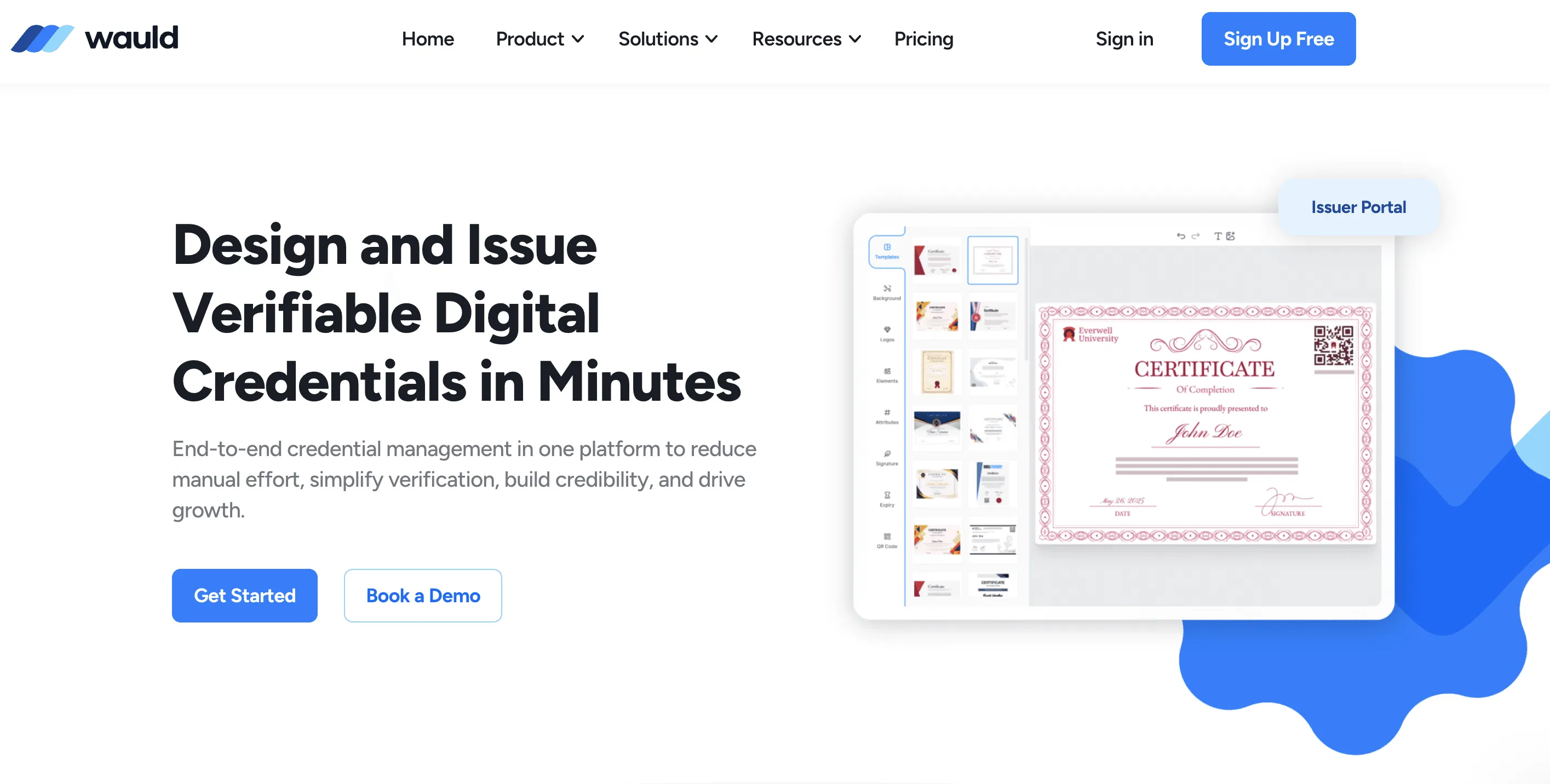
Wauld is a digital credentialing platform that lets you design, issue, manage, and verify digital badges and certificates end to end, all in one place. Instead of stopping at a badge image, Wauld treats every badge as a verifiable credential with its own verification link and QR code, so an employer or registrar can confirm it in seconds.
What you get with Wauld:
- Issuer Portal to create and track badges, plus a recipient portal to store and share what they earn
- 1000+ customizable templates for badges and certificates, personalized to your brand
- Bulk issuance from a simple list, for example straight from Google Forms responses
- Engagement analytics showing who opened, downloaded, and shared each badge, including LinkedIn additions
- Workspace management to organize assets and assign role-based access across teams
- Open standards support for Open Badges 3.0 and W3C Verifiable Credentials, keeping badges interoperable
- Free to start with no onboarding fees, ideal for smaller issuers
Named a SourceForge Top Performer for Digital Credential Management. If you are weighing the field, our list of top Credly alternatives by use case puts Wauld in context.
| Pros | Cons |
|---|---|
| Free to start with no onboarding fees | Newer name than legacy enterprise incumbents |
| Full lifecycle: design, issue, manage, and verify in one platform | |
| 1000+ customizable badge and certificate templates | |
| Built-in verification link and QR code on every badge | |
| Supports Open Badges 3.0 and W3C Verifiable Credentials | |
| Recipient portal, bulk issuance, and engagement analytics |
Credly
Credly is one of the best-known badge platforms and a common choice for large enterprises. Key points:
- Global Open Badge platform supporting Open Badges 2.0 and 3.0
- Automatically parses badge metadata
- Enterprise-class program management with detailed analytics
- Strong network effect - many well-known certification programs are issued through Credly, so earners often already have a profile
The trade-offs are cost and access:
- No published pricing - you have to contact sales
- Widely regarded as one of the more expensive options, out of reach for many smaller issuers
It is a strong badge management platform if you are a large organization that needs scale and network reach, but it asks for a real budget and a sales conversation before you can start.
| Pros | Cons |
|---|---|
| Established, widely recognized badge network | No public pricing; sales contact required |
| Open Badges 2.0 and 3.0 with automatic metadata parsing | Generally expensive, tough for small issuers |
| Enterprise-grade analytics and program management | No free path to simply try it |
Sertifier
Sertifier is a well-rounded digital badge and certificate platform aimed at training providers and institutions. Highlights:
- Create badges, certificates, and micro-credentials with your branding
- Issue at scale from an LMS, CRM, or enrollment data using smart triggers or a REST API
- Every credential gets a unique verification link and QR code
- Recipients can add badges to LinkedIn in one click
- Supports Open Badges 3.0 and W3C Verifiable Credentials
Pricing is transparent and reasonable:
- Free for up to 250 unique recipients per year
- Basic at $75/month for up to 1,000 recipients
- Pro at $167/month for up to 5,000 recipients
It is a solid all-around choice, with Wauld standing out for its larger template library and free-to-start entry.
| Pros | Cons |
|---|---|
| Badges, certificates, and micro-credentials in one tool | Recipient-based pricing can climb for large audiences |
| Open Badges 3.0 and W3C support with QR verification | Free tier capped at 250 recipients per year |
| Strong LMS/CRM automation and REST API |
Accredible
Accredible is an enterprise digital badging and certificate platform known for polished recipient experiences and flexible credential design. What stands out:
- Learning pathways, credential wallets, and branded recipient websites with custom URLs
- Per-recipient pricing rather than per badge, suiting programs that issue several credentials to the same learners
That power comes with enterprise costs:
- Roughly $1,500 setup fee
- About a $1,000 annual minimum
- Essentials pricing that often starts in the low thousands per year for up to 1,000 credentials
For a large, well-funded credentialing operation, Accredible is a capable badge management platform. For smaller issuers, the setup fee and minimums make Wauld's free-to-start model an easier place to begin.
| Pros | Cons |
|---|---|
| Polished recipient sites and learning pathways | Setup fee and annual minimum raise the entry cost |
| Per-recipient pricing suits multi-credential programs | Priced for enterprise budgets |
| Mature badge and certificate design | No free-to-start path |
Open Badge Factory
Open Badge Factory is a standards-focused platform built specifically for Open Badges, popular with universities, NGOs, and training organizations that care about doing badging properly. Features include:
- Badge application workflows with questionnaires and evidence
- Multi-step assessment, including peer and jury review
- Milestone badges and endorsements
- Competency framework alignment (ESCO and CASE) on higher tiers
Pricing is tiered by service level:
- Basic - 220 EUR/year
- Premium - 700 EUR/year
- Pro - 1,280 EUR/year, with a 60-day Pro trial
There is no permanent free plan, and the platform is deliberately badge-only, so if you also need certificates you would pair it with another tool. It is an excellent choice for serious, pedagogy-led Open Badges programs, while Wauld covers badges and certificates together from a single free-to-start account.
| Pros | Cons |
|---|---|
| Deep Open Badges features and assessment workflows | Badge-only; no built-in certificate side |
| Competency framework alignment on higher tiers | No permanent free plan |
| Trusted by universities and NGOs | Annual license required to keep using it |
BadgeCert
BadgeCert is a long-standing badge platform aimed at associations, certification bodies, and continuing education providers. What it offers:
- Follows the Open Badges standard
- Bulk issuance, one-click verification, and analytics
- Real emphasis on badge expiration and revocation, which matters for credentials that must stay current
- Hands-on strategy support
Pricing is annual and paid only:
- Bronze - $1,000/year for 500 badges
- Silver - $1,500/year for 1,000 badges
- Gold - $2,500/year for 2,000 badges
There is no free plan, so you commit before you test. BadgeCert is a dependable pick for professional bodies that need mature expiry handling, though the lack of a free tier and the fixed badge caps make Wauld a more flexible starting point for many teams.
| Pros | Cons |
|---|---|
| Strong expiration and revocation handling | No free plan; paid-only from the start |
| Open Badges support with one-click verification | Fixed annual badge caps per tier |
| Good fit for associations and CE providers | Less template flexibility than broader tools |
Virtualbadge.io
Virtualbadge.io focuses on making badges and certificates easy to design and distribute. Key features:
- Drag-and-drop editor and branded landing pages
- Bulk sending by email
- QR-code verification and expiration dates
- Digital wallet support - store badges in Apple Wallet or Google Wallet (a nice touch many rivals lack)
- Advanced plans add API access, Zapier, LinkedIn sharing, and attendance tracking
Pricing comes in Growth and Enterprise tiers with a free trial, though full figures are not all public, so you may need to request a quote for higher plans. It is a friendly, well-designed badge management platform, especially for events and training. Wauld matches the ease of use while adding a larger template library, W3C Verifiable Credentials support, and a free-to-start plan.
| Pros | Cons |
|---|---|
| Easy drag-and-drop design and branded landing pages | Full pricing not all public on higher tiers |
| Digital wallet support (Apple and Google Wallet) | Advanced features gated to upper plans |
| QR verification and bulk email sending |
Certifier
Certifier is a user-friendly badge and certificate platform with one of the more generous free plans in the category. Highlights:
- Forever-free tier for up to 250 credentials per year
- Paid plans scale by volume, for example, around $35/month for 100 certificates
- Supports Open Badges 3.0
- Built-in digital wallet for recipients
- Custom domain sending - deliver badges from your own domain
- Zapier and API connections for automation
Certifier is a strong, accessible option for coaches, course creators, and training teams that want to start for free and grow. Wauld competes closely here, differentiating with a larger 1000+ template library, W3C Verifiable Credentials support alongside Open Badges, and its own free-to-start recipient portal experience.
| Pros | Cons |
|---|---|
| Generous forever-free plan (250 credentials/year) | Volume-based pricing adds up at higher tiers |
| Open Badges 3.0 with built-in recipient wallet | Fewer templates than the largest libraries |
| Custom domain sending and API/Zapier automation |
POK
POK is a verifiable credential platform with a blockchain angle, popular with universities that need to scale without entry barriers. What it offers:
- Free unlimited plan for issuing and verifying Open Badges 3.0 credentials
- Optional blockchain verification from $0.30 per credential (or a $3,000/year license for up to 50,000) using the Blockcerts standard, plus NFT options
- No setup fee and no minimum commitment
- 1EdTech certified and compliant with the European Learning Model
- API-first design that suits LMS integration
If cryptographic, self-serve verification and open standards are priorities, POK is a compelling badge management platform. Its blockchain focus is more than some issuers need, though, and Wauld offers a simpler all-in-one design-to-verify experience with 1000+ templates for teams that want less infrastructure to think about.
| Pros | Cons |
|---|---|
| Free unlimited Open Badges 3.0 issuing | Blockchain layer is more than many issuers need |
| Blockchain verification with no setup fee or minimums | Design and template experience is lighter |
| 1EdTech certified and API-first | Best value skews toward technical, university use |
Territorium
Territorium takes a bigger-picture approach, built around the Learning and Employment Record (LER) and Comprehensive Learner Record (CLR). What sets it apart:
- LifeJourney product gives learners a digital wallet, mobile app, and career pathways
- Stackable Achievements let organizations issue verified credentials for entire learning paths across multiple badge levels
- Built on Open Badges 3.0 and CLR 2.0
This is a strong fit for institutions that want badges tied to skills, careers, and long-term learner records, not just one-off issuance. Pricing is not published, so you would contact sales for a quote. Territorium is powerful for education systems and workforce programs, while Wauld is the more direct choice when your main goal is to design, issue, and verify badges quickly without adopting a full LER framework.
| Pros | Cons |
|---|---|
| LER/CLR approach ties badges to skills and careers | No public pricing; sales quote required |
| Stackable Achievements and a learner mobile wallet | Heavier framework than simple badge issuance |
| Open Badges 3.0 and CLR 2.0 standards | Aimed at institutions more than small teams |
Badgr
Badgr was one of the original Open Badges platforms and became widely used through its Canvas LMS integration as Canvas Credentials. In short:
- Strong standards support and a fit inside the Instructure ecosystem
- A default choice for many schools and universities
The big change to know for 2026:
- Free Badgr and Canvas Badges issuing ended after December 31, 2025
- The product is being folded into Parchment Digital Badges with quote-based, contact-sales pricing
- That removes the free tier many small issuers relied on and makes costs opaque unless you are already in the Canvas or Parchment world
It remains a reasonable badge management platform inside that ecosystem, but for teams outside it, Wauld's free-to-start, all-in-one model is a friendlier path.
| Pros | Cons |
|---|---|
| Strong Open Badges standards and Canvas integration | Free issuing ended after December 31, 2025 |
| Familiar to the Instructure/Canvas ecosystem | Quote-based, opaque pricing under Parchment |
| Mature badging heritage | Less appealing outside the Canvas ecosystem |
Overall Comparison Table
| Platform | Free to start | Templates | Standards (Open Badges/W3C) | Recipient portal/wallet | Best for |
|---|---|---|---|---|---|
| Wauld | Yes, no onboarding fees | 1000+ | Yes (Open Badges 3.0 + W3C) | Yes | All-in-one design, issue, manage, and verify |
| Credly | No (sales contact) | Custom | Yes (Open Badges 2.0/3.0) | Yes | Large enterprise badge networks |
| Sertifier | Yes (250/year) | Yes | Yes (Open Badges 3.0 + W3C) | Yes | Training providers and institutions |
| Accredible | No (setup fee) | Yes | Yes (Open Badges) | Yes | Enterprise credentialing programs |
| Open Badge Factory | Trial only | Yes | Yes (Open Badges) | Backpack | Standards-led university/NGO badging |
| BadgeCert | No (paid only) | Yes | Yes (Open Badges) | Yes | Associations and CE providers |
| Virtualbadge.io | Trial | Yes | Open Badges (varies by plan) | Yes (Apple/Google Wallet) | Events and training badges |
| Certifier | Yes (250/year) | Yes | Yes (Open Badges 3.0) | Yes | Coaches, creators, and small teams |
| POK | Yes (Web2 plan) | Lighter | Yes (Open Badges 3.0) | Yes | Blockchain-verified university programs |
| Territorium | No (sales quote) | Yes | Yes (Open Badges 3.0 + CLR) | Yes (mobile wallet) | LER/CLR education and workforce records |
| Badgr / Parchment | No (as of 2026) | Yes | Yes (Open Badges) | Backpack | Canvas/Instructure ecosystem users |
Line them up and the picture is clear. Several platforms are excellent inside a specific niche, whether that is enterprise scale (Credly, Accredible), standards-pure badging (Open Badge Factory, POK), or a learning-record framework (Territorium). What sets Wauld apart is that it delivers the full lifecycle, design, issue, manage, and verify, with 1000+ templates and both Open Badges 3.0 and W3C support, and it is free to start with no onboarding fees.
Curious how a full credentialing platform compares with a narrow badge tool? You can start issuing verifiable digital badges with Wauld for free and see the difference for yourself.
Why Wauld Is the Best Badge Management Software
Most platforms here are strong at one part of the job:
- Credly brings a network
- Open Badge Factory brings assessment depth
- POK brings blockchain verification
- Territorium brings learner records
Wauld's advantage is that it does the whole job well, in one place, without asking you to pay a setup fee just to begin.
Design: With 1000+ customizable templates plus your own branding, you can build badges and certificates that look professional without a designer on call.
Issuance and management:
- Send in bulk from a list of recipients
- Automate from form responses
- Manage everything from a central dashboard where you can edit or void badges and process change requests
- Use workspace management to organize assets and assign role-based access, so a growing team stays tidy
Verification is the part that makes a badge worth having, and Wauld builds it in:
- Every badge carries a unique verification link and QR code, so anyone can confirm it is real with no account required
- Recipients get their own portal to store badges and share them on LinkedIn, resumes, and email signatures
- Support for both Open Badges 3.0 and W3C Verifiable Credentials keeps badges interoperable across the wider ecosystem
- Engagement analytics close the loop, showing who opened, downloaded, and shared each badge, including LinkedIn additions
For the broader context on where this is heading, our complete guide to digital badges for 2026 and our overview of digital certificate platforms for certificate management both go deeper.
The commercial part is refreshingly simple:
- Free to start with no onboarding fees
- A coach, training provider, association, or university department can run a real program end-to-end before spending anything
- Compared with platforms that require setup fees, per-recipient minimums, or a sales call just to see a price, that is a friendlier on-ramp, and it scales as you grow
A badge is only as valuable as it is verifiable. Wauld gives every badge a link and a QR code anyone can check, so what your recipients earn actually holds up when it counts.
Conclusion
Badge management software in 2026 is a rich field, and the right pick depends on your program. Suppose you need a giant enterprise network, Credly or Accredible fits. If you want standards-pure Open Badges with deep assessment, Open Badge Factory delivers. If blockchain verification or a full learner record is the goal, POK and Territorium are built for it. And if you live inside Canvas, the former Badgr, now Parchment, still has a place.
For most teams, though, the smart starting point is a platform that handles the entire lifecycle without a paywall at the door. Wauld lets you design, issue, manage, and verify digital badges and certificates from one account, with 1000+ templates, open-standards support, a recipient portal, and analytics, free to start with no onboarding fees. If you want your badges to look good, travel well, and be easy for anyone to trust, that is a strong place to begin. For more ideas, our guide to certificate maker apps and software is a helpful next read.