Top 15 Certificate Management Software Solutions in 2026

Credential Management Software
If you issue or track certificates, the tool you pick decides how much admin you do, how professional your credentials look, and how easily people can verify them. This blog compares the top 15 Certificate Management Software solutions for 2026, so you can match the right one to your situation as a solo coach, a training company, a school, an association, or a large L&D team.
You will get a short list of buying criteria, a tool-by-tool breakdown with features and pricing, a side-by-side comparison table, and a simple way to choose based on your size and needs. We list Wauld first as the best overall pick, then cover the rest fairly, with what each one does well and where it falls short.
One note before the list. "Certificate management" means two related things. Most tools here issue and verify certificates and badges (you design a credential and send it). A few (Certemy, Cobalt, MyComply) instead track and renew the licenses and certifications your workforce already holds. We flag which camp each tool sits in because picking the wrong type is the most common mistake.
What To Look for in Certificate Management Software
Before you commit, weigh these criteria. They map to how this software actually works day to day.
- A real free plan, not just a trial. A recurring free tier (around 250 to 300 credentials a year) lets you run a pilot without paying. A 7 or 60 day trial does not.
- Transparent pricing and contract flexibility. Public, self-serve pricing and monthly billing beat sales-gated quotes and locked-in annual contracts.
- Issuing or tracking. Decide whether you need to create and send certificates, or monitor and renew licenses your staff already hold. Few tools do both well.
- Design quality. A large template library, brand controls (logo, colors, QR codes, signatures), and AI-assisted layout tools save real time.
- Verification and standards. QR code verification, Open Badges support (a shared standard that keeps a credential portable and verifiable across platforms), and blockchain anchoring where it matters.
- Analytics. Recipient-level data on opens, shares, LinkedIn adds, and verifications, so you can prove program impact.
- Integrations and automation. LMS connectors, Zapier or webhooks, and an API so credentials issue or update automatically.
The 15 Best Certificate Management Software Tools for 2026
Wauld: Best overall for issuing certificates and badges
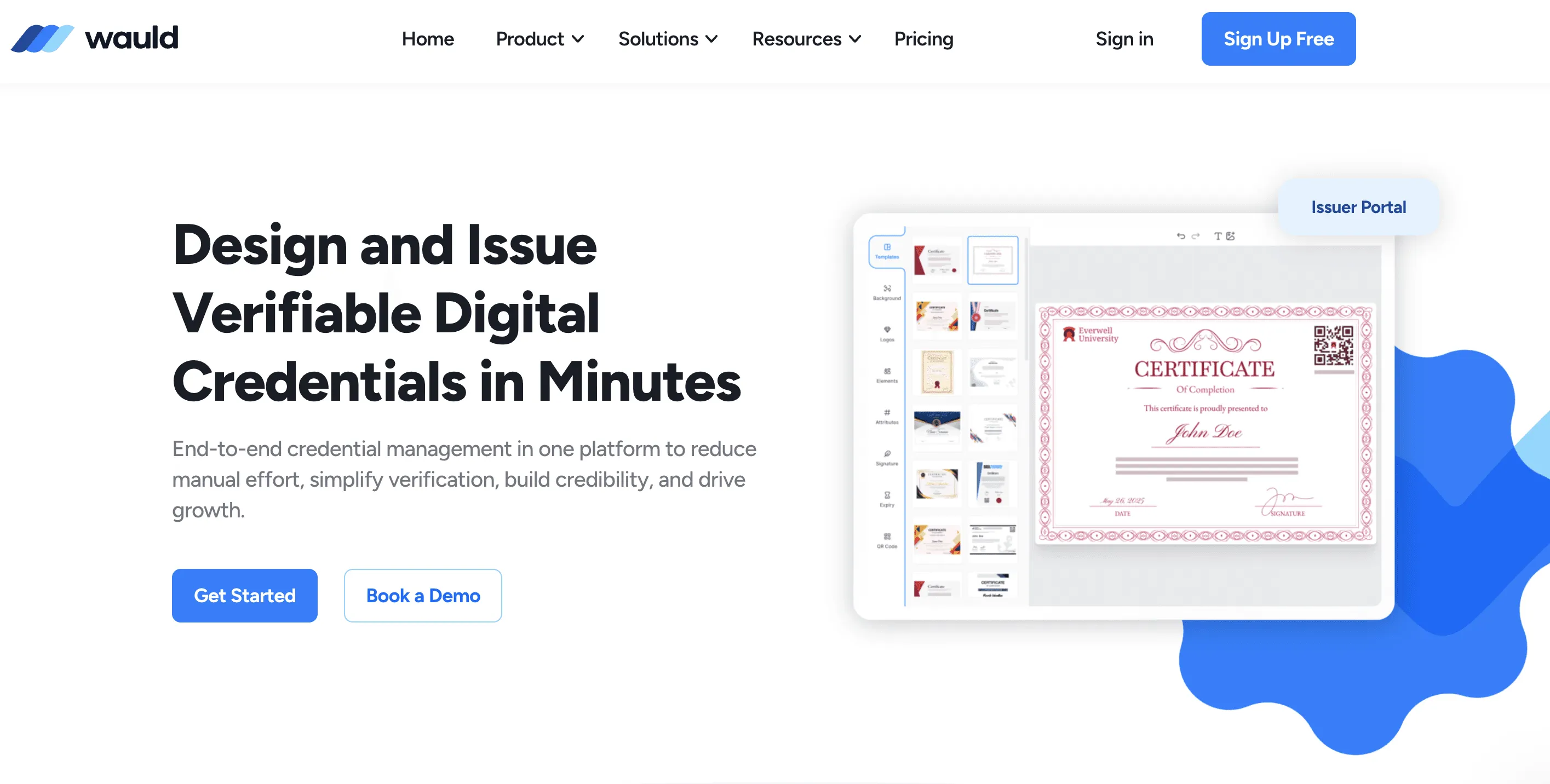
Wauld is a digital credential platform for designing, issuing, and verifying certificates and badges. It suits coaches, course creators, training companies, associations, schools, and L&D teams that want professional credentials, transparent pricing, and no annual lock-in. It pairs a large template library with real analytics and automation that you get even on the free plan.
What sets Wauld apart is that it does not force a trade-off. Many tools make you pick cheap but basic, or full-featured but expensive and locked into a yearly contract. Wauld gives you both certificates and badges, recipient-level analytics, and automation from the free tier up, with public self-serve pricing and no sales call. You can run a full program on the free plan, prove the value, and pay only when your volume grows.
Key features
- 1,000+ handcrafted certificate and badge templates, ready from day one
- Design editor with alignment guides, snapping, and accurate previews, built for people who are not designers
- Full white-label branding (logo, colors, backgrounds, QR codes, signatures) on all plans
- Open Badge 3.0 compliant, so credentials stay portable and verifiable across platforms and employer systems
- QR code verification on every credential, with no account needed to check it
- Real-time, recipient-level analytics: opens, downloads, shares, LinkedIn adds, verifications
- One-click LinkedIn add straight from the delivery email
- Zapier, webhooks, and event triggers included on the free plan
- AI-assisted design plus full post-issuance editing of data and design
Pricing: Free plan includes 300 credentials a year with analytics, automation, and AI design included. Growth plan from $39/month, no annual contract and no setup fee.
| Pros | Cons |
|---|---|
| Certificates and badges in one account, with 1,000+ templates and AI design | None |
| Analytics, automation, and a 300-credential free plan with no annual contract | None |
| Transparent self-serve pricing and full post-issuance editing of data and design | None |
If you want to dig deeper, our breakdowns of the leading enterprise credentialing tools and unlimited free blockchain platforms go feature by feature.
Certemy
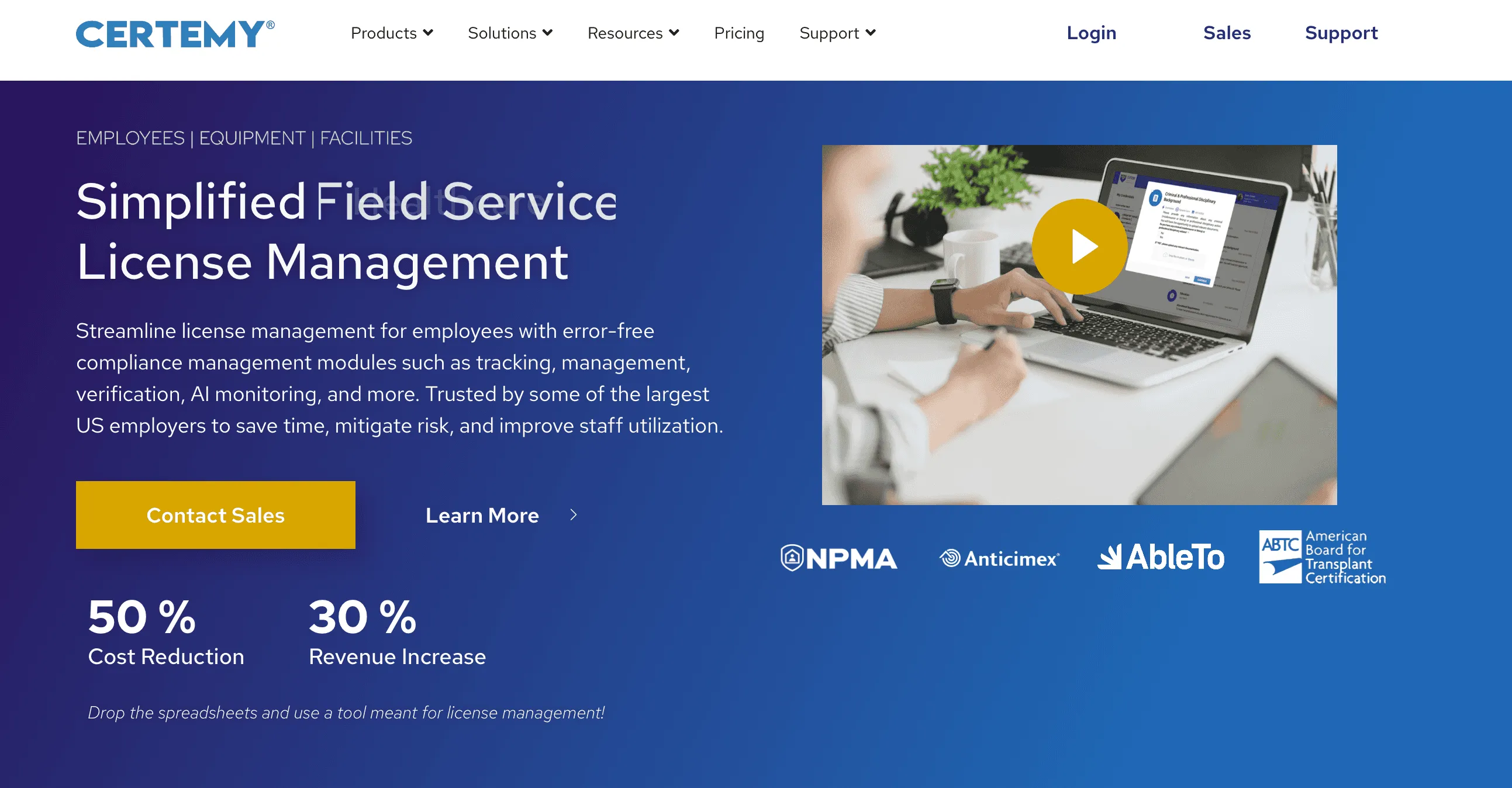
Certemy is not a certificate maker. It is compliance software that tracks the licenses and certifications your employees or members already hold, automates renewals, and runs primary source verification (confirming a credential directly with the body that issued it). It suits certification boards, associations, and regulated employers that need to prove their workforce stays current.
Key features
- License and certification tracking with a central document store
- Automated renewal and expiration reminders
- Automated primary source verification of licenses and certifications
- Application and renewal processing workflows for certification boards
- Continuing education (CE) credit management
- Role-based access for data entry and document uploads
Pricing: Not public. Third-party listings put entry around $5,000 per year and up, quote-based. [CHECK THESE FACTS]
| Pros | Cons |
|---|---|
| Automated license tracking, renewals, and expiry reminders in one hub | No certificate designer or generator, so you need a separate tool to create credentials |
| Automated primary source verification confirms credentials at the source | Pricing is not public and starts high, so it is a poor fit for small teams |
| Strong fit for certification boards and regulated employers | Reporting and filtering are basic, per user reviews |
Cobalt
Cobalt (by Momentive Software) builds certification and association management on top of Microsoft Dynamics 365. It is aimed at established certification boards and credentialing organizations that run complex application, approval, and continuing-education rules and want testing-vendor integrations.
Key features
- Online initial and continuing certification applications with a form builder
- Requirements engine for complex approval and processing rules with auditing
- Applicant self-service portal, desktop, and mobile
- Integrations with testing systems like Pearson VUE and Prometric
- Built on Microsoft Dynamics 365 for reporting and CRM depth
Pricing: Quote-based. Third-party listings indicate roughly $75 to $200 per user per month, with significant implementation costs for mid-to-large organizations.
| Pros | Cons |
|---|---|
| Powerful requirements engine for complex certification rules and auditing | Heavy implementation cost and a steep learning curve |
| Integrates with testing systems like Pearson VUE and Prometric | Overkill for anyone who just needs to send course certificates |
| Built on Microsoft Dynamics 365 for deep reporting and CRM | Users note limited data connectors |
MyComply
MyComply is a construction-focused platform that tracks worker certifications and site access, so general contractors know everyone on site is qualified. It manages internal and subcontractor credentials, sends expiry reminders, and builds digital orientations and forms.
Key features
- Worker certification tracking for internal staff and subcontractors
- Automated reminders for certification expiry dates
- Site access and on-site workforce transparency
- Subcontractor onboarding and custom digital orientations
- Customizable digital form builder for compliance records
Pricing: Certification Manager module is listed at Small Business $499/year, Medium $999/year, and Large $1,999/year. Custom estimates available. [CHECK THESE FACTS]
| Pros | Cons |
|---|---|
| Tracks internal and subcontractor certifications with expiry reminders | Built for construction compliance, not for issuing branded certificates |
| Site-access transparency improves safety and reduces liability | No Open Badge support or recipient-facing credential design |
| Affordable, tiered annual pricing for small to large firms | Narrow to the construction use case |
Certifier
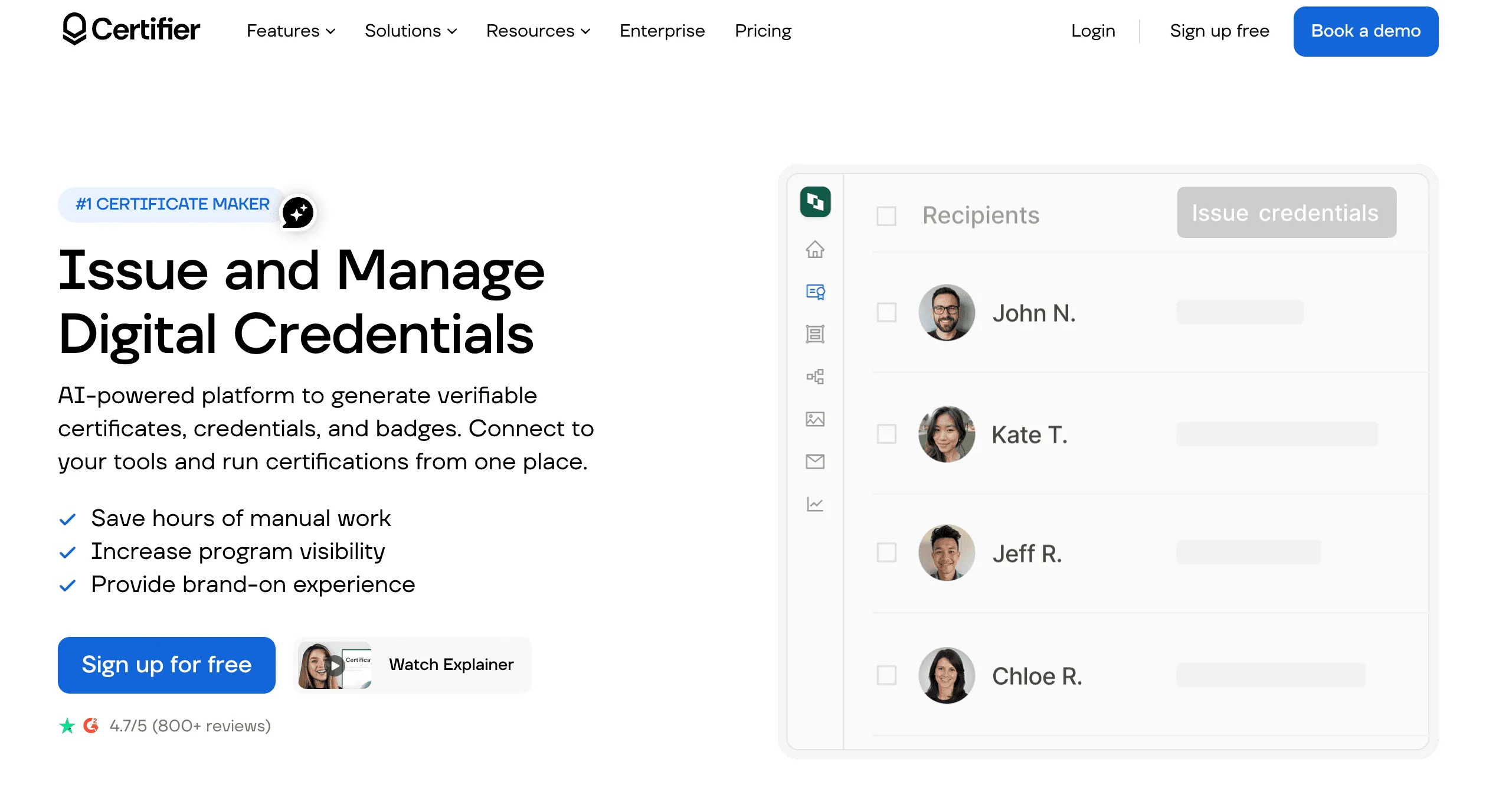
Certifier is a feature-rich platform built around the whole credential lifecycle, from design and issuance to post-issuance editing and analytics. It is a strong fit for teams that want clear pricing and deep operational control, and it is used by large organizations including Amazon, Stanford, and Warner Bros.
Key features
- Large certificate and badge template library with an AI generator
- Full lifecycle management: draft to published to expired, name corrections, revocation
- Post-issuance editing of both data and design
- Analytics dashboard with open rates, wallet views, and per-cohort reporting
- Native integrations with Google Sheets, HubSpot, Salesforce, Airtable, Zoom, and LMS tools
- Open Badge 3.0 applied automatically, GDPR compliant, ISO 27001 certified
Pricing: Free plan includes 250 credentials a year. Paid plans from $67/month, no annual contract.
| Pros | Cons |
|---|---|
| Full lifecycle control with post-issuance editing of data and design | No NFT or built-in employer discovery network |
| AI certificate generator and a 250-credential free plan, no annual contract | Paid entry has risen to $67/month, higher than several rivals |
| Broad native integrations and automatic Open Badge 3.0 |
Sertifier
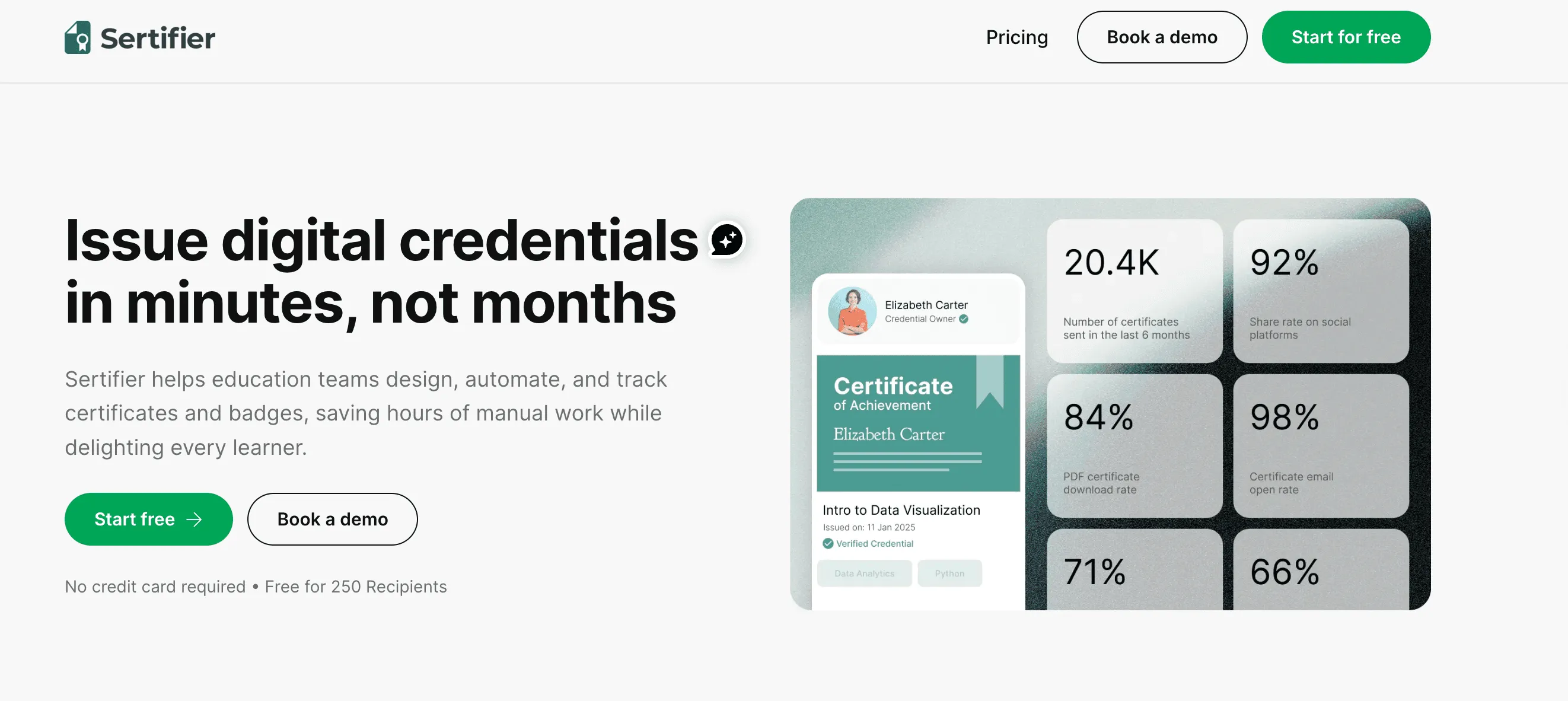
Sertifier targets L&D teams and higher-education institutions running credentials across several programs. It stands out for a wide integration set, a recipient credential wallet, and formal security certifications. Clients include Harvard, MIT, and Cisco.
Key features
- 1,000+ templates with a drag-and-drop editor and brand controls
- Recipient credential wallet that aggregates credentials from multiple issuers
- 100+ native integrations (Canvas, Moodle, Salesforce, Zoom, Zapier)
- REST API and webhooks for event-triggered issuance
- One-click LinkedIn sharing, optional blockchain verification
- SOC 2 Type II, ISO 27001, GDPR, and FERPA alignment
Pricing: Free plan includes 250 recipients a year. Pro from $250/year. Enterprise on request.
| Pros | Cons |
|---|---|
| 100+ integrations across LMS, CRM, and HR systems | White-label with a custom domain sits on the Enterprise tier |
| Recipient credential wallet aggregates credentials from many issuers | Smaller teams may not get full branding at the lower price |
| SOC 2 Type II, ISO 27001, and FERPA alignment, with a 250-recipient free plan |
Accredible
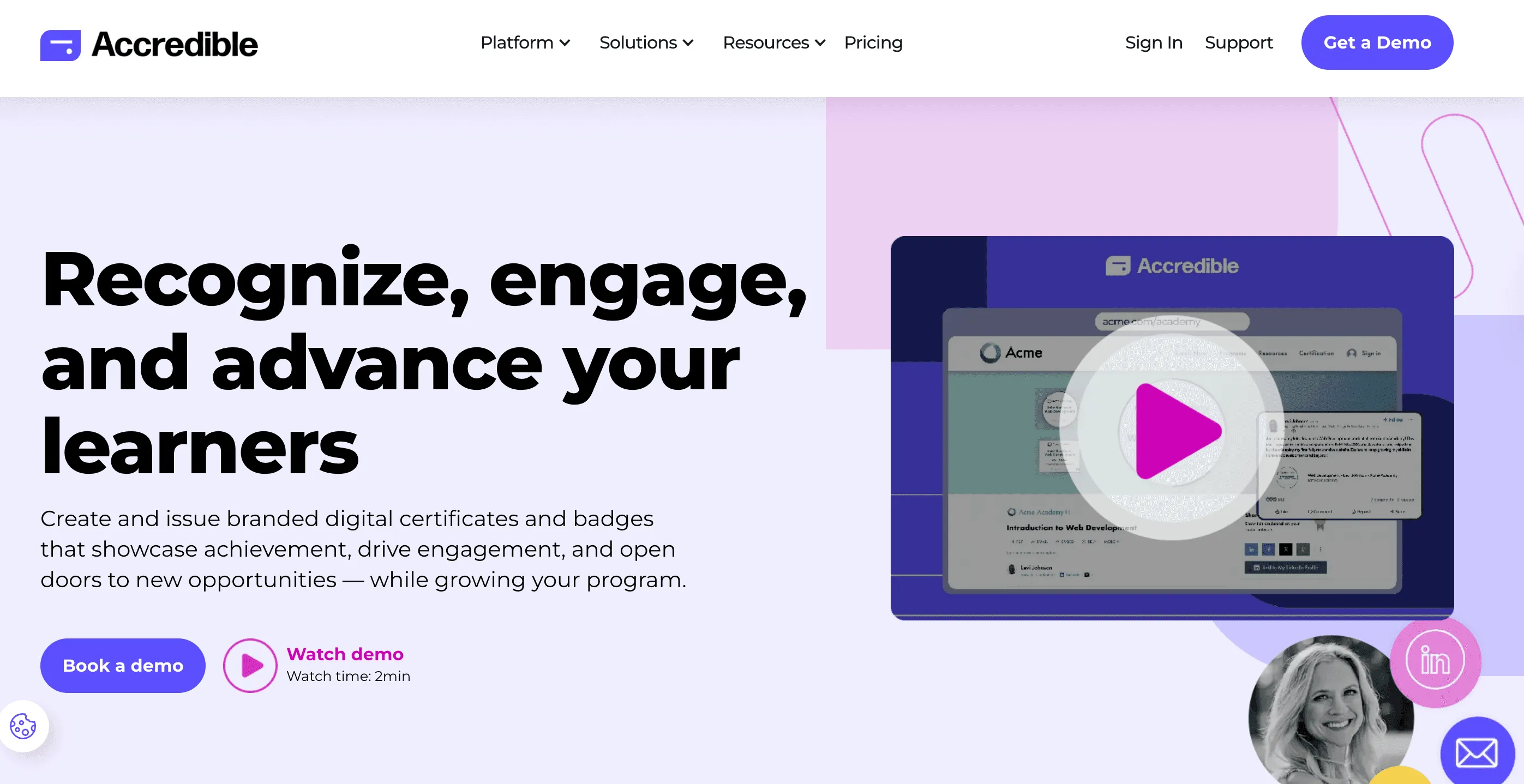
Accredible is a mature enterprise platform used by universities, associations, and corporate L&D teams. It is on track to issue 200 million credentials and carries a G2 rating of 4.7 from 130+ reviews. Its Spotlight directory lets employers discover certified professionals.
Key features
- Enterprise LMS integrations (Moodle, Canvas, Cornerstone, Workday)
- Spotlight certified professional directory for employer discovery
- Credential pathways and learner progression tracking
- Apple and Google Wallet cards, advanced analytics, email campaigns
- Open Badges compliance and micro-credential support
Pricing: From about $45/month for 50 credentials a year, rising to roughly $3,000 to $6,000/year for 1,000 credentials. Annual contracts required.
| Pros | Cons |
|---|---|
| Spotlight directory lets employers discover certified professionals | All plans require annual contracts |
| Deep LMS integrations, credential pathways, and wallet cards | Pricing beyond entry is sales-gated and can escalate at renewal |
| High G2 satisfaction and strong institutional credibility | No AI design or post-issuance design editing |
Credly
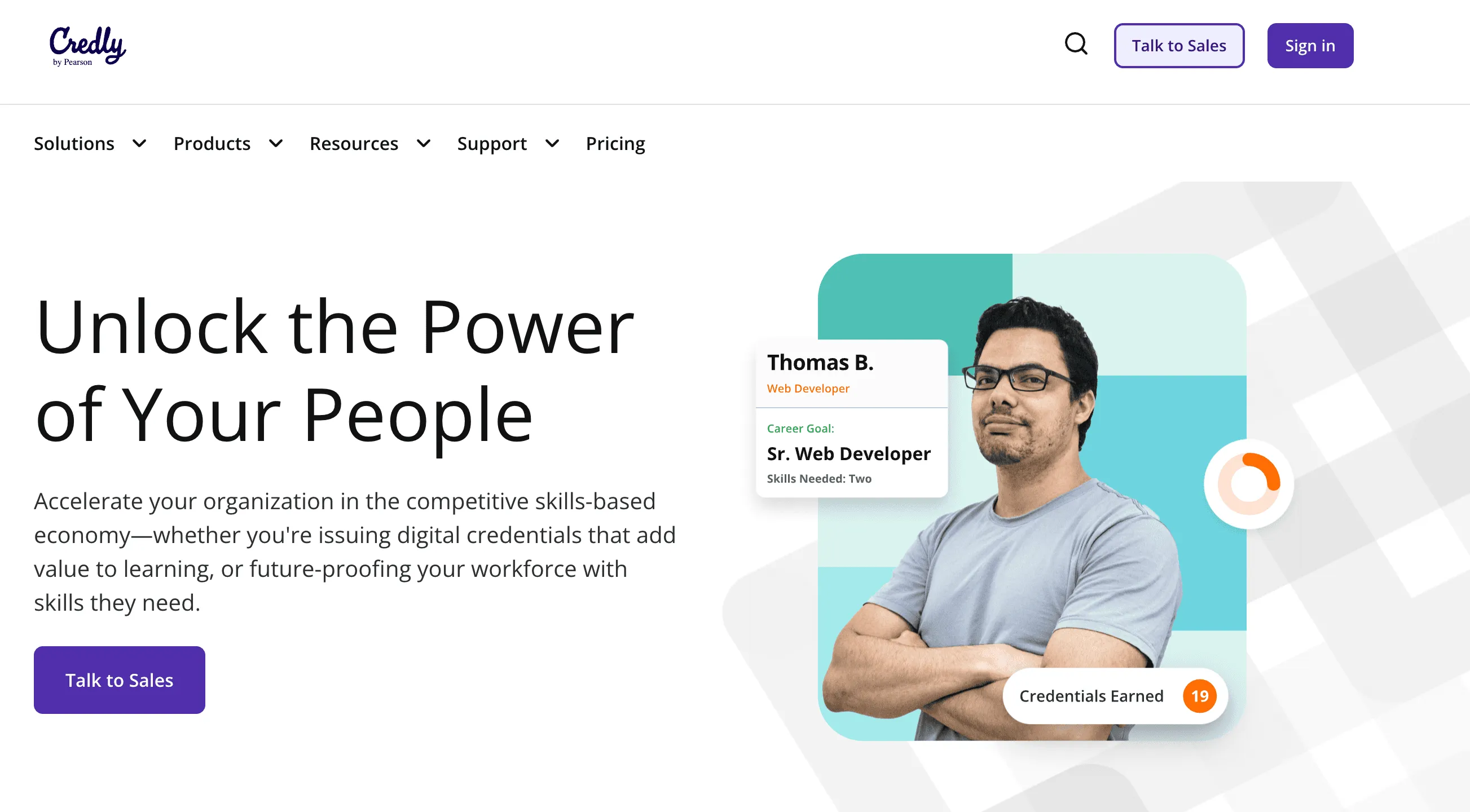
Credly (by Pearson) is one of the largest digital badge networks, with 4,000+ issuing organizations and a frequently cited base of tens of millions of credentials and earners. It fits technology certification bodies, associations, and enterprises whose main goal is for badge holders to be found by employers, rather than LMS-integrated certificate delivery.
Key features
- One of the largest digital badge networks, with global discoverability
- Employer-facing talent discovery across the network
- Open Badges standard for portable, interoperable credentials
- Deep enterprise HR integrations (Workday, SAP SuccessFactors, Oracle)
- Workforce analytics for skill distribution and program reporting
- One-click LinkedIn add for social visibility
Pricing: On request. Minimum annual commitments reported from about $1,000/year, plus a one-time setup fee around $2,000. [CHECK THESE FACTS]
| Pros | Cons |
|---|---|
| One of the largest badge networks, with employer discovery at scale | No meaningful free plan |
| Deep enterprise HR integrations (Workday, SAP SuccessFactors, Oracle) | Less design flexibility than dedicated certificate tools |
| Strong brand recognition and workforce analytics | Sales-led, annual model with a setup fee |
Hyperstack
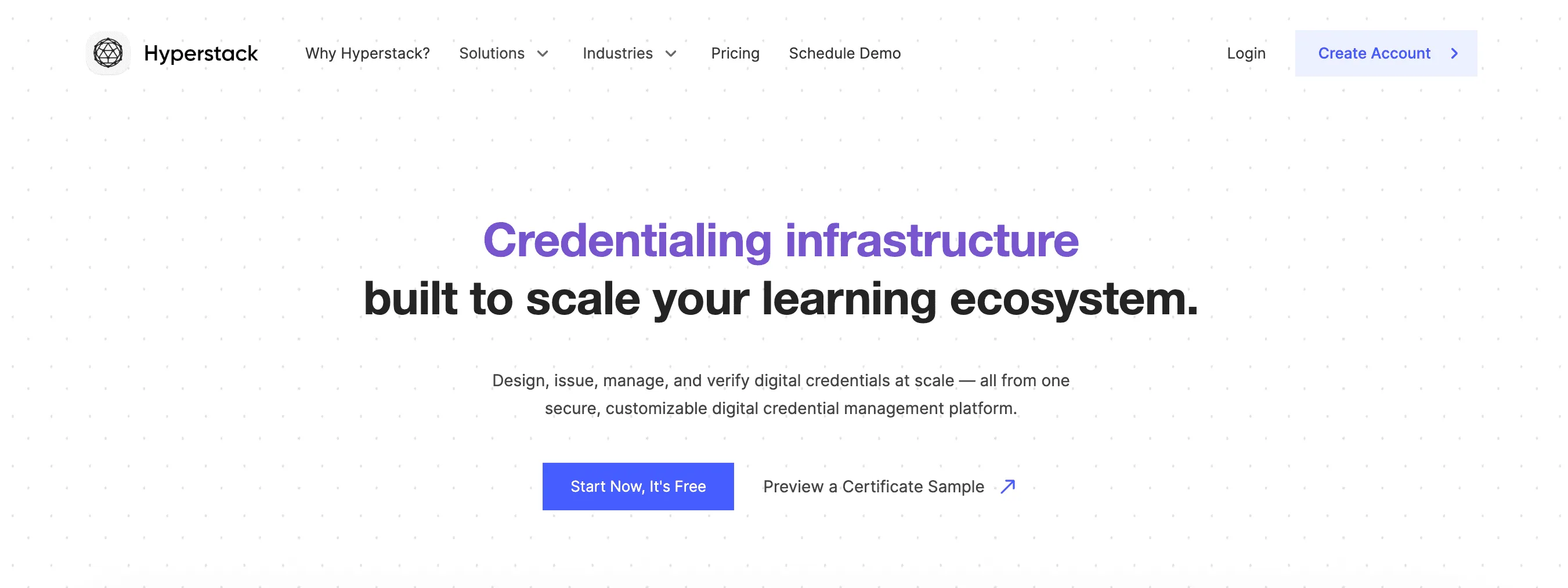
Hyperstack is a blockchain-based platform built on the Hedera Hashgraph. It suits organizations that need formal security documentation and tamper-proof verification without enterprise-level pricing.
Key features
- Multi-blockchain support via Hedera for independently verifiable credentials
- SOC 2 Type 2 and GDPR compliance with formal documentation
- Design Studio with Canva integration and bulk issuance
- API access and Zapier integrations, white-label and custom domain
- Lifecycle management with expiry, revocation, and collections
- Student wallet for recipient-side credential management
Pricing: Free plan includes 20 recipients a year. Premium from $24.51/month for 250 recipients a year. Enterprise on request.
| Pros | Cons |
|---|---|
| Hedera blockchain for independent, tamper-proof verification | No AI design |
| SOC 2 Type 2 documentation at an accessible price | Free tier is small at 20 recipients a year |
| Canva-based design studio, white-label, and lifecycle management |
CertifyMe
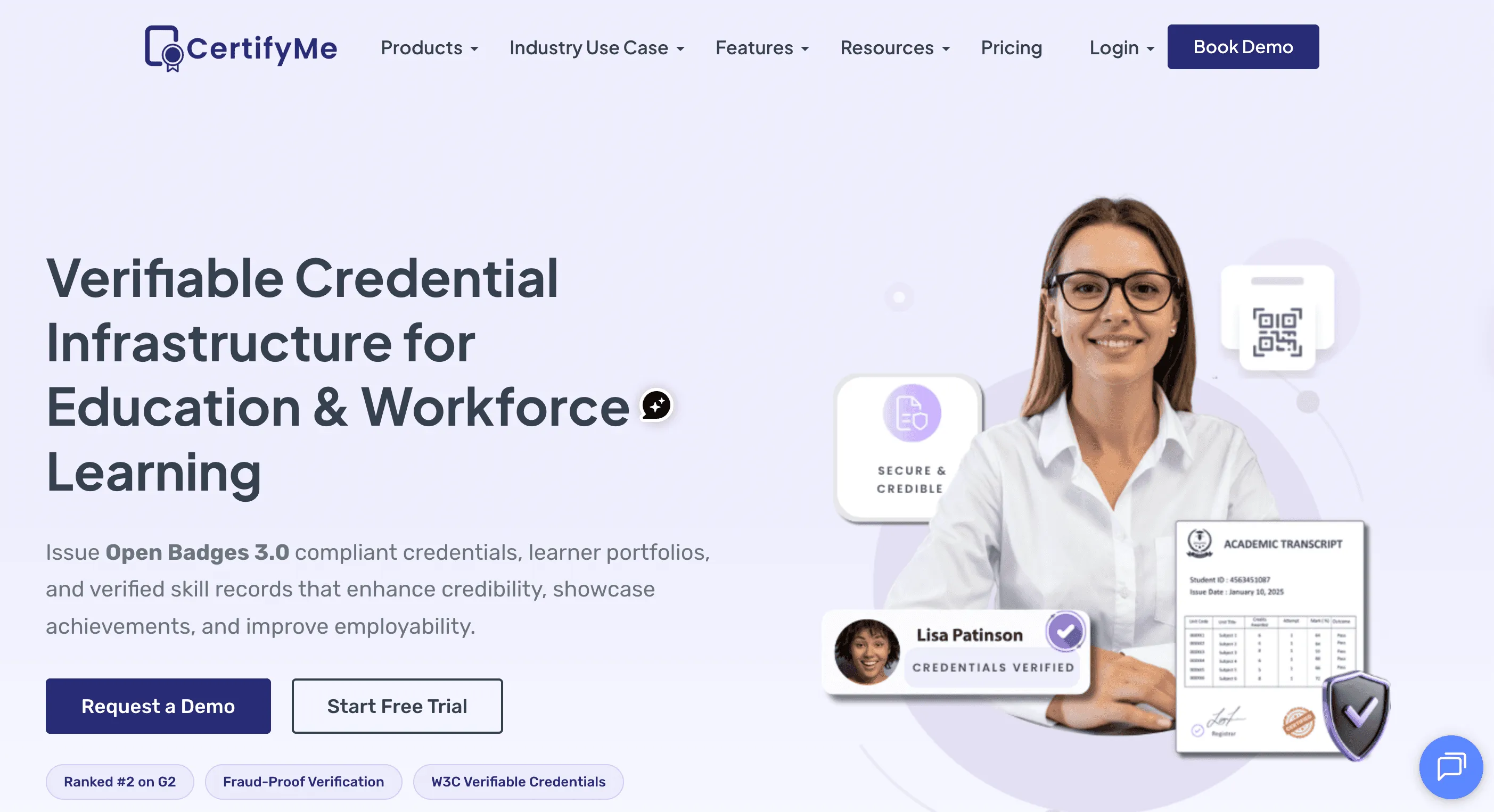
CertifyMe is a dependable certificate and badge platform trusted by thousands of brands, with a 4.8 G2 rating from 570+ reviews. Its support is widely praised, and its anti-forge identity tagging is a genuine differentiator for fraud-sensitive programs.
Key features
- Certificates and badges with a Canva integration for design
- Bulk issuance via CSV and cryptographic signatures
- Anti-forge tagging to unique recipient IDs for fraud prevention
- EduTranscript module for higher-education transcript workflows
- Analytics at the template and individual levels
- LMS and Zapier integrations with API and SSO
Pricing: No public self-serve pricing; quotes are sales-led. Entry appears to start around $500 to $750/year for roughly 500 to 750 badges, an effective cost near $1.50 to $2 per credential.
| Pros | Cons |
|---|---|
| Anti-forge identity tagging is a genuine fraud-prevention differentiator | Per-credential cost is high at scale |
| Widely praised support and a strong 4.8 G2 rating | Pricing is not public |
| EduTranscript module and Canva integration | The free option is a limited trial, not a real free plan |
Certopus
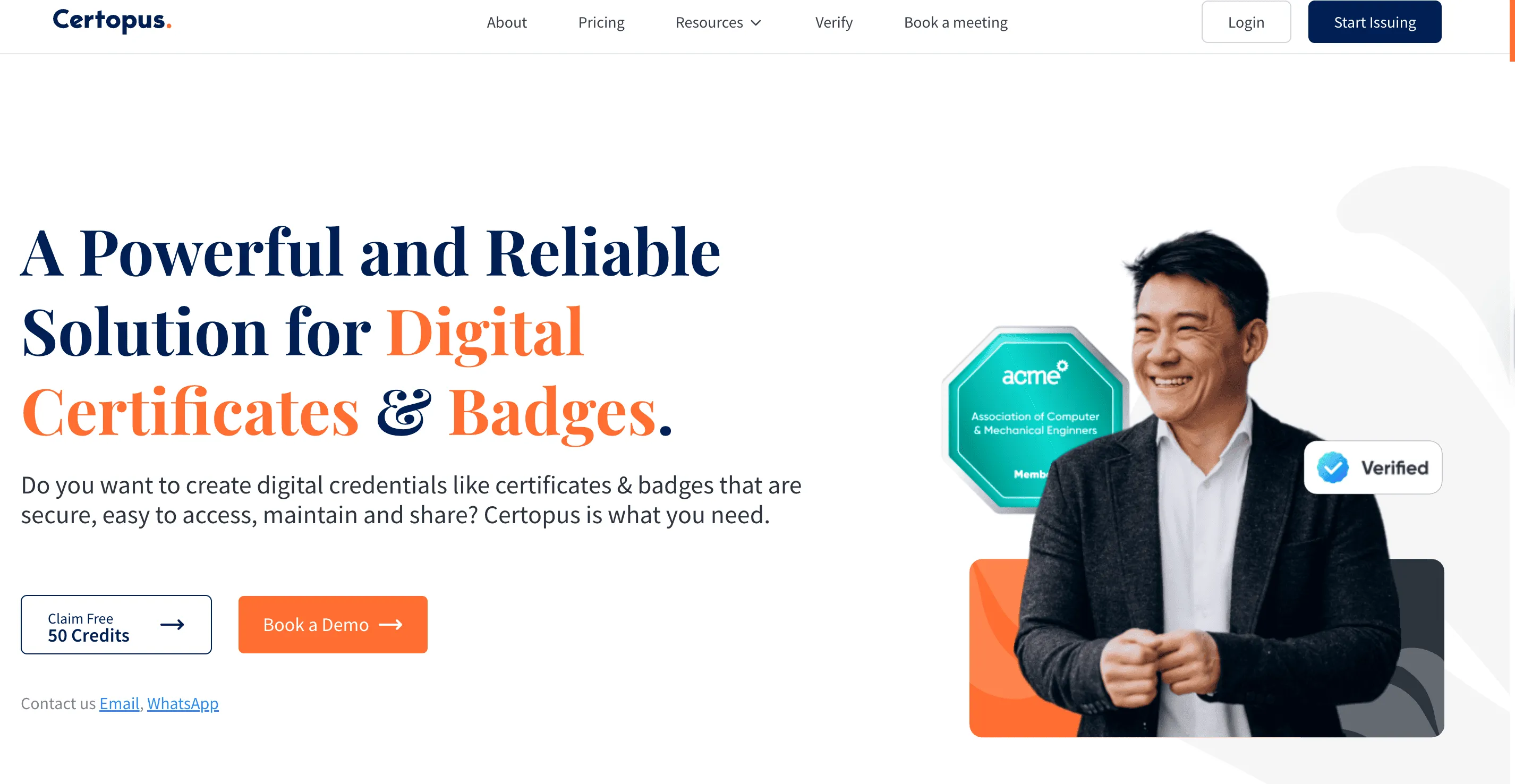
Certopus is a lightweight certificate tool built for speed and affordability. It connects to a broad set of automation platforms, which makes it handy for teams that want fast, hands-off issuance without a big design investment.
Key features
- Visual drag-and-drop certificate designer
- Bulk CSV generation and email delivery
- QR code verification and shareable verifiable links
- Optional blockchain integration via Polygon ID
- Automation through Zapier, Make, Pabbly Connect, and Microsoft Power Automate
Pricing: The free plan includes 100 credentials a month. Paid tiers from $29.99/month.
| Pros | Cons |
|---|---|
| Low entry price with a 100-credential-a-month free plan | Analytics are thinner than higher-ranked tools |
| Broad automation (Zapier, Make, Pabbly, Power Automate) | Smaller template library and less design depth |
| QR verification and optional Polygon ID blockchain |
Virtualbadge.io
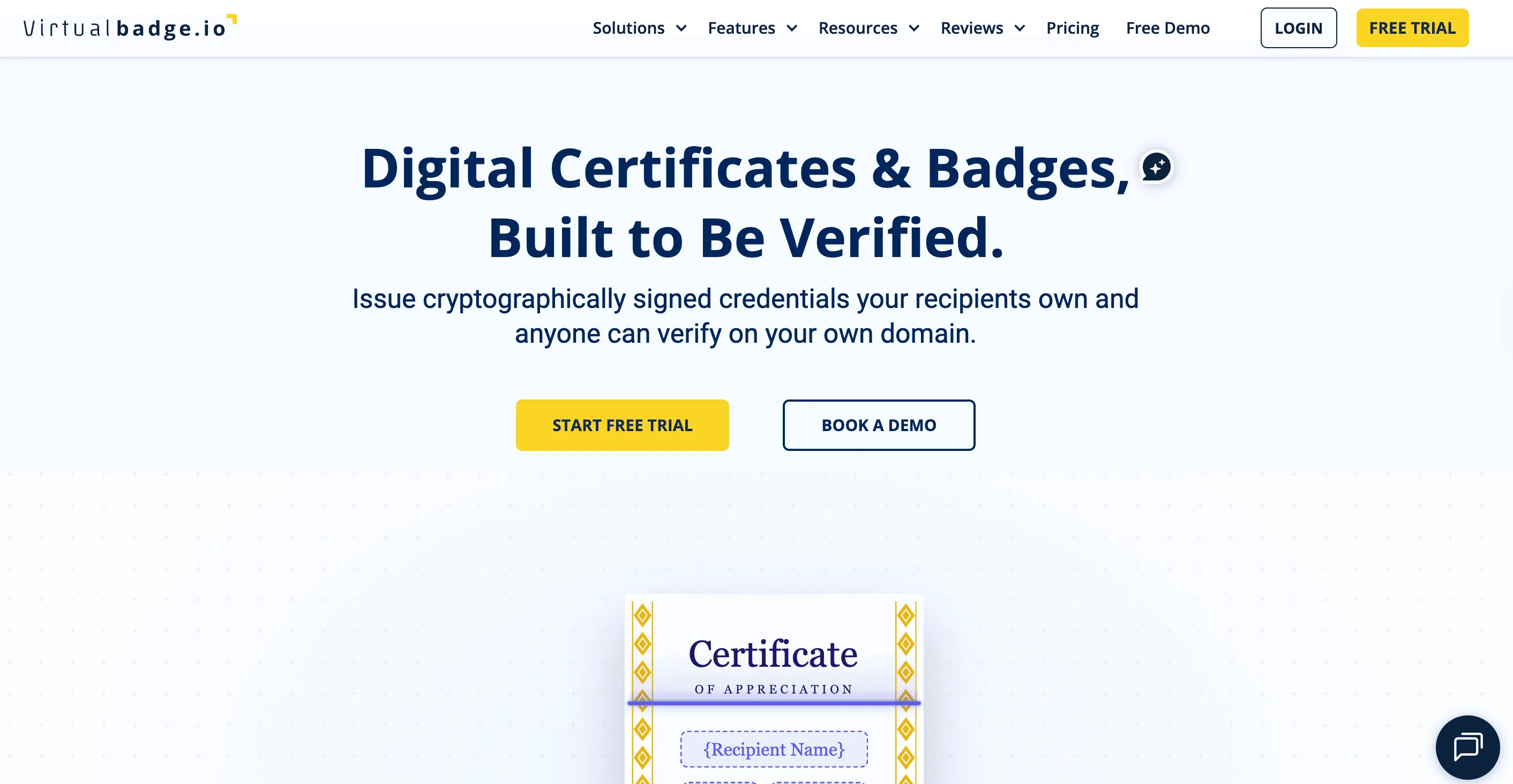
Virtualbadge.io is a German-built platform designed around turning recipients into brand ambassadors through social sharing and LinkedIn optimization. It fits organizations that want social amplification as a core priority rather than an afterthought, with EU data residency.
Key features
- Certificate and badge designer with a drag-and-drop interface
- Bulk issuance via CSV or Excel
- QR code verification and validation pages
- LinkedIn integration with automatic pre-filling of certificate details
- Social media optimization for one-click sharing
- Apple and Google Wallet cards on the Plus plan
- GDPR-compliant German infrastructure
Pricing: Tiered by credential volume. Recent listings show the Growth plan from about $420/year (300 credentials) and scaling up by volume, with Lite, Plus, and Enterprise tiers. Confirm current plan names and prices on virtualbadge.io. [CHECK THESE FACTS]
| Pros | Cons |
|---|---|
| Purpose-built for LinkedIn and social sharing amplification | Less depth in LMS connectivity than bigger platforms |
| GDPR-compliant German infrastructure for EU data residency | Advanced pathways and analytics are limited |
| Apple and Google Wallet cards on the Plus plan | Wallet cards and automation gated to higher tiers |
SimpleCert
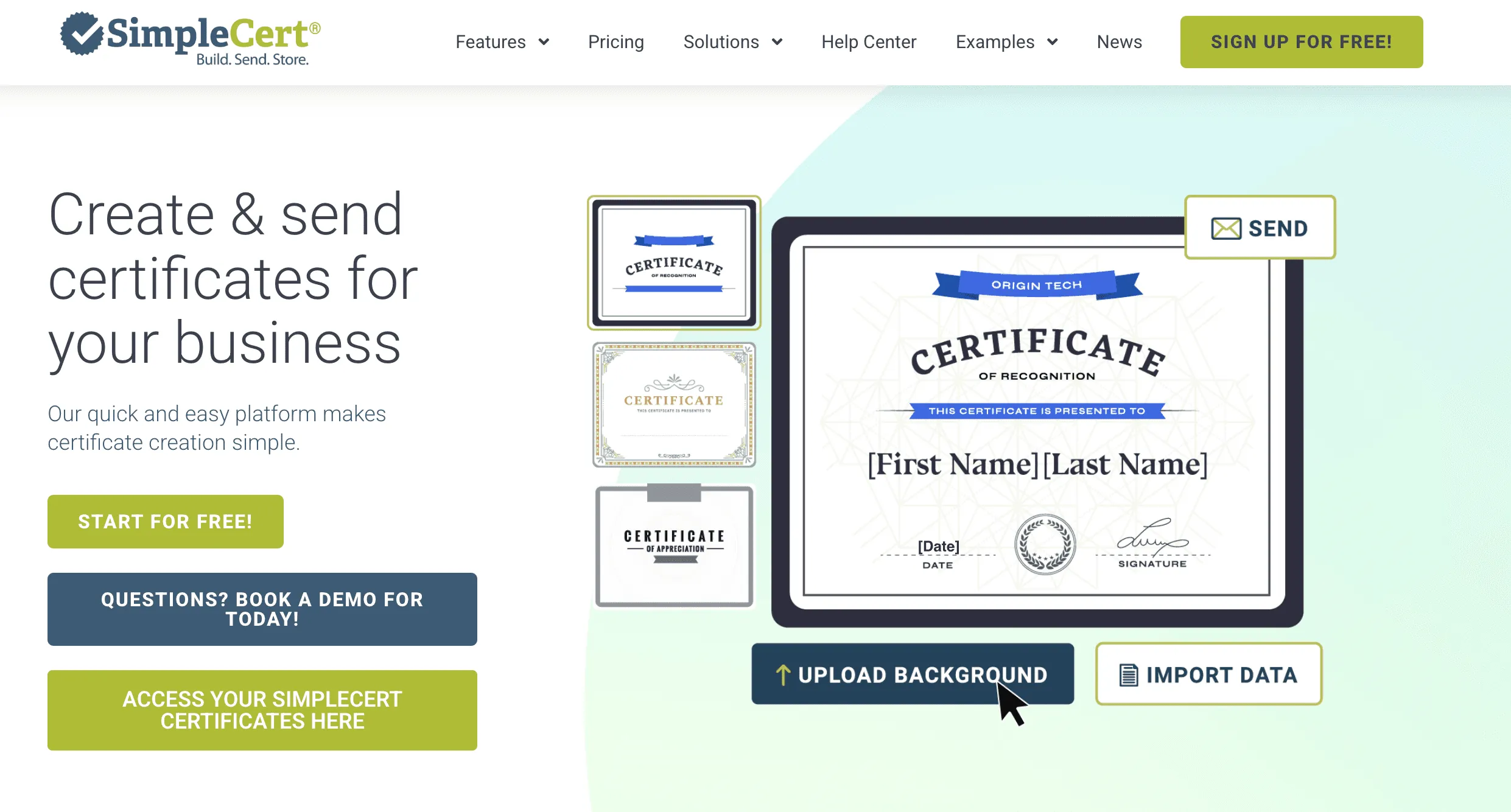
SimpleCert is a certificate management tool built around automated generation, delivery, and storage. It is aimed at trainers, event organizers, and teams that want a straightforward way to produce and send certificates in bulk, with a template editor and a recipient self-service portal for re-downloads.
Key features
- Drag-and-drop certificate designer with reusable templates
- Bulk creation and automated email delivery
- Recipient portal for self-service certificate access
- Integrations and API for automated issuance from other tools
- Certificate storage and management in one place
Pricing: Free tier with a monthly certificate allowance; paid plans scale by volume. Confirm current limits directly. [CHECK THESE FACTS]
| Pros | Cons |
|---|---|
| Simple automated generation, delivery, and storage | Certificate-focused, so badge and Open Badge features are limited |
| Recipient self-service portal for re-downloads | Less suited to teams that need both certificates and badges |
| Free tier and an API for automated issuance | Confirm current free-tier limits before relying on them |
POK
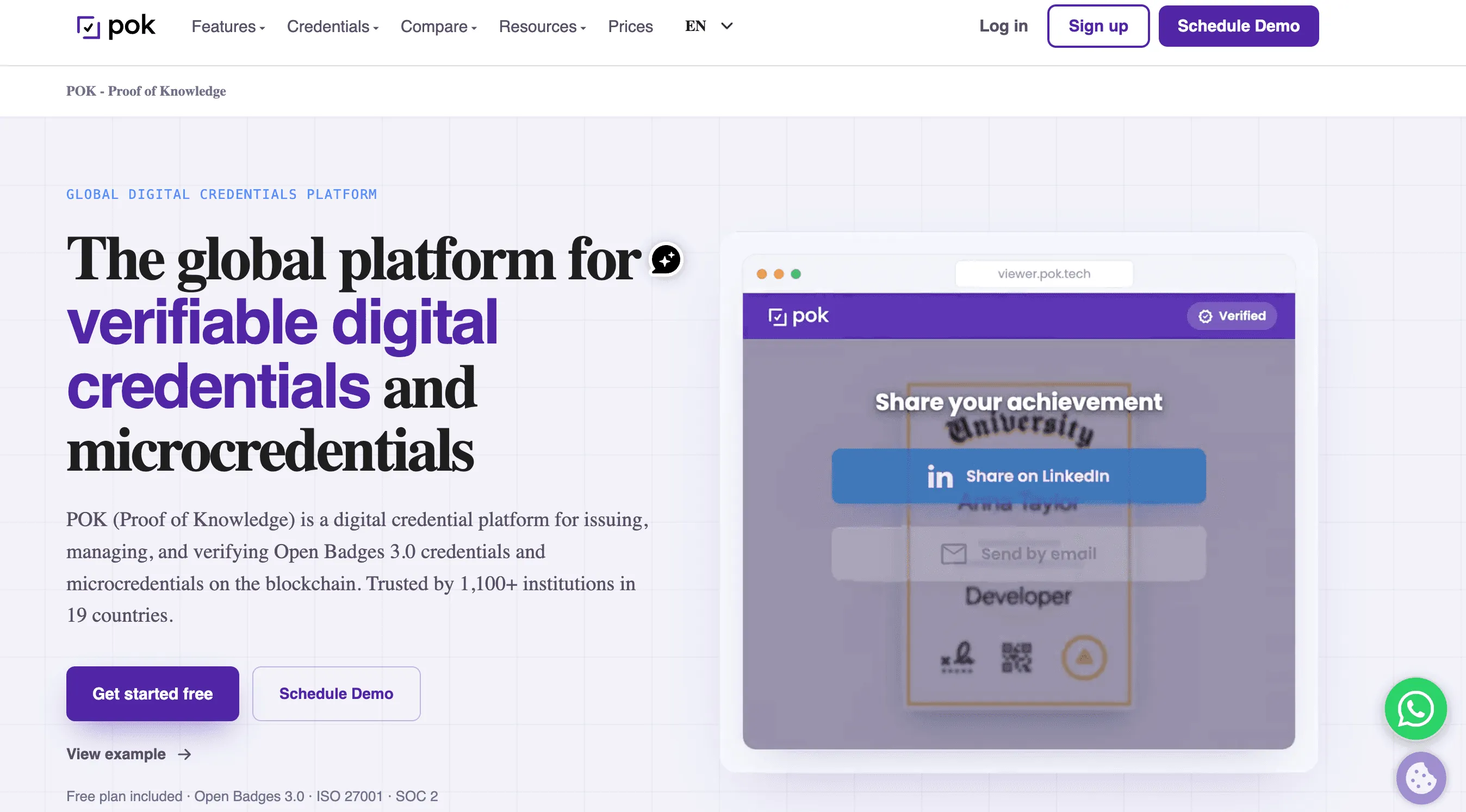
POK (Proof of Knowledge) is a blockchain-first platform used by 1,100+ universities, companies, and governments across 19 countries. It is certified by 1EdTech, ISO 27001, and SOC 2, and offers the most generous free tier on this list.
Key features
- Unlimited free Web2 issuance: no cap, no credit card, no expiry
- NFT credentials on public blockchains for permanent, independent verification
- Open Badge 3.0 certified by 1EdTech, compatible with W3C Verifiable Credentials
- 100% white-label, institutional credential wallet, real-time LinkedIn analytics
- LMS connectors (Moodle, Canvas, Blackboard) and REST API
Pricing: Free plan with unlimited credentials. NFT credentials from $0.80 each, blockchain verification from $0.30 each. No setup fee, no annual contract.
| Pros | Cons |
|---|---|
| Unlimited free Web2 issuance with no cap, card, or expiry | NFT terminology can confuse non-technical recipients |
| NFT credentials give permanent, independent verification | Template and design depth is more limited |
| 1EdTech-certified Open Badge 3.0, ISO 27001, and SOC 2 |
Acreditta
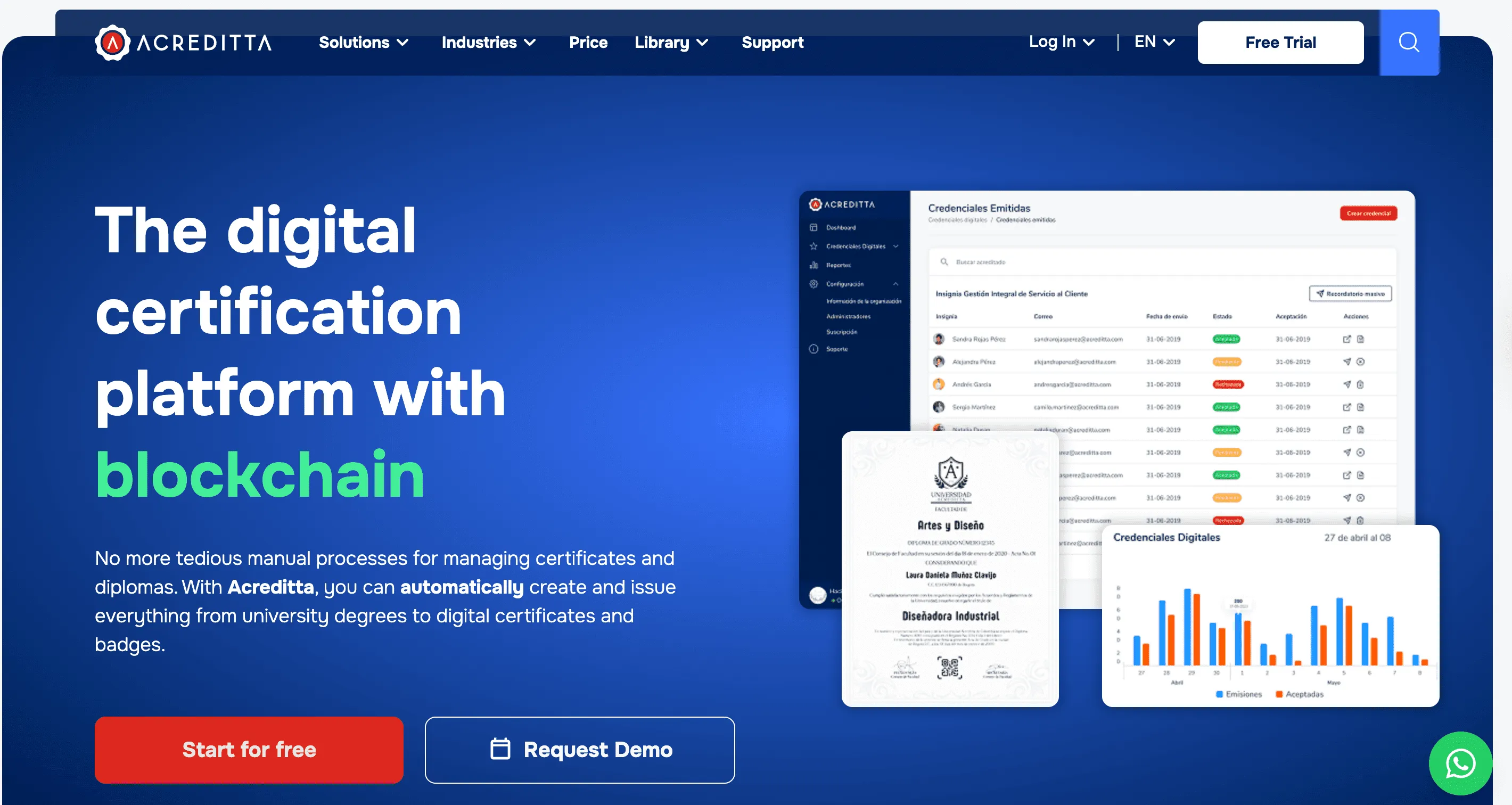
Acreditta is a blockchain platform from Colombia, built for Latin American institutions and trusted by Banco de Bogotá, ICONTEC, and the Universidad Nacional de Colombia. It runs on LACNet and supports legally backed digital signatures in the region.
Key features
- Badges, certificates, diplomas, and microcredentials
- Blockchain verification on LACNet, Open Badge 3.0 and W3C aligned
- Digital signature for legally backed authentication (Enterprise)
- Microcredential pathways and a digital skills wallet
- Spanish and Portuguese as primary languages, certification consultancy
Pricing: Free Starter for up to 249 credentials. Enterprise custom pricing for 500+ credentials. No self-serve mid-tier.
| Pros | Cons |
|---|---|
| LACNet blockchain and legally backed regional digital signatures | Analytics, API, LMS, and white-label are all gated behind Enterprise |
| Spanish and Portuguese as primary languages, plus consultancy | No self-serve middle tier between free and Enterprise |
| Free Starter plan for up to 249 credentials | Limited global brand presence and template depth |
Certificate Management Software Compared
| Tool | Free plan | Entry paid price | Standout strength | Best for |
|---|---|---|---|---|
| Wauld | 300/year | $39/month | Certificates + badges, AI design, no contract | Overall pick for most teams |
| Certemy | No | ~$5,000/year | License tracking + primary source verification | Compliance boards |
| Cobalt | No | ~$75-200/user/mo | Dynamics 365 certification engine | Large certification bodies |
| MyComply | Demo only | $499/year | Site-access certification tracking | Construction compliance |
| Certifier | 250/year | $67/month | Full lifecycle + post-issuance editing | Lifecycle control |
| Sertifier | 250/year | $250/year | 100+ integrations, recipient wallet | Multi-program L&D |
| Accredible | Trial only | ~$45/month | Spotlight directory, deep LMS | Universities, enterprise |
| Credly | No | ~$1,000/yr + setup | Large badge network | Employer discovery |
| Hyperstack | 20/year | $24.51/month | Hedera blockchain, SOC 2 | Affordable blockchain |
| CertifyMe | Trial only | ~$500+/year | Anti-forge identity tagging | Fraud-sensitive issuers |
| Certopus | 100/month | $29.99/month | Broad automation, low cost | Budget automation |
| Virtualbadge.io | Trial | ~$420/yr (tiered) | Social sharing, EU data | Brand amplification |
| SimpleCert | Yes (monthly cap) | Volume-based | Automated certificate workflows | Certificate-only teams |
| POK | Unlimited | $0.80/credential (NFT) | Unlimited free, NFT permanence | Free-first institutions |
| Acreditta | 249 credentials | Custom | LACNet, regional signatures | LATAM institutions |
How to Choose
The right pick depends on your size, budget, and whether you issue or track credentials. Here is a simple way to map tools to situations.
- Solo coach or course creator: Start with Wauld's free plan (300 credentials a year with analytics and automation). If you only need certificates and simple automation, Certopus or SimpleCert are cheap alternatives.
- Small training business: Wauld scales cleanly from free to a $39/month Growth plan with no contract. Certifier is a close second if post-issuance editing and AI design are priorities.
- School or university: Wauld covers most needs at a transparent price; Accredible suits large institutions with deep LMS infrastructure and predictable volume; Sertifier fits multi-program teams that need many integrations and FERPA alignment.
- Large L&D team or enterprise: Wauld for flexible pricing and both credential types, Credly if employer discovery through a badge network is the goal, Accredible for pathways and wallet cards.
- Regulated or blockchain-first: POK for unlimited free blockchain issuance, Hyperstack for auditable SOC 2 verification, Acreditta for Latin American institutions.
- Tracking workforce licenses, not issuing them: Certemy or Cobalt for certification boards and compliance teams, MyComply for construction site safety.
Conclusion
The market for Certificate Management Software is wide, and the right pick depends on your size, budget, and whether you issue or track credentials rather than a single "best" label. Compliance trackers, blockchain platforms, and regional tools each earn their place for specific audiences.
For most teams that issue certificates and badges, Wauld is the strongest starting point. It handles both credential types, includes AI design, analytics, and automation, and gives you a free plan for 300 credentials a year with no annual contract and no sales call. You can pilot a full program before paying a cent, then move to the Growth plan from $39/month when you are ready. If you would rather start with simpler, design-led tools first, our roundup of free certificate maker apps is a good next read.