Fake Diploma Risks and What to Use Instead

Revisiting The Past
A couple of years ago, I was a final-year student at a well-known college. Like everyone around me, I had one thing on my mind: getting a job. A good job offer felt like the reward for years of hard work.
Then something happened that stuck with me. I realized just how easy it was to fake a certificate. Add a course you never took. Sprinkle in an internship that only ever existed in your imagination. Print it out, and poof, your resume looks amazing. The recruiters had no fast way to check, so all those shiny extra credentials got counted at face value. Every so often, the person with the "creative" resume got the offer, while the classmate who did the work watched.
It bothered me, and honestly, it felt unfair simply because it was. Nobody questioned the certificates. The companies never found out. For the longest time, I figured this was just how things worked. Certificates could be faked, checking them was slow or impossible, and the honest folks quietly lost out.
Then I joined Wauld, a coincidence I'd say. I learned something that flipped my thinking. It does not have to be this way. The faking only works because the certificate cannot prove it is real. Fix that one little thing, and the whole trick falls apart.
That is what this post is about. You may be a school, an HR team, or an L&D group that issues certificates and badges. I want to explain why fake document generators are risky and what to use instead.
Why This Matters
A diploma or a course certificate is meant to be proof. Proof that someone showed up, did the work, and earned the result. That is the whole point. The trouble is that a "fake diploma" is now one search away. Type those two words into Google and you will find fake diploma maker tools, template sites, and full services that promise a real-looking degree, transcript, or certificate in minutes. Some even copy real school seals. So for certificate issuers, this is not a design problem. It is a trust problem, and it is worth taking seriously.
What Fake Document Generators Actually Are
A fake document generator is any tool or service that creates official-looking documents that were never really issued by a real organization. In credentialing, that usually means a fake diploma, a fake degree, a fake certificate, or a fake academic transcript. They come in a few flavors:
- Template Forgery. Cheap tools let anyone drop a name, a course title, and a date onto a professional-looking template, then export a clean PDF.
- Diploma Mills. Businesses that sell degrees and transcripts that look real, sometimes with fake accreditation. One operation named Axact reportedly sold more than 8 million fake documents across 190+ countries.
- Edited Originals. Someone takes a genuine certificate, opens it in an editor, and swaps the name, grade, or date.
The common thread is simple. Ordinary certificates were never built to prove themselves, and that gap is exactly what forgers count on.
Why Fake Diplomas Are a Bigger Problem Than Most Issuers Realize
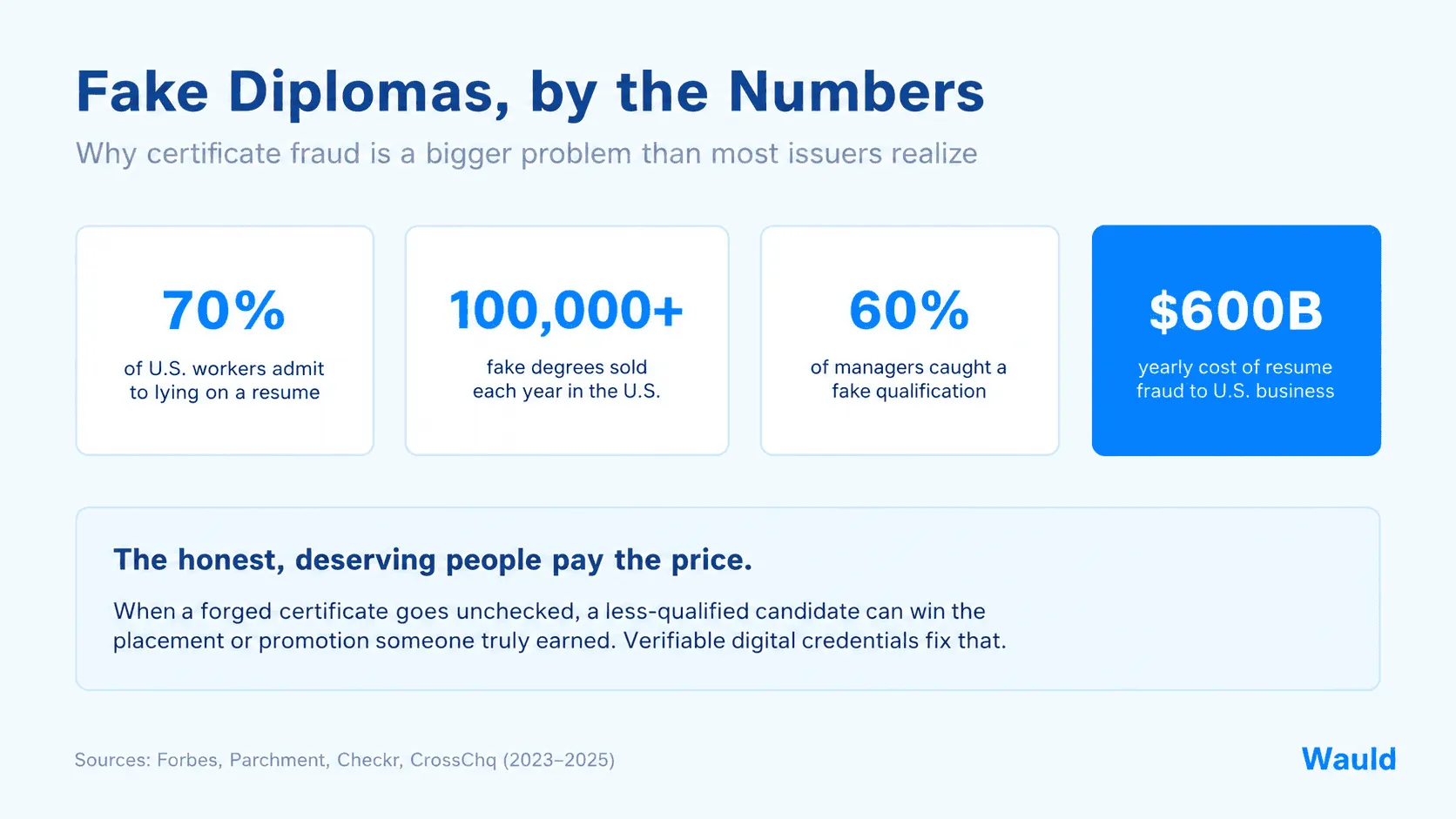
It is tempting to treat certificate fraud as a few bad apples. The numbers say otherwise. Roughly 70% of U.S. workers admit to lying on a resume at least once, and about one in three stretch the truth about their education.
One survey of 3,000 managers found that 60% had caught a candidate lying about their qualifications, and another 13% suspected it but could not confirm it.
The cost is not just embarrassment. When a fake certificate carries your institution's or your company's name, it is your brand that gets pulled into the fraud.
The Real Risks for Certificate Issuers
If you issue certificates, badges, or diplomas, a fake document generator threatens you on a few fronts at once:
- Your Brand Gets Copied. A forger can lift your logo, seal, and layout to make a fake diploma that looks just like yours, and every copy chips away at what your name stands for.
- You Cannot Easily Prove What Is Real. If an employer calls to confirm a certificate, can your team answer in minutes? For many issuers, that check is slow and easy to work around.
- Deserving People Lose Out. This is the part I saw firsthand. When forged credentials go unchecked, the honest, qualified candidate can be passed over.
- Compliance Risk Rises. In regulated fields like healthcare, finance, and safety, a fake degree that slips through can be dangerous and legally serious.
Why HR and L&D Teams Feel This Most
HR and L&D departments sit right where forged credentials do the most harm. HR leans on certificates and transcripts to make hiring and promotion calls. L&D teams issue their own completion certificates, and they need those to mean something, both inside the organization and on a graduate's LinkedIn profile or resume. The trouble is that an ordinary certificate is hard to trust at a glance. A real one, a lightly edited one, and a fake diploma maker output can all look identical in an inbox, and busy teams rarely have time to chase each one down. That is the gap forgers count on.
What to Use Instead: Verifiable Digital Credentials
The fix is to change what a certificate can do. A verifiable digital credential is a certificate or badge that carries its own proof. Built on open standards like Open Badges 3.0 and W3C Verifiable Credentials, each one holds secure, tamper-evident data about who issued it, who earned it, and when. If a single detail is changed, verification fails. In plain English, it answers three questions instantly:
- Who Issued This? The real organization, confirmed, not a copied logo.
- Who Earned It? The named person, tied to the record.
- Has It Been Changed? If yes, it will not verify.
A recipient shares the credential with a unique link or a QR code. An employer clicks it and sees a live, official confirmation in seconds, no phone calls, no guesswork. That is the difference between a certificate you hope is real and one you can prove is real, and it is exactly the upgrade Wauld is built around.
Wauld: Issue Credentials People Can Trust
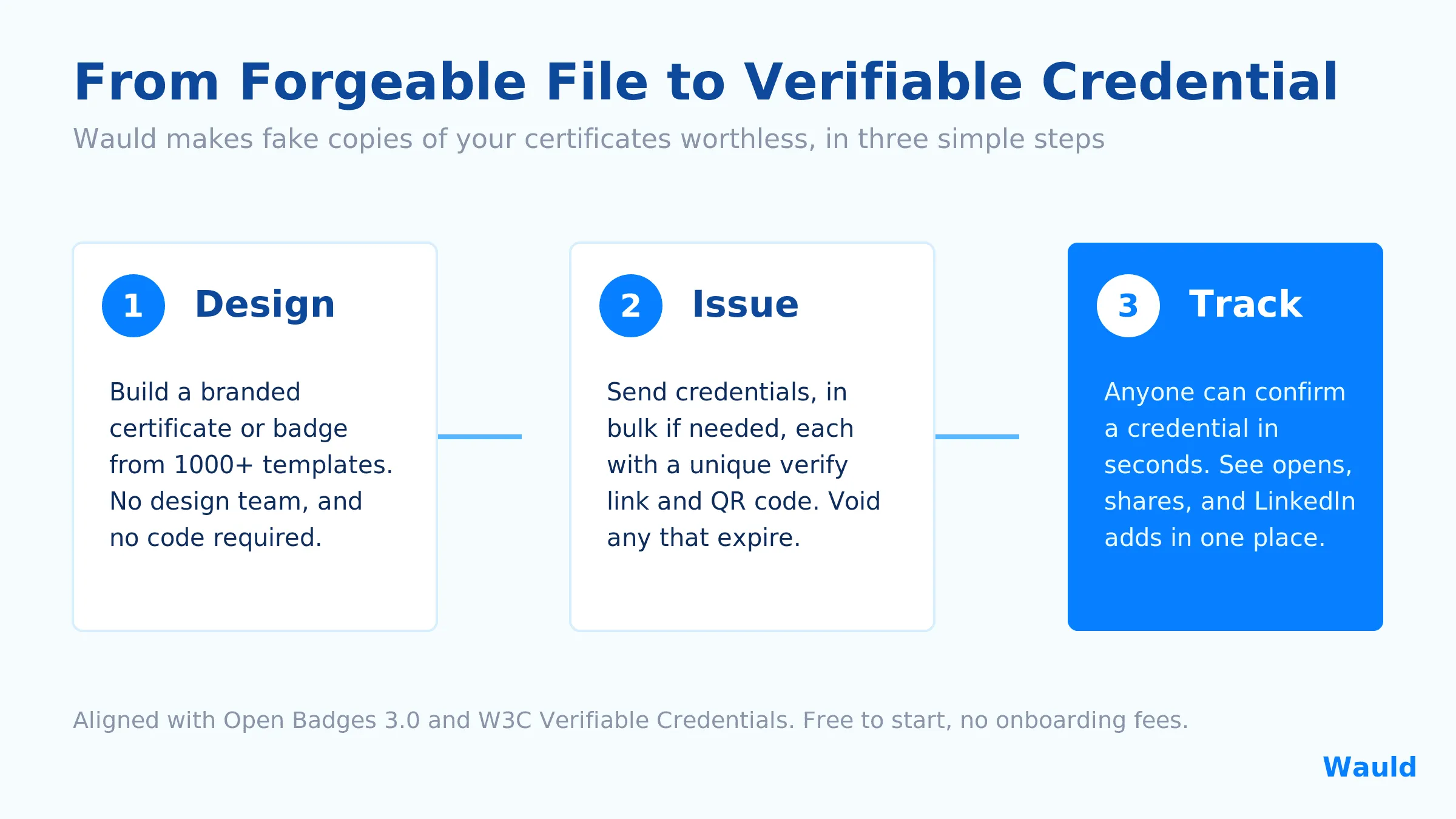
Wauld is a digital credentialing platform that lets organizations design, issue, manage, and verify digital certificates and badges, all in one place. The lifecycle is three simple steps: design, issue, and track.
- Branded, Professional Design. Use an intuitive generator and over 1,000 customizable templates to create certificates, badges, QR codes, and emails that match your brand.
- Built-In Verification. Every credential is verifiable through a unique link, and recipients can add it to their LinkedIn profile, resume, or email signature.
- Aligned With Open Standards. Credentials follow Open Badges 3.0 and W3C Verifiable Credentials, so your badges are interoperable and verifiable across platforms.
- One Dashboard for Everything. Issue, edit, and void credentials from a single secure dashboard.
- Issue at Scale. Send credentials in bulk, including from form responses, so a whole cohort is covered in one run.
- See Real Engagement. Track who opens, shares, and adds your credentials to LinkedIn.
For an educational institute, that means the diplomas carrying your name can be checked by any employer, instantly. For HR, the certificates you receive can be trusted at a glance. For L&D, the badges you award actually hold their value.
Conclusion
Fake document generators are risky because they attack the one thing certificates are meant to give you: trust. A fake diploma, a fake degree, or a forged transcript can look perfect, and when there is no fast way to check, the honest, deserving people lose out. I saw that back in my student days, and for a long time I thought that was just how it worked.
It is not. When a certificate can prove itself, faking it stops paying off. Verifiable digital credentials, built on open standards and issued through a platform like Wauld, turn your certificates into records anyone can confirm in seconds. As more organizations make the upgrade, it is also how you keep your credentials as trusted and current as everyone else's.