Medical Interpreter Training: What It Is & Why It Matters

The Healthcare Gap That's Hiding in Plain Sight
Medical interpreter training is the single most effective tool we have for closing one of healthcare's most dangerous gaps, and yet it still does not get the attention it deserves.
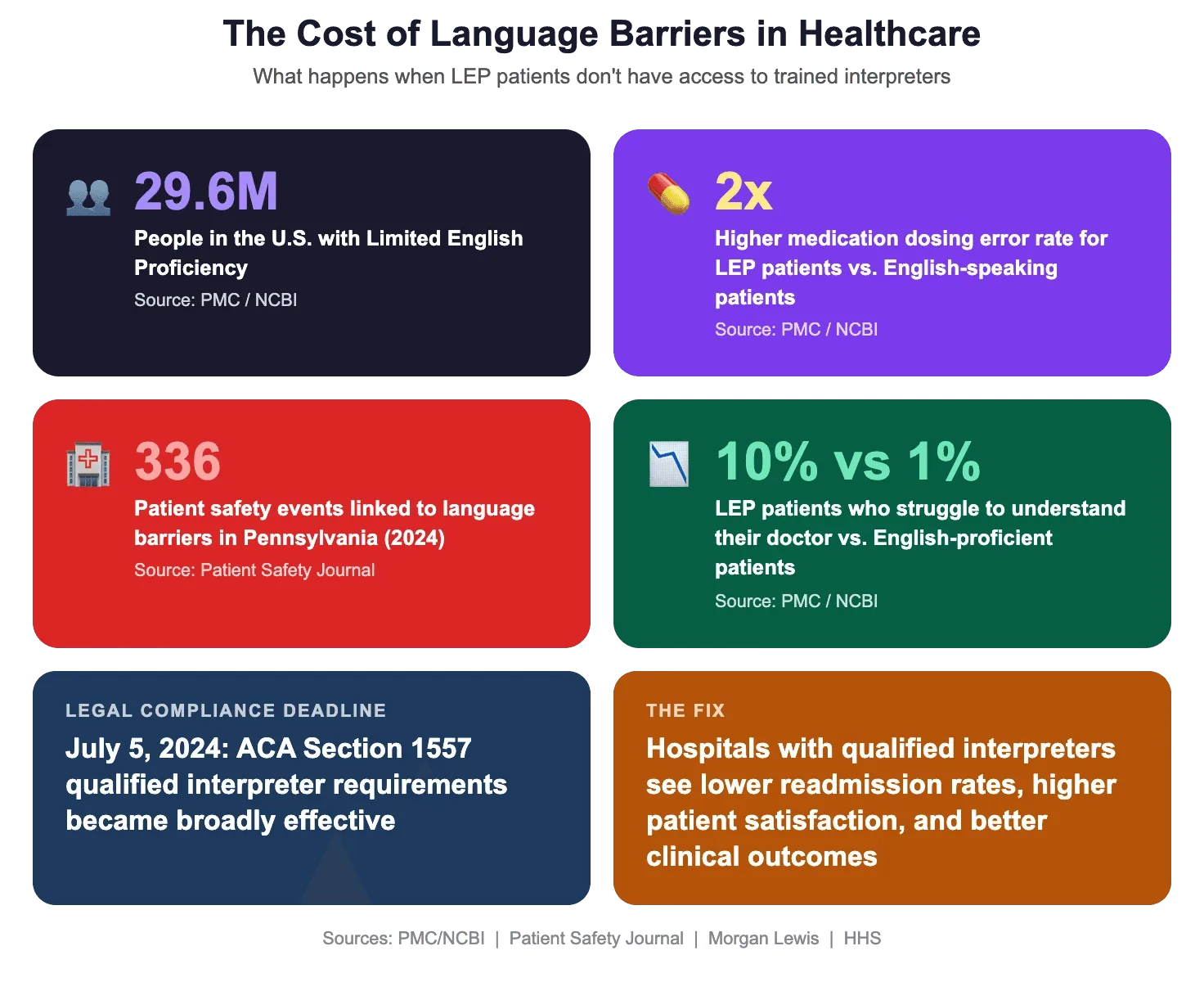
29.6 million people in the United States live with limited English proficiency (LEP). When they walk into a hospital or clinic without a trained interpreter, the risk of harm is real and well-documented. A 2025 study published in Patient Safety journal, which reviewed 336 safety events from 2024 in Pennsylvania, found that language barriers were directly linked to preventable adverse outcomes, including:
- Wrong diagnoses
- Medication errors
- Delayed or missed treatment
The good news is that this problem has a clear solution. Trained, certified medical interpreters save lives. And as a credential issuer in this space, the programs you run and the certificates you issue are a core part of that solution.
This blog walks through what medical interpreter training actually involves, why the need for it is growing, what the main program formats look like, and why the certificate at the end matters as much as the training itself.
Inside Medical Interpreter Training: It Goes Well Beyond Bilingualism
Most people assume that speaking two languages qualifies someone to interpret in a medical setting. It does not. Not legally, not practically, and not ethically.
Medical interpreter training is a structured program that builds a distinct set of professional skills. A trained interpreter learns to navigate clinical conversations with accuracy, neutrality, and cultural intelligence. The curriculum typically covers:
- Medical Terminology and Anatomy: Interpreters must know the correct vocabulary in both languages across a wide range of specialties, from cardiology and oncology to obstetrics and psychiatry. A term that sounds familiar in everyday speech can mean something very specific in a clinical context.
- Core Interpreting Techniques: Training covers three primary modes: consecutive interpreting (waiting for the speaker to pause before interpreting), simultaneous interpreting (real-time interpretation), and sight translation (translating written documents on the spot). Each requires practice and precision.
- Professional Ethics and Confidentiality: Both the National Council on Interpreting in Health Care (NCIHC) and the International Medical Interpreters Association (IMIA) have established codes of ethics that govern the profession. Trained interpreters learn to maintain confidentiality, stay impartial, and put patient safety first.
- Cultural Competency: A clinical encounter is shaped by cultural beliefs about illness, pain, authority, and the body. Trained interpreters know how to identify cultural nuances and help providers understand the full context of what a patient is communicating.
- Patient Rights and Legal Standards: Interpreters learn what Section 1557 of the Affordable Care Act requires, how to protect patients' rights to qualified language access, and what the professional and legal boundaries of their role are.
Most programs require a minimum of 40 hours of formal training to qualify for national certification exams. Oregon requires 60 hours, and some college-based programs run as long as 400 to 532 hours for deep academic preparation
Why Trained Interpreters Are Now a Legal and Clinical Necessity
The demand for qualified medical interpreters is not just about compassion. It is about compliance, safety, and outcomes. Here is why the need has become impossible to ignore.
The Patient Safety Argument
The data on what happens without trained interpreters is hard to read:
- Patients with LEP make medication dosing errors twice as often as English-speaking patients.
- 10% of LEP patients report difficulty understanding their doctor, compared to less than 1% of English-speaking patients.
- LEP patients experience higher rates of preventable readmissions, missed diagnoses, and adverse events.
- A 2025 study in the Patient Safety journal identified 336 safety events from 2024 in Pennsylvania directly linked to language barriers.
On the other side, hospitals that provide qualified interpreters see measurable improvements. When LEP patients have access to trained interpreters, their readmission rates drop, their satisfaction scores rise, and providers can make better clinical decisions.
The Legal Argument
Under Section 1557 of the Affordable Care Act, any healthcare provider receiving federal funding (including Medicare and Medicaid participation) must provide qualified language services to LEP patients, free of charge. This rule became broadly effective on July 5, 2024.
What counts as a "qualified interpreter" under the law? The U.S. Department of Health and Human Services is clear. A qualified interpreter must:
- Demonstrate language proficiency in both English and the target language
- Follow professional ethics standards, including confidentiality and impartiality
- Interpret accurately, effectively, and impartially using specialized medical vocabulary
Being bilingual alone does not meet the legal standard. Organizations with 15 or more employees are also required to:
- Designate a Section 1557 coordinator on staff
- Have written language access policies on file
- Train employees on these procedures
Using untrained staff, or asking patients to bring family members to interpret (except in very narrow emergency circumstances), is prohibited.
The Workforce Argument
The interpreter workforce is growing, but not fast enough. According to the U.S. Bureau of Labor Statistics:
- About 6,900 openings for interpreters and translators are projected each year
- Healthcare remains one of the largest employers of professional interpreters
- Demand for bilingual professionals in clinical settings continues to outpace supply
The Main Types of Medical Interpreter Training Programs
One of the most important shifts in this field is the increased accessibility of training. Programs now exist in multiple formats to meet the needs of different learners, institutions, and communities.
Traditional Classroom Training
In-person programs remain one of the most effective formats, particularly for learners who benefit from real-time feedback and structured role-play. The Bridge the Gap (BTG) curriculum, the first recognized 40-hour professional medical interpreter training program in the United States, has trained thousands of interpreters and remains a gold standard in the field.
Key features:
- Live instructor feedback during role-play and practice scenarios
- In-person peer learning and interaction
- Immediate correction on tone, pacing, and non-verbal technique
- Best suited for learners who thrive in structured, face-to-face environments
Online, Self-Paced Courses
Online self-paced medical interpreter training delivers the same 40-hour core curriculum through video modules, quizzes, and interactive exercises, accessible from any computer or tablet.
Key features:
- Study on your own schedule, from anywhere
- Most affordable entry point for new interpreters
- Accessible to learners in rural or underserved areas
- Popular with working healthcare professionals seeking certification
Live-Remote and Hybrid Programs
Live-remote training programs combine the structure of a classroom with the convenience of online delivery. These courses typically run over six to eight weeks and include instructor-led sessions via video conferencing.
Key features:
- Real-time instructor feedback without the need to commute
- Often extend to 60 hours, exceeding the national minimum
- Designed specifically to prepare learners for CMI and CHI exams
- Strong accountability structure through live sessions
College and Continuing Education Certificate Programs
Community colleges and universities across the country offer formal healthcare interpreter certificate programs. Borough of Manhattan Community College (BMCC) and LaGuardia Community College are well-known examples. Some institutions offer programs spanning 400 to 532 hours for learners who want an academic foundation alongside their professional credential.
Key features:
- Deep academic coverage of the medical interpreting field
- Strong pipeline for healthcare institutions building in-house interpreter teams
- May qualify for academic credit
- Ideal for career changers entering healthcare interpreting
Why the Certificate Carries Real Weight in This Field
Training earns the skills. The certificate proves them. In medical interpreting, that distinction matters enormously.
It Is the Gateway to National Certification
The two national credentials in medical interpreting are:
- CMI (Certified Medical Interpreter): Awarded by the National Board of Certification for Medical Interpreters (NBCMI), the CMI is one of the most recognized credentials in the field.
- CHI (Certified Healthcare Interpreter): Awarded by the Certification Commission for Healthcare Interpreters (CCHI). CCHI's CoreCHI™, CoreCHI-P™, and CHI™-Spanish certifications are the only interpreter certifications in the United States currently accredited by the National Commission for Certifying Agencies (NCCA). Note: CHI™ in Arabic and Mandarin are available but not yet NCCA-accredited.
Both certifications require proof of completing at least 40 hours of formal interpreter training before a candidate can sit for the exam. That means the training certificate your program issues is not a finishing touch. It is the document that unlocks access to professional credentialing.
It Gives Healthcare Employers What They Need for Compliance
Under ACA Section 1557, healthcare organizations must be able to demonstrate that their interpreters are "qualified" under federal standards. A verifiable training certificate gives the following people the documentation they need:
- HR teams review interpreter qualifications before hiring
- Compliance officers preparing for regulatory audits
- Credentialing departments verifying staff qualifications
Without a verifiable certificate, a bilingual employee cannot be classified as a qualified interpreter, and the organization is exposed to legal risk.
It Signals Professional Commitment
A certificate tells the patient, the provider, and the employer that this person took their role seriously. It shows they:
- Completed a formal, recognized training program
- Were held to the ethical standards set by NCIHC
- Understand the scope and limits of their professional role
- Are prepared to interpret with accuracy, impartiality, and cultural sensitivity
In a field where the margin for error is narrow, that professional commitment matters enormously.
It Opens Doors for Career Growth
For interpreters themselves, the certificate is often the first step in a career that can grow significantly. According to the U.S. Bureau of Labor Statistics:
- Interpreters and translators earned a median annual wage of $59,440 in May 2024
- The top 10% earned more than $99,830
- Certification opens access to hospital positions, contract roles, telephonic and video remote interpreting, and specialization in areas like mental health or legal medicine
How Wauld Helps Credential Issuers Do This Right
If you run a medical interpreter training program, you already handle the demanding work: designing the curriculum, holding learners to professional standards, and preparing people for a career that directly affects patient safety.
But many programs still issue certificates through manual processes. A PDF downloaded from a template, a printed document mailed to graduates, or a generic certificate that cannot be verified by a third party. In a field where compliance documentation and credentialing are critical, that approach creates real gaps.
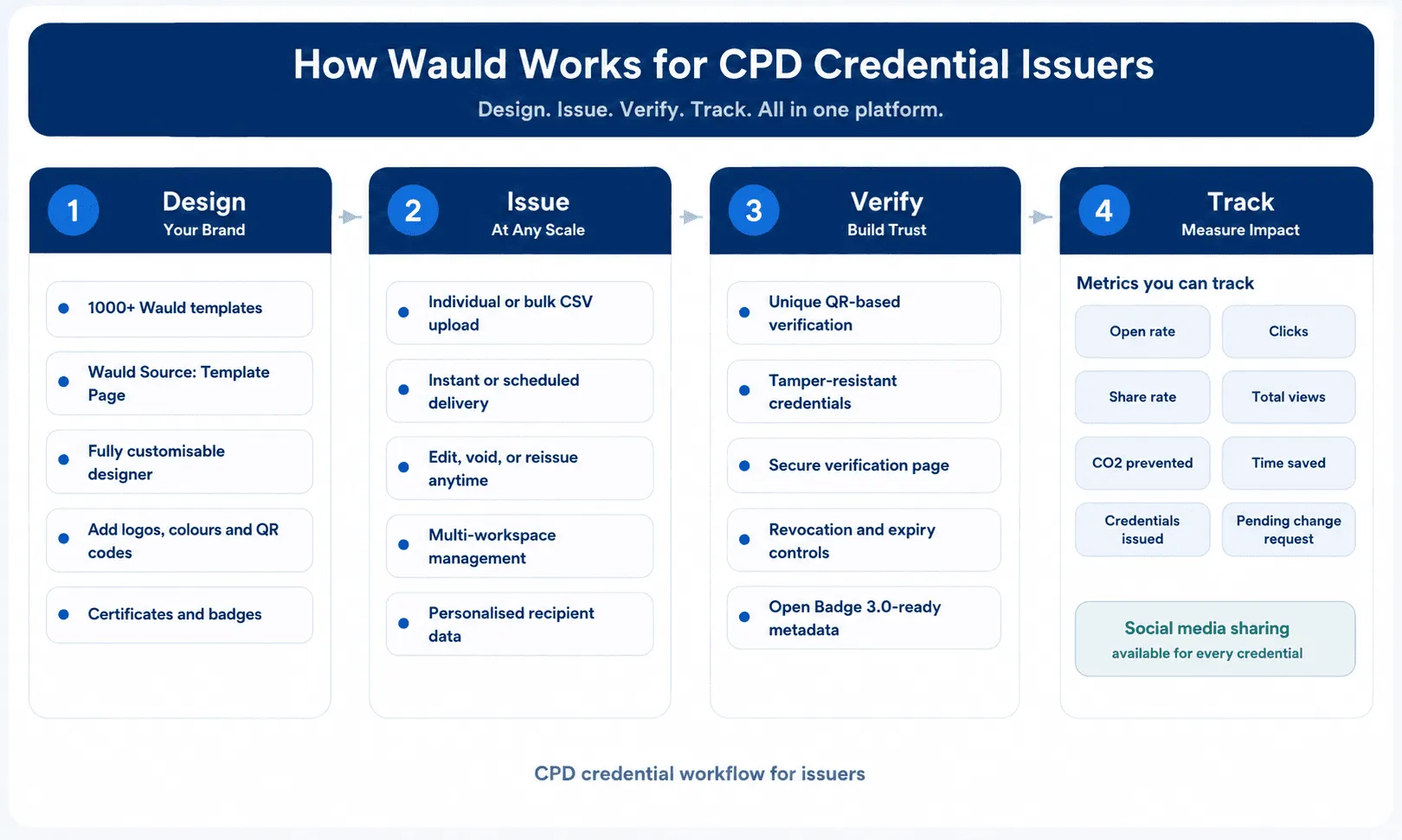
Wauld is a credential issuing platform that helps training programs and professional organizations issue, manage, and verify digital certificates with the professionalism the medical interpreting field demands.
Here is what Wauld offers credential issuers:
- Issue digital certificates instantly after program completion: The moment a learner finishes your program, you can issue a secure, branded digital certificate through Wauld. No delays, no printing, no manual tracking.
- Make every credential verifiable in seconds: Each certificate issued through Wauld includes a unique verification link. Certification bodies like NBCMI and CCHI, healthcare employers, and compliance teams can confirm a certificate's validity instantly. That is exactly what they need when reviewing a candidate for a national certification exam or a hospital position.
- Build your program's reputation as a trusted issuer: When your certificates look professional, carry your organization's branding, and can be verified online, they reflect the quality of the training behind them. That makes your program more credible to learners, partners, and healthcare employers.
- Help your learners share credentials where it counts: Interpreters can add their Wauld certificates to LinkedIn profiles, include them in job applications, and present them to employers digitally. The more visible and portable your credential, the more value it creates.
- Scale without losing track: Whether you issue 100 certificates a year or 10,000, Wauld keeps every credential organized, searchable, and auditable. You always know exactly what has been issued, to whom, and when.
For credential issuers in the medical interpreting space, where third-party verification is a real requirement, Wauld gives you the infrastructure to issue credentials in a way that matches the professionalism of the field itself.
Closing Thoughts
When a patient cannot communicate with their doctor, the person in the middle is doing something extraordinary. They are not just translating words. They are making sure that the person is heard, understood, and cared for correctly.
That is what medical interpreter training prepares people to do. And the certificate at the end of that training is not an administrative detail. It is the proof that someone took that responsibility seriously, met a professional standard, and is ready for the work.
As a credential issuer, the programs you offer and the certificates you issue are part of a larger system that:
- Protects patients from preventable harm
- Supports healthcare workers with the tools they need
- Upholds the legal standards that make equitable care possible
If you want to issue those credentials in a way that reflects their real value, Wauld is ready to help.