How Verifiable Digital Diplomas Stop Fake Certificates

Why Voice This Issue
A fake certificate is any certificate or diploma that claims an achievement the holder never earned. And it is more common than most people would guess. Back in college, I noticed a few placement offers went to people whose credentials did not quite add up: a certificate for a course that was never finished, a transcript with grades that did not match the classroom. No recruiter called the school to check. Nobody questioned a nice-looking page with the right logo.
That is really the heart of this topic:
- A fake certificate is not the whole problem.
- The real problem is that paper credentials are hard to verify quickly, so most never get verified at all.
The good news is that this has changed. A verifiable digital diploma proves itself, so an employer can confirm it in one click. If you issue credentials or hire based on them, that difference is the difference between hoping and knowing. Here is how the two compare, and what you can do about it.
What Exactly Is A Fake Certificate?
A fake certificate usually falls into one of a few buckets:
- A forged copy of a real credential. Someone takes a genuine design, then edits the name, dates, or grades. This is the classic Photoshop-and-print job, and it is easier than most people assume.
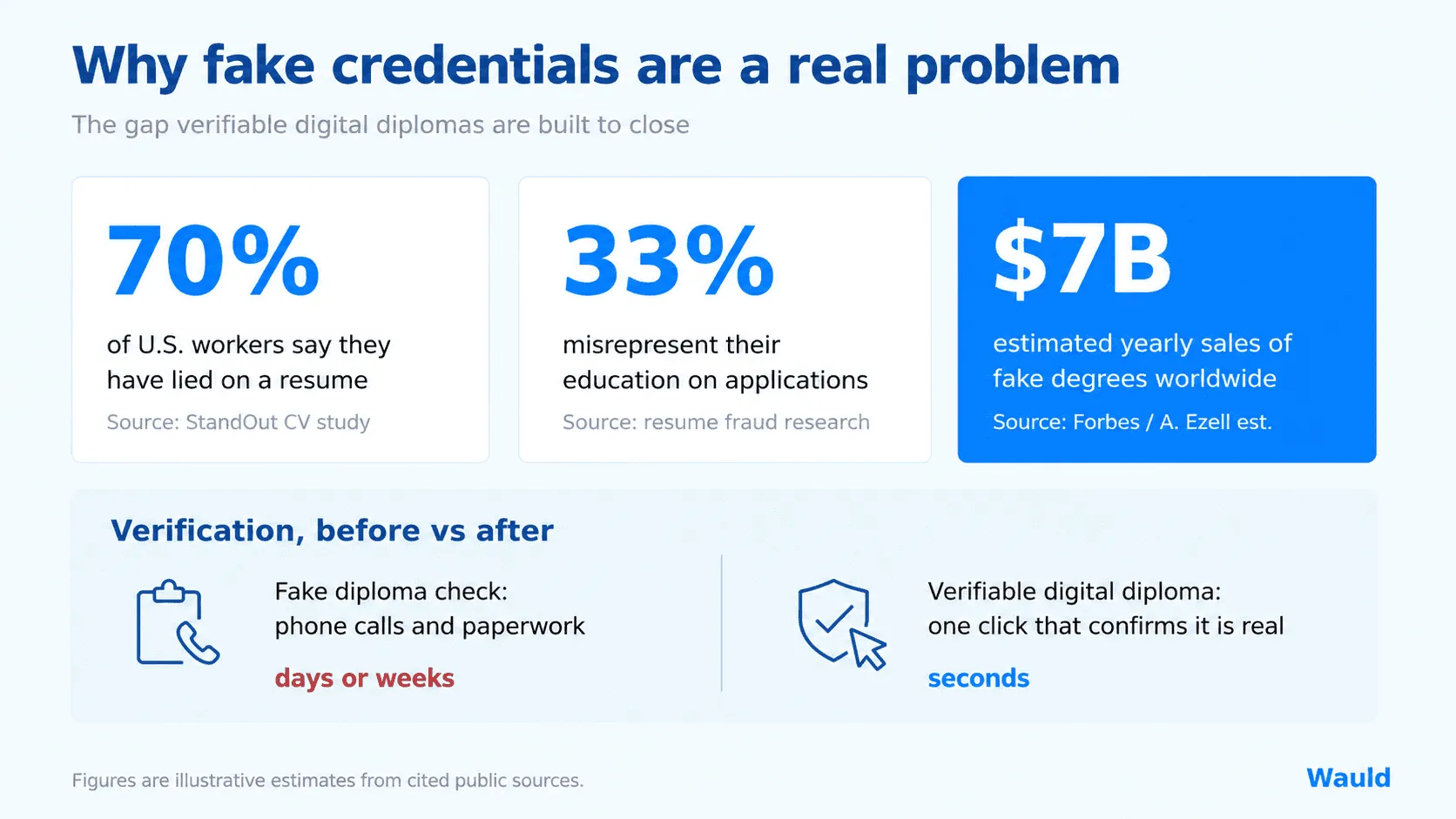
- A "diploma mill" purchase. These businesses sell official-looking degrees and certificates for a fee, with little or no study involved. The scale is not small. A retired FBI investigator has estimated that phony degree sales now run around $7 billion a year worldwide. One company alone, Axact, reportedly sold more than 8 million fake diplomas across 190 countries.
- An inflated or invented claim. No document at all, just a line on a resume for a credential that was never earned.
And this is common enough to matter:
- Around 70% of U.S. workers have lied on a resume at some point.
- About a third specifically misrepresent their education.
It is not always a hardened con artist. Sometimes it is an ordinary applicant who knows the paper will probably never be checked. That last part is the real issue. Traditional paper credentials are almost impossible to verify quickly, so most of them never get verified at all.
What Is A Verifiable Digital Diploma?
A verifiable digital diploma is a credential issued digitally that carries proof of who issued it and proof that it has not been changed. Think of it as a certificate with a built-in lie detector.
Here is how it works, in plain terms:
- The issuer signs it. When a school or organization issues the credential, it signs it with a private cryptographic key. That signature is baked into the credential.
- Anyone can check it. The signature confirms two things: the credential really came from that issuer, and not one character has been altered since.
- Tampering breaks it. If a fraudster changes the name or bumps up a grade, the signature no longer matches and the credential fails verification on the spot. This is what "tamper-proof" means.
- It is instant. No phone call to a registrar, no waiting. As one explainer puts it, the signature is the verification method, so a verifier does not even need to contact the issuer's server. You click, and you know.
This is not a fringe idea. In 2017, MIT began issuing digital diplomas that graduates could store on their phones and share with employers, cutting verification from weeks down to seconds.
The standards that make it trustworthy
Two open standards do the heavy lifting here, and they are worth knowing by name:
- W3C Verifiable Credentials. The World Wide Web Consortium's shared data model for digital credentials. It defines how a credential is structured, signed, and checked, so credentials work across different platforms.
- Open Badges 3.0. Published by 1EdTech in 2023, this standard aligns Open Badges with the W3C model, which makes each badge a type of verifiable credential. A credential issued on one conformant platform can be displayed and verified on another.
Open standards are what keep a credential useful for years. Because it is not locked to a single vendor, a recipient can hold it in a digital wallet, add it to a LinkedIn profile, or drop it into a resume, and it stays verifiable everywhere.
Fake Certificate vs. Verifiable Digital Diploma Certificate
If you only remember one section, make it this one. Here is the honest comparison.
| What you're comparing | Fake certificate | Verifiable digital diploma |
|---|---|---|
| How it's made | Printed or copied to look real | Issued and cryptographically signed by the source |
| Can it be edited? | Yes, names and grades swap easily | No, any change breaks the signature |
| How you verify it | Call the school and wait days | Click a link and confirm in seconds |
| Who really controls it | Anyone with a template | The genuine issuer, on open standards |
| Employer trust | Easy to fake, hard to catch | Proof is built into the credential |
| Portability | A file that could be anything | Shareable to LinkedIn, resumes, and wallets, still verifiable |
The pattern is clear:
- A fake certificate asks people to trust the way it looks.
- A verifiable digital diploma lets people check what is true.
For anyone issuing credentials, that shift from "looks right" to "is right" is the whole game.
Why This Matters Most For Issuers, HR, and L&D Teams
If you design and hand out certificates, you are the first line of defense. When your credentials are easy to fake, the people who cheat can out-compete the people who earned it, and you may never find out. Over time, that also chips away at the value of every real credential you issue.
Here is what verifiable digital credentials do for each team:
- Educational institutions: protect your reputation. When an employer can confirm your degree in one click, your graduates stand out and your name is harder to counterfeit.
- HR teams: turn verification from a slow chore into an instant check. No chasing registrars or waiting days on background checks, and far less risk of a bad hire slipping through on a fake college diploma.
- L&D departments: give your training real weight. A course certificate anyone can verify is worth far more than a PDF that could be edited in a browser, and you get data on who shares and uses it.
Verifiable credentials exist so the people who did the work do not lose out to the people who did not.
The good news: fixing this does not require a research lab or a blockchain team. Platforms like Wauld are built exactly for this.
How Wauld Makes Verifiable Credentials Simple
The best part is how ordinary it makes all of this. You do not need to be a cryptographer. You design a credential, you issue it, and it verifies itself.
Wauld is a digital credentialing platform that lets organizations design, issue, manage, and verify digital certificates and badges, end to end, in one place. The lifecycle is three simple steps: Design, Issue, Track.
- Design. Use an intuitive generator and over 1,000 customizable templates to create certificates, badges, QR codes, and emails that match your brand.
- Issue. Send credentials one at a time or in bulk, even straight from form responses, so a whole graduating class or training cohort can be issued at once.
- Track. See who opens, downloads, and shares their credentials, and watch as they get added to LinkedIn profiles and verified by others.
A few things worth knowing:
- Every credential is verifiable. Each one carries a unique verification link, so recipients can share it to LinkedIn, a resume, or an email signature, and anyone can confirm it is genuine.
- It is built on open standards. Credentials align with Open Badges 3.0 and W3C Verifiable Credentials, so they stay interoperable and verifiable across platforms.
- It is recognized. Wauld was named a SourceForge Top Performer for Digital Credential Management.
- It is free to start. With no onboarding fees, a small college, an association, or a lean HR team can move from forgeable paper to verifiable digital credentials without a big budget or a long project.
Conclusion
The difference between a fake certificate and a verifiable digital diploma comes down to one word: proof. The paper asks you to trust how it looks. A verifiable digital diploma lets anyone confirm, in seconds, that it is real and unchanged.
If you issue credentials, you get to decide which of these your recipients carry. You can keep handing out documents anyone could copy, or you can issue credentials that carry their own proof and make fraud pointless. The tools are here, they are affordable, and they are built on open standards that will outlast any single vendor. The people who earned their credentials should win, and verifiable credentials are how you make sure they do.
Ready to issue credentials that prove themselves? Create your first verifiable digital credential with Wauld.