Cybersecurity Training for Independent Bootcamps

The Credibility Gap Independent Trainers Face
Cybersecurity training certificates have quietly become one of the most important tools an independent bootcamp or instructor can offer, and most solo creators are still underusing them. You have spent months building a course that teaches real skills, your learners finish it feeling more confident, and then they walk away with nothing they can show an employer. That gap is exactly where good trainers lose ground to bigger, better-funded programs.
When a learner finishes a course from a large university bootcamp, they get a polished, verifiable certificate with a recognizable name behind it. When they finish your course, what do they get? If the answer is a plain PDF or a thank-you email, you are leaving real value on the table. The good news is that closing this gap no longer requires a university partnership or a big budget. A well-designed, verifiable certificate does most of the heavy lifting, and this guide walks you through why that matters and how to get it right.
A Booming Market for Trainers
The demand for cybersecurity skills is not a passing trend, and that creates real room for independent bootcamps and instructors:
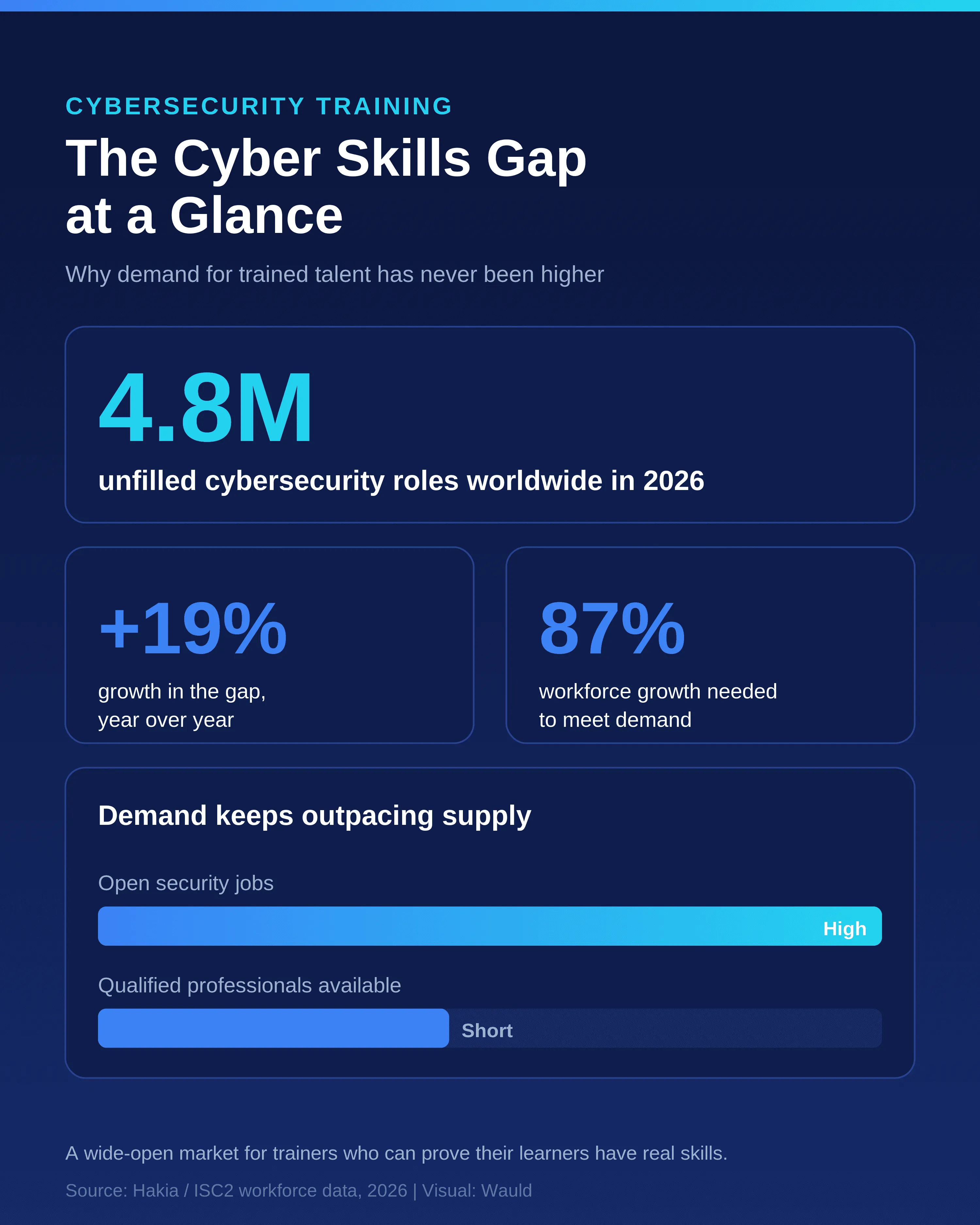
- The global cybersecurity workforce gap reached 4.8 million unfilled roles in 2026, growing roughly 19 percent year over year. The workforce would need to grow by close to 87 percent to meet current demand.
- Learners are actively looking for fast, practical ways to break into security or level up, and they are turning to bootcamps and self-paced courses to do it.
- The skills gap goes deeper than headcount, with most teams reporting capability gaps in areas like cloud, AI, and threat detection. That leaves room for niche courses taught by real practitioners.
- The catch: learners have endless options and are comparing you against household names. What they walk away with, not just what they learn, often tips their decision. A credential they can show off is part of the product, not an afterthought.
Why CPD Matters in Cybersecurity
Cybersecurity is a field where last year's knowledge can be this year's blind spot. New threats, tools, and attack methods show up constantly, so skills have a short shelf life if they are not refreshed. That is exactly why continuing professional development, or CPD, sits at the heart of the industry, and it shapes how learners think about the courses they take.
Most major security credentials are not "earn it once and forget it." Certifications like CISSP, CISM, and CRISC require holders to earn ongoing Continuing Professional Education credits to keep their certification active. CISSP holders, for example, need 120 CPE credits over a three-year cycle. Letting a certification lapse can quietly damage someone's career and credibility, so professionals are always looking for quality learning that counts toward their requirements.
For independent bootcamps and instructors, this is a real opportunity. When your course is designed to support CPD, and you issue a clear, verifiable certificate that shows hours completed and skills covered, you become more than a one-time purchase. You become part of a learner's ongoing professional journey. CPD-friendly courses also tend to attract working professionals, who are often more committed and more willing to pay than absolute beginners. A well-documented credential is what lets them submit your course toward their CPE or CPD records with confidence, which makes your program far more valuable to them.
Why Are Certificates Needed In Cybersecurity Training
In most fields, a certificate is a nice bonus. In cybersecurity, it is closer to a requirement because the entire industry runs on verification and proof. Here is what a strong certificate actually does for your learners and for you.
It proves a skill in a field that demands proof: Security professionals spend their days verifying identities, validating access, and confirming that things are what they claim to be. It would be strange for that same industry to accept "trust me, I took a course" as evidence of skill. A certificate gives your learner something concrete to point to, and a verifiable one gives an employer something they can actually check.
It pushes learners to finish: Course completion is a constant struggle for online education, and a certificate is one of the most reliable motivators there is. When learners know a real, shareable credential is waiting at the finish line, their commitment goes up because their effort is tied to a tangible reward. Higher completion rates also mean better reviews, more word of mouth, and stronger proof that your course works.
It carries weight with employers, but only if it is credible: Employers do pay attention to course certificates, and more than 6 in 10 say the quality of assessment behind a course matters a lot when they evaluate it during hiring. A certificate awarded for genuine completion and assessment is taken seriously. A certificate handed out for simply showing up is not. The format you choose either reinforces or undercuts that credibility.
It protects your reputation from forgery: A plain PDF can be edited in minutes, and even popular course platforms leave real gaps in how their built-in certificates handle verification. If your certificates can be faked, their value drops to zero, and your brand takes the hit. This is why verification matters so much. A credential that can be confirmed through a QR code or a unique verification link keeps the document trustworthy and keeps your name protected.
It markets your course for free: Every time a learner adds your certificate to their LinkedIn profile, resume, or email signature, your brand shows up in front of a new audience of peers, recruiters, and potential students. A credential is one of the few marketing assets your customers are genuinely happy to share, because sharing it makes them look good, too.
What Makes a Cybersecurity Certificate Worth Something
Not all certificates are equal, and learners in this field are sharp enough to know the difference. It helps to understand how a certificate, a degree, and a credential each really count before you decide what to issue. If you want yours to carry real weight, a few things separate a credential people are proud to share from one they quietly delete.
- Verifiability comes first: A modern certificate should be checkable by anyone, anytime, without a phone call to you. Credentials built on open standards like Open Badge 3.0 and W3C Verifiable Credentials carry built-in metadata, including who issued it, who earned it, what skills it represents, and when it was awarded, all secured with cryptographic signatures. That is what turns a pretty image into trustworthy proof.
- Branding makes it yours: A certificate is a brand touchpoint. Your logo, your colors, and clean professional design tell the learner and everyone who sees it that you take your program seriously. Generic, template-stamped certificates with someone else's branding do the opposite.
- Skill mapping adds real meaning: The strongest credentials say more than "completed a course." They spell out what the person can now do. Mapping your certificate or badge to a recognized framework like the NIST NICE Cybersecurity Workforce Framework helps employers instantly understand the skills behind it, which matters a lot in a field with clearly defined roles.
- Shareability turns learners into advocates: If a credential is awkward to post or does not display well on professional platforms, it stays hidden. A certificate built to be shared on LinkedIn and other networks gets seen, and getting seen is how you grow.
Certificates or Badges: What to Issue and When
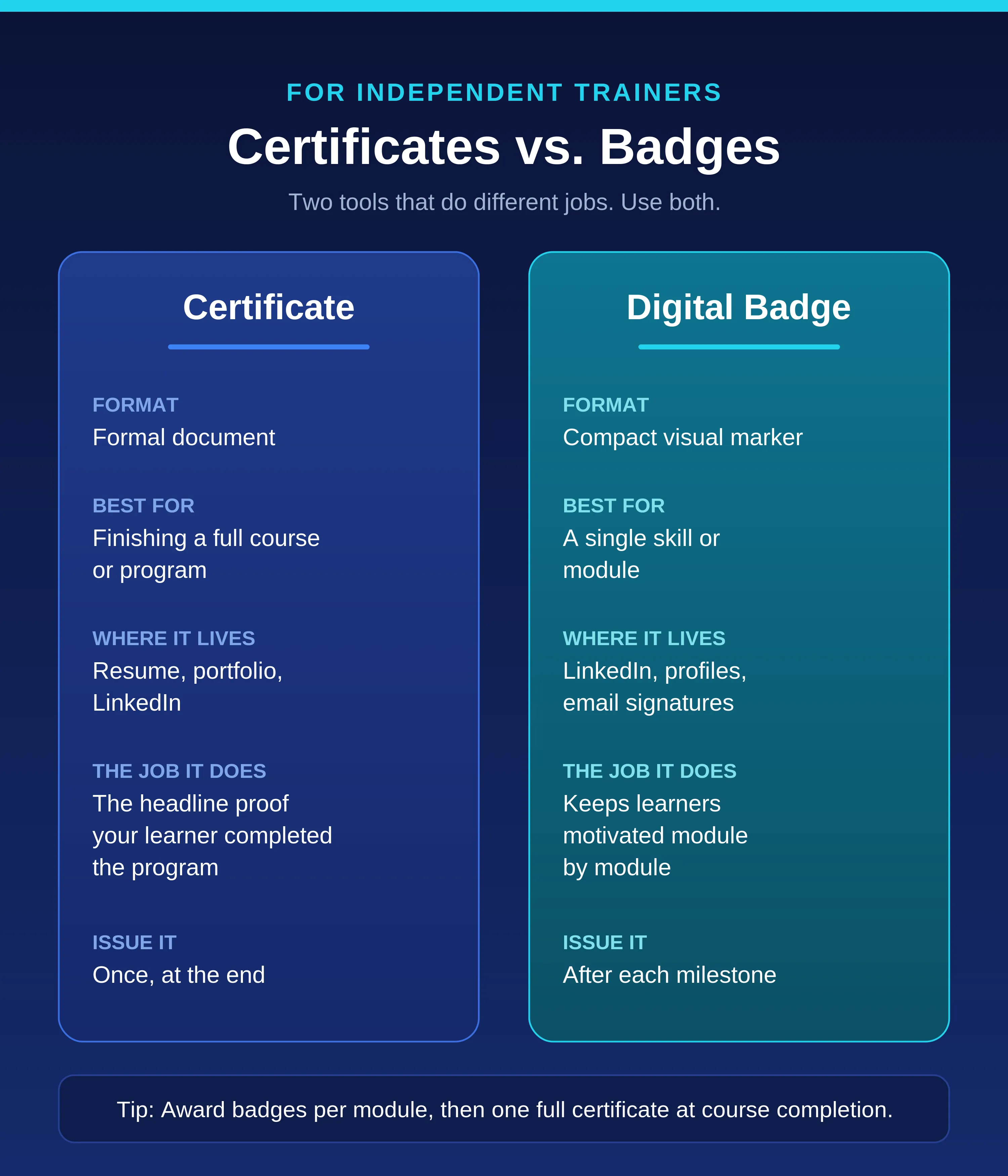
A lot of trainers assume they have to pick one. You do not. Certificates and digital badges do different jobs, and the best programs use both. If you are weighing a simple certificate of completion against a fuller digital credential, the difference mostly comes down to verification and shareability. A digital badge is a compact, verifiable visual marker of a single achievement, perfect for recognizing each module a learner completes and keeping them motivated through a longer course. A certificate is the bigger, more formal document that marks the completion of the whole program.
A practical approach for a multi-week cybersecurity course looks like this: award a badge after each major module, such as network fundamentals, threat detection, or incident response, then issue a full completion certificate at the end. The badges keep learners engaged module by module, and the certificate gives them the headline credential to put on their resume.
How Wauld helps Independent Bootcamps and Instructors
Designing, issuing, verifying, and tracking credentials by hand is the kind of work that eats your week and pulls you away from teaching. Wauld is a digital credentialing platform built to handle all of it in one place, which makes it a strong fit for solo instructors and small bootcamps that do not have an operations team behind them. Here is what that looks like in practice.
- Design certificates that look like your brand: You can start from 1,000+ professional templates, including ready-made course completion certificate designs, or build from scratch, then customize logos, colors, fonts, layout, and data fields so every credential reflects your program. If you are still comparing tools, this roundup of the best certificate maker apps and software is a useful starting point. Wauld also supports white labeling across custom URLs, emails, and credential portals, so the entire experience feels like yours rather than a third party's.
- Issue credentials automatically: Instead of creating certificates one by one, you can automate issuing them the moment a learner completes a course or cohort. That removes the manual busywork and means your learners get their credential right away, while their excitement is highest and they are most likely to share it.
- Make every credential verifiable: Each certificate and badge includes a unique QR code for instant verification, and Wauld supports the Open Badge 3.0 standard. Employers, peers, and institutions can confirm a credential is real in seconds, which protects both your learners and your reputation.
- Turn certificates into new sign-ups: Built-in social sharing makes it simple for learners to post their achievements on LinkedIn, profiles, and email signatures. Every share puts your brand in front of a fresh audience, so your past students become a steady, organic source of new ones.
- See what is working with analytics: Wauld's analytics go beyond a simple issue count and track engagement, shares, referrals, and completions. That data helps you understand which courses drive the most credential activity and where to focus next.
- Trust the security behind it: For a security audience, especially, the platform you choose says something about you. Wauld is built on enterprise-grade protocols and globally recognized standards, including ISO 27001 certification, so the credentials you issue rest on a serious foundation.
The Final Note
The cybersecurity field is wide open for independent bootcamps and instructors who teach real skills, but learners are choosing between you and programs with much bigger names. A verifiable, well-branded certificate is one of the most practical ways to compete, because it proves your course delivers, motivates learners to finish, earns trust with employers, and quietly markets your program every time it gets shared. The teaching is your craft. The credential is how the rest of the world finds out about it.
If you are ready to give your learners something they will be proud to show off, start creating verifiable certificates and badges with Wauld today. Design your first credential in minutes, issue it automatically, and watch your past students help bring in your next ones.