ICF-Aligned Life Coaching Certification for Trainers

Building an ICF-Aligned Life Coaching Certification
A life coaching certification is the moment your learners have worked toward, the proof that they can sit across from someone and truly help. For you as the trainer, it is also a quiet promise. It tells every future student that your program delivers something real, something recognized, and something worth their time and money.
What you will take away from this article
Course creators and trainers hear the same question on repeat: is this ICF-aligned? That single phrase shapes who enrolls and who clicks away. In the sections below, we will look at what ICF alignment actually means, what a life coach really does, why a credible certificate matters so much to your learners, and how you can issue certificates that stand up to scrutiny. No filler, just what you need to build a program people respect.
What ICF Alignment Signals
The International Coaching Federation is the largest professional body for coaches in the world, and its standards have become the quiet benchmark most serious programs measure themselves against. When a program calls itself ICF-aligned, it usually means the curriculum is built around the ICF core competencies, follows the ICF code of ethics, and meets the federation’s training-hour standards. In plain terms, it means a graduate can take what they learned with you and go on to apply for a recognized ICF credential.
One thing worth clearing up early. You may still see older programs advertise themselves with terms like ACTP or ACSTH. The ICF retired those labels and moved to a simpler structure built around three levels. If a program still leans heavily on the old language, that is often a sign that the materials could use a refresh. Knowing the current system keeps your own program credible.
The Three ICF Credential Levels
The ICF now organizes coach training into three levels, and each one points toward a specific credential a coach can earn. Here is the short version, without the jargon.
- Level 1 asks for at least 60 hours of coach-specific training plus 10 hours of mentor coaching. It sets a graduate up to apply for the Associate Certified Coach, or ACC, credential. This is the natural starting point for most new coaches.
- Level 2 asks for at least 125 training hours and 10 hours of mentor coaching. It leads toward the Professional Certified Coach, or PCC, credential, which signals a deeper level of practice.
- Level 3 is the advanced path, with 75 or more advanced learning hours and mentor coaching led by a Master Certified Coach. It points toward the MCC credential, the highest mark of mastery the ICF offers.
As a trainer, knowing exactly where your program sits in this picture helps you set honest expectations. A learner who understands they are working toward an ACC pathway is a learner who trusts you, and that trust is the foundation of every good review and referral you will ever get.
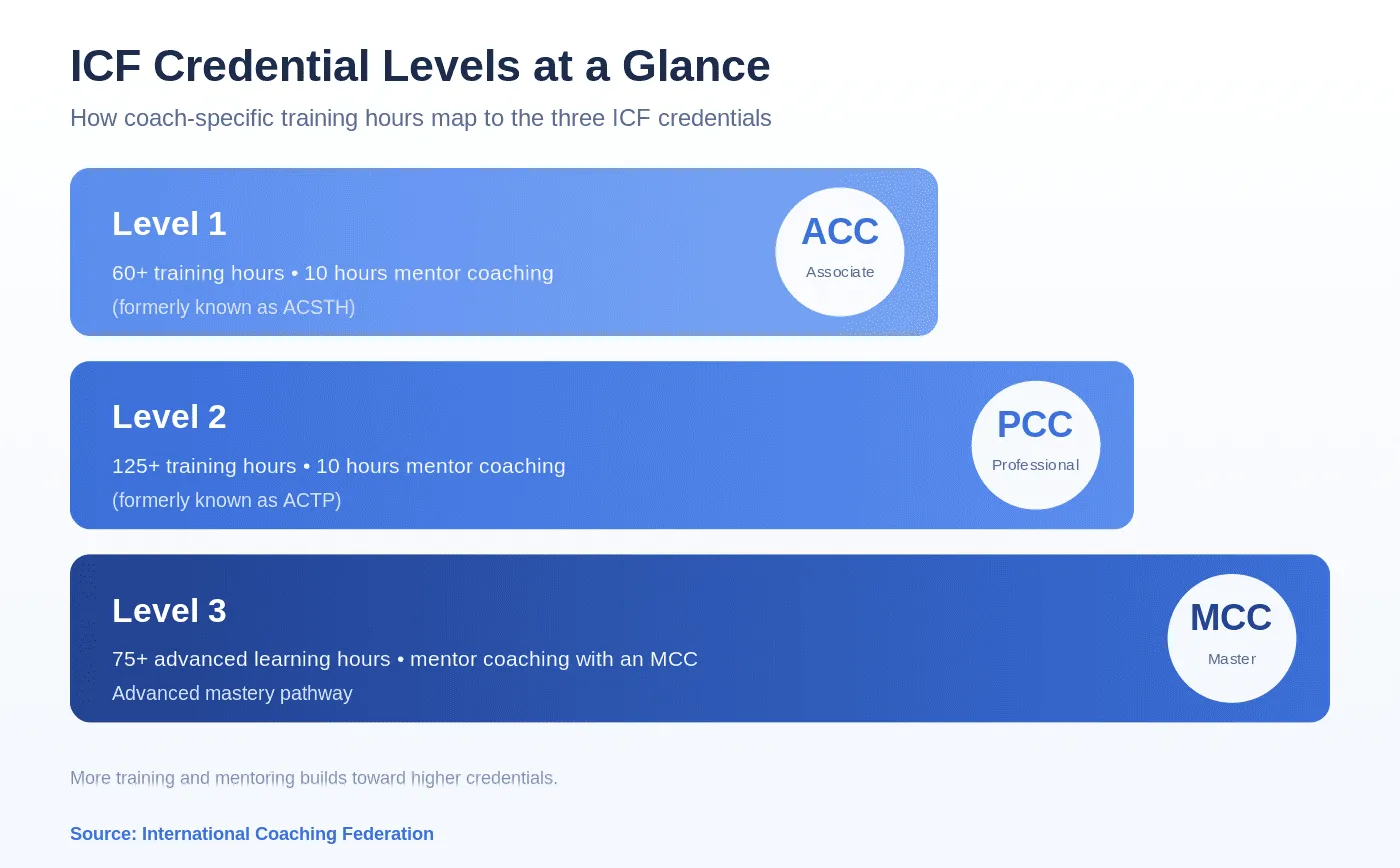
ICF credential levels and the training hours behind each one.
What a Life Coach Does, And Why It Matters
Before we talk more about certificates, it helps to be clear about what your learners are actually training to become. A life coach helps people get clear on what they want and take steady action toward it. Unlike a therapist, who often works on healing the past, a coach focuses on the present and the future: setting goals, building better habits, working through obstacles, and staying accountable along the way. The best coaches do not hand people answers. They ask the kind of questions that help a person find their own.
This work matters more than ever. People now turn to coaches for career changes, confidence, relationships, health, and a clearer sense of direction, which is one reason the coaching field keeps growing year after year. If your learners plan to build the business side of their practice too, it is worth pointing them toward how to grow a coaching business online and how to scale a coaching practice without burnout. For you as a trainer, this is the heart of it all. The better you prepare your learners to coach with real skill and care, the more your certification comes to mean. A certificate carries the most weight when the person holding it can genuinely do the work behind it.
Why Continuing Development is Part of the Job
Coaching is not a skill someone masters once and sets aside. Clients change, life throws new challenges at them, and proven approaches keep evolving. This is exactly why continuing professional development, often shortened to CPD, matters so much for a coach. It is the steady, structured learning that keeps a practitioner current, ethical, and genuinely useful to the people in front of them long after the first certificate is framed on the wall.
There is a very practical reason, too. An ICF credential is not permanent. Coaches have to renew it every three years, and that renewal calls for a set number of continuing coach education hours. So for your learners, ongoing development is not just a nice extra. It is what protects the credential they worked hard to earn, and the investment they made in your program. Here is what regular CPD does for a working coach:
- Keeps skills sharp. New tools, frameworks, and research reach the field all the time, and CPD is how a coach stays fluent in them rather than falling behind.
- Protects the credential. Continuing education hours are what allow a coach to renew an ICF credential, so CPD keeps their professional status active.
- Builds deeper client trust. A coach who keeps learning can point to it, and clients feel safer working with someone who clearly takes their craft seriously.
- Opens new niches. Extra training in areas like wellness, leadership, or career change lets a coach grow into higher-value work and stand out in a busy market.
For you as a trainer, this is an opportunity, not just a footnote. Offering refresher courses, advanced modules, or CPD-friendly workshops gives your past graduates a reason to come back to you, which turns a one-time certification into a long relationship.
Why Does a Credential Carry So Much Weight
It can be tempting to treat the certificate as a small final step after the real work of teaching. In truth, the credential does a lot of heavy lifting for both your learner and your brand. Here is what it quietly delivers:
- It builds instant trust. Coaching is a field where almost anyone can claim the title, so clients look for proof. Coaching is now a 4.56 billion dollar global industry, and around 85 percent of life coaches say their clients expect some form of certification. If you want the full case, here is why course certificates are a must for your online course.
- It helps learners get hired and get seen. A certificate they can add to a LinkedIn profile or a coaching directory turns months of effort into something visible and shareable, which quietly markets your program at the same time.
- It keeps learners motivated. When a recognized credential is waiting at the finish line, people are far more likely to complete the course instead of drifting away halfway through. Higher completion rates make your whole program look and perform better.
- It sets your program apart. In a crowded market, a verifiable credential signals that your training meets a real standard. That makes your offer easier to choose and easier to recommend.
What Goes into a Certification Worth Earning
If you want your certificate to mean something, the program behind it has to earn that meaning. Most respected coaching certifications share a few common building blocks. You do not need every single one on day one, but they are worth planning toward.
- Coach-specific training hours are delivered through live sessions or structured lessons, so learners practice real coaching rather than only reading about it.
- Mentor coaching, where experienced coaches observe and give feedback. This is a requirement at every ICF level, and one that learners genuinely value.
- A clear ethical foundation, built around the ICF code of ethics, so graduates know how to handle confidentiality, boundaries, and difficult moments.
- Assessment of actual coaching, not just a quiz. Watching a learner coach is the truest test of whether they are ready.
- A sense of community, because coaches grow faster when they practice with peers and stay connected after the course ends.
Many trainers also build in ongoing learning after the certificate is earned, which is where continuing professional development comes in. When these pieces are in place, the certificate you award stops being a formality and becomes a real statement: this person trained properly and is ready to coach. The last step is making sure the credential itself looks and behaves as professionally as the program behind it.
Turning Course Completion into a Credential People Trust
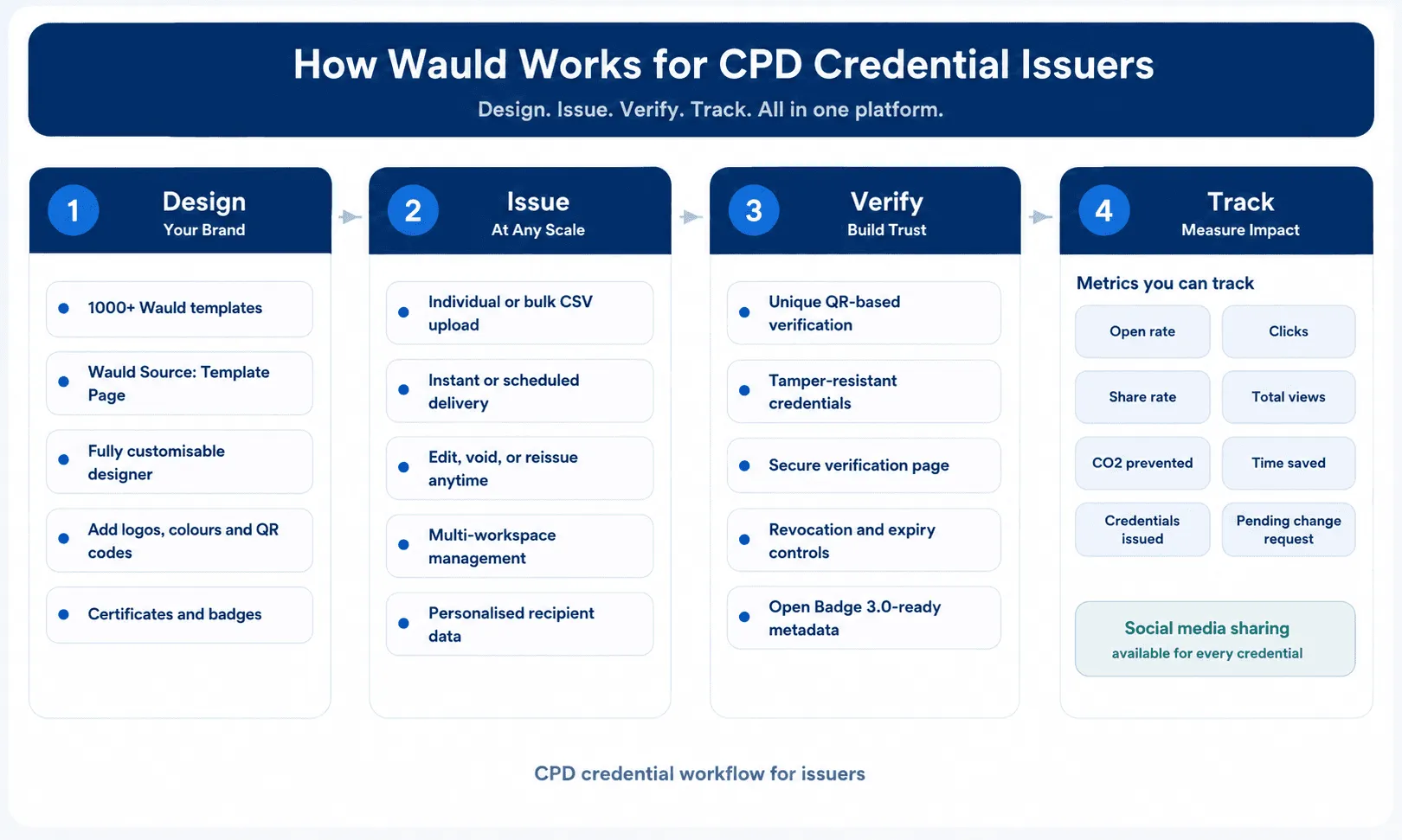
This is where the right tools make your life easier. Wauld is a digital credentialing platform built for trainers and course creators who want their certificates to carry weight. Instead of emailing out a flat file that anyone could copy, you issue branded, verifiable certificates and digital badges that reflect your brand and prove they are real.
A few things stand out for coaching programs in particular:
- Verification that holds up. Every credential carries a unique QR code and follows the Open Badge 3.0 standard, so an employer or client can confirm it is genuine in seconds, from anywhere.
- Your brand, front and center. You can white-label the whole experience, from the certificate design to the emails and the portal, so learners only ever see your name.
- Badges that keep learners moving. Award a digital badge for each completed module and a certificate at the finish line. That steady recognition is a simple way to lift completion rates.
- Sharing that grows your program. Graduates can post their certificate to LinkedIn in one click, which turns their proud moment into free word-of-mouth for you.
- A single dashboard. Design, issue, track, and even revoke credentials from one place, and connect it to the LMS or course platform you already use.
Bringing It all Together
A great coaching program and a great credential belong together. When you build your training around current ICF standards and back it with a certificate people can actually verify, you give your learners two gifts at once: real skill and real proof of it. That combination is what turns a one-time course into a reputation, and a reputation into a steady stream of new students.
If you are ready to give your life coaching certification the polish and trust it deserves, start issuing verifiable certificates and badges with Wauld. Your learners earned their moment. Make sure the credential lives up to it.