CPD Certification: What It Is and Why It Matters

CPD Certifications on Trainer's Radar
Picture two training programs side by side. Same topic, similar instructors, similar price. The only real difference is that one carries CPD certification and the other doesn't. Nine times out of ten, a serious learner will pick the certified one without thinking twice.
If you build training programs, coach professionals, or work in an HR or L&D team, CPD certification has likely come up. People want proof that their time and money support real career growth. This credential is one of the most trusted ways to provide that proof.
In this blog, we'll cover what CPD means, how the process works in different countries, why CPD matters for your organization, and how to offer accredited training that your audience can rely on the moment they sign up.
What CPD Means, and What Accreditation Adds to It
CPD stands for Continuing Professional Development. It covers any structured learning that helps working professionals build new skills and knowledge after they've finished their formal education. Think of it as the learning that runs alongside a career rather than kicking it off. When a course is described as CPD accredited or CPD certified, it means an independent body has reviewed it and confirmed it meets a recognized quality standard. That review process gives learners and employers a reliable way to evaluate what they're paying for. Without it, there's no straightforward way to tell a well-built course from one that just looks good on paper.
How the Accreditation Process Works
Getting CPD accredited isn't simply submitting a course and waiting for a stamp. The process starts at the organizational level. Training providers first need to earn CPD Provider status, which is a company-wide review checking that the right policies, delivery processes, and quality controls are in place. After that, individual activities go through their own review against a published framework. The CPD Group, for example, uses something called the A.C.C.R.E.D.I.T.E.D Framework, which they publish openly so providers and learners both know exactly what is being measured. Approved activities get a unique accreditation number, appear on the CPD Register, and carry a defined number of CPD credits. Most accreditations run for one to three years, after which the content needs to be reviewed again to make sure it stays current.
Who Is CPD For?
CPD matters to three different groups, and it's worth understanding what each of them gets out of it. For learners, CPD is how they prove to employers, clients, and regulators that their knowledge hasn't stood still. In professions where it's mandatory, having a clear record of accredited credits keeps them licensed and employable. In others, it's simply a way to stay competitive and show a genuine commitment to their field. For trainers, getting individual trainer accreditation is a separate step from getting a course accredited. Trainer accreditation confirms that the person delivering the learning has the qualifications and skills to do it well. Accredited trainers receive a CPD Trainer Card, which is a portable credential they can show to employers and clients. For employers, many accreditation bodies offer a free recognition that endorses organizations investing meaningfully in staff development. Having that external endorsement gives auditors and leadership confidence that internal training programs meet a standard beyond what the organization sets for itself. Staff notice that too, and it has a real impact on engagement and retention.
The Full Range of CPD Activity Types
One of the most common misunderstandings about CPD is that it only means classroom courses. Accreditation bodies recognize a much wider range of formats. Here are the main ones:
- Courses and Seminars: Structured in-person or online programs with defined learning objectives and assessment.
- Workshops: Hands-on sessions built around practice and problem-solving, great for learners who retain knowledge best by doing.
- eLearning Modules: Self-paced online content for professionals who need flexibility in when and where they learn.
- Webinars: Live or recorded online sessions where attendees can often scan a QR code at the end to receive their CPD certificate on the spot.
- Conferences and Events: Multi-session gatherings where professionals learn from several speakers and connect across their field. Many accreditation bodies offer free event accreditation for organizers.
- Podcasts (Audio and Video): Formal CPD accreditation now exists for podcasts. Each episode can carry a unique verification number that listeners use to collect CPD minutes and download a certificate.
- Edutorials: Trade magazines, journals, newsletters, and blogs that have been formally accredited. Readers scan a QR code at the end of an article to collect CPD minutes from content they were already reading.
- Mentoring and Coaching: One-to-one development sessions with a qualified, accredited CPD trainer.
- On-the-Job Training: Workplace learning that counts toward CPD when it is properly documented and supervised.
Most accreditation bodies group CPD into three categories: Structured CPD (formal, assessed learning with the highest credit value), Reflective CPD (journals, case reviews, and peer discussions), and Self-directed CPD (independent reading and research). A well-rounded program blends all three.
CPD Standards as the Quality Benchmark
Not every program can claim the CPD label. To earn CPD accreditation, your training has to meet the criteria set by recognized accreditors and align with their standards. They review course structure, learning objectives, assessment methods, instructor qualifications, and how well the content fits a particular job role.
CPD standards act like a quality guard at the door of your training. They make sure anything carrying the label is structured, measurable, and tied to real industry standards. Without these professional development standards and benchmarks, the CPD value would lose meaning, and people would have no easy way to tell whether a course is worth their time.
Most accreditors measure progress in CPD points, hours, or credits. As ANHCO explains, one hour of structured CPD usually equals one CPD point. Active learning, like workshops and live sessions, often carries more weight than passive learning, which is one reason engaging in CPD activities that mix formats brings stronger value.
This is also why high-quality CPD programs go through an independent CPD accreditation review. They're built to keep pace with shifting trends and best practices in their field, not just teach a fixed curriculum.
CPD Provider vs CPD Trainer: Can You Hold Both?
One of the questions that comes up most often from people exploring CPD accreditation for the first time is whether they need provider accreditation, trainer accreditation, or both. The honest answer is: it depends on how you work. Here's a clear breakdown of what each one actually means.
| CPD Provider | CPD Trainer | |
|---|---|---|
| What it recognizes | An organization, company, or institution | An individual professional |
| Best suited for | Training businesses, event organizers, publishers, and employers with external audiences | Freelance trainers, coaches, consultants, and independent speakers |
| Ownership | Stays with the organization, not any individual within it | Portable — travels with the individual regardless of who they work for |
| Gateway to activity accreditation? | Yes, provider status is required before individual activities can be submitted | No, trainer accreditation is a personal credential, not a prerequisite for activities |
| Can you hold both? | Yes | Yes, and many professionals do |
| Cost to register | Free to register as a provider | Individual assessment fee applies |
So, Can You Hold Both?
Yes, absolutely, and it's actually quite common. If you run a training business and also deliver some work independently as an individual, holding both credentials gives you full coverage. Your provider accreditation covers everything your business delivers. Your trainer accreditation travels with you personally, whatever context you're working in. A good example is a training company director who also takes on independent coaching clients. The business would hold provider accreditation for its courses and team-delivered programs. The director, as an individual, would hold trainer accreditation for their personal coaching practice. Both credentials can sit on their website and marketing materials, and clients get assurance at every level.
What About Sole Traders?
If you're a sole trader running your own training or coaching business, you most likely need provider accreditation first. That's what allows you to register your business as CPD-ready and then submit your individual activities for accreditation. You can also apply for trainer accreditation on top of that if you want to carry a personal professional credential alongside your business one.
Is There a Third Option?
Yes. Employer accreditation is a separate pathway for organizations that want to formally recognize their own internal staff training programs. It's different from provider accreditation, which is designed for organizations delivering training to external audiences. Some organizations hold all three: provider accreditation for their external offer, employer accreditation for internal learning, and trainer accreditation for their individual trainers.
CPD Across Different Countries
Requirements vary slightly depending on where your audience lives and works. Here's a quick view of three major markets where the rules are well established.
- United Kingdom: The CPD Standards Office and the CPD Certification Service are the two big names. The CPD Certification Service provides approval for thousands of accredited programs every year. CPD is mandatory across regulated professions, including law (overseen by the Bar Standards Board), medicine (General Medical Council), and education.
- United States: Continuous professional development often goes by other names like CEUs (Continuing Education Units) and CME (Continuing Medical Education). NASBA covers finance professionals, AAPC handles medical coding and billing, and ACCME governs physician education. The principle is the same: structured learning tied to a recognized role.
- United Arab Emirates: Workforce planning in both public and private sectors leans heavily on CPD. The Dubai Health Authority requires it for licensed medical professionals, and the KHDA sets expectations for education workers. UK and US accreditations are widely accepted alongside local CPD requirements.
- Australia and New Zealand: CPD is widely practiced across healthcare, engineering, teaching, and finance, and UK-accredited programs are broadly accepted.
- Africa: CPD is growing fast across the continent, particularly in medicine and pharmaceuticals, with increasing emphasis on credits as evidence of development.
- Asia: Healthcare, education, engineering, finance, and IT all maintain CPD expectations for professionals, and UK-accredited programs are broadly accepted in the region.
- Europe: Well established in regulated professions and growing steadily in the broader training market. UK accreditation bodies are recognized as credible validators across the continent.
If you're a trainer, coach, or organization building a global audience, choose a CPD accreditation body whose name carries weight in the regions you want to reach.
The Benefits of CPD Certification for Your Organization
The credential ripples across the entire training experience. Whether you're a small training provider or a large organization rolling out training and development at scale, the credential raises the value of your work.
For training providers and coaches
- Third-party credibility that no amount of self-promotion can replicate.
- Visibility on the CPD Register, where professionals actively search for qualifying learning.
- A structured improvement process if your content needs work before it's approved.
- Easier conversations with corporate L&D teams and industry associations that require accredited suppliers.
For learners
- Verified CPD credits they can log with their employer or regulatory body.
- An accredited certificate with a unique verification number they can use to prove completion.
- Proof of ongoing commitment to their profession, in a format recognized by employers worldwide.
For HR and L&D leaders
- Training that satisfies external audits, not just internal benchmarks.
- Reduced compliance risk in regulated industries.
- Higher employee engagement from staff who can see their development is being taken seriously
What Is a Blanket CPD Accreditation?
Not all CPD accreditation works the same way, and it's genuinely worth understanding the difference before you choose an accreditation body. Blanket CPD accreditation is when some accreditation bodies approve a training provider's entire output in one go, without ever individually reviewing the specific activities they deliver.
Under a blanket model, a provider pays a membership or registration fee, receives an accreditation logo, and is permitted to display that logo across all their courses, webinars, and events, regardless of the quality or professional relevance of each one. No one has actually read the course. No one has checked the learning objectives or assessed the content against any professional standard. The logo is there because the provider paid for it.
Why Is This a Problem?
- For learners, there is no real quality assurance. A logo on a course should mean that the specific course has been reviewed. Blanket accreditation simply means the provider paid a fee.
- For employers and professional bodies: when a professional submits CPD evidence, the assumption is that it has been genuinely quality-assured. Blanket-accredited activities may never have been assessed at all.
- For the wider sector: when unreviewed courses carry CPD logos, it erodes trust in accreditation as a concept and makes it harder for learners to tell the difference between a rigorous credential and a logo on a landing page.
How to Spot Blanket Accreditation?
- The provider uses the same logo on all activities with no individual accreditation numbers.
- The accreditation body has no searchable register of individually assessed activities.
- The accreditation process involves no review of course content, learning objectives, or trainer credentials.
- The accreditation number on the certificate cannot be independently verified anywhere.
A good accreditation body will assess every activity individually, assign a unique accreditation number to each one, and list it on a publicly searchable register. That way, any learner, employer, or professional body can verify a specific course is genuinely accredited before relying on it.
Where Is CPD Mandatory?
In many professions, CPD is a legal requirement, not a nice-to-have. Professionals who miss their annual credits risk losing their license to practice. Here are some of the industries where that applies:
Healthcare and Medicine: Doctors, nurses, and pharmacists are overseen by bodies like the GMC and NMC in the UK.
Legal Services: Solicitors and barristers governed by the SRA and Bar Standards Board.
Education: Teachers and educational leaders across most countries.
Construction and Engineering: Chartered surveyors and engineers through bodies like CIOB and ICE.
Finance and Accountancy: Financial advisers and accountants through ICAEW, ACCA, and NASBA in the US.
Counselling and Psychotherapy: Annual hours required by bodies such as the BACP.
Information Technology: BCS members and tech professionals in regulated contexts.
If you're building a course for professionals in any of these fields, it's worth understanding their specific requirements early. They will shape how you structure, assess, and accredit your content from the start
CPD Credits and CPD Points: What They Are
Every accredited activity carries a credit value based on hours of active learning, not on how long the course runs in calendar time. One hour of genuine engagement equals one CPD credit. CPD Points and CPD Credits are two names for the same thing. To put that in context: a twelve-week program with one hour of learning per week carries twelve credits, the same as a two-day intensive with six hours per day. Calendar length does not determine credit value. Active learning time does. Many professions require a set number of credits per year. Nurses, lawyers, accountants, and construction professionals all need to show an annual CPD record to stay compliant. Learners track their credits in a CPD portfolio or passport and present it to their employer or regulator when needed.
How to Build a CPD Program Your Audience Trusts
If you want your training to carry real weight, here are six practical steps to follow when you undertake CPD accreditation.
1. Match recognized CPD standards. Pick a credible accreditor, study their criteria, and design your curriculum to match. Once your course earns the official CPD label, keep updating it to maintain that status year after year.
2. Mix active and passive learning. Theory has its place, but case studies, role plays, and real-world projects usually carry stronger weight in the eyes of a reviewer. They also keep participants engaged.
3. Bake in assessment. A program shouldn't end with someone clicking "finish." Add quizzes, reflections, or short assignments so participants actively prove what they've absorbed.
4. Provide verifiable certificates. When someone wraps up your CPD course, handing them a verifiable certificate is part of meeting the standards your reviewer expects. A strong certificate gives participants real evidence of what they've put in and builds trust in your training. Think of it as an accreditation certificate for the skills they've gained in their job role, something they can add to their LinkedIn profile, CV, or portfolio to open doors to new opportunities.
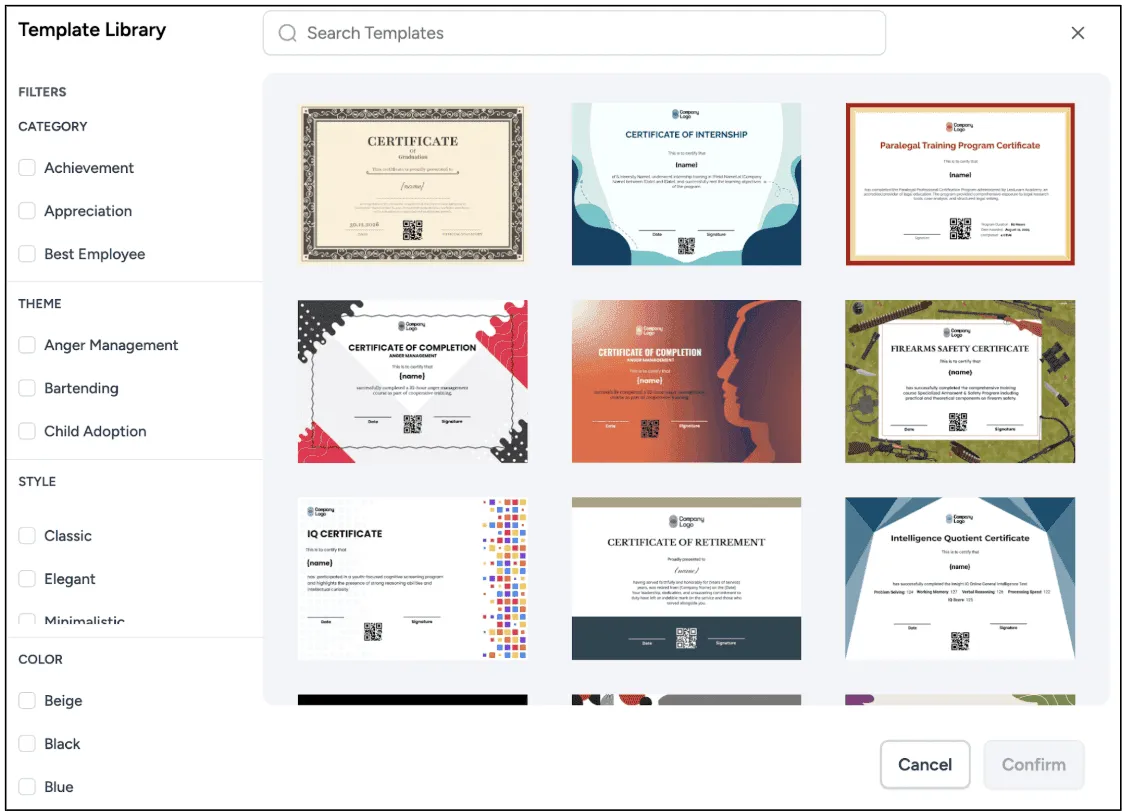
Wauld has over 1,000 certificate templates in its template library, where you can choose and issue certificates within minutes.
5. Bring in expert voices. Guest lecturers and industry practitioners add credibility and a practical layer that pure theory can't match.
6. Apply for review. Most accreditors follow a similar three-step path: submit an application with course details, work with the assessment team to refine your offering, then receive your CPD provider status. From there, you can grow your catalog with more approved programs.
Why Your Certificate Quality Makes or Breaks the Experience
Once a participant finishes a program, the certificate is the proof they walk away with. The quality of that document matters more than most training providers realize.
A strong credential does four things at once.
- Authenticates the learning. It lists the hours or points earned, the accreditor's name, the date of completion, and a unique ID for verification.
- Reduces fraud. Watermarks, QR codes, and unique identifiers protect against forgery.
- Builds your brand. A clean certificate puts your organization in front of every employer, hiring manager, and LinkedIn connection it gets shared with.
- Saves admin time. Modern platforms generate and send hundreds of credentials in one click, with the tracking baked in.
If your course delivers strong value but the certificate looks like a clip art template from 2005, you're leaving real credibility on the table. Treat it as the final layer of the continuous learning experience, not an afterthought.
Where Wauld Fits into Your CPD Workflow
Wauld is a digital certificate platform built for trainers, coaches, HR teams, and L&D departments who want their training to feel as professional as the learning behind it. Professional certification is only as strong as the proof that backs it up, and Wauld gives you that proof in a format your workforce can actually use.
With Wauld, you can:
- Design branded certificates that match your CPD course and your organization's identity, without needing a designer on call.
- Issue verifiable digital certificates with QR codes, secure verification links, and the information participants need for audits or license renewals.
- Send certificates in bulk to entire cohorts in minutes.
- Track who has received, opened, and shared their certificate.
- Plug into LinkedIn sharing so people can showcase their training to their network in one click.
Whether you're a solo coach issuing your first credential or an L&D leader rolling training out across an entire workforce, Wauld takes the friction out of the certificate side of CPD.
Click here to explore CPD templates and learn more about how to issue a certificate using Wauld.
Final Thoughts
The importance of continuing professional development comes down to one simple idea: in a world where skills shift fast, ongoing development protects the value of every professional who finishes a continuing professional development program. The right credential ties it all together. It tells your audience your training has been built to a recognized standard, and it shows people that completing CPD with you will move their careers forward.
For trainers, coaches, HR leaders, and L&D specialists, getting CPD accredited and pairing your work with strong, verifiable digital certificates is one of the smartest moves you can make in 2026 and beyond.
Ready to give your training the credentials it deserves? Start issuing with Wauld today and turn every course completion into something your audience will be proud to share.