Digital Badge Software: 10 Best Platforms for You

Let's talk about digital badges
A digital badge is a small, verifiable image that shows someone earned a skill, finished a course, or reached a milestone. Click it and you can see who issued it, what it took to earn, and a link that confirms it is real. That single click is the point: anyone can trust the badge without emailing you to check.
Digital badge software is the platform that produces those badges. It lets you design them, send them out at scale, and give recipients a clean way to display them on a LinkedIn profile, resume, or portfolio. Large organizations rely on this heavily. IBM, Google, and Microsoft all issue verifiable badges to recognize skills, and learners add them to their profiles.
This guide compares the top 10 digital badge software platforms for 2026 with real features, current pricing, and honest pros and cons, so you can pick the one that fits how you actually work.
The problem: not all badge software is built the same
Choosing a badge platform sounds simple until you are three demos deep and every vendor's pricing is "contact sales." A few pain points show up quickly:
- Hidden costs. Some platforms advertise a low headline price, then add a setup fee, an annual minimum, or per-recipient charges that grow with your audience.
- Weak or missing standards. A badge that is not built on Open Badges or W3C Verifiable Credentials cannot be trusted or read by other systems, which defeats the purpose.
- Design that fights you. If one on-brand badge takes an afternoon, issuing at scale becomes a chore.
- No visibility after you send. Without analytics, you have no idea whether recipients open, download, or share what you issued.
The right digital badge software handles all four: transparent pricing, open standards, fast design, and real engagement data. Here is how the top platforms compare.
Digital Badge Software Platforms In 2026
Wauld
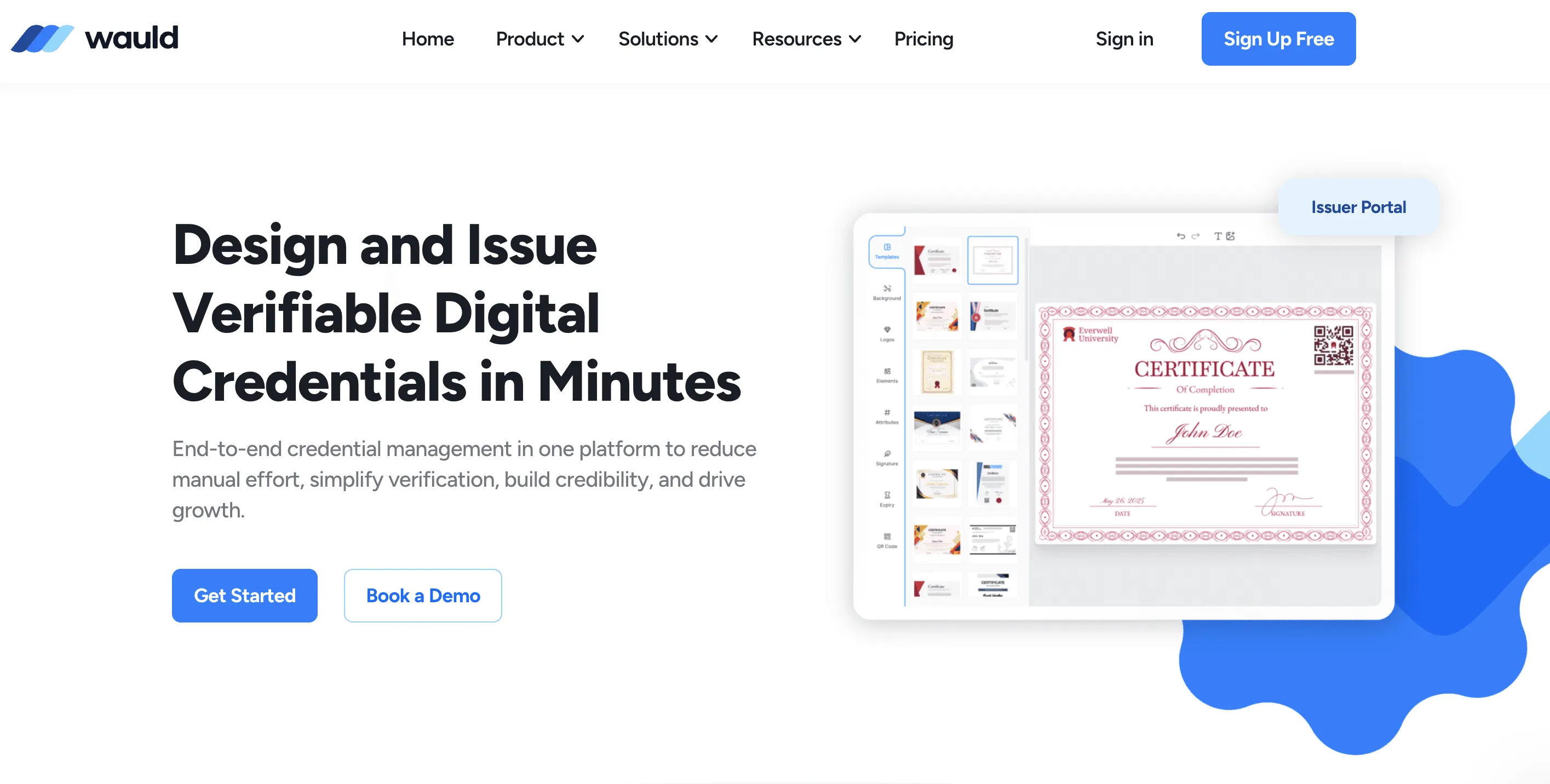
Wauld is a modern, minimal digital credentialing platform built for organizations that want to design, issue, manage, and verify digital badges and certificates in one place. The workflow is three steps: design, issue, and track. What sets it apart is how much of the job lives under one roof, so you are not paying for a design tool, a delivery tool, and a verification tool separately.
On the design side, an intuitive generator lets you build badges, certificates, QR codes, and recipient emails that match your brand, starting from 1000+ customizable templates. Issuing happens from a single secure dashboard, where you can send in bulk, edit or void credentials, and process change requests. You can automate issuance from form responses, including Google Forms, which makes recurring programs almost hands-off. For teams running several brands or departments, workspace management with role-based access keeps everything organized.
After you issue, the analytics show who opens, downloads, and shares each credential, along with LinkedIn profile additions, views, clicks, and verifications, so you can measure whether the program is working. Every credential is verifiable through a unique link and aligns with Open Badges 3.0 and W3C Verifiable Credentials, which keeps badges portable across platforms, employer systems, and professional networks. Recipients get their own portal to store and share credentials to LinkedIn, resumes, email signatures, and portfolios.
| Pros | Cons |
|---|---|
| Free to start with no onboarding fees, no setup charge, no annual minimum, and no sales call to evaluate | Newer brand than long-established enterprise incumbents |
| 1000+ customizable badge and certificate templates to match your brand quickly | |
| All-in-one workflow: design, issue, track, and verify from one dashboard, with separate issuer and recipient portals | |
| Built-in engagement analytics, including opens, downloads, shares, and LinkedIn additions | |
| Bulk issuance and automation, including from Google Forms, plus workspace and role-based access | |
| Open Badges 3.0 and W3C Verifiable Credentials support for portable, verifiable badges |
Wauld fits educators, trainers, coaches, associations, and workforce teams that want a complete badging program without a contract or a setup invoice. It was also named a SourceForge Top Performer for Digital Credential Management.
Badgr (Parchment Digital Badges)
Badgr is one of the original Open Badges platforms and grew popular through its tight integration with the Canvas LMS, where it was offered as Canvas Credentials. It supports badge issuing, stackable credential pathways, and learner records. The important recent change: the platform has been rebranded again as Parchment Digital Badges, and the free issuing tier ended after December 31, 2025.
| Pros | Cons |
|---|---|
| Deep Canvas LMS integration and strong Open Badges heritage | Free issuing tier has ended; access now runs through Parchment's paid model |
| Stackable pathways and learner records for structured programs | Quote-only pricing with no public price list |
| Standards-first approach to open, portable badges | Repeated rebrands and ownership changes can complicate long-term planning |
Credly (by Pearson)
Credly is the market leader in enterprise digital credentialing, managing more than 110 million credentials for tens of millions of people. It offers polished badge design, enterprise analytics, and one-click sharing to LinkedIn and other networks, all built on the Open Badges standard. For a large organization that needs scale and a recognizable network, Credly is the incumbent.
| Pros | Cons |
|---|---|
| Large, recognized network and enterprise-class analytics | Pricing typically starts around $3,000/year and scales up by badge volume |
| Strong LinkedIn and social sharing for recipients | Quote-based, with onboarding or setup fees reported on top of the plan |
| Open Badges support and mature reporting | No free tier, and evaluation requires a sales conversation |
Certif-ID
Certif-ID is a blockchain-based credentialing and verification platform focused on tamper-proof badges and certificates. It is split into CredSure for issuing and TalentSure for talent verification and hiring, and it adds a network where verified professionals can be discovered by employers. If independent, fraud-proof verification is your priority, it is worth a look.
| Pros | Cons |
|---|---|
| Blockchain-anchored verification keeps badges tamper-proof | Pricing is on request rather than a public self-serve plan |
| Talent network connects verified earners with opportunities | Design tooling is lighter than template-first platforms |
| Instant verification pages for employers and third parties | Less public detail about pricing and technology |
Accredible
Accredible is a well-established badging and certificate platform trusted by names like Google, McGraw Hill, and the University of Cambridge, with more than 130 million credentials issued. It is known for strong white-labeling, learning pathways, and one-click sharing to 40+ social platforms. Pricing is per recipient, so you can issue unlimited credentials to the same person within your annual allowance.
| Pros | Cons |
|---|---|
| Strong white-labeling, including custom URLs, emails, and credentials | Quote-based pricing that typically starts around $3,000/year for up to 1,000 credentials |
| Learning pathways and a Spotlight recipient directory | Per-recipient model needs planning as your audience grows |
| Rich analytics and 40+ sharing destinations | Small pilots can hit an annual minimum before you scale |
Open Badge Factory
Open Badge Factory is a specialist Open Badges platform popular with universities, NGOs, and training organizations, especially in Europe. It is built around collaborative badge ecosystems, letting badge creators network and build large systems together. Plans run Basic, Premium, and Pro, with a 60-day free Pro trial and pricing that starts around €200/year.
| Pros | Cons |
|---|---|
| Standards-pure Open Badges with deep badge-system tooling | Focused on badges rather than all-in-one certificate design |
| Collaborative ecosystem features for large badge networks | Interface is more utilitarian than modern template-first tools |
| 60-day Pro trial with no payment details required | Euro-denominated pricing and annual licensing |
BadgeCert
BadgeCert is a digital badging platform aimed at associations, certification bodies, and continuing education providers that want standards-based Open Badges with secure verification and mature expiry handling. It offers customizable badges, bulk issuance, one-click verification, and hands-on strategy support.
| Pros | Cons |
|---|---|
| Open Badges plus secure verification and solid expiry handling | No free plan, and a trial needs a promo code |
| Bulk issuance and API integration with LMS and CRM tools | Entry pricing starts around $1,000/year for 500 badges |
| Hands-on strategy support for certification programs | Tiered by badge volume, so costs climb with scale |
Certifier
Certifier is a design-forward platform for issuing both digital badges and certificates, with a usable free tier. The Starter plan is free for up to 250 credentials a year, the Professional plan starts at $67/month for up to 1,000, and the Advanced plan at $339/month adds workspaces, verified status, and recipient directories. Nonprofits get 15% off.
| Pros | Cons |
|---|---|
| Free plan for up to 250 credentials a year, good for pilots | Annual credit caps mean you upgrade as volume grows |
| Clean design tools and branded emails | Higher tiers get pricey for large programs |
| Analytics, scheduled issuing, and a nonprofit discount | Features like verified status sit on upper tiers |
Sertifier
Sertifier is a credentialing platform focused on automation and built-in email delivery. It charges $1 per unique recipient per year above a free tier of 250 recipients, and it is strong at automating issuance from your LMS, CRM, or enrollment data through smart triggers or a REST API. Every credential includes a verification link and QR code.
| Pros | Cons |
|---|---|
| Free for up to 250 recipients, then a simple $1 per recipient per year | Per-recipient cost adds up for very large audiences |
| Built-in branded email with open and click tracking | Email-centric workflow may be more than small issuers need |
| Open Badges support with LMS/CRM automation and a REST API | 20% discount applies only to nonprofits and accredited schools |
SimpleCert
SimpleCert is a certificate-first platform that also handles digital badges, aimed at educators, trainers, and event organizers who issue in bulk with minimal effort. You design a template, upload a recipient list, and it populates and emails everything automatically. Pricing is flexible: 150 credits for $24 pay-as-you-go, or $19/month for 150 credits with extra features.
| Pros | Cons |
|---|---|
| Affordable, flexible credit-based pricing | Template library is small, around 30 designs |
| Automatic bulk email with tracking and resends | Extra templates cost about $29 each |
| QR codes and LinkedIn integration on paid plans | More certificate-focused than a full badge platform |
Overall Comparison Table
| Platform | Free to start | Templates | Analytics | Standards (Open Badges/W3C) | Best for |
|---|---|---|---|---|---|
| Wauld | Yes, no onboarding fees | 1000+ | Yes | Yes | All-in-one design, issue, track, verify |
| Badgr (Parchment) | No (free tier ended 2025) | Limited | Yes | Yes | Canvas LMS-based programs |
| Credly | No (quote-based) | Yes | Yes (enterprise) | Yes (Open Badges) | Large enterprises and networks |
| Certif-ID | On request | Limited | Yes | Yes (blockchain) | Fraud-proof verification and hiring |
| Accredible | No (quote-based) | Dozens | Yes | Yes | White-labeled programs at scale |
| Open Badge Factory | 60-day Pro trial | Yes | Yes | Yes (Open Badges) | Badge-focused ecosystems, education |
| BadgeCert | No (promo trial) | Yes | Yes | Yes (Open Badges) | Associations and CE providers |
| Certifier | Yes (250/year) | Yes | Yes | Yes | Design-forward small-to-mid programs |
| Sertifier | Yes (250 recipients) | Yes | Yes | Yes (Open Badges) | Automated, email-driven issuing |
| SimpleCert | Free (1 design) | ~30 | Basic | Limited | Simple bulk certificate and badge sends |
Why Wauld is the Best Digital Badge Software
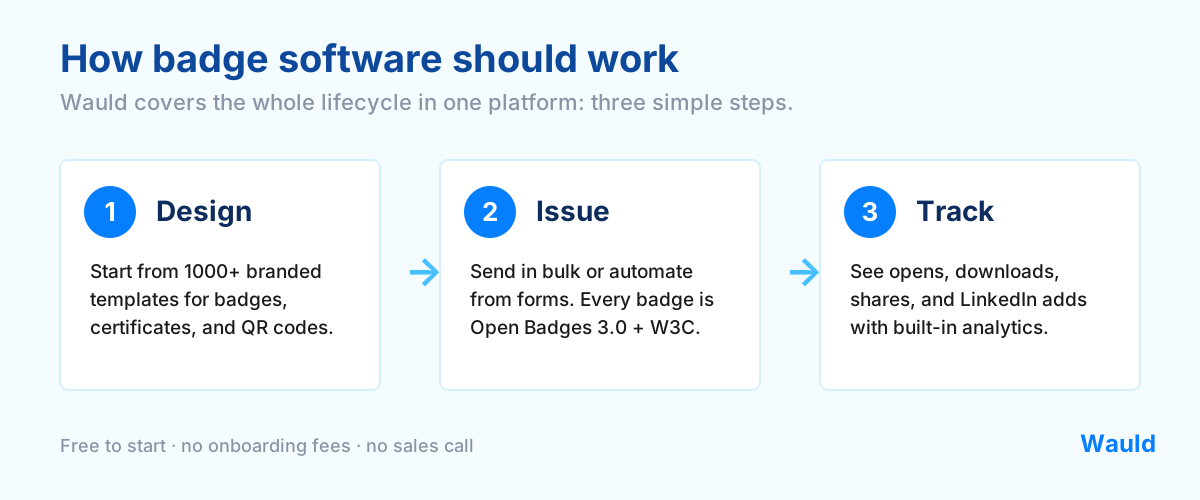
Every platform here does something well. Wauld's advantage is that it does the whole job at a price that stays reasonable as you grow.
You start free, with no onboarding fees. There is no setup charge, no annual minimum, and no sales call before you can try it. You can sign up and issue your first badge the same day.
It is a true all-in-one. Design the badge, issue it in bulk, track engagement, and let recipients verify and share it, all from one dashboard with separate issuer and recipient portals. You are not connecting three tools.
Management is centralized. Issue, edit, and void credentials and handle change requests from a single secure dashboard, and use workspaces with role-based access when more than one team is involved.
1000+ templates mean your first on-brand badge takes minutes, and you can style badges, certificates, QR codes, and emails to match.
Standards are covered. Open Badges 3.0 and W3C Verifiable Credentials support keep your badges portable and verifiable across LinkedIn, employer systems, and other platforms.
You can measure the outcome. Built-in analytics show opens, downloads, shares, LinkedIn additions, and verifications, so you can see what the program returns.
Wauld will not be the right pick for every buyer. If you need a decades-old enterprise brand with a massive existing network, Credly still owns that space. But for most educators, trainers, coaches, associations, and workforce teams, Wauld covers the same core job for less friction and less cost.
Conclusion
The best digital badge software in 2026 is not the one with the longest feature list. It is the one that fits how your organization issues, tracks, and verifies credentials, at a price that stays honest as you scale. Enterprises may still choose Credly, universities may prefer Open Badge Factory, and verification-first teams may lean toward Certif-ID or BadgeCert. For most educators, trainers, coaches, and associations who want everything in one place without onboarding fees, Wauld is the strongest fit.
Whatever you choose, insist on open standards and real analytics. A badge is only as valuable as the trust behind it, and the platforms that get that right are the ones worth building on.