What is a Credential Flywheel? How It Can Grow Your Business Organically

A credential flywheel is a growth model where every certificate or badge you issue does double duty. It recognizes the learner, and it also brings the next learner through the door. Instead of a credential marking the end of someone's relationship with your program, it becomes the start of someone else's. For credentialing and training leaders looking to grow your program without a bigger ad budget, this is the lever that does it.
This matters more now than it did even two years ago. A randomized study from Stanford Graduate School of Business found that learners who shared a credential on LinkedIn were 6% more likely to report new employment within a year, a figure that rose to 11% for learners with the lowest baseline employability. Learners know this. So when they earn something worth sharing, they share it, and the people they share it with are often exactly the kind of person who would enroll in your program next.
This guide breaks down what a credential flywheel actually is, how it differs from a funnel, the stages that make it spin, and a practical checklist for creating a credential flywheel even if you are starting from a basic certificate template and a free Wauld account. The goal throughout is simple: engage learners enough that they want to share what they earned, and let that sharing do the work of attracting the next one.
What is a Credential Flywheel?
A credential flywheel is a growth model built around one idea: a digital credential does not have to be the last interaction a learner has with your program. It can be the first interaction someone else has with it.
A credential itself can take a few different forms. The most common are certificates (formal, document-style recognition of completion), digital badges (compact, visual recognition of a specific skill or achievement), and diplomas or transcripts for academic programs. The flywheel works the same way regardless of which format you issue, as long as the credential is digital and verifiable.
In the traditional credentialing process, the learner enrolls, completes the program, and receives a certificate. That is where the relationship typically ends. A paper certificate or a static PDF gets filed away, and the issuer has no idea whether it ever left an inbox. There is no visibility into who saw it, who shared it, or whether it brought anyone new to the program.
A credential flywheel changes what happens after issuance. Three things happen instead of one:
- The learner receives a verifiable, branded digital credential.
- The learner shares that credential somewhere their network will see it, most often LinkedIn.
- People in that network click through, discover the program, and some of them enroll.
Each of those new learners then completes the program, earns their own credential, and shares it again. The loop repeats, and because every cycle adds a few more credential holders and a few more shares, the loop tends to pick up speed rather than slow down. That compounding quality, a flywheel of growth that gets stronger the longer you run it, is what separates a flywheel from a one-time marketing push.
The term itself traces back to the credentialing world's reframing of the classic flywheel principle (more on that below), but the mechanics are credentialing specific: the credential is not just the reward. It is the marketing asset, and it only adds value to your program if learners actually want to put it somewhere visible.
Why Shared Credentials Became a Growth Channel
Three shifts in the labor market explain why credential sharing turned into something issuers actively design for, rather than a side effect they happened to notice.
Skills-based hiring is reshaping how candidates get noticed.
- TestGorilla's State of Skills-Based Hiring 2025 report found that 53% of employers have eliminated degree requirements from at least some job postings, up from 30% the year before.
- 85% of employers say they now use some form of skills-based hiring, up from 81% the prior year.
- When a job posting no longer requires a degree, a verifiable credential becomes one of the clearest signals a candidate can offer in its place.
Employers are actively rethinking how they screen candidates.
- A joint report from HolonIQ and the American Council on Education found that 81% of employers think they should look at skills rather than degrees when hiring.
- The Brookings Institution has documented a growing number of employers, including several state governments, formally eliminating degree requirements for roles where verified skills matter more than a diploma.
- A verifiable digital credential closes the gap this shift creates: it gives employers a faster way to confirm a specific skill without relying on a resume claim alone.
Badge issuance has scaled fast, and sharing measurably changes outcomes.
- 1EdTech's 2025 Badge Count found that the total number of digital badges issued grew from roughly 74.7 million in 2022 to over 320 million in 2025, more than a fourfold increase in three years.
- Separately, Credential Engine's Counting Credentials 2025 report counted 1.85 million unique credentials offered by more than 134,000 providers in the U.S. alone, with $2.34 trillion invested annually in education and workforce development.
- The Stanford Graduate School of Business study cited above found that the effect of sharing isn't just anecdotal: it measurably increases a learner's odds of landing a new job, especially for learners without traditional credentials or strong employment histories.
Put together: learners have a real incentive to share what they earn, employers are primed to notice it, and issuers finally have the data to see the loop working in real time. That combination is what turns a certificate from a keepsake into a growth channel.
Credential Flywheel vs Funnel
If you have spent any time in marketing or sales, you have likely run into the flywheel concept before. Jim Collins introduced the flywheel as a metaphor in Good to Great, and HubSpot popularized it for marketing teams around 2018 as an alternative to the traditional funnel. The credential flywheel is a direct, credentialing-specific application of that same logic.
| Funnel Model | Flywheel Model | |
|---|---|---|
| Where the customer sits | At the narrow end, exiting the process | At the center, driving the process |
| What happens after conversion | Relationship effectively ends | Relationship continues and compounds |
| Where new growth comes from | New, separately sourced leads | Existing customers and their networks |
| How momentum behaves | Resets with each new campaign | Builds over time if friction is removed |
| Credentialing equivalent | Enroll, complete, receive a static certificate | Enroll, complete, receive, share, refer, return |
A funnel treats credential issuance as the finish line. A flywheel treats it as the handoff point. The certificate that used to mark the end of a learner's journey becomes the mechanism that starts someone else's, and eventually brings the original learner back for the next credential in their path.
This does not mean funnels are obsolete. Funnel thinking still works well for a single bounded campaign, a one-time webinar promotion, or short-term conversion tracking. The flywheel is the better lens for the ongoing, compounding growth of a credentialing program itself.
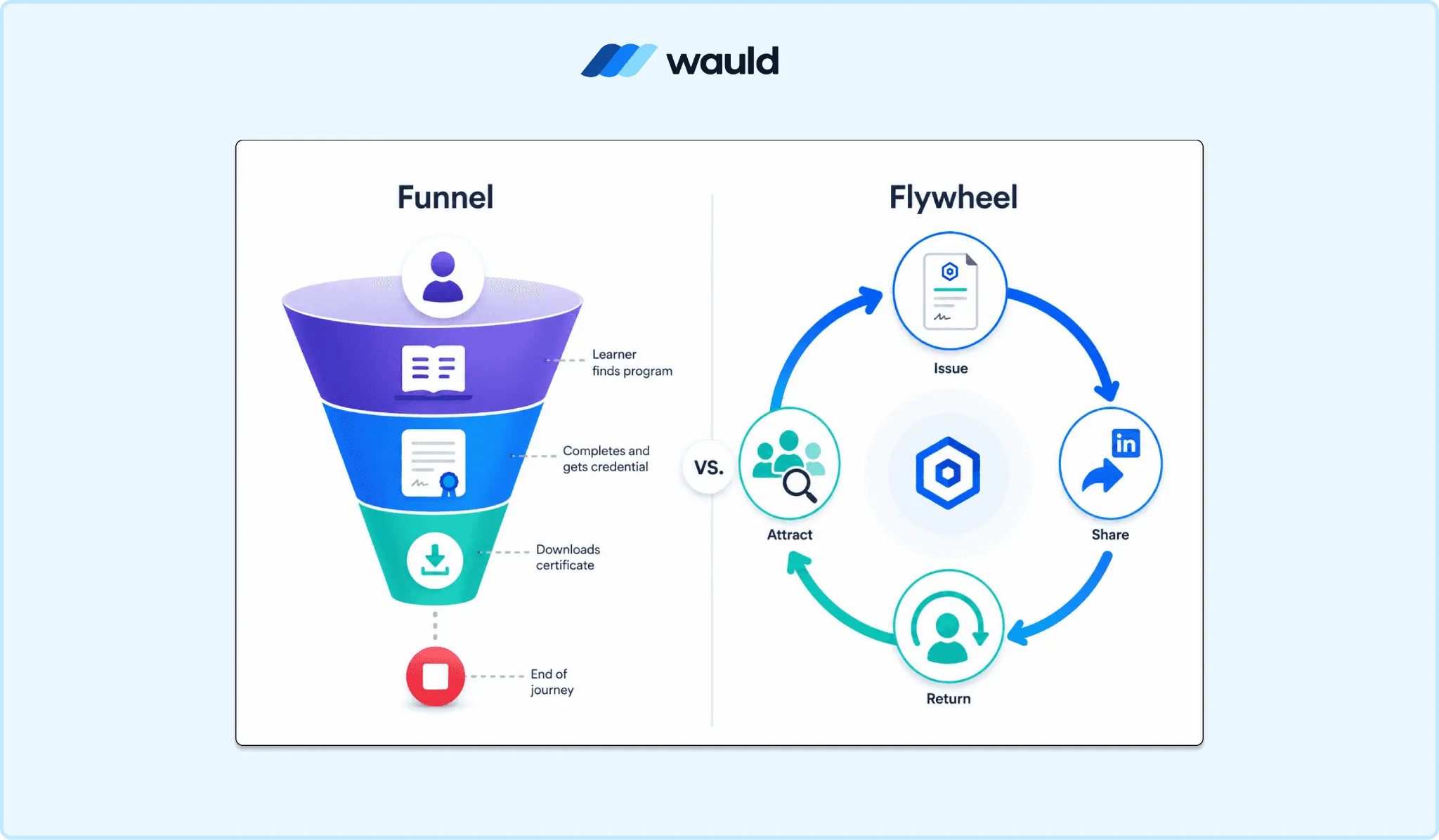
Traditional funnels end at credential issuance, while a credential flywheel turns every shared credential into a continuous source of engagement, referrals, and new learners.
The Four Stages of a Credential Flywheel
A useful way to break the loop into actionable stages is Issue, Share, Attract, Return. Each stage has a clear job, and each one feeds the next, and together they help you broaden your reach without adding headcount. The same structure works whether you are recognizing a single competency or a full stack of learning pathways.
1. Issue
This is where the loop starts. A learner completes a program and receives a digital credential. For this stage to feed the rest of the flywheel, the credential itself needs to do more than confirm completion.
It needs to:
- Arrive instantly, ideally the moment criteria are met, so the learner receives it at their peak moment of pride
- Be branded clearly enough that anyone who sees it immediately knows your organization issued it
- Include real context: program name, skills demonstrated, criteria met, and issue date
- Be hosted on a public, verifiable page rather than delivered only as a flat PDF
A credential that looks like a generic template, arrives a week late, or has no public verification page rarely makes it past the issuer's inbox, let alone onto someone's profile.
2. Share
This is the stage that distinguishes a flywheel from ordinary issuance. The learner needs an easy, low-friction way to put the credential somewhere their network will see it.
In practice that means:
- A one-click "Add to LinkedIn" option that pre-fills the credential details
- No required account creation just to view or accept the credential
- A clear next step in the delivery email itself, not buried three clicks deep
- Optional but effective: a short nudge email to recipients who opened the credential but have not shared it yet
Friction at this stage is the single biggest reason flywheels stall. Requiring a learner to create an account before they can even view their own credential is a common, avoidable blocker.
3. Attract
Once a credential is shared, it needs to do real work for the people who see it. A credential page with no information beyond a name and a date does not convert a curious viewer into a prospective learner. A page that explains the program, shows the criteria, and links straight to enrollment does.
At this stage you want:
- A dedicated credential page with program details, not just a name and a logo
- A direct link to your enrollment page, not just your homepage
- Visibility into related programs, so a viewer interested in one credential can see what else is available
4. Return
The flywheel does not stop with new learners. It should also bring the original credential holder back. Showing them a clear next step, whether that is a related certification, a look at broader career pathways, or the next level in a learning pathway, turns a one-time learner into a repeat one and opens up new learning opportunities they might not have known to look for. This is also the stage where issuers should be watching the data: open rates, share rates, click-throughs, and which credentials are driving the most referral traffic.
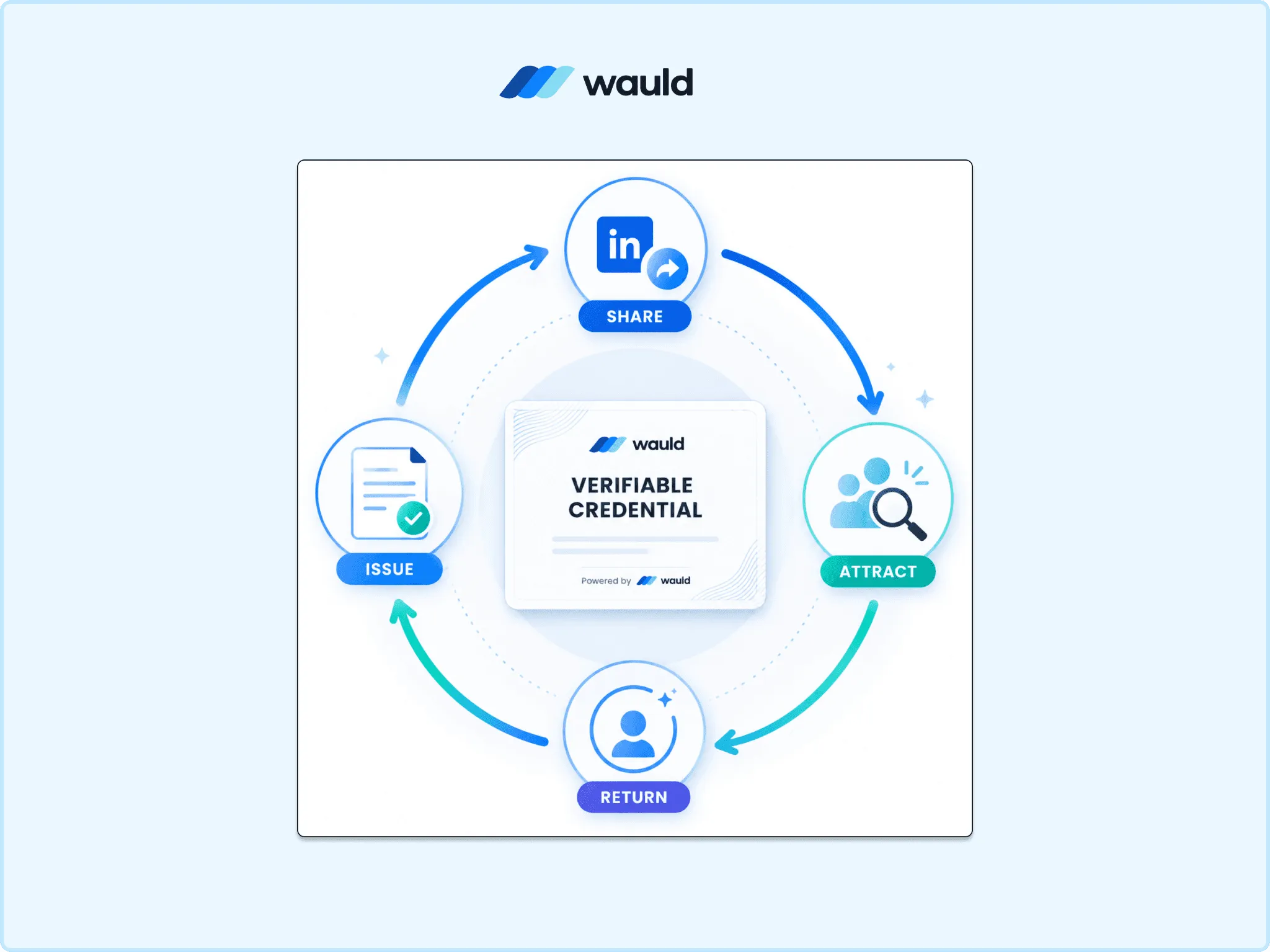
The credential flywheel in action.
What Makes the Flywheel Spin Faster (and What Slows It Down)
A flywheel works on the same physics whether it is a literal disk or a growth model: you add force, and you remove friction. Doing both at once is what makes the wheel pick up speed rather than stall. The most agile credentialing teams leverage their existing data rather than waiting for a bigger budget, and they integrate sharing into the credential itself instead of treating it as an afterthought.
Forces that add momentum:
- Instant, automated credential delivery tied to your LMS or course platform
- Strong visual branding so the credential is instantly recognizable as yours
- A public directory or showcase of credential holders, which gives both recipients and your program more visibility
- Clear calls to action inside the delivery email itself ("Add to LinkedIn," "Share your achievement")
- Analytics that show you which credentials and which CTAs are actually driving shares and click-throughs, so you can double down on what works
Friction that slows the wheel down:
- Requiring account creation before a recipient can view or accept their own credential
- Certificates delivered as flat, unverifiable PDFs with no public credential page
- No clear next step on the credential page itself
- Slow or manual issuance that delays delivery past the learner's moment of pride
- No visibility into what happens after a credential is sent, so problems go unnoticed for months
Real Examples
The strongest evidence for this model comes from outside the credentialing industry itself. Stanford Graduate School of Business economist Susan Athey ran a randomized experiment on credential sharing and found a direct, measurable employment effect, not just a correlation.
- Learners who shared a newly earned credential on LinkedIn were 6% more likely to report new employment within a year than learners who did not share.
- For learners in the bottom third of baseline employability, meaning those with less traditional education, less work experience, or based in emerging markets, the effect nearly doubled to an 11% increase.
- The study also tested whether the loop could be engineered rather than left to chance: a platform feature that nudged learners to share their credential, paired with a simplified one-click sharing process, increased both visibility and job outcomes. That is the credential flywheel in miniature, a small reduction in sharing friction produced a measurable downstream gain.
This matters for issuers because it reframes "encourage learners to share their credential" from a nice-to-have engagement tactic into something closer to a fiduciary responsibility. If sharing genuinely improves a learner's odds of getting hired, then making sharing effortless is part of delivering on the credential's promise, not just a marketing tactic for the issuer's own growth. It is also the clearest evidence available that small, specific changes to how a credential is delivered and how easy it is to share produce outsized changes in real outcomes, not just engagement metrics.
How to Build Your Own Credential Flywheel
You do not need an enterprise platform or a large marketing team to start this, whether you run an in-person certification or a fully online program. Here is a practical sequence.
- Audit what you currently send. If your certificates are static PDFs with no verification link, that is your starting point, not a dead end.
- Move to a verifiable digital credential. Choose a platform that can auto-issue based on completion criteria and gives every credential a public, shareable page with a QR code or unique ID. This is also how you award learners something they will actually want to show off.
- Remove the account-creation barrier. Make sure a recipient can view and accept their credential without signing up for anything first.
- Add a one-click LinkedIn share option. This single feature consistently drives the largest jump in share rates across the programs that track it.
- Rewrite your delivery email. Lead with a clear subject line, keep the "View Credential" CTA prominent, and add a secondary CTA like "Add to LinkedIn."
- Build a real credential page. Include program details, skills demonstrated, and a direct link to enrollment, not just your homepage.
- Set up follow-up emails. Target recipients who opened their credential but have not shared it within a week.
- Track four numbers monthly. Credentials issued, open rate, share rate, and referral click-throughs. This learner engagement data tells you exactly where the flywheel is gaining or losing momentum.
- Close the loop with a next step. Add a visible "what's next" section to the credential page, whether that is a related certification, a career pathway, or the next stage in upskilling.
Credential Flywheel Checklist
Use this as a working checklist rather than a one-time setup task. Revisit it every quarter as your program grows.
| Stage | Add This Force | Remove This Friction |
|---|---|---|
| Issue | Instant, auto-triggered delivery on completion | Manual, delayed certificate generation |
| Issue | Clear branding and program context on the credential | Generic templates with no criteria listed |
| Share | One-click LinkedIn and social sharing | Required account creation to view the credential |
| Share | Reminder email for unopened or unshared credentials | A single, buried CTA with no follow-up |
| Attract | A dedicated credential page with program details | A flat PDF with no public verification page |
| Attract | A direct link to your enrollment page | A link to your homepage only |
| Return | Visible "what's next" or related credentials | No path back into the program after issuance |
| Measure | Monthly tracking of opens, shares, and click-throughs | No visibility into post-issuance engagement |
Final Thoughts
A credential flywheel is not a redesign of your entire program. It is a redesign of what happens in the moments right after you issue a credential. The inefficiency of manual, paper-based issuance is usually what holds programs back from ever testing this in the first place.
Wauld builds that loop directly into how certificates and badges work: instant issuance, no account creation required, one-click LinkedIn sharing, QR-verified credential pages with full portability across devices, and analytics that show you exactly where the wheel is picking up speed. The goal is a self-sustaining program that empowers learners to do your marketing for you, one credential at a time.
You can start with over 1,000 free templates and a free plan that covers up to 300 verifiable credentials a year. If you want a deeper look at the sharing mechanics specifically, see our guide to leveraging digital credentials on LinkedIn and how associations use this same model to retain members.