CPD Certificate Software Solutions: 10 Best Tools & Pricing

Let's Talk About CPD Certificate Software
If your organization runs continuing professional development (courses, workshops, webinars, compliance refreshers), you eventually need to hand people something that proves they did it. That "something" used to be a PDF stapled to an email. In 2026, it should be a verifiable digital certificate or badge that anyone can check with a click.
CPD certificate software is the tool that makes that happen. At its simplest, it lets you design a professional certificate, issue it to the right people (often in bulk), and give each recipient a way to prove it is real. The best options also track engagement, handle renewals, and align with open standards so your credentials travel well and stay trustworthy.
One distinction is worth understanding before you shop: "CPD software" describes two different kinds of product. Some are full learning management systems (LMS) that host and deliver the training itself, then add certificate features at the end. Others are credentialing platforms built specifically to design, issue, track, and verify the certificates and badges. Neither is wrong. It depends on whether your gap is delivering the learning or proving it. In this guide we compare ten of the strongest options across both camps, with honest pros, cons, and real pricing where it is public. For a wider roundup beyond CPD, you can also read our guide to the top digital certificate platforms. We start with Wauld, then work through the rest.
Why Choosing the Right CPD Platform Matters
Getting this choice right saves you money and hours; getting it wrong tends to reveal itself slowly and expensively.
- The bill can balloon. Several enterprise LMS platforms in this space are quote-only and can run from $18,000 into six figures per year, sometimes with separate implementation fees of $5,000–$25,000. If your real need is issuing certificates, that is a lot of overhead.
- Manual work creeps back in. Without bulk issuance and automation, you end up hand-making certificates in a design app and emailing them one by one, which is exactly the busywork software should remove.
- Unverifiable certificates lose their value. A CPD certificate that cannot be checked is just a nice-looking image. Unique verification links, QR codes, and open standards are what make it credible to employers and regulators.
- Renewals get missed. In regulated fields, lapsed certifications are a real risk. Tools that track expiry and prompt renewals quietly protect you.
The market has matured, so there are strong picks at every budget. Here are ten worth knowing for 2026.
The 10 Best CPD Certificate Software Solutions
Wauld
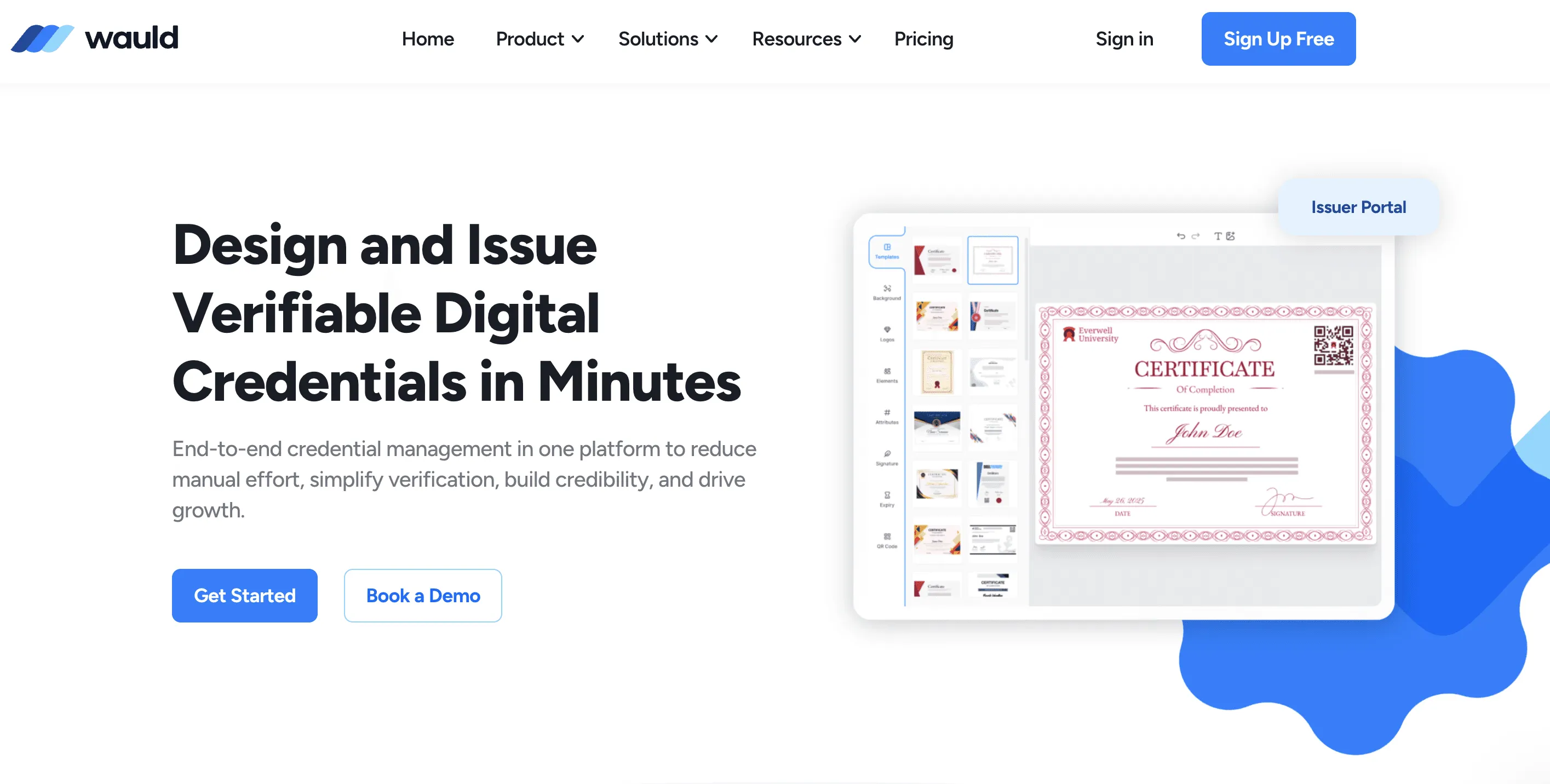
Wauld is a modern, minimal credentialing platform built to handle the certificate side of CPD end to end: design, issue, manage, track, and verify. If your courses already run somewhere (a webinar tool, an LMS, in person) and what you actually need is polished, verifiable CPD certificates and badges, Wauld is the most direct route. It is free to start with no onboarding fees, which makes it especially friendly for associations, trainers, coaches, and educators.
You design a certificate from 1000+ customizable templates, issue in bulk (including from Google Forms responses), and then track real engagement such as opens, downloads, shares, LinkedIn additions, and verifications from one dashboard. Every credential carries a unique verification link and is aligned with Open Badges 3.0 and W3C Verifiable Credentials, so your CPD certificates stay portable and trustworthy. Wauld was named a SourceForge Top Performer for digital credential management.
| Pros | Cons |
|---|---|
| Free to start, no onboarding or setup fees: issue real CPD certificates without a contract | Not a full course-delivery LMS; it is the certificate and badge layer |
| All-in-one credentialing: design, issue, track, and verify in one platform | Newer brand than legacy LMS incumbents |
| 1000+ customizable templates plus a branded generator for certificates, badges, QR codes, and emails | |
| Built-in analytics: opens, downloads, shares, LinkedIn additions, verifications | |
| Standards-aligned with Open Badges 3.0 and W3C Verifiable Credentials | |
| Bulk issuance and automation (e.g. from Google Forms), plus workspaces and role-based access |
If your gap is proving the learning rather than delivering it, Wauld can issue branded, verifiable CPD certificates in minutes.
Totara Learn
Totara Learn is an open-source-based LMS with a real strength in compliance and CPD. It automatically issues certificates, tracks certification status, and its compliance module flags who needs refresher assessments to stay current, which is valuable in regulated industries. It also awards badges and supports detailed reporting for stakeholders.
Pricing is quote-based and scales with organization size and features. Totara tends to be more affordable than some enterprise LMS rivals, but it typically needs more in-house or partner support to run well.
| Pros | Cons |
|---|---|
| Strong CPD, compliance, and certification tracking for regulated sectors | Quote-based pricing; no public rate card |
| Automatic certificates and badges with detailed reporting | Requires more in-house or partner support to configure |
| Flexible, open-source-based platform | Heavier setup than a certificate-first tool |
Degreed
Degreed is an enterprise upskilling platform (a learning experience platform) used by many large employers to track and grow workforce skills. It includes compliance and certification management, skill credentialing, and gamified badges and points, wrapped in a polished, recommendation-driven experience.
It is built for scale, and pricing reflects that: Degreed is quote-only and enterprise-oriented, so you will need to talk to sales. Its focus is broad skill development rather than issuing standalone CPD certificates.
| Pros | Cons |
|---|---|
| Enterprise-grade skills and certification tracking | Quote-only, enterprise pricing |
| Gamified badges, points, and skill credentialing | Overkill if you mainly need to issue certificates |
| Strong content and recommendation experience | Less focused on standalone CPD certificate design |
Moodle
Moodle is the world's most widely used open-source LMS, and it is very capable for CPD: it can track time spent learning, issue CPD points, model complex credit and completion rules, and deliver certificates automatically. Because it is open source, the software itself is free.
The trade-off is effort. Many CPD-critical features, like richer certificates and advanced reporting, depend on plugins or custom development, and your real cost is hosting, setup, and ongoing administration. If you go the Moodle route, our roundup of the best Moodle plugins for badges is a useful starting point.
| Pros | Cons |
|---|---|
| Free, open-source, and highly flexible | Certificate and reporting depth often needs plugins or custom builds |
| Can issue CPD points and model complex programs | Real cost is hosting, development, and admin time |
| Huge community and plugin ecosystem | Steeper setup and maintenance than hosted tools |
Cornerstone OnDemand
Cornerstone is an enterprise LMS built for large organizations that must enforce uniform training and produce audit-ready compliance records. It centralizes courses, certifications, transcripts, and role-based learning paths and handles industry-specific compliance certifications at scale.
Pricing is quote-based and modular, with figures often cited around $6–$10 per employee per month depending on modules and services. It is powerful, but it is aimed at big, complex training operations rather than lean certificate issuing.
| Pros | Cons |
|---|---|
| Enterprise compliance and certification at scale | Quote-based, modular pricing can get costly |
| Audit-ready reporting and role-based learning paths | Heavy for organizations that just need certificates |
| Global, uniform training standards | Longer implementation and administration |
Docebo
Docebo is a premium enterprise LMS known for multi-portal training (separate branded environments for employees, partners, and customers), certification tracking, and strong analytics. It is a mature choice for large organizations with diverse audiences.
It is priced accordingly. Docebo is quote-based and premium, commonly cited around $7–$10 per user per month, with annual total cost of ownership frequently starting near $25,000 and running much higher for enterprises.
| Pros | Cons |
|---|---|
| Multi-portal training and strong analytics | Premium, quote-based pricing (TCO often $25k+) |
| Certification tracking across large audiences | Aimed at complex enterprises, not lean certificate issuing |
| Mature, scalable enterprise platform | Longer setup and higher overhead |
LearnUpon
LearnUpon is a corporate LMS focused on structured training for employees, partners, and customers. It issues certificates and digital badges automatically on completion, supports SCORM/xAPI content and detailed auditing, and offers multi-portal training and compliance-friendly features.
Pricing is custom and enterprise-oriented, with plans commonly starting around $18,000 per year and implementation typically bundled into the contract. It is a strong LMS, but it is a bigger commitment than a certificate-first platform.
| Pros | Cons |
|---|---|
| Automatic certificates and badges on course completion | Custom pricing; plans commonly start around $18,000/year |
| SCORM/xAPI support, auditing, and multi-portal training | Bigger commitment than a certificate-focused tool |
| Polished, compliance-friendly LMS | Overhead is high if you only need to issue certificates |
Accredible
Accredible is an established credentialing platform popular with universities and associations for issuing certificates and badges. Its pricing is by recipient rather than by credential, so you can issue unlimited credentials per unique recipient per year, and it offers digital wallet cards, a public directory, expiration management, and analytics.
Pricing is public and predictable: your first 20 credentials are free, paid plans start around $996 per year (about $83/month for 250 unique recipients), with roughly a $1,000 annual minimum and no separate setup fees.
| Pros | Cons |
|---|---|
| Unlimited credentials per recipient under recipient-based pricing | Annual minimum of roughly $1,000 |
| Digital wallet cards, directory, and analytics | Recipient-based model can get pricey at scale |
| Public pricing and no hidden setup fees | Focused on issuing rather than delivering courses |
TalentLMS
TalentLMS is a friendly, affordable LMS aimed at small and mid-sized teams. It lets you build courses with quizzes and gamification, and issue branded certificates on completion, with white-label options to remove TalentLMS branding. There is a useful free tier.
Pricing is transparent: a Free Forever plan (up to 5 users and 10 courses), then paid plans from around $69 per month, billed per active user. It is a great entry LMS, though certificate design is simpler than a dedicated credentialing tool.
| Pros | Cons |
|---|---|
| Free Forever tier plus affordable, transparent paid plans | Certificate design is basic versus credential-first tools |
| Branded, white-label certificates on completion | Fewer verification and open-standard features |
| Easy to set up for small and mid-sized teams | Scales in cost as active users grow |
Arlo
Arlo is training management software built for training providers running CPD, CPE, and CLE programs. It is strongest on the operations side: course scheduling, registrations, payments, and CRM, plus certificates that can be triggered by attendance, completion, or even a post-course survey. It also reminds clients when a certification or license is about to expire and helps manage renewals.
Pricing is public and usage-based: a Simple plan from around $105/month, Professional from $179/month, and Enterprise from $240/month, with a free trial. It is excellent for commercial training providers, though it is broader (and pricier) than a pure certificate tool.
| Pros | Cons |
|---|---|
| Purpose-built for CPD/CPE/CLE training providers | Broader operations tool; more than certificate-only needs |
| Certificates on attendance/completion, plus expiry reminders and renewals | Higher entry price than credential-first tools |
| Registrations, payments, and CRM in one platform | Certificate design depth trails dedicated credentialing tools |
Overall Comparison Table
| Platform | Free to start | Certificate templates | Analytics | Open standards (OB 3.0 / W3C) | Best for |
|---|---|---|---|---|---|
| Wauld | Yes, no onboarding fees | 1000+ | Yes | Yes (Open Badges 3.0 + W3C) | Designing, issuing, tracking, verifying CPD certificates |
| Totara Learn | No (quote) | Yes | Yes | Badges | Compliance-heavy CPD in regulated sectors |
| Degreed | No (quote) | Skill credentials | Yes | Badges | Enterprise upskilling at scale |
| Moodle | Free (self-host) | Via plugins | Yes | Via plugins | Institutions wanting full control |
| Cornerstone | No (quote) | Yes | Yes | Not emphasized | Large-enterprise compliance |
| Docebo | No (quote) | Yes | Yes | Not emphasized | Complex, multi-audience enterprises |
| LearnUpon | No (quote) | Yes | Yes | Badges | Structured corporate/partner training |
| Accredible | 20 free credentials | Yes | Yes | Yes | Universities and associations |
| TalentLMS | Yes (5 users) | Yes | Basic | Not emphasized | Small and mid-sized teams |
| Arlo | Free trial | Yes | Yes | Not emphasized | Commercial CPD/CPE/CLE providers |
Just need to issue verifiable CPD certificates without the enterprise overhead? You can design and send a branded CPD certificate with Wauld in minutes, for free.
Why Wauld is The Best CPD Certificate Software
Look across this list, and a clear split appears. The enterprise LMS platforms (Cornerstone, Docebo, LearnUpon, Degreed) are powerful, but they are big, quote-gated systems built to deliver training at scale. The credential-first tools focus on the certificate itself. For most organizations whose real need is issuing polished, verifiable CPD certificates, Wauld is the natural fit.
- You start for free, with no onboarding fees. Many options here are quote-only or carry setup fees of thousands of dollars. Wauld lets you issue real, branded CPD certificates from day one.
- It is truly all-in-one for credentials. Design from 1000+ templates, issue in bulk, track engagement, and let recipients verify and share, all in one platform, not a stack of tools.
- The analytics prove your program's impact. See who opens, downloads, and shares certificates, and track LinkedIn additions and verifications, so you can show CPD engagement to your board or members.
- Your certificates stay portable and trustworthy. Alignment with Open Badges 3.0 and W3C Verifiable Credentials means credentials are verifiable anywhere, not locked to one vendor.
- It scales with real organizations. Workspaces, role-based access, and automation (including from Google Forms) grow with you from a solo trainer to a full association.
For associations, training providers, coaches, and educators especially, that combination of free entry, no onboarding fees, a full credential lifecycle, and standards alignment is hard to beat.
Conclusion
The CPD certificate software market in 2026 gives you real choice. If you need to deliver the training itself at enterprise scale, Cornerstone, Docebo, LearnUpon, Degreed, Totara, and Moodle each have a place, and Arlo is a standout for commercial training providers. If your gap is issuing and proving the certificates, credential-first tools like Wauld and Accredible are the faster, leaner fit.
For most teams that simply want to hand out branded, verifiable CPD certificates without a heavy contract, Wauld is the clearest all-in-one choice on this list. It is free to start, standards-aligned, and built to design, issue, track, and verify. As skills-based recognition and micro-credentials keep growing, the sooner your CPD certificates are live and verifiable, the sooner they start working for the people who earned them.