How to Build Online HR Certification Programs People Trust

Your certificate says more than you think
When someone completes your HR training certificate program, the certificate you hand them continues to work long after the course ends. It shows up on their LinkedIn, in their job applications, and in the quiet moment when a hiring manager decides whether to trust their skills. If you create courses, run training sessions, or lead an L&D team, that little credential is carrying your reputation out into the world.
So the question worth sitting with is this: does your certificate hold up when someone looks closely?
This blog is for course creators, trainers, L&D teams, and subject-matter experts who build and deliver HR programs. We will explain what HR certification training involves. We will also cover why ongoing professional development should be central. We will look at what makes a certificate carry real weight.
What is HR Certification Training?
HR certification training is any structured learning program that builds human resources skills and ends with a credential confirming the learner has met a defined set of HR skills and standards. That standard might cover recruitment, employee relations, compensation, HR compliance, people analytics, or broader strategic HR leadership.
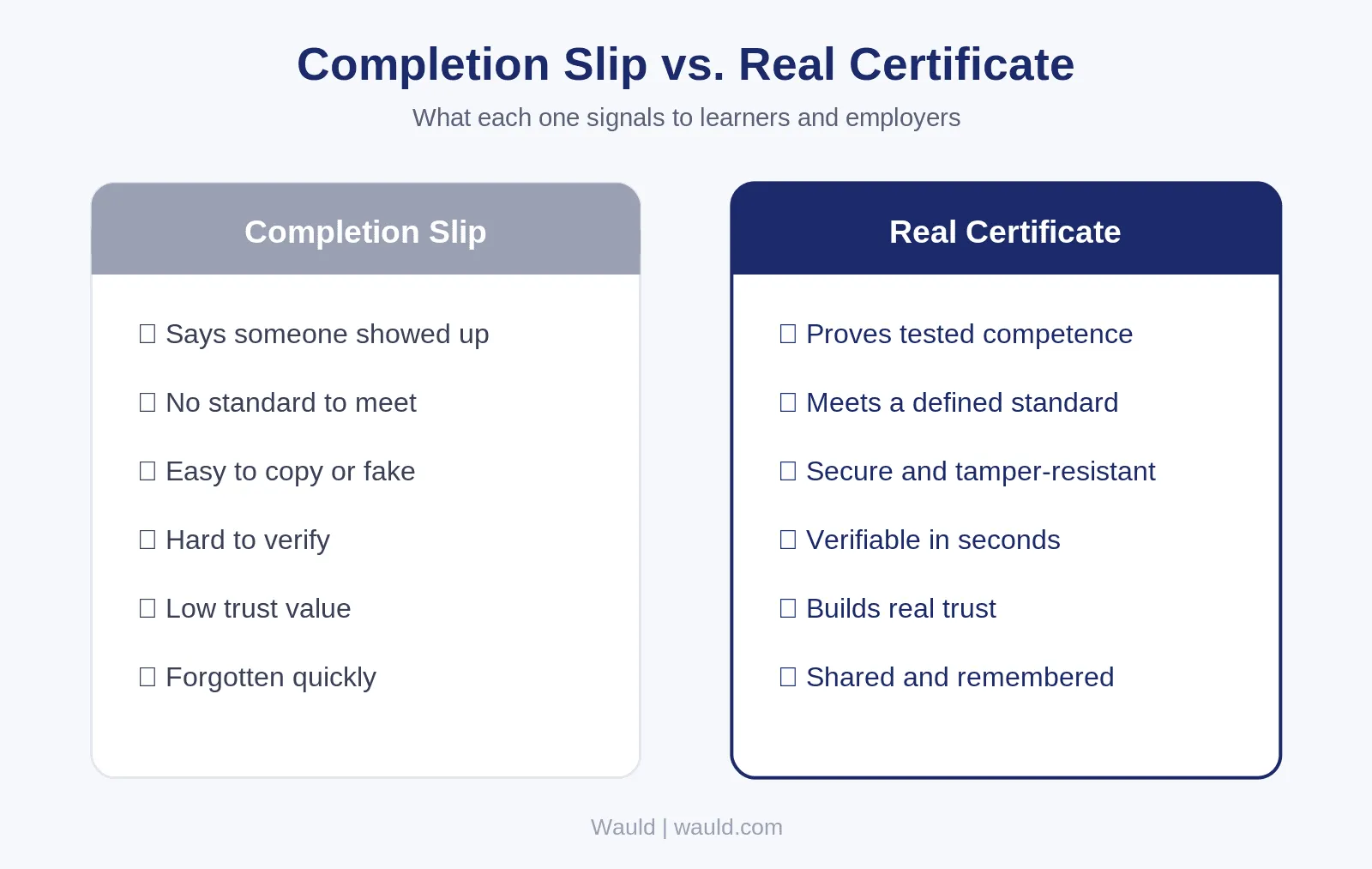
It helps to separate two things that often get blurred. A completion record simply says someone showed up and finished. A certification says someone met a benchmark you set and defended. Industry bodies like SHRM and HRCI built their reputation on that second idea, where the credential signals tested competence rather than attendance.
As an issuer, your training can take a few shapes:
- Live or instructor-led, where learners join sessions and get direct feedback.
- Self-paced, where people move through modules on their own schedule.
- Blended, which mixes recorded content with live workshops or assessments.
Whatever format you choose, the credential at the end is the part that travels. It is the proof your learner carries forward, so it deserves as much care as the curriculum itself.
HR Keeps Changing, And So Should The Training
HR is one of those fields that never sits still. Compliance rules shift, hiring practices evolve, and the tools teams use change from one year to the next. Artificial intelligence is now woven into recruitment and screening. Remote and hybrid work reshaped how people are managed. Pay transparency, wellbeing, and inclusion have moved from nice-to-have topics to board-level priorities.
For the professionals taking your course, this churn means a one-time qualification fades fast. The CIPD makes the point plainly: HR practitioners need to keep up with the latest trends, regulations, best practices, and workplace demands to stay effective in the workforce. For you as an issuer, that constant change is also an opportunity. It creates ongoing demand for fresh, relevant training certification courses and for credentials that show someone's knowledge is current, not a decade old.
Building HR Certification Training People Trust
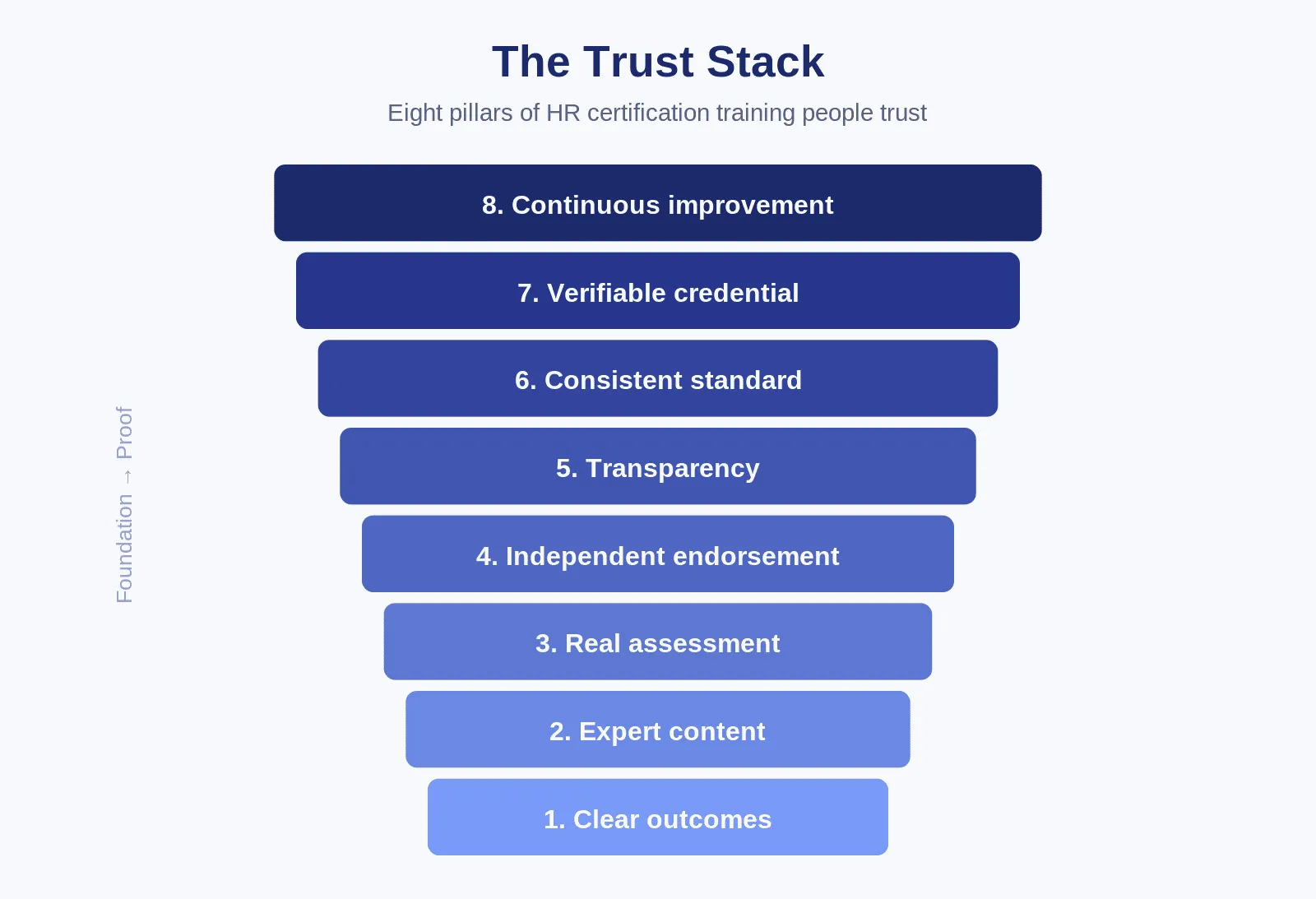
Trust is not one big thing. It is a stack of smaller decisions that add up, and learners, employers, and professional bodies can feel the difference. If you want your HR training programs to carry real weight, these are the pillars worth getting right. Certificate issuance is one of them, but it sits on top of everything else.
Start with clear outcomes, not just topics
Before you record a single lesson, write down what a learner should be able to do by the end. Not "understand recruitment," but "screen candidates fairly and within current hiring law." Clear, measurable learning outcomes are the backbone of any credible program, and accreditation bodies look for them first. They also make your training easier to sell, because people can see exactly what they are getting.
Put real expertise behind the content
A program is only as trustworthy as the people who built it. HR moves fast, so your material needs to be current and correct, which usually means working with practitioners or subject matter experts who can validate accuracy. When learners can see who designed the course and why they are qualified to teach it, confidence goes up. Name your instructors, share their background, and keep the content under review so it does not quietly go stale.
Assess, don't just deliver
This is the line between a completion slip and a certification. A credible program checks that real learning happened. That can mean short knowledge checks along the way and a final assessment at the end, scenario questions, or a practical task. The point is that the credential at the end means someone met a standard, not that they clicked "next" enough times. Reliable assessment is what employers are really trusting when they accept your certificate.
Get independent endorsement where you can
You can vouch for your own program, but outside recognition carries further. CPD accreditation is one accessible route: an external body reviews your content, learning outcomes, and assessment methods and confirms they hold up. As The CPD Standards Office explains, that independent review signals quality to learners and the organizations that employ them. For larger certification bodies, formal standards like ISO/IEC 17024 set the bar for fairness and consistency. You do not need every badge of approval on day one, but having at least one independent stamp does a lot of quiet reassuring.
Be transparent about what the credential means
Trust grows when there are no surprises. Spell out who the training is for, how long it takes, how someone passes, how many CPD hours it carries, and what the certificate does and does not claim. Honest, plain descriptions protect your reputation and stop learners feeling misled later.
Keep the standard consistent
Fairness is part of trust. Two people who do the same work should get the same result. Keeping your content, assessments, and the way you award certificates consistent means nobody feels the credential was easier or harder depending on when they took it. Document how you run things so it stays steady as you grow.
Issue a credential that proves all of this
Here is where it comes together. After all the work on outcomes, expertise, and assessment, the certificate is the proof your learner walks away with. If that proof is a plain file anyone could copy, it undersells everything behind it. A secure, verifiable, well-branded credential is what makes the rest of your effort visible to the outside world. We will come back to exactly what that looks like, and how to issue it without drowning in admin, a little further down.
Listen and improve
No program is finished at launch. Collect feedback, watch where learners struggle or drop off, and update accordingly. Credible providers treat their training as something they keep refining, which keeps it relevant and keeps learners coming back for their next round of CPD.
CPD: Keep Your Program Relevant
Continuing professional development, usually shortened to CPD, is the ongoing process of building skills and knowledge across a whole career rather than in one burst. The CPD Certification Service describes it as the documented record of learning that helps professionals stay capable and current in their roles.
For HR people, CPD is close to non-negotiable. As DPG explains, continuing development keeps HR professionals sharp on changing law, technology, and workplace culture, and it supports the career growth most of them are chasing. Many professional memberships also expect members to log CPD hours each year to stay in good standing.
Here is why this matters to you as a certificate issuer. When you build CPD value into your training, you give learners something they can point to during appraisals, membership renewals, and promotions. A few ways to do it:
- Map your course to a clear number of CPD hours or learning points.
- State the learning outcomes so the value is easy to record.
- Offer short refresher modules so learners come back as the field moves on.
CPD turns a single sale into a relationship. People who use your training to maintain their development tend to return, and they tend to recommend you to peers doing the same.
A Certificate That Carries Real Weight
A certificate is a small thing that does a lot of heavy lifting. For your learner, it is proof. It is the difference between saying "I know recruitment compliance" and showing a credential that backs it up. And the payoff is real: SHRM's own career research found certified HR professionals reported salaries roughly 14 to 15 percent higher than peers without the credential, and most surveyed professionals link certification to better promotion odds.
For you, the issuer, the certificate works just as hard. Every time a learner adds it to a profile or shares it in a feed, your brand travels with it. A well-made credential builds trust in your program, draws in new learners through word of mouth, and gives people a reason to enroll in your next course.
But weight only holds if the certificate is believable. And that is where many programs quietly fall short.
What Makes People Believe Your Certificate
A certificate is only as strong as the trust behind it. The hard truth is that fake and altered credentials are easier to produce than most training providers assume, and a plain PDF is simple to copy or edit. Credly notes that as digital credentials grow more popular, so does the temptation to fake them, which is exactly why verification has become so important.
So what separates a credential people trust from one they quietly doubt? A few things:
- Instant verification. Anyone, an employer, a recruiter, a membership body, should be able to confirm the credential in seconds without calling you. A scannable QR code or a verification link does this well.
- Tamper resistance. The credential should be hard to alter. Open standards help here. Open Badges 3.0 uses cryptographic signatures so a badge can be checked for authenticity and stays verifiable even years later.
- Clear issuer identity. The credential should plainly show who issued it, when, and for what.
- Strong branding. A clean, on-brand design tells people the program is serious and run by professionals.
- Easy sharing. If learners can post it to LinkedIn or drop it into a CV in one click, your reach grows on its own.
Get these right and your certificate stops being a decorative file. It becomes a piece of evidence people are happy to rely on.
Where Wauld Fits In
This is the part that used to eat your time. Designing certificates, sending them one by one, fielding "is this real?" emails, and keeping track of who got what. Wauld is built to take that whole job off your plate so you can focus on teaching.
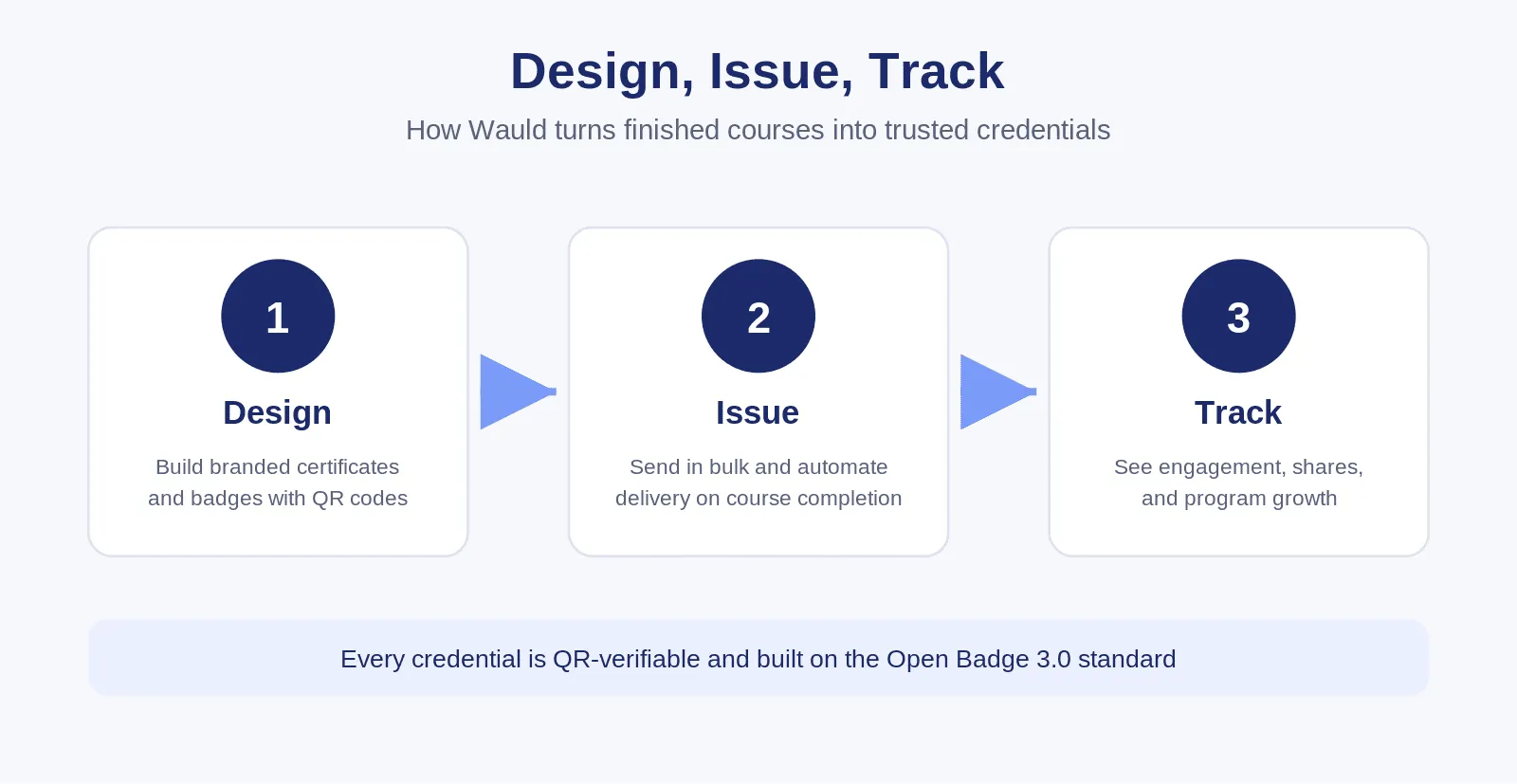
Wauld runs on a simple three-step idea: design, issue, and track.
- Design. Use the certificate and badge design studio to build credentials that match your brand, including QR codes and branded emails, without needing a designer.
- Issue. Send credentials in bulk and automate delivery, so a finished course can trigger a certificate without you lifting a finger.
- Track. See how learners engage with and share their credentials, which gives you real data on how your program is growing.
On the trust side, every Wauld certificate and badge carries a unique QR code that lets anyone verify it in seconds, and the credentials follow the Open Badge 3.0 standard so they stay portable and tamper-resistant across platforms.
It also fits a range of issuers. Wauld supports coaches and course creators, universities and colleges, and memberships and associations, which cover most of the people building HR certification training today. And because learners share their credentials online, they end up promoting your program for you.
A Quick Check Before You Hit Publish
Before you launch your next HR certification training program, run through this short list:
- Does the course map to clear learning outcomes and CPD hours?
- Is the content current with today's HR rules and tools?
- Can anyone verify the certificate in seconds?
- Is the credential tamper-resistant and built on an open standard?
- Does the design reflect your brand properly?
If you can tick most of these, you are offering something learners will value and trust.
Wrapping Up
HR certification training is only as strong as the credential it ends with. Your curriculum proves your expertise, but the certificate is what carries that expertise into the world, into job applications, appraisals, and professional networks. When you build CPD value into your program and back it with a credential people can verify and trust, you give learners something genuinely worth having, and you grow your own reputation every time they share it.
The good news is you do not have to build the credentialing side from scratch. Start with Wauld to design, issue, and verify HR certificates and badges that hold up to scrutiny, and let your learners carry your name forward with confidence.