Food Handler Certification: A Guide for Issuers

Why Food Handler Certification Matters
Picture a small barista academy on inspection day. A health inspector walks in and asks for proof that every staff member holds a food handler certification. The owner reaches for a shoebox, an actual shoebox, stuffed with coffee-stained paper certificates. The next hour disappears into matching names to smudged printouts. That scene plays out in kitchens and classrooms everywhere, and it is exactly the mess this guide helps you skip.
If you train people or issue certificates, food handler certification is part of your daily work. Getting it right keeps your learners legal, your reputation clean, and inspectors happy.
So what is it, in plain English?
Food handler certification is proof that a food worker has completed basic food safety training and passed a short exam on handling food safely.
It covers the everyday habits that keep people from getting sick: handwashing, keeping cold food cold, avoiding cross-contamination, and cleaning properly. It matters because food safety is not a small thing. The CDC estimates that foodborne illness causes about 48 million illnesses, 128,000 hospitalizations, and 3,000 deaths in the US every year (CDC). Good training lowers those numbers.
What the Certificate Actually Proves
A food handler certificate is not a formality. It shows that a worker can spot and prevent the common causes of foodborne illness.
Most courses, and the exam at the end, cover a short but important list:
- Personal hygiene. Handwashing, glove use, and staying home when sick. This one is huge, because studies link many restaurant outbreaks to staff working while ill (CDC MMWR).
- Time and temperature control. Cooking, cooling, and holding food at safe temperatures.
- Cross-contamination. Keeping raw and ready-to-eat foods apart.
- Cleaning and sanitizing. The difference between the two, and when to do each.
Good courses build their content from the FDA Food Code, the model rules that most state and local health departments follow (FDA). If a course ignores the Food Code, that is a red flag.
State Rules and Accreditation
Here is where trainers really need to pay attention, because food handler certification requirements are not the same everywhere.
Some states run their own program. Others accept any course that holds the right accreditation. The gold standard is ANSI-CFP accreditation, granted by the ANSI National Accreditation Board (ANAB) against the Conference for Food Protection standards. California, for example, requires courses to be ANAB-accredited, and Texas requires programs accredited by ANAB or licensed directly by the state (ANAB).
Deadlines vary too. New hires often have between 14 and 60 days to earn their food handlers card, depending on the state. Certificates usually stay valid for a set period (often three to five years) before a worker needs to retest.
The short rule for issuers: know your learners' states, and make sure your food handler training course meets each one's rules before you enroll anyone.
If you issue across several states, keep a simple reference sheet of local requirements. It saves the shoebox scramble later. Renewal dates deserve the same treatment, and our guide to certificate expiry management covers how to keep a whole cohort from lapsing at once.
How to Issue Certificates Online
The whole process has moved online, and it is quick. A learner can usually finish a food handlers certificate online in one to two hours.
Here is the flow when you issue certificates as a trainer:
- Build your course to the FDA Food Code. Cover hygiene, temperature, contamination, and cleaning.
- Get accredited where it counts. Seek ANSI-CFP accreditation so health departments recognize your certificate.
- Assess the learner. A short exam confirms they understood the material.
- Issue a certificate they can prove. Give them a certificate that carries a verification link, so any employer or inspector can confirm it in seconds.
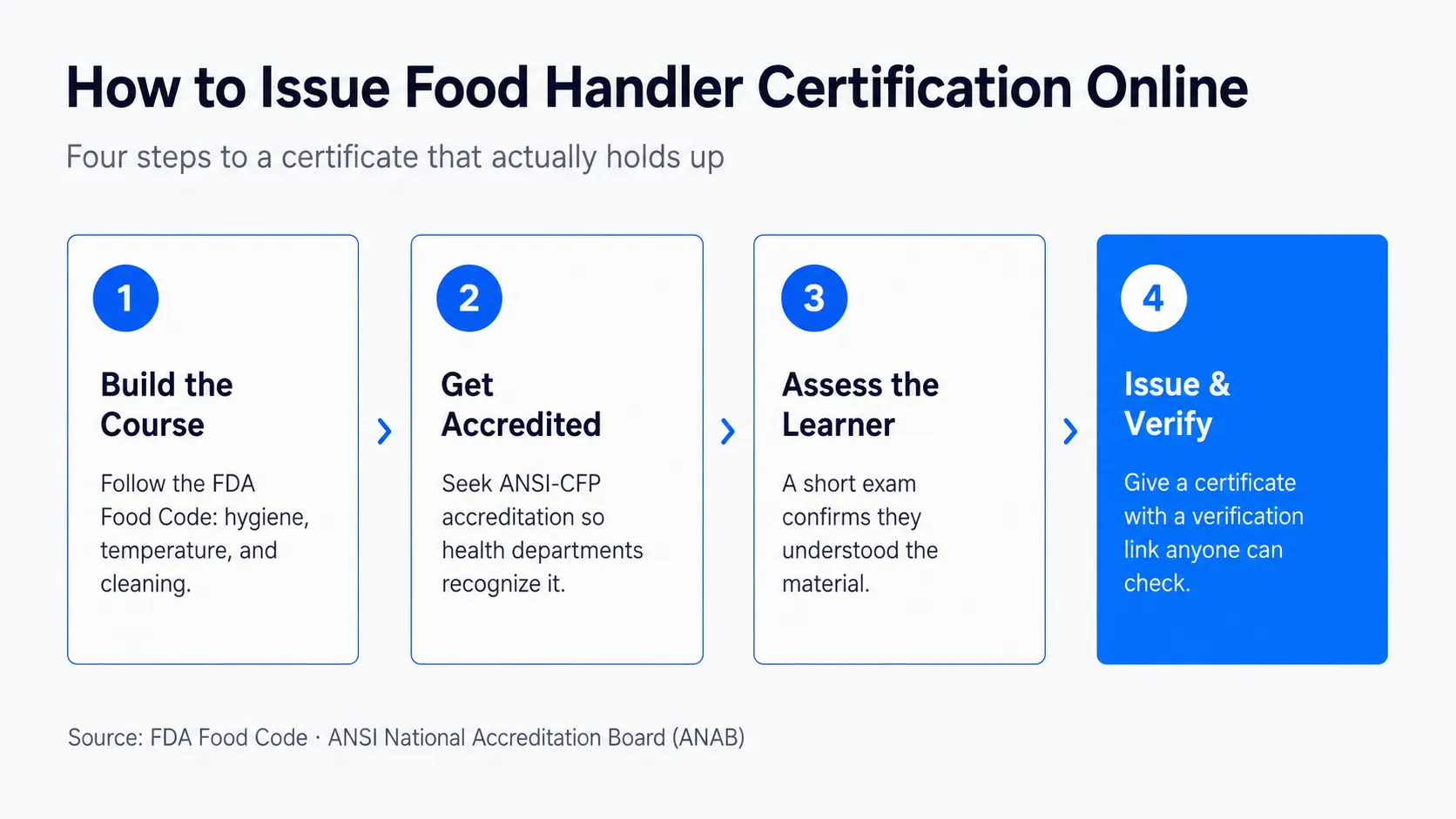
That last step is the one people forget. A certificate is only useful if someone can check that it is real. If your course runs on a learning platform, you can even automate delivery, as this walkthrough on issuing certificates automatically from LearnDash shows. It is why many trainers have dropped paper for digital certificates.
Going Digital With Your Credentials
Paper certificates get lost, faked, and coffee-stained. A digital certificate does not. This is where a credentialing platform fits into your food safety training.
Wauld lets you design, issue, and track food handler certificates from one place. Start with a template, add your branding, and send certificates in bulk after a class. Each one carries a verification link, so an inspector or employer can confirm it instantly. No phone calls, no shoebox.
The lifecycle is three simple steps: Design, Issue, and Track.
A few things make this practical for trainers and course issuers:
- 1000+ templates. Start from a professional design instead of a blank page. This roundup of free certificate maker apps shows how the options compare, or you can browse the template gallery.
- Bulk issuance. Send certificates to a whole class at once, even from form responses.
- Built-in verification. Every credential is verifiable through a unique link or a QR code, aligned with open standards like Open Badges and W3C Verifiable Credentials.
- Easy sharing. Learners can add each credential to their LinkedIn profile in a click, so your program gets seen.
- Engagement analytics. See who opened, downloaded, and shared their certificate.
For trainers, this turns certification from a chore into a smooth part of your training program. For a deeper look at structuring a compliant course, see this guide on building effective training programs.
Bringing It All Together
Food handler certification protects people and reflects the quality of your training. The idea is simple: teach safe habits, test them, and hand over proof. The part that trips trainers up is that proof, especially when it lives in a shoebox.
Build your course to the FDA Food Code, get the accreditation your states expect, and issue certificates anyone can verify in a click. Do that, and you never lose another certificate.
Ready to issue food handler certificates?
Design them with your branding, send them to a whole class at once, and give every learner a certificate an inspector can verify in seconds.
FAQs on Food Handler Certification
- What is a food handler certification? A food handler certification is proof that a food worker has completed food safety training and passed a short exam. It covers hygiene, temperature control, cross-contamination, and cleaning. Employers and health inspectors use it to confirm that staff know how to handle food safely.
- How do you get a food handler certificate? You take an approved food handler training course, usually online, then pass a final exam. Most courses take one to two hours. When you pass, you download your certificate. If you are an issuer, you can deliver that certificate digitally with a verification link so it is easy to check.
- How long is a food handler certificate valid? It depends on the state, but most food handler certificates stay valid for three to five years. After that, the worker retakes the course and exam to renew. Always check your local health department rules, because renewal periods and deadlines differ.
- Does a food handler certificate need to be accredited? In many states, yes. Health departments often require courses with ANSI-CFP accreditation, granted by ANAB against Conference for Food Protection standards. Accreditation shows the course follows the FDA Food Code and tests learners properly, which is why states like California and Texas ask for it.
- Can I issue food handler certificates online as a trainer? Yes. If your course meets your state's requirements, you can deliver food handlers certificates online. A platform like Wauld lets you design branded certificates, issue them in bulk after a class, and give each learner a verification link. That makes proof simple for employers and inspectors.
- What is the difference between a food handler and a food manager certification? A food handler certification is for entry-level staff who prepare or serve food. A food manager certification is a higher level for supervisors, with a harder exam and its own ANAB-CFP accreditation. Many kitchens need both: certified handlers on the line and at least one certified manager on site.