CPD Training in Legal Services: Keep Legal Professionals Ready for What's Next

CPD Training in Legal Services
When a law changes overnight, a legal professional cannot afford to catch up a year later.
That is the reality of working in legal services today. Regulations shift, case law evolves, compliance expectations grow more demanding, and the stakes of falling behind are not just professional. They can be life-changing for the clients, depending on those professionals.
This is exactly why CPD training in legal services is no longer a box-ticking exercise. It is a genuine lifeline, both for the lawyers and solicitors living it, and for the coaches, trainers, HR teams, and L&D departments responsible for making that learning happen.
If you sit on the issuing side of professional development, this one is for you.
The Basics: What CPD Certification Actually Means
CPD, or Continuing Professional Development, refers to the structured learning activities professionals engage in to maintain, sharpen, and grow their skills throughout their careers, not just at the start.
CPD certification is the formal recognition of those learning activities. When a course, workshop, webinar, or training program is CPD certified, it means an independent body has reviewed it and confirmed it meets recognized quality standards.
Here is what that process typically involves for training providers seeking accreditation:
- Submitting course materials to a recognized accreditation body
- Demonstrating clear, measurable learning objectives
- Showing the content is accurate and up to date
- Confirming that trainer qualifications are appropriate
- Providing evidence of how participant learning is assessed
- Showing that feedback from participants is collected systematically
Two of the most widely recognized bodies globally are the CPD Standards Office (founded 2012, members in 72 countries) and the CPD Certification Service (established 1996, members in 100+ countries). Both operate independently and assess CPD content against defined quality frameworks.
For credential issuers, whether coaches, training providers, HR professionals, or L&D departments, CPD certification is what separates your program from the noise. It signals that your content is structured, purposeful, and worth a legal professional's limited time.
How CPD Standards Keep Legal Training Honest
Not all training is created equal. CPD standards act as a quality filter across the legal sector, helping regulatory bodies, employers, and professionals themselves distinguish rigorous development from loosely educational content.
In a field where outdated guidance can have serious legal consequences, this filter matters. CPD accreditation criteria are grounded in ongoing research, which means certified content is expected to stay current and relevant, not just good at launch.
Here is how CPD standards play out across different regions around the world:
United Kingdom
The Solicitors Regulation Authority (SRA) moved from a prescriptive hours-based system to a competence-based approach in 2016. Here is what solicitors are now expected to do:
- Reflect on the quality of their practice
- Identify their learning and development needs
- Plan and carry out relevant learning activities
- Record their learning and development
- Declare compliance annually when renewing their practising certificate
There is no fixed minimum number of hours. The focus is on quality and relevance to the solicitor's specific role. Notably, the SRA launched a consultation in April 2026 proposing to strengthen these requirements further, including mandatory record-keeping and annual ethical discussions for all solicitors.
Barristers operate under the Bar Standards Board (BSB), which takes a different approach by career stage:
- New practitioners must complete 45 CPD hours over three years (including at least 9 hours of advocacy and 3 hours of ethics)
- Established practitioners are no longer subject to minimum hour requirements. They carry individual responsibility for deciding what training they need and declaring completion annually
United States
The US has no single national standard. Instead, Continuing Legal Education (CLE) is managed state by state, creating varied obligations across jurisdictions:
- California: 25 MCLE hours per 3-year compliance period, with at least 12.5 participatory credit hours
- Minnesota: 45 CLE hours per reporting period, including 3 hours in ethics, 2 hours in bias elimination, and 1 hour in mental health and substance use
- Colorado: 45 CLE hours per period, with 7 dedicated to professional responsibility
- Washington D.C.: No minimum hour requirement
For training providers targeting US-based legal professionals, knowing your audience's jurisdiction is not optional. Requirements differ significantly, and a program built for one state may not satisfy another.
Australia
Australian lawyers must complete 10 CPD units annually, with the year typically running from 1 April to 31 March. What makes Australia distinctive is the mandatory category structure:
- At least 1 unit in Ethics and Professional Responsibility
- At least 1 unit in Practice Management and Business Skills
- At least 1 unit in Professional Skills
- At least 1 unit in Substantive Law
Additional notes worth knowing:
- Recorded or on-demand content is capped at 5 units per year (live webinars attended in real time are not subject to this limit)
- Some states, including South Australia and the Northern Territory, include mandatory units on bullying, discrimination, and harassment
- The system runs on self-assessment, meaning lawyers track and document their own learning
Canada
CPD requirements vary across provinces, though most cluster around 12 hours per year:
- Ontario: 12 hours per year, including at least 3 hours in professionalism topics (ethics, practice management, EDI)
- British Columbia: 12 hours per calendar year
- Manitoba: 12 hours per year
- Nova Scotia: 12 hours per year, with a written CPD plan due by June 1
- Quebec: 30 hours per 2-year cycle, including at least 3 hours in ethics or professional practice
- Alberta: No minimum hours. Lawyers submit an annual CPD plan instead
European Union
Across the EU, requirements vary considerably by member state. Belgium, for example, requires lawyers registered with the OBFG to accumulate an average of 20 CPD points per calendar year across a three-year reference period. The Academy of European Law (ERA) supports cross-border CPD for legal professionals working across multiple jurisdictions, reflecting how interconnected European legal practice has become.
Why Staying Current in Law Is Non-Negotiable
The legal landscape does not stay still. In recent years, legal professionals have had to navigate:
- AI and technology: Understanding how AI tools affect legal practice, from contract review to evidence handling
- Cybersecurity obligations: Protecting client data and managing firm-wide cyber risk
- Anti-money laundering (AML): Identifying suspicious transactions and meeting evolving regulatory obligations
- Data protection: GDPR and its interpretations continue to develop across jurisdictions
- Employment law: Fast-moving changes in worker rights, hybrid working, and tribunal outcomes
A lawyer who qualifies and stops learning is not just stagnant. They are a risk, to their clients, to their firm, and to themselves.
CPD training in legal services gives professionals a structured, ongoing way to stay current. And critically, it gives firms a way to demonstrate that their teams are genuinely competent, not just technically licensed.
For HR and L&D professionals in legal organizations, CPD is also a retention and engagement tool. Lawyers who receive quality continuing education tend to feel more supported, more confident, and more valued. Investment in development signals that the firm sees them as a long-term asset.
The Real Value of a CPD Certificate
Once a legal professional completes a CPD program, they need something that reflects the work they put in. And so do you, as the provider who designed and delivered it.
A CPD certificate does several things at once:
For the learner:
- Provides verifiable proof of their continuing development
- Strengthens their CV and supports career progression
- Helps demonstrate compliance when regulators or employers ask for it
- Builds professional confidence and credibility
For the credential issuer:
- Acts as a public-facing marker of your program's quality
- Builds trust with prospective learners comparing your offering to competitors
- Demonstrates your commitment to professional standards
- Provides shareable content that extends your reach when learners post credentials online
There is also the question of verification. Regulatory bodies and employers do not always take people at their word. A certificate that can be independently verified in seconds carries far more weight than one that cannot. In the legal sector specifically, where compliance documentation matters, this distinction is significant.
Where Wauld Comes In
This is where Wauld is built for the job.
Wauld is a digital credential platform that helps organizations design, issue, and manage verifiable certificates and badges, all in one place. It handles the full end-to-end credential workflow so you can focus on the training itself rather than the admin that follows.
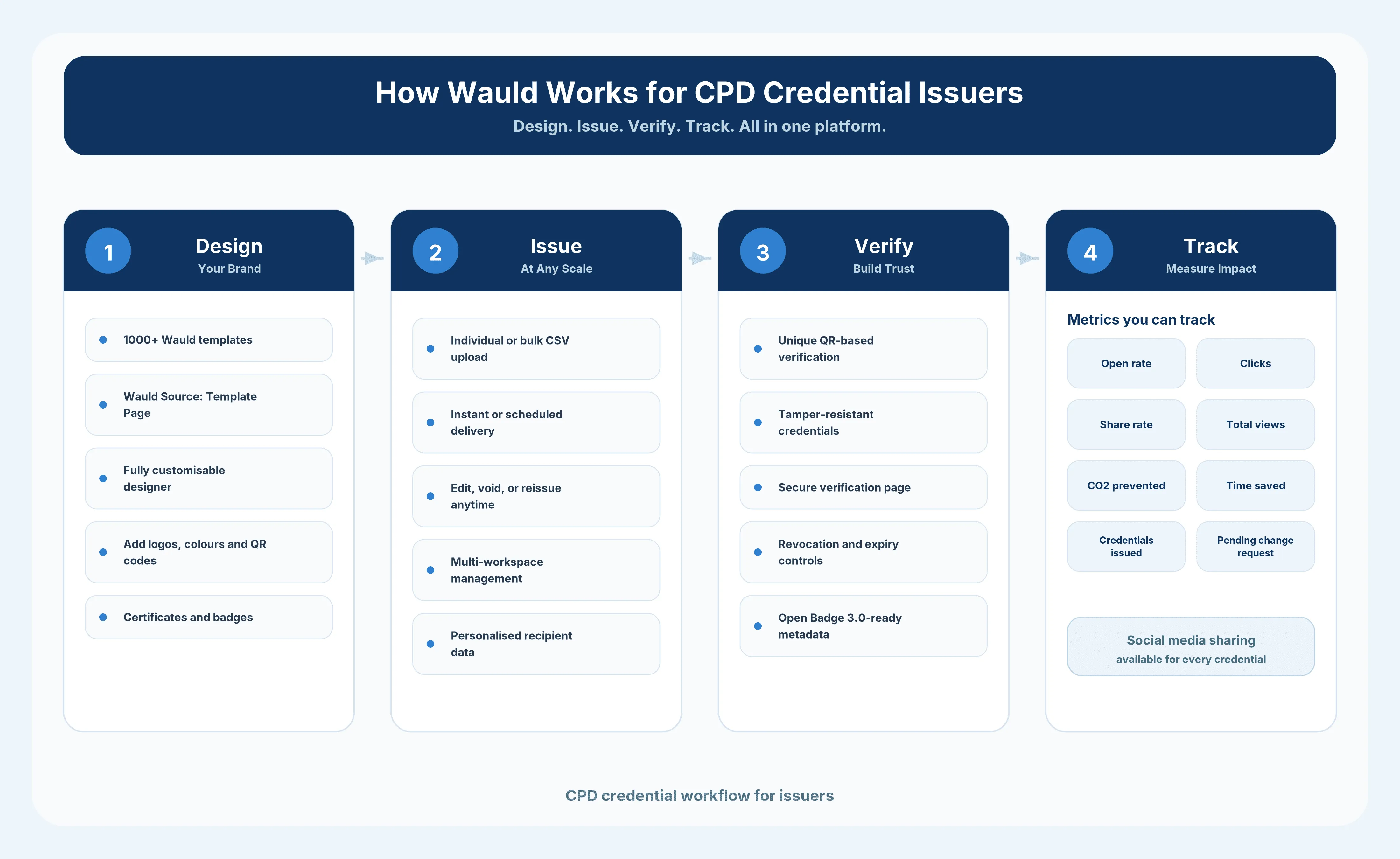
For legal training providers specifically, this matters. Regulatory requirements across jurisdictions mean your credential program needs to be airtight: well-designed, verifiable, and trackable. Wauld gives you the infrastructure to deliver that without the manual overhead.
Keep Legal Professionals Growing, and Let the Credentials Prove It
CPD training in legal services exists because the law never stops changing, and neither can the people who practice it.
As a credential issuer, whether you are a coach supporting independent practitioners, an HR team managing compliance training, an L&D department building development frameworks, or a training provider running accredited programs, your role in this process genuinely matters. You are not just issuing certificates. You are helping legal professionals stay competent, compliant, and confident in a field that demands it.
The right platform makes that work much easier.
Ready to issue CPD credentials that legal professionals can actually use and trust?