CPD Training in HR and Workplace Management

CPD Training in a Workplace
People stay where they grow. That one idea explains why CPD training in HR and workplace management has become such a big focus, and why more teams are putting real money and real time behind it. When your people learn on a steady cadence, your policies get sharper, your culture gets warmer, and your business keeps pace with rules that change almost every quarter.
A quick note before we dig in
This blog is written for the people who shape learning and recognize it with a certificate at the end. If you build courses, run a training studio, lead an L&D team, coach professionals, or hand out completion credentials of any kind, the next few sections are for you. We will keep it simple, walk through what CPD is, what good standards look like, how different countries treat them, and how the right digital certificate setup can save you a lot of time.
A simple way to understand CPD certification
CPD stands for Continuing Professional Development, and a CPD certification is proof that a piece of learning has been reviewed against a recognized standard. Think of it like a quality stamp. When someone finishes your course, the certificate tells the world that the content was structured, current, and worth the learner's time.
CPD itself is just the intentional habit of growing your skills after you finish formal education. It can be a workshop on Friday afternoon, a quiet hour with a book, a coaching call, a webinar, or a full diploma. The CPD Certification Service sorts these into formal learning (structured courses, lectures, online programs) and informal learning (on-the-job practice, mentoring, conferences). Both count, as long as the learner can show what they took away from it.
For credential issuers, the takeaway is this. A CPD-accredited certificate carries more weight than a generic certificate of attendance, especially in regulated industries where employees in finance, law, medicine, and construction can lose their license if they fall behind on their CPD.
What sits behind a CPD-accredited course
A CPD accreditation body reviews your course materials, your structure, and your learning outcomes. Once you pass that review, your certificate can carry official CPD points or hours, which the learner can submit to their professional body.
What good CPD looks like inside HR and workplace management
Workplace management has changed a lot in the last few years. Hybrid teams, AI tools, new privacy rules, fresh wellbeing expectations, and updated discrimination law all land on the HR desk first. CPD for HR professionals is the steady drumbeat that keeps a people team current on every one of these shifts.
Strong CPD programs within HR usually cover a few common areas. Employment law refreshers. DEI and inclusive leadership. Conflict resolution and mediation. Workplace safety. Mental health first aid. Data privacy and HR analytics. Performance management. Recruitment and onboarding ethics. The CPD Standards Office groups HR and recruitment as one of its busiest categories, which tells you how active this space is.
The CIPD, which is the main HR body in the UK, takes an outputs-based view of CPD. That means the focus is not on how many hours someone sat in a chair. It is what changed in their day-to-day practice. As a credential issuer, that distinction is useful. The certificates you hand out are more valuable when they point to a clear outcome, not just attendance.
What standards are usually required of a course
Most CPD standard bodies ask for three things. Clear learning objectives. Up-to-date content reviewed by a subject expert. A way to assess whether the learner actually understood the material. If your course ticks those boxes, accreditation is within easy reach.
CPD around the world: a quick country tour
There is no single global rulebook for CPD. Every country builds its own version, but the CPD Standards Office reports that the basic idea is shared everywhere, just under different names. In the United States it is often called Continuing Education or CE. In healthcare you will hear Continuing Medical Education. Lawyers call it Continuing Legal Education. The shape is the same, the labels just shift.
United Kingdom
The UK has one of the most mature CPD systems anywhere. More than 450 professional bodies require it from their members. For HR specifically, the CIPD recommends around 30 hours of planned learning each year, backed by at least three CPD records to show the impact of that learning.
United States
The US is highly fragmented but very active. The two main HR bodies are SHRM and HRCI. SHRM credential holders must earn 60 professional development credits over a three-year cycle (45 for SHRM-CP). HRCI uses a similar model, asking for 60 recertification credit hours every three years. Both let HR pros earn credits through courses, webinars, conferences, and reading approved materials.
Australia
The Australian HR Institute (AHRI) runs CPD for the country's certified HR practitioners. To keep your CPHR status, you complete at least 40 hours of CPD a year and stick to the AHRI Code of Ethics. The structure is close to the UK model.
Canada
The HRPA, which oversees the CHRP, CHRL, and CHRE designations, requires 66.67 hours of professional development across each three-year cycle. That averages out to a little over 22 hours a year.
Wider Asia and India
India does not yet have one single national HR CPD framework, but bodies like NHRDN, SHRM India, and CIPD India all encourage members to follow the same kind of structured learning. Many Indian employers are now adopting internationally accredited CPD courses so their staff can compete in a global job market.
Why CPD matters in the workplace
A workplace is only as strong as the people running it, and CPD is one of the cleanest ways to keep those people sharp. There are five reasons it pays off again and again.
- Compliance: Employment law, health and safety, and data privacy rules update constantly. A team trained last year may not be trained for this year. Regular CPD closes that gap before a regulator does.
- Better policy writing: HR policies that come from teams who learn often tend to be clearer, fairer, and easier to follow. When your people read new case studies, new research, and new frameworks every quarter, your handbook reflects that thinking.
- Retention. CPD signals that the company is invested in the person. According to Insights for Professionals, professional development is one of the strongest reasons employees stay loyal, because it helps them feel fulfilled in their current role instead of looking elsewhere.
- Culture. CPD builds a workplace that talks about learning naturally. People share what they read, what they tried, and what worked. That habit alone reduces conflict and improves collaboration.
- Trust with leadership. When HR teams hold current credentials, the rest of the business takes their advice more seriously. That trust is the difference between a policy that gets followed and one that gets ignored.
How CPD certificates help everyone involved
A certificate is not just a piece of paper at the end of a course. It is a record, a motivator, and a verification tool all at once. For your learners, a certificate is something they can share on LinkedIn, add to a CV, and use to renew their professional license. For HR and L&D teams, the certificate is the audit trail that proves the training happened.
Modern digital certificates take this even further. As Sertifier explains, digital credentials are cryptographically signed, meaning they are near-impossible to fake, and they can be checked in seconds with a single click. That matters when a recruiter or regulator needs to confirm a credential without calling you for a manual check.
For workplaces, the benefits stack up quickly. Faster verification means lighter admin. Cleaner records mean better compliance reports. Shareable badges mean your training brand travels with every employee who completes a course. The research from Certifier also points out that learners stay more engaged when they know their effort will be recognized with something they can show and verify.
Where Wauld fits into your CPD workflow
If you issue CPD certificates today, you already know how much time the back-end work can eat. Designing each certificate, uploading recipient lists, mailing them out, handling reissue requests, and answering verification queries can become a small department on its own. That is the gap Wauld was built to close.
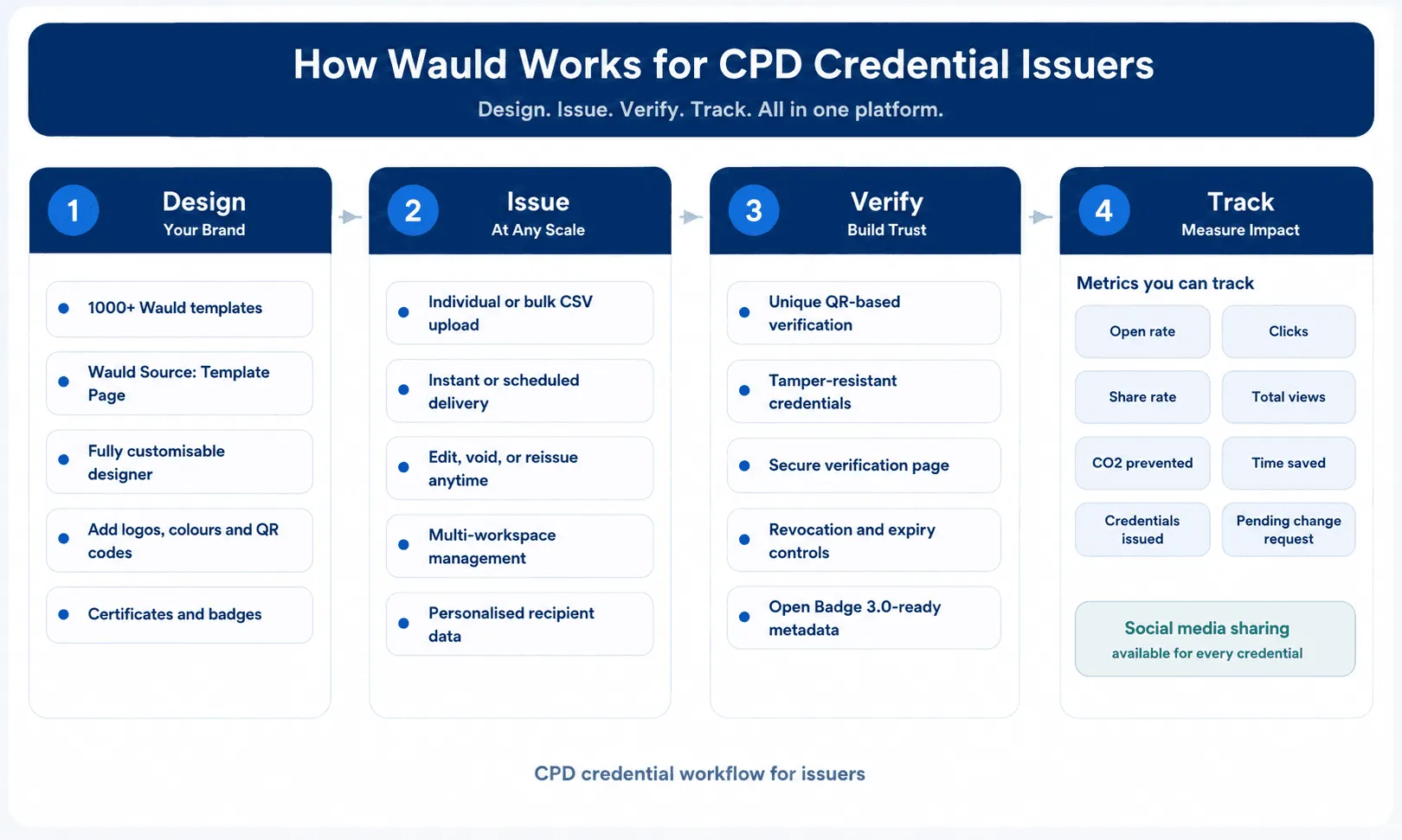
Wauld is a digital credential platform that lets you design, issue, track, and verify certificates and badges from one dashboard. You can start with one of 1,000+ ready-made templates, including a universal CPD certificate template that you can brand in minutes. You can issue in bulk with a CSV file, or one by one when you need to. Every certificate carries a secure verification ID and a QR code, so anyone can confirm it in seconds.
For trainers and coaches, the training solution makes it easy to scale up a program without scaling up the paperwork. For universities and colleges, the higher education solution keeps every diploma, badge, and certificate tied to the institution's brand and verifiable for life. For HR teams running their own academies, the memberships and associations solution lets you celebrate member milestones with badges and certificates that travel across LinkedIn and CVs.
You also get the analytics piece, which is often missing in older tools. You can see who opened the certificate, who shared it on LinkedIn, who downloaded the PDF, and how many people have verified it. That data is gold when you are reporting on the impact of a training program.
Final thoughts
CPD training in HR is not a tick-box exercise anymore. It is one of the quietest, steadiest ways to build a workplace people want to stay in, and it is one of the clearest ways to show the outside world that your training is the real thing. The standards are out there. The country frameworks are out there. The need is out there. What used to be missing was a simple way to wrap it all in a credential that holds up.
If you are ready to issue CPD certificates that are easy to design, fast to send, and instantly verifiable, start with Wauld today and put the admin time back into the work that actually grows your people.