CPD Training in Finance: Building Professional Trust

The Main Question
CPD training in finance is one of the most scrutinized forms of professional development in the world. So here is a question worth sitting with: if one of your learners completed a compliance course last year, how do you prove it today?
That question matters more than it might seem at first. In finance, staying current is not just about career growth. It is a regulatory obligation. And the organizations behind that learning, from training providers and professional associations to HR departments, L&D teams, and many others, carry real responsibility in how they certify and document that development.
If you design finance programs, lead structured CPD initiatives, or issue certificates to professionals working in financial services, what follows will walk you through:
- What CPD certification means in the finance industry
- The global standards and country-specific requirements you need to know
- Why getting credentialing right is non-negotiable
- How Wauld helps you issue CPD certificates that actually hold up
What CPD Certification Means in Finance
Continuing Professional Development (CPD) is an ongoing process by which professionals maintain and expand the knowledge and skills that keep them effective in their roles. In finance, this is not something professionals opt into out of personal ambition. It is a condition of staying licensed, credible, and trusted.
CPD in finance spans a wide range of topics, including:
- Technical skills: financial modeling, risk management, data analytics
- Regulatory updates and compliance training
- Ethics and professional conduct
- ESG fundamentals and sustainable finance
- Leadership and professional communication
The point is not just to tick a box. It is to ensure that professionals working in high-stakes environments are not operating from outdated knowledge.
How CPD can be earned
There are three main types of CPD activity, and most regulatory bodies in finance rank them differently:
- Structured CPD is the most commonly required type. It includes formal, active learning activities like courses, workshops, webinars, and seminars where outcomes are measurable and attendance is documented.
- Reflective CPD covers more passive engagement, such as watching recorded sessions, listening to podcasts, or reviewing case studies.
- Informal CPD is self-directed: reading industry publications, participating in professional forums, or carrying out independent research.
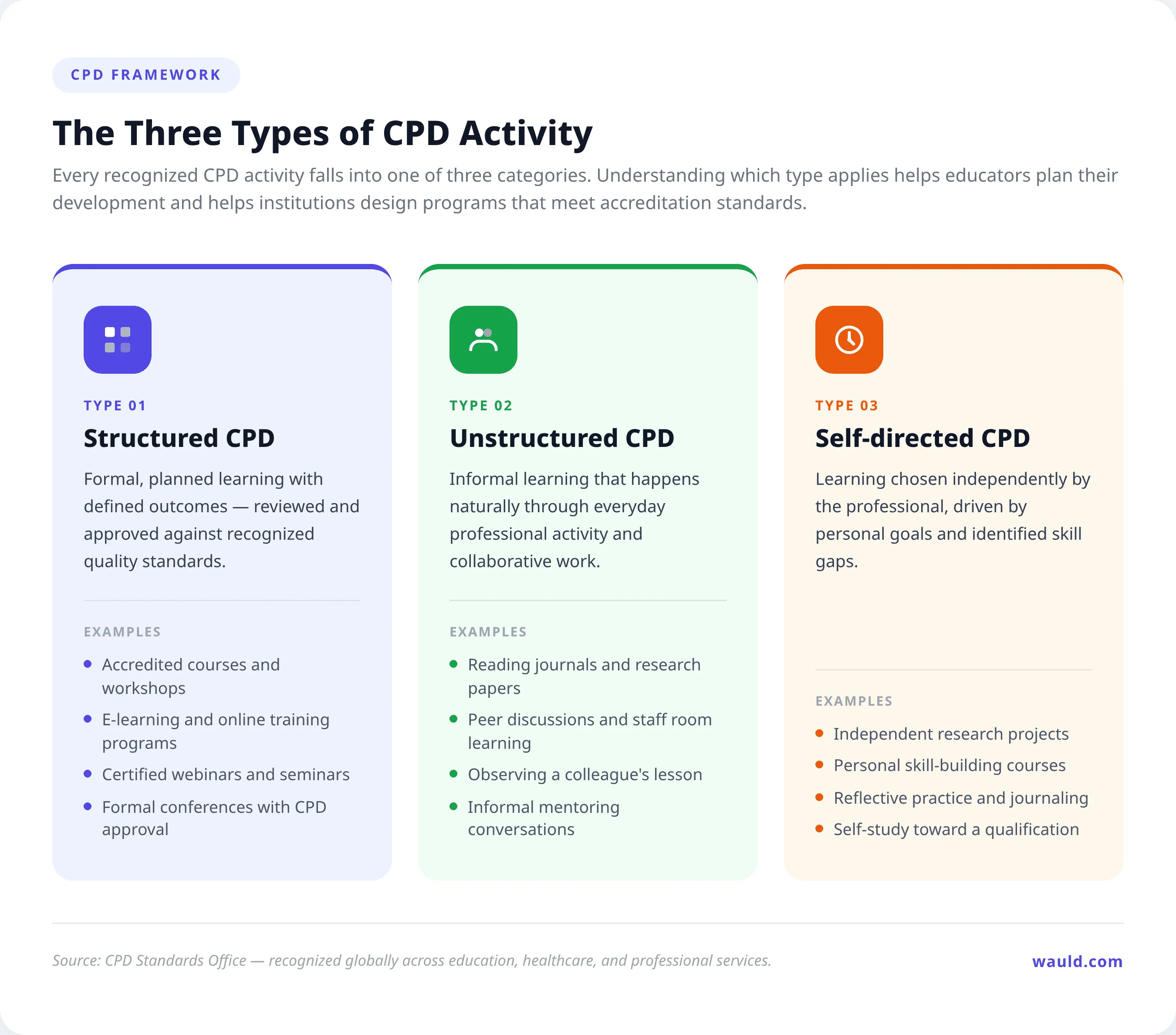
In finance, regulators place the greatest weight on structured CPD. That is the type that is easiest to document, easiest to verify, and the type your learners most need you to certify properly.
CPD vs CPE: a quick note
CPD in finance is also distinct from CPE (Continuing Professional Education), a term more commonly used in the United States. Here is how they differ:
- CPD is used in the UK, Canada, Europe, Asia, and Australia as a broader term covering all types of professional learning
- CPE is used primarily in the US and focuses on formal, structured education tied to specific certification bodies
If your programs serve professionals across multiple regions, understanding both frameworks helps you position your offering correctly.
The Regulatory Framework Behind CPD in Financial Services
Financial services is one of the most CPD-intensive industries in the world. Regulators across jurisdictions have established specific minimum hours, mandatory topics, and documentation requirements that finance professionals must meet annually or on a multi-year cycle.
This is where it gets important for issuers. When a financial professional presents your certificate as evidence of CPD, it is not just their credibility on the line. It is yours too.
Regulatory bodies and employers expect CPD certificates to be:
- Accurate and traceable to the issuing organization
- Aligned with recognized standards for the relevant jurisdiction
- Verifiable by third parties without manual effort
The CPD Standards Office, one of the leading accreditation bodies for CPD providers globally, actively works with finance organizations to ensure that training programs meet the standards regulators expect. Becoming a recognized CPD provider in finance is a signal of quality that professionals and employers notice.
For any organization issuing CPD certificates in financial services, alignment with the right standards is the starting point. The certificate is the end product, and it needs to be built on a solid foundation.
CPD Requirements Around the World
Understanding CPD standards in finance is not a one-size-fits-all exercise. Requirements vary by country, by designation, and sometimes by employer. If your programs serve professionals across more than one market, here is what each region expects.
United Kingdom
The Financial Conduct Authority (FCA) sets the baseline for financial advisers:
- Minimum 35 hours of CPD per year
- At least 21 of those hours must be structured
- The CISI and ICAEW maintain their own frameworks on top of this
ICAEW updated its CPD regulations in November 2023. Under the new rules:
- A proportion of learning hours must now be verifiable
- At least one hour per year must cover ethics
- CPD records must be retained for a minimum of three years
- Active monitoring visits began in November 2024
United States
In the US, CPD requirements are largely driven by individual designations:
- Certified Financial Planners (CFP): 30 hours every two years, including 2 hours of ethics
- CPAs: typically 40 hours of CPE per year (varies by state board; Vermont, for instance, requires 80 hours over two years)
- Certified Management Accountants: 30 CPE hours annually, 2 of which must be in ethics
- Certified Internal Auditors: 40 hours per year, with an ethics component
Australia
ASIC sets mandatory CPD standards for financial advisers:
- 40 hours of CPD required per year
- 70% of those hours must be approved by the adviser's licensee
- Advisers providing tax financial advice must include a minimum of 5 hours in that specific CPD area
- The framework was originally established under FASEA and is now directly administered by ASIC
Canada
FP Canada updated its requirements effective January 2025. CFP professionals must complete 25 hours of CE annually in total, broken down as follows:
- At least 12 hours in the Financial Planning category (up from 10), which now includes a new Professional Skills sub-category
- At least 2 hours in the Professional Responsibility category, which must be pre-accredited by FP Canada before it qualifies
- Remaining hours as General CE
For CPAs in Canada, the requirement is 120 hours of CPD over a rolling three-year period, with at least 20 hours (including 10 verifiable hours) completed every year.
European Union
Under MiFID II, EU firms are required to:
- Carry out at least an annual review of staff development needs
- Ensure those needs are addressed through active continuing professional development
- Cover areas including AML compliance, product governance, and broader regulatory knowledge
The specific hours and format vary by country and role, but the overarching principle is consistent: finance professionals must actively keep their knowledge current.
Singapore
The Institute of Banking and Finance Singapore (IBF) administers CPD requirements for finance professionals under MAS regulations. For representatives regulated under the Financial Advisers Act (FAA):
- A minimum of 14 hours of core CPD is required annually, made up of 6 hours in Ethics and 8 hours in Rules and Regulations
- Core CPD courses must be accredited by IBF or the Singapore College of Insurance (SCI) to count
- Supplementary CPD hours may also be required depending on the specific license and scope of advisory services
The common thread across all of these markets is that CPD is mandatory, documented, and increasingly verified. The certificate your learner receives from you is the evidence that follows them through audits, employer checks, and license renewals.
Why CPD in Finance Carries Consequences
Finance is not an industry where professional development is a nice addition. It is embedded in the regulatory architecture for good reason.
The cost of non-compliance
Failing to meet CPD requirements can be serious for everyone involved:
- For individual professionals: fines, suspension of certification, or revocation of their license to practice
- For employing firms: compliance risk and reputational exposure
- For training providers and issuers: association with incomplete or inaccurate certificates can damage credibility significantly
Why regulators take it seriously
Financial professionals work with people's savings, investments, pensions, and futures. Regulators and professional bodies require CPD because:
- Markets change constantly, bringing new instruments and new risks
- Regulations evolve, and professionals must stay aligned
- Ethical standards require ongoing reinforcement, not just a one-time introduction
- A professional working from five-year-old knowledge in a fast-moving environment is a liability, not an asset
The trust dimension
For clients, visible CPD compliance builds confidence. When an adviser can show they have consistently met their development obligations, it is a clear signal of professional commitment. That signal becomes far stronger when the certificate backing it up can be verified instantly.
Employers are also increasingly looking for proof rather than claims. A line on a CV that says "completed CPD training" carries far less weight than a digital certificate with a verification link that confirms the credential is genuine, current, and issued by a recognized provider.
Why the Certificate Is More Valuable Than You Might Think
A CPD certificate is doing more work than it looks like it is doing. In finance, it is not just a record of attendance. It serves as:
- A proof of professional standing for license renewals
- Evidence for regulatory audits and employer due diligence
- A credential for career progression and job applications
- In some jurisdictions, a legal document tied to ongoing compliance
The problem with traditional certificates
CPD fraud is a growing problem in regulated industries. Traditional paper or PDF certificates fall short in several ways:
- They can be lost, altered, or fabricated
- Fragmented tracking systems mean records do not follow the professional across roles or organizations
- Employers and regulators cannot verify them without contacting the issuer directly
What digital CPD certificates solve
Digital CPD certificates address these problems directly. When a certificate is issued digitally with a unique, secure identifier:
- It can be checked by any employer, regulator, or professional body in real time
- The check confirms the recipient's identity, the issuer's legitimacy, and the certificate's authenticity, without anyone needing to contact you directly
- Verifiable credentials are digitally signed at the point of issue, so any alteration breaks the signature and flags the fraud
For organizations issuing CPD credentials in finance, this is not a future consideration. It is the present expectation. Professionals in regulated industries need credentials that travel with them and hold up to scrutiny wherever they go.
How Wauld Helps You Issue CPD Credentials
Wauld is an end-to-end digital credentialing platform built to make the full certificate lifecycle manageable, covering everything from design to delivery to verification. For organizations issuing CPD credentials in finance, it brings together everything you need in one place.
Here is what that looks like in practice:
- Branded credentials that reflect your quality. Wauld's certificate builder lets you design professional, fully branded digital certificates and badges that represent your organization well. Browse Wauld's CPD certificate template library with over 900 ready-to-use, customizable designs to find one that matches your brand and gets you issuing faster.
- Fraud-proof certificates, instantly verifiable. Every certificate issued through Wauld carries a secure, unique ID. Anyone with the link, whether an employer, a regulator, or a professional body, can verify the credential in seconds, checking the recipient's identity, the issuer's details, and the certificate's authenticity. No manual verification calls needed on your end.
- Real visibility into how your credentials perform. Wauld's issuer dashboard lets you see who has opened, downloaded, and shared their certificates. You can track LinkedIn profile additions, views per click, and verification requests. For CPD programs where engagement and reach matter, this data is genuinely useful.
- Centralized management at any scale. Whether you are issuing credentials to 20 learners or 2,000, Wauld's centralized dashboard gives you full control. Issue, edit, and void certificates; manage multiple workspaces; assign role-based access, all without the administrative overhead that manual processes create.
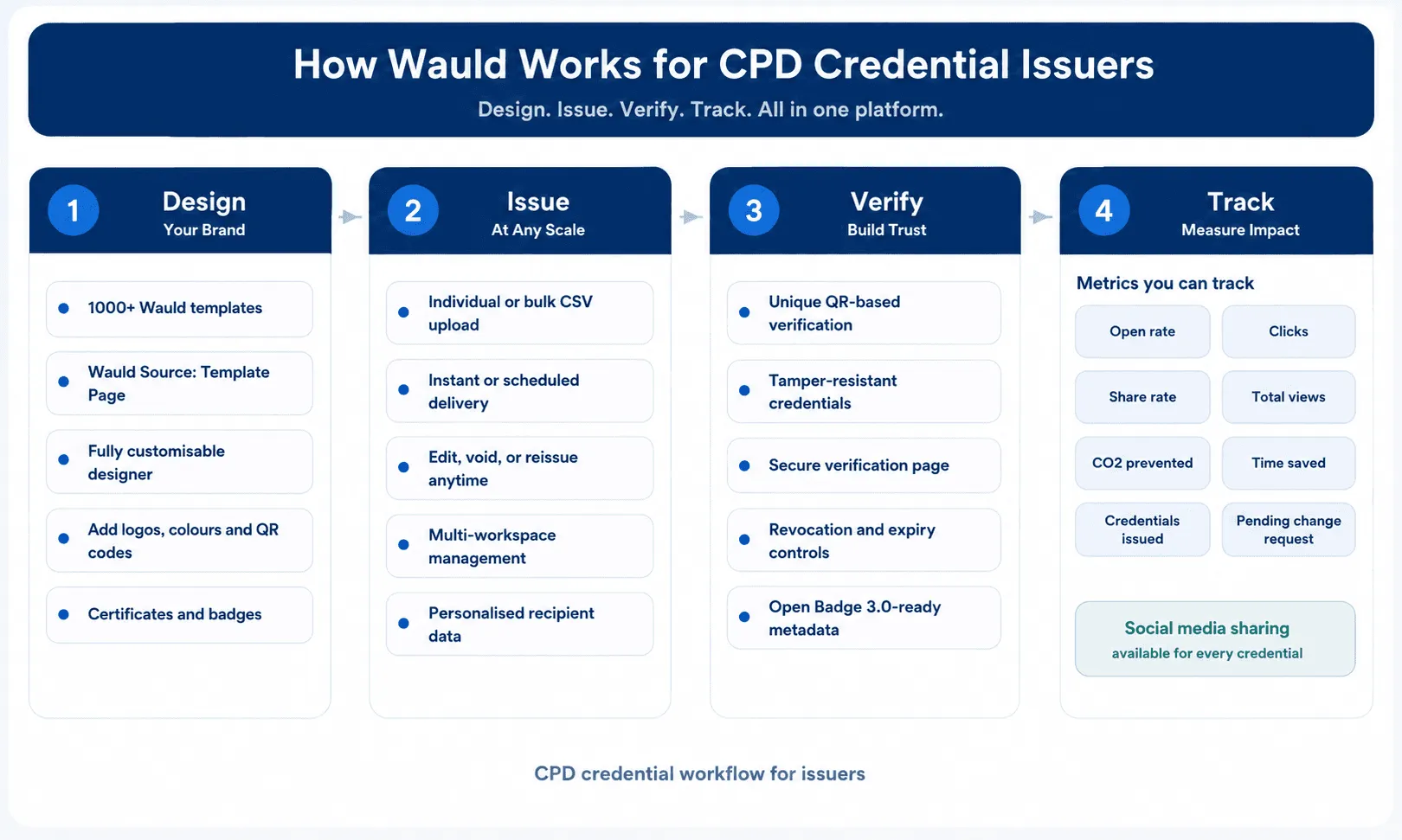
For training providers, professional associations, HR teams, and L&D departments working in financial services, the ability to issue professional, instantly verifiable CPD certificates is not a bonus feature. It is the baseline for being taken seriously by the professionals and organizations you serve.
Getting This Right Is Worth the Effort
CPD in finance is one of the most consequential areas of professional development that exists. The regulatory expectations are clear, the stakes for non-compliance are real, and the professionals who go through your programs are relying on the credentials you give them to maintain their licenses, build their careers, and earn the trust of the people they advise.
Getting CPD credentialing right means:
- Understanding what different regulators expect in each jurisdiction
- Building programs that genuinely meet those standards
- Issuing certificates that can stand behind your learners wherever they go
- Treating the certificate not as a formality, but as a core part of the value you deliver
If you are ready to raise the standard of the credentials you issue, Wauld is built to help you do exactly that.