CPD Training in Education for Teachers, Trainers, and Academic Staff

Why the Best Educators Are Also the Best Learners
Ask any experienced educator what separates a good teacher from a great one, and you will likely hear the same answer: they never stopped learning. CPD training in education is how that commitment gets structure, recognition, and real-world value, and it is becoming more central to the profession than ever before.
Schools, universities, training providers, and coaching institutions around the world are recognizing that great teaching does not happen by accident. It takes intentional, ongoing professional development, and credentials that prove that growth is happening.
Whether you run a teacher training program, manage a learning and development department, or lead an educational institution, this blog is for you. We will walk through:
- What CPD certification actually means
- How standards and requirements work globally
- Why it matters beyond just ticking boxes
- How the right credentials make CPD count
Let us get into it.
What CPD Certification Means
CPD stands for Continuing Professional Development. For teachers, trainers, and academic staff, it is the structured way they stay on top of evolving curricula, new teaching methods, emerging technologies, and the changing needs of their learners.
CPD certification takes this a step further. A CPD-certified course or program has been independently reviewed and approved to confirm that it meets recognized quality standards. Think of it as a quality mark: an assurance that the training content is credible, relevant, and genuinely valuable.
Organizations like the CPD Standards Office and the CPD Certification Service are among the most recognized accreditation bodies globally. When a course earns approval from one of these organizations, it signals to learners, employers, and professional bodies that the program is worth their time and trust.
For educators, CPD covers a wide range of learning formats:
- Formal courses and accredited workshops
- Webinars and online learning programs
- Peer mentoring and coaching
- Conferences and professional events
- Structured self-study and independent research
Hours completed are typically tracked in the form of CPD points or units. Many professional bodies, including teacher registration councils, nursing regulators, and HR associations, now recognize CPD certificates as formal evidence of ongoing professional competence.
Understanding CPD Standards in Education
CPD standards in education are built on a few core principles: the learning must be structured, intentional, and directly tied to professional competence. It needs to genuinely improve a professional's ability to do their job.
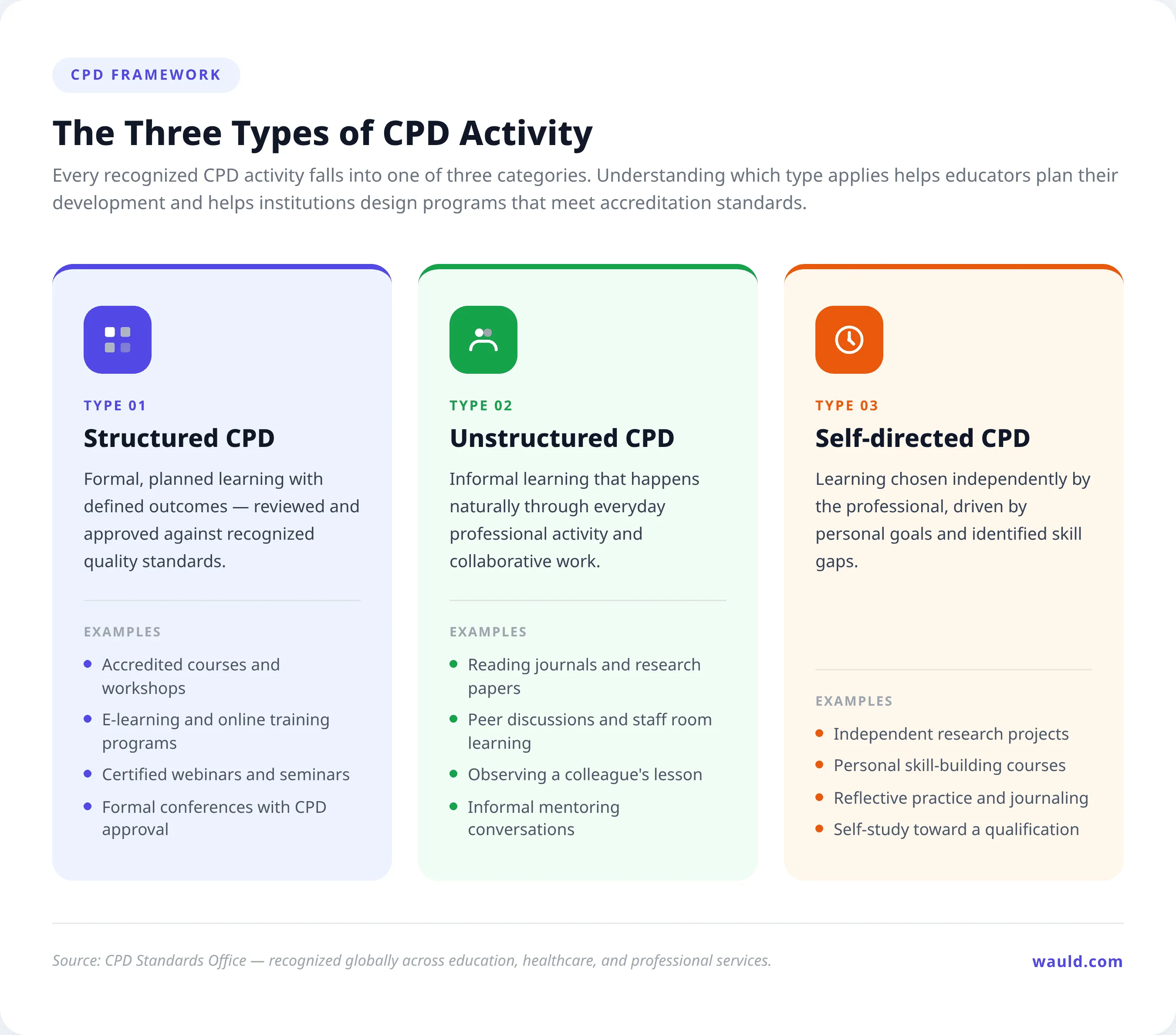
According to the CPD Standards Office, CPD activities fall into three broad categories:
- Structured CPD: Formal courses, accredited workshops, and e-learning programs with clearly defined learning outcomes
- Unstructured CPD: Informal learning such as reading, independent research, and peer discussions
- Self-directed CPD: Learning professionals seek out on their own initiative, based on personal development goals
For educational institutions, the most relevant CPD standards are set by national teacher regulatory bodies or government education departments. These organizations define:
- How many hours must educators complete each cycle
- Which activities qualify as valid CPD
- How development should be recorded and evidenced
- What is needed to maintain professional registration or accreditation
Getting clear on these standards matters, especially if you are issuing CPD training to educators across different countries or regions. The rules are not the same everywhere.
How Countries Approach Teacher Development
One of the most striking things about CPD in education is that there is no single global standard. Requirements vary significantly from country to country. Here is how some major education systems approach it.
United Kingdom
In England, CPD requirements for teachers are not set by statute. Schools and trusts decide how professional development is delivered and recorded, placing responsibility on institutions to build their own strong, consistent frameworks.
Scotland takes a more structured approach:
- Teachers must complete a minimum of 35 hours of CPD per year
- A Professional Update review is required every five years
- Both are necessary to maintain registration with the General Teaching Council for Scotland
Australia
Australian teachers must meet CPD requirements to keep their registration, with requirements varying by state:
- New South Wales: 100 hours of accredited professional development over a five-year cycle
- Victoria: Minimum of 20 hours per year for fully registered teachers
- Western Australia: 100 hours of professional development over the five-year registration period
All PD must align with the Australian Professional Standards for Teachers (APST), ensuring the learning connects directly to recognized practice standards.
India
India's National Education Policy (NEP 2020) brought a major shift in how teacher development is handled at a national level:
- Every teacher is expected to complete at least 50 hours of CPD per year
- This replaced the older model of occasional, infrequent in-service training courses
- The policy reflects India's broader ambition to build a professionally consistent teaching workforce
Singapore
Singapore does not mandate CPD by law, but the professional culture around it is strong:
- The Early Childhood Development Agency strongly encourages educators to engage in at least 20 hours of CPD per year
- Participation rates are high even without a formal requirement
Middle East
The Gulf region has seen growing investment in educator CPD over the last decade. Countries like the UAE are increasingly focused on educator quality and raising professional standards across both public and private school systems, with more institutions seeking internationally recognized CPD accreditation for their programs.
This global variation is exactly why having a credible, internationally recognized CPD certification matters so much. When educators hold verifiable credentials tied to recognized standards, those credentials carry meaning wherever they go.
Why CPD in Education Is About More Than Ticking Boxes
There is sometimes a tendency to treat CPD as something educators have to do, rather than something that genuinely matters. A requirement to fulfill, hours to fill, a form to submit. But the research on continuing professional development in education tells a much more compelling story.
It directly improves student outcomes.
According to a review by the Education Policy Institute, high-quality CPD has a measurable positive effect on students' learning outcomes. Educators who stay current with research and best practices are better equipped to:
- Differentiate instruction to meet different learning needs
- Support students who need additional help
- Respond confidently to new challenges in the classroom
- Bring evidence-based methods into everyday teaching
It benefits trainers and L&D professionals too.
For those working outside traditional schools, including coaches, corporate trainers, and executive education providers, the same logic applies. Practitioners who invest in their own development bring more credibility and depth to the work they do, and their learners feel the difference.
It helps retain talented educators.
When staff feel genuinely supported in their professional growth, they tend to be more engaged and more committed. Teacher retention is a serious challenge in many education systems globally, and access to meaningful CPD is consistently cited as one of the factors that helps keep talented people in the profession.
It models lifelong learning.
Educators who continue to learn set a powerful example for the students they teach: that curiosity does not end with a qualification, and that professional growth is a practice worth taking seriously.
Why CPD Certificates Do the Heavy Lifting
Completing CPD is one thing. Being able to prove it is another.
Digital certificates and credentials have become genuinely important tools in the professional development ecosystem. The digital badge market is projected to exceed $500 million by 2029, and a large share of that growth is being driven by professional development in education, healthcare, and business training.
The shift is happening because verifiable digital credentials carry far more practical weight than a static PDF sitting in someone's email inbox.
For the educator or professional, a good CPD certificate:
- Serves as tangible, shareable proof of growth
- Can be added to a CV, LinkedIn profile, or professional portfolio
- Supports license renewal or registration requirements
- Provides a clear personal record of development over time
If you are working in education contexts where registration renewal depends on evidencing CPD hours, having clean and accessible digital certificates makes the whole process simpler. You might also want to look at professional CPD certificate templates to understand what a well-designed credential looks like.
For the institution issuing the training, certificates:
- Build trust and reflect the quality of your program
- Create a professional, shareable artifact for your learners
- Generate organic visibility when educators share their credentials online
- Differentiate your CPD offering from less formal alternatives
For employers and professional bodies, a verifiable credential:
- Removes guesswork from hiring and registration decisions
- Confirms a credential's validity quickly and reliably
- Supports compliance with CPD tracking requirements
Tracking CPD hours and keeping proper records has historically been one of the more frustrating parts of the process. Digital credentialing has changed that picture significantly, making it much easier to manage the full lifecycle from issuing to tracking to verifying.
How Wauld Helps You Issue CPD Credentials
If you are running CPD programs for educators, trainers, or academic staff, you already know the admin involved. Designing certificates, sending them out, managing updates, handling re-issuance requests, and keeping track of who has verified what. It adds up quickly, especially at scale.
Wauld is built to take that burden away.
Wauld is a digital credential platform that lets educational institutions, training providers, coaching organizations, and L&D teams design, issue, and verify certificates and digital badges from a single dashboard. For organizations running CPD programs, this means issuing branded, verifiable credentials without juggling multiple tools or relying on manual processes.
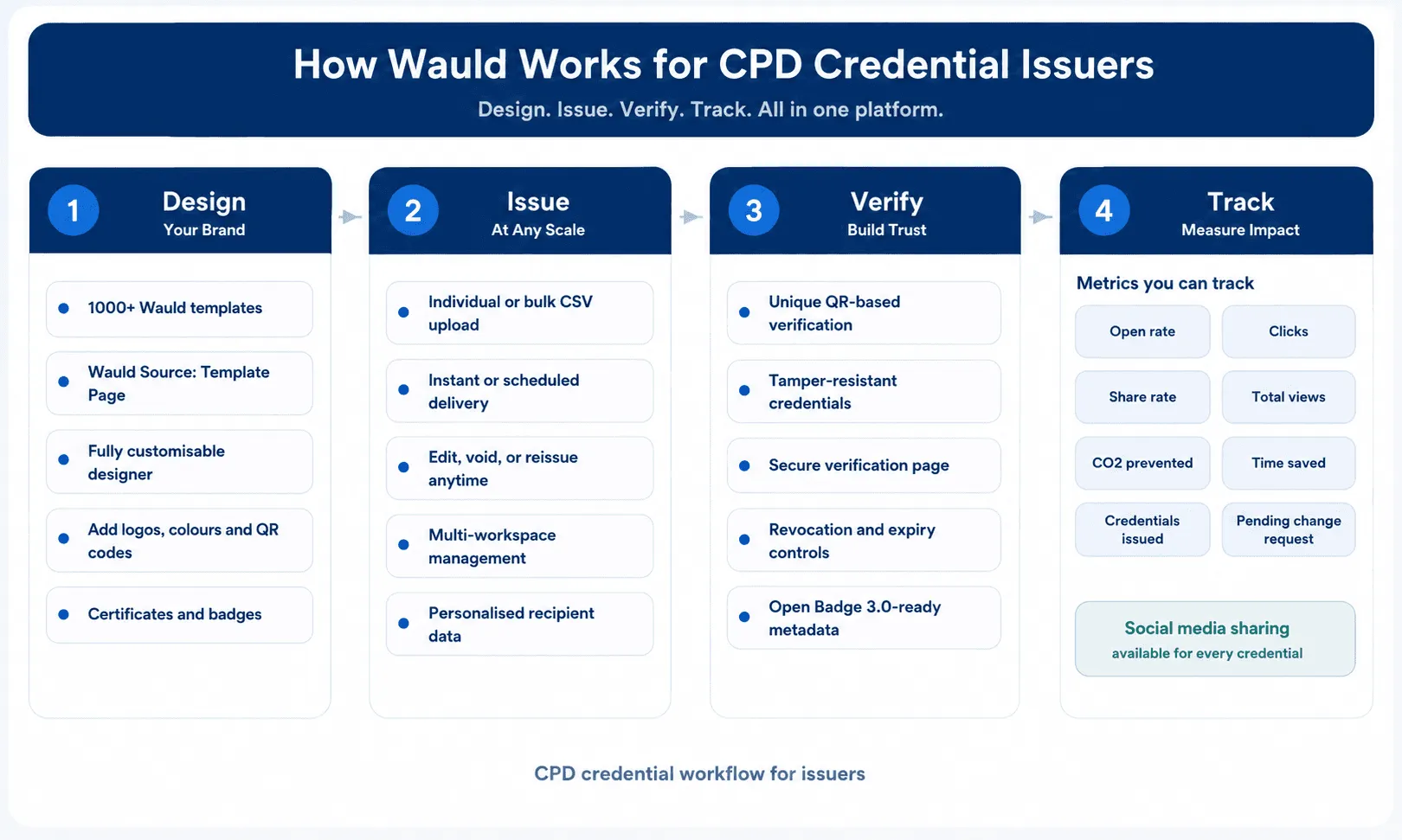
Here is what makes Wauld a practical fit for education and training organizations:
Full brand control: Every certificate, email, and credential portal reflects your institution's identity. Browse Wauld's template gallery (600+ professionally designed certificate templates) to find a starting point that fits your brand and customize it end-to-end.
Instant, trustworthy verification: Every credential issued through Wauld can be verified with a QR scan or a single click. For CPD purposes, this means professional bodies, employers, or registration authorities can confirm a certificate's validity without any additional back-and-forth. Take a look at Wauld's CPD certificate template to see what a verifiable CPD credential looks like in practice.
Analytics that show real-world impact: Wauld's built-in analytics help you see how your credentials perform after they are issued: how many have been shared, viewed, or added to professional profiles. This gives you a clearer picture of the value your CPD programs are creating.
And if you are issuing credentials for graduation or academic milestones too, Wauld has you covered there as well. Check out Wauld's guide to graduation certificate templates for higher education for design ideas and best practices.
In an educational landscape where professional trust and accountability carry real weight, having a credentialing system that backs up your programs is not optional. It is a practical part of how you demonstrate that your CPD training delivers genuine value.
Give Every Educator the Recognition They Have Earned
CPD training in education is about more than hours logged or requirements met. It is about building a profession that keeps growing, keeps improving, and keeps showing up for the learners it serves. And when you issue a certificate at the end of that journey, you are doing more than handing over a document. You are recognizing genuine professional effort and giving educators something meaningful to carry forward in their careers.
When those credentials are verifiable, shareable, and backed by a platform that institutions trust, they do real work in the world. They open doors, support registration renewals, build professional reputations, and reflect the quality of the programs behind them.
Get started with Wauld today to issue CPD credentials that carry real credibility.