CPD Training in Construction: Improving Safety, Skills, and Industry Compliance

CPD Training in Construction
Every year, the construction industry loses hundreds of lives and thousands of work hours to preventable incidents, and the smallest knowledge gap on site can carry the biggest cost. That is exactly why CPD training in construction has moved from being a quiet professional habit to a serious business priority.
Learning that keeps pace with the job site
If you train, certify, or develop people who work in construction, you already know how fast the rules, materials, and methods change. New safety regulations roll out. New tech like BIM, drones, and modular building shows up on site. New compliance checks get added. Continuing Professional Development is how the people on the ground keep up, and how the people behind them (educators, trainers, HR, and L&D teams) prove the learning happened.
In this guide, we will walk through what CPD really means in construction, the standards that shape it across different countries, why it matters more than ever, and how digital certificates make the whole process easier for issuers like you.
What is CPD Certification?
CPD stands for Continuing Professional Development. It is the structured way professionals keep learning, growing, and staying current after their initial qualification. A CPD certificate is essentially proof: it says a learner showed up, completed a recognized activity, and earned a measurable amount of learning credit, usually expressed in hours or points.
In construction, CPD covers a wide range of topics: health and safety refreshers, sustainability practices, project management, leadership, BIM and digital tools, sector-specific updates, and more. According to The CPD Certification Service, it can be earned through both formal learning (courses, conferences, workshops) and self-directed learning (reading, mentoring, research).
For training providers and educators, CPD-accredited courses signal quality. They tell learners, and the regulators behind them, that the content meets a recognized standard. For learners, the certificate becomes part of a professional record they can present to employers, licensing bodies, or industry councils.
The Standards that shape CPD in Construction
Construction CPD is not one single rulebook. It is shaped by a mix of professional bodies, industry councils, and national regulators, each with their own way of measuring learning.
In the UK, for example, the Chartered Institute of Building (CIOB) has updated its policy to require a minimum of 25 hours of CPD per year, with at least 3 hours dedicated to each of its core chartership themes. The new model moves from points to hours, which aligns it more closely with wider industry practice.
Then there is the Construction Industry Training Board (CITB) and the Construction Skills Certification Scheme (CSCS), which together set the baseline for site access and skills certification. Most UK construction sites now require workers to hold a valid CSCS card, which proves they have the right health and safety training for the job.
For architects working on construction projects, RIBA requires 35 hours of CPD a year, with at least 20 of those hours covering its mandatory core curriculum topics.
Together, these standards form a framework that issuers can plug into. If you design a training program for construction professionals, mapping it to one of these recognized bodies adds credibility and gives learners a clear reason to enroll.
How CPD Plays Out Around The World
CPD requirements in construction vary by country, and sometimes by state or province. Here is a quick look at how a few different regions approach it.
United Kingdom
Beyond CIOB and RIBA, professional bodies across surveying, engineering, and project management each set their own hours-based or points-based CPD. The CSCS card system ties it all back to site-level compliance, which is why most major contractors will not let anyone on a site without one.
Australia
Builders in New South Wales and Tasmania are legally required to complete CPD as part of their license renewal. As Payroller explains, NSW builders must earn at least 12 CPD points each year, and Tasmanian builders need to accumulate 36 points over three years. For engineers, Engineers Australia sets a higher bar of 150 hours every three years.
United States
The language shifts a little here. CPD is often referred to as Continuing Education (CE) or Continuing Professional Education (CPE), and requirements vary by state and licensing board. For construction managers, the Construction Management Association of America requires Certified Professional Constructors to earn 32 hours of CPD every two years.
Singapore
The Building and Construction Authority (BCA) plays a central role in setting industry standards and tracking compliance, with productivity and safety data being central to its oversight of the construction sector.
Middle East and beyond
As the CPD Standards Office notes, regions like the UAE are seeing strong growth in demand for internationally recognized CPD, often because contracts and tenders increasingly call for it.
The point is simple: no matter where your learners live and work, CPD is part of how the industry signals competence. Issuers who can speak to multiple frameworks and offer credentials that travel well across borders are in a strong position.
Why CPD Matters in Construction
Construction has always been a high-stakes industry, and the data backs that up. The latest figures from the UK Health and Safety Executive show 40 worker fatalities and 61,000 non-fatal injuries in a single year. Globally, construction continues to record some of the highest accident rates of any sector.
Now layer in the skills shortage. According to recent industry research, 370,000 construction jobs were unfilled by late 2024, with 94% of contractors struggling to find skilled workers. The CITB has also reported that 31% of construction employers find sourcing skilled staff a significant challenge.
CPD helps address both problems at once. On the safety side, regular training keeps workers up to date on the latest hazards, equipment, regulations, and best practices. It is also a sound financial decision. Studies cited by SafetyCulture suggest that investing just 2.5% of project costs in safety training and procedures can lift profits by 4 to 7% per project while bringing accident rates down.
On the skills side, CPD opens a path for current workers to keep learning new technologies and methods, from BIM modeling to drone-based site surveys to greener building methods. That helps employers retain talent, gives workers a clearer career path, and shrinks the skills gap over time.
For everyone involved, whether you are an educator, a trainer, an L&D team, or an HR lead, structured CPD is one of the most reliable ways to show that learning leads to measurable improvement on site.
The Quiet Power of a Good Certificate
Once a learner completes a CPD program, the certificate becomes the record that proves it. And in construction, where compliance audits and license renewals are real, that record has to be easy to find, easy to verify, and impossible to fake.
This is where a traditional PDF or paper certificate starts to fall short. Anyone can edit a PDF. The paper gets lost. Verification often turns into a long email chain between an employer and the issuer.
A modern, verifiable digital certificate solves these problems. Built to open standards like Open Badge 3.0, each credential carries a unique link or QR code that anyone can scan to confirm its authenticity. No login. No phone calls. Just instant verification.
For learners, that means they can share their CPD achievements on LinkedIn, in email signatures, on their CV, or directly with an employer. For issuers, it means fewer manual checks, fewer support emails, and a credential that quietly markets your training program every time it gets shared.
The CPD Standards Office has called this kind of recognition essential for an industry that depends so heavily on trust between contractors, regulators, and clients.
How Wauld Supports CPD Issuers in Construction
This is where Wauld fits into the picture. Wauld is a digital credential platform built for issuers like educational institutions, trainers, coaches, professional bodies, and L&D and HR teams who want to design, issue, and verify certificates and badges that actually hold up under scrutiny.
Here is what that looks like in practice for a construction training provider:
- You can design CPD certificates and badges that match your brand, choosing from 1,000+ professional templates or starting from scratch.
- You can issue them in bulk after a cohort completes a course, or set them to trigger automatically on completion.
- Every credential carries a unique QR code for instant verification, so an employer or licensing body can confirm authenticity in seconds.
- Wauld is built to Open Badge 3.0 standards, which means your certificates are portable, shareable, and recognized across systems.
- Built-in analytics let you track engagement, shares, and completions, so you can see what is working and where to invest next.
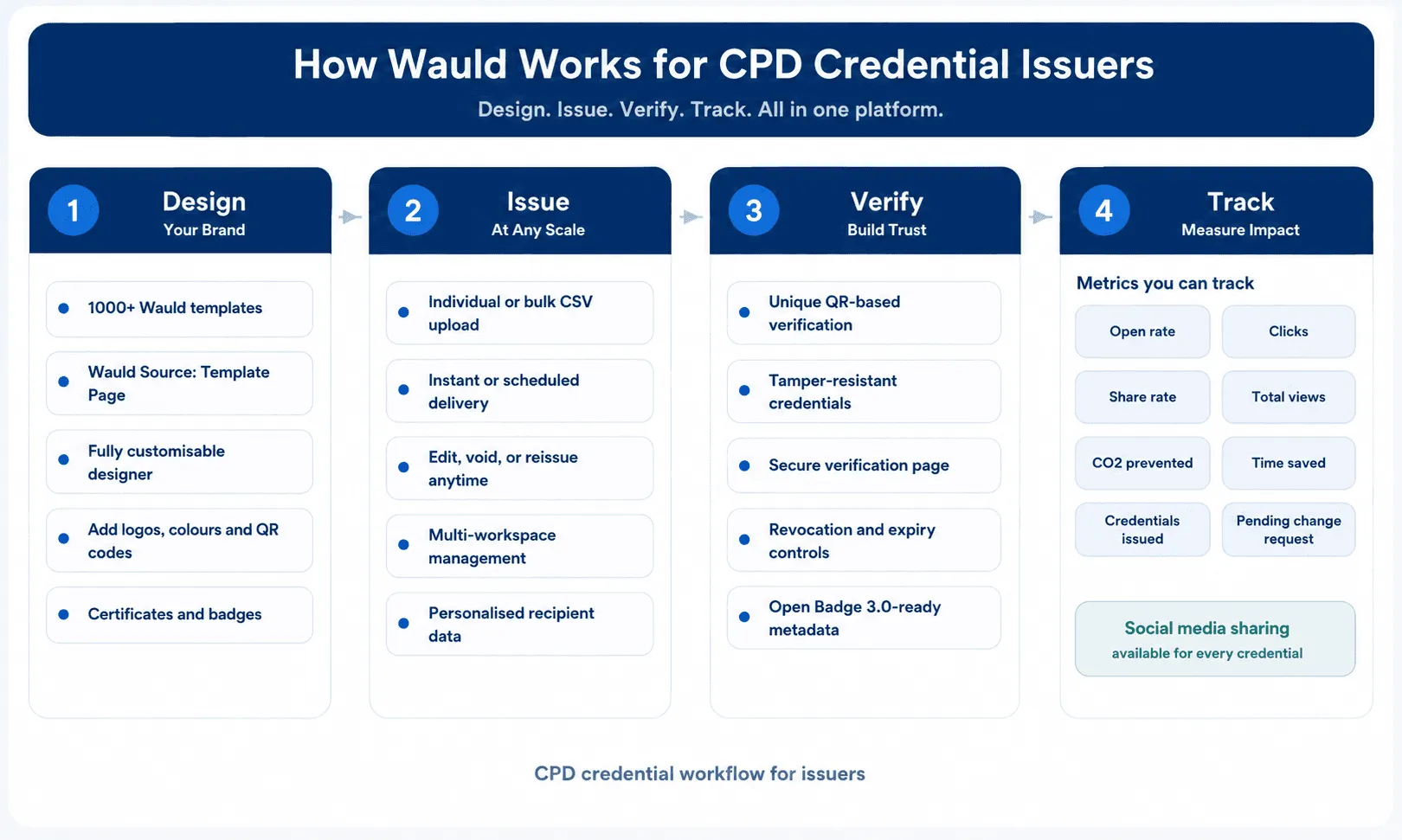
For HR and L&D teams, that means less time tracking spreadsheets and more time focused on learning outcomes. For trainers and educational institutions, it means your CPD certificates do more than sit in a folder. They get shared, drive referrals, and quietly grow your program.
And because security in construction (and in construction-related data) is non-negotiable, Wauld is ISO 27001 certified and CPRA compliant, so you can issue credentials with confidence.
Closing Thoughts
CPD training in construction is no longer just a professional nicety. It is part of how the industry stays safer, more skilled, and more compliant year after year. For the people doing the work, it is a path to better careers. For the people doing the teaching, it is a chance to make a measurable difference on-site.
If you issue CPD certificates and want them to look as professional as the training behind them, give Wauld a try. Build credentials your learners are proud to share, and your industry is happy to trust.