Continuing Education in Problem Gambling: What You Should Know

Continuing Education in Problem Gambling
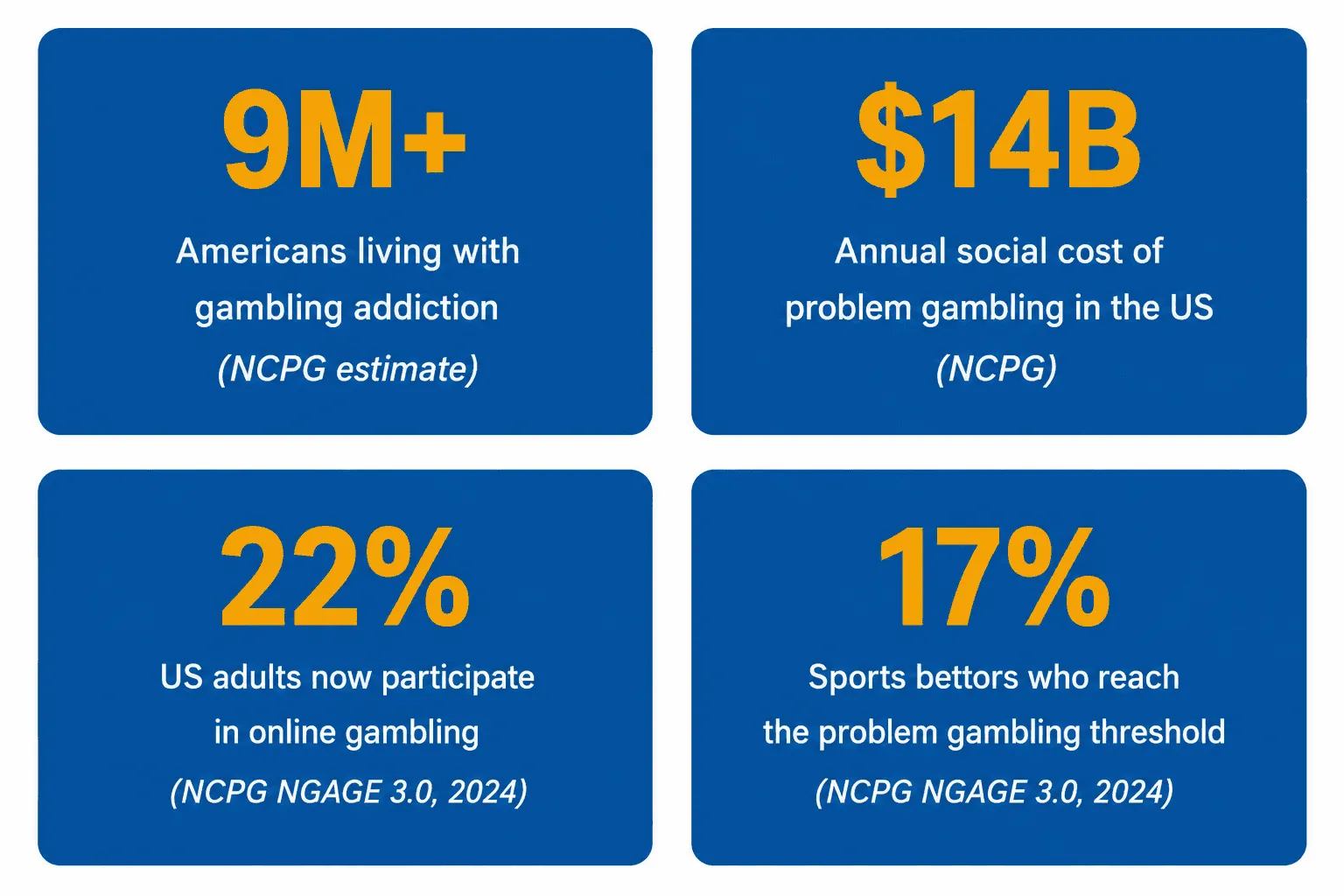
Nearly 9 million Americans are living with a gambling addiction right now, and an even larger number sit in the gray zone where risky habits are quietly taking hold. Yet fewer than one in ten of them will ever reach out for help.
That gap between suffering in silence and getting real support is where counselors step in. But what about the people who train those counselors? That is where you come in.
This blog is written for problem gambling training program directors, professional educators, and certification bodies that develop and deliver training for gambling counselors and support workers. If you design curricula, lead training programs, or issue credentials to people entering the problem gambling field, then continuing education in problem gambling is not just a compliance requirement for the people you certify. It is also the heartbeat of the work you do, and the foundation every good counselor stands on.
Let's talk about why it matters so deeply, and what the data says.
What Problem Gambling Looks Like
Problem gambling is not simply about losing money. It is a recognized behavioral health condition. The DSM-5 classifies it as Gambling Disorder, placing it alongside substance use disorders in terms of how it affects the brain and behavior. It involves cravings, loss of control, tolerance (the need to gamble more to get the same thrill), and in many cases, withdrawal-like symptoms when someone tries to stop.
What makes it especially difficult to catch is how normalized gambling has become. Online gambling participation in the US rose from 15% of the adult population in 2018 to 22% by 2024. Sports betting is now accessible in the majority of states. This normalization means that many people with gambling problems do not recognize themselves in the clinical description, and neither do the people around them.
Early recognition can be the difference between a timely intervention and a full crisis. But that recognition requires well-trained counselors, and well-trained counselors require strong, current, evidence-based training programs led by people who stay sharp in this field. That responsibility sits with you.
The States Where Gambling Problems Run Deepest
Problem gambling is not evenly spread across the country. Some states carry a significantly heavier burden, often because of how accessible gambling is, how few treatment resources exist, and whether training requirements are in place for gambling industry workers. Understanding this landscape helps training program leaders make the case for the work they do and identify where the need is most urgent.
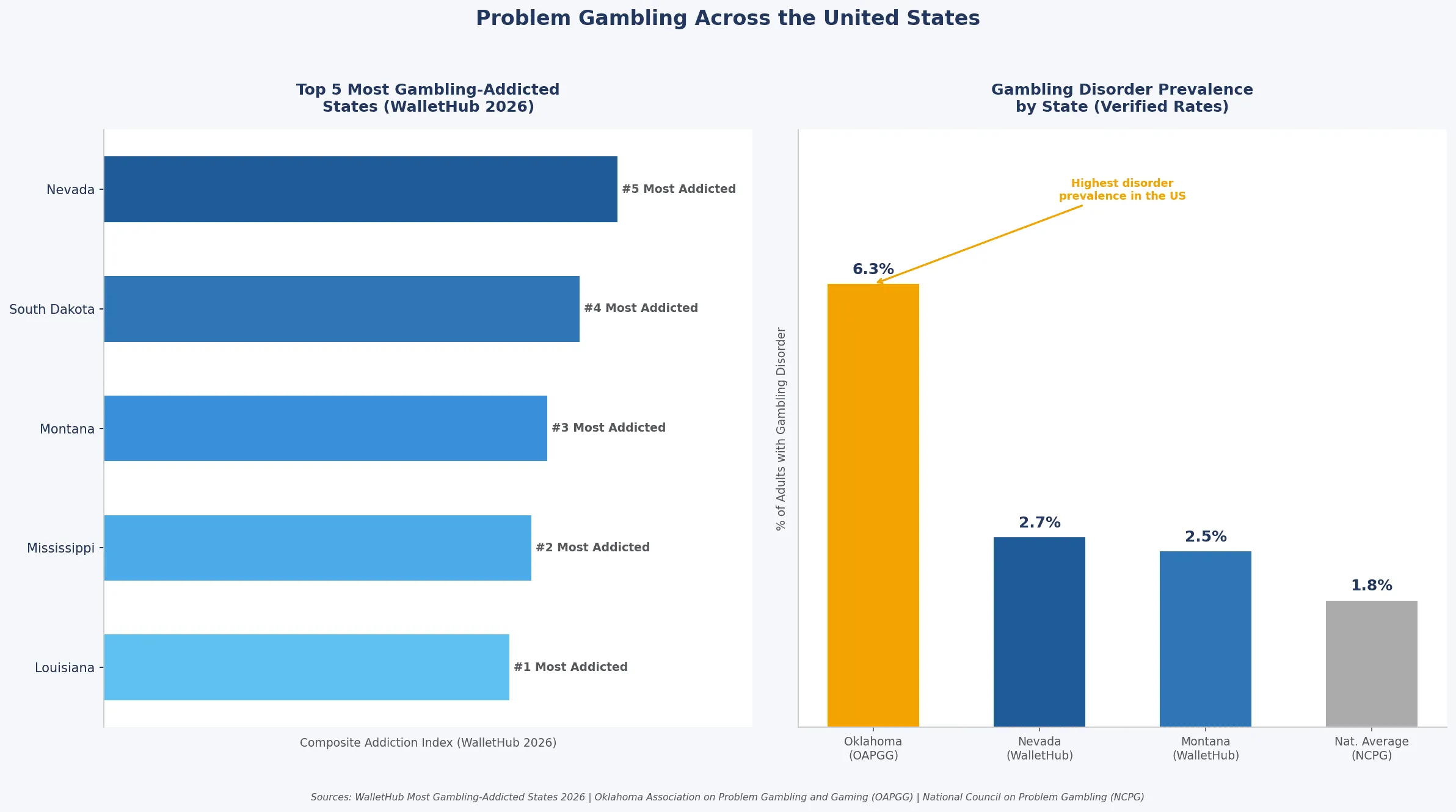
WalletHub's 2026 analysis of the most gambling-addicted states uses a composite index measuring gambling access, disorder rates, and treatment availability. Their top five are Nevada, South Dakota, Montana, Mississippi, and Louisiana.
When looking strictly at gambling disorder prevalence rates, Oklahoma stands out sharply, with approximately 6.3% of adults meeting diagnostic criteria for gambling disorder, according to the Oklahoma Association on Problem Gambling and Gaming (OAPGG). That is more than double the national average and among the highest rates confirmed for any state. Nevada's rate sits around 2.7%, and Montana's around 2.5%.
Montana's situation is particularly instructive. The state has one of the highest concentrations of gaming machines per capita in the country, yet it lacks robust requirements for problem gambling training in retail settings. According to reporting, Montana does not require employee training on problem gambling in many venues, which makes early identification and referral far less likely. This is exactly the kind of gap that strong training programs are built to close.
Why this matters for training directors: As sports betting expands state by state and online platforms continue to grow, demand for trained gambling support professionals will keep increasing. The states most in need are also often the ones with the fewest credentialed counselors per capita. Your programs directly address that shortfall.
At the national level, the National Council on Problem Gambling estimates the annual social cost of problem gambling at $14 billion, covering criminal justice costs, healthcare spending, lost productivity, bankruptcy, and family breakdown. Some researchers applying per-person cost models from countries like Sweden suggest the true figure for the US could be considerably higher.
How Continuing Education Makes Training Programs More Effective
If you lead a training program in the problem gambling space, you set the standard for what "competent" looks like in this field. And that standard only holds up when the education you deliver stays current, evidence-based, and responsive to a rapidly changing landscape.
Here is why ongoing continuing education is so important, not just for the counselors you certify, but for the quality of the programs you lead:
The gambling landscape changes faster than most curricula can keep up
Online gambling participation rose from 15% in 2018 to 22% by 2024, and sports betting has opened legal access in more states than ever before. According to the NCPG's NGAGE 3.0 survey (2024), 17% of traditional sports bettors reached the problem gambling threshold, compared to around 1-2% in the general non-gambling population. A training program designed five years ago may not adequately address these modern gambling forms unless it has been actively updated.
Evidence-based treatment approaches keep evolving
Cognitive Behavioral Therapy (CBT) frameworks for gambling disorder continue to be refined. Motivational interviewing techniques have been specifically adapted for the gambling context. Trauma-informed care is gaining more traction as research links adverse childhood experiences to gambling disorder risk. Counselors who are not regularly exposed to these developments may default to older models with weaker outcomes. As the Illinois Council on Problem Gambling notes, continuing education in this field is not just about compliance; it is about equipping counselors to handle real challenges their clients face.
Cultural responsiveness is no longer optional
Research shows that Black, Native American, and Asian American communities experience gambling disorder at higher rates than the white population average. For training programs to serve these communities well, cultural competency must be embedded into the curriculum, and that requires staying current with the research and adapting training content accordingly.
Co-occurring conditions add clinical complexity
Gambling disorder rarely shows up alone. Depression, anxiety, and substance use disorders frequently co-occur, and counselors who understand these overlaps are better equipped to provide integrated support. Training programs that update their curricula to reflect this complexity produce counselors who are meaningfully more effective.
Why Certifications Are the Backbone of Quality in This Field
Certifications serve a function far beyond compliance. They signal to clients, employers, and state licensing bodies that a professional has met a defined, reviewed standard of competency. In a field where stigma still discourages many people from seeking help, working with a credentialed counselor can be a meaningful factor in someone's decision to reach out.
From a training director's perspective, the credentials your program issues carry the reputation of everything you have built. Rigorous CE requirements protect that reputation, and they protect the people your graduates serve.
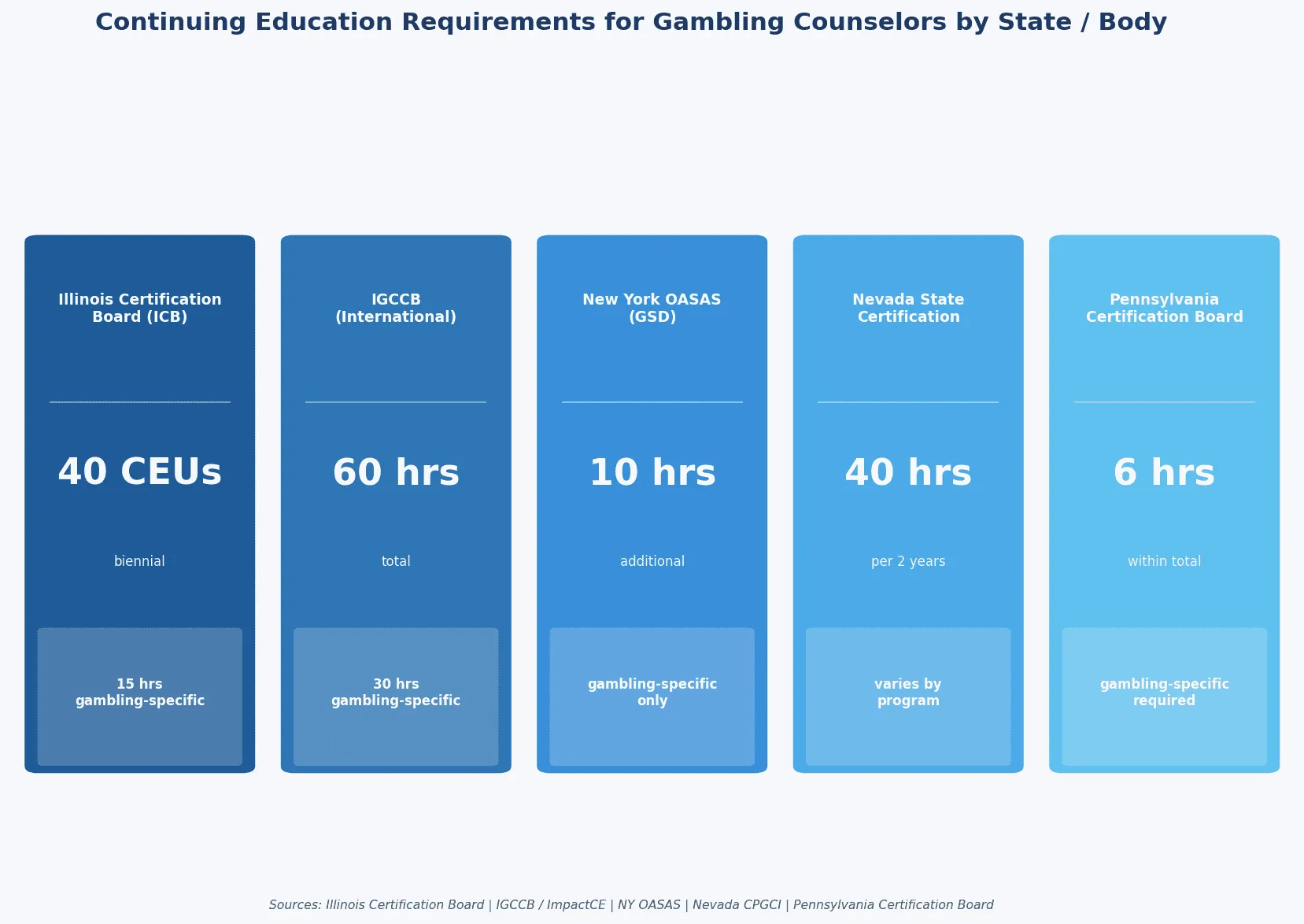
Here is a snapshot of current CE requirements across key credentialing bodies:
| Credentialing Body | Total CEU Requirement | Gambling-Specific Requirement | Renewal Period |
|---|---|---|---|
| Illinois Certification Board (ICB) | 40 CEUs | Minimum 15 hours gambling-specific | Biennial |
| IGCCB (International Gambling Counselor Certification Board) | 60 hours | Minimum 30 hours of gambling-specific | Per renewal cycle |
| New York OASAS (Gambling Specialty Designation) | 10 additional hours | All 10 hours must be gambling-specific | Per CASAC renewal cycle |
| Nevada State Certification | 40 hours | Varies by program | 2 years |
| Pennsylvania Certification Board | Within qualifying credential total | 6 hours gambling-specific required | Per qualifying credential cycle |
These requirements are not just bureaucratic hurdles. They represent a minimum threshold of current knowledge. When you design a training program that meets or exceeds these standards, you are ensuring that the people you certify are genuinely prepared, not just technically compliant.
A note on ethics training: Most credentialing bodies require 2 to 6 hours of ethics education per renewal cycle. This is not a formality. Ethical clarity matters especially in gambling treatment, where issues around confidentiality, dual relationships, and boundaries with clients who are often in financial and emotional crisis come up regularly.
How Wauld Helps Training Program Directors Manage Credentials
Running a training program in problem gambling is meaningful, intensive work. You are developing curricula, managing learner cohorts, staying current with state requirements, issuing certificates to participants, tracking renewals, and making sure everything is verifiable when licensing boards or employers come asking.
Wauld was built to take the administrative burden out of that process. It is a digital credential platform that helps training organizations design, issue, and verify professional certificates and badges from one centralized dashboard, so you can focus your energy on the training itself rather than the paperwork around it.
Here is what that looks like in practice:
Design credentials that match your program's identity
Wauld's certificate design studio includes over 1,000 professionally designed templates, including editable training completion certificate templates that you can customize to match your branding, program name, and certification level. Your credentials look as professional as the training behind them.
Issue certificates automatically, without manual work
Once a participant completes your program requirements, Wauld lets you issue their certificate directly, in bulk if needed, with a single workflow. No manually generating PDFs, no chasing down email addresses, no version control headaches across a spreadsheet.
Verify credentials in real time
Every certificate Wauld issues comes with a unique identifier and secure verification link. Employers, licensing boards, and state agencies can confirm a credential's validity instantly, without contacting your office. This reduces the administrative load on your team and adds a layer of trust to every certificate you issue.
Track who is engaging with their credentials
Wauld's analytics dashboard shows who has opened, downloaded, shared, or added their credential to LinkedIn. This gives you real data on how your certifications perform in the real world, which is useful for evaluating program outcomes and reporting to funders or accreditation bodies.
Your Program Standards Are Only as Strong as the Support Behind Them
Continuing education in problem gambling is not about checking a box. It is how you make sure that every person your program certifies is ready to show up for someone in real distress, with current knowledge, ethical clarity, and the right tools.
As a training program director in this space, you set that standard. The quality of your curriculum, the rigor of your CE requirements, and the credibility of the certificates you issue all flow directly from the seriousness with which you approach your own professional practice.
And the systems you use to manage that process should reflect the same care. Wauld makes credentialing simple, verifiable, and scalable, so the operational side of your program does not get in the way of the mission-driven side.