How Digital Credentials Support Workforce Pell Programs

Why Workforce Pell Matters Now
If your institution runs short-term workforce programs, this year changed a lot. Traditional Pell Grants were built for longer programs of at least 600 clock hours over 15 weeks. Now Workforce Pell extends federal aid to programs as short as eight weeks, which opens funding to many of the certificate courses your workforce division already offers, from phlebotomy to welding.
The catch: approval, and keeping it, takes proof that learners finish, get hired, and earn a credential that counts toward something bigger.
That's where digital credentials come in. This guide covers what Workforce Pell asks of your programs and five ways digital badges and certificates help universities, colleges, and their educators show that value.
What Is Workforce Pell, Really?
So, what is Workforce Pell? It's an expansion of the federal Pell Grant created by the One Big Beautiful Bill Act. The U.S. Department of Education published the final rule on May 19, 2026, and it took effect on July 20, 2026, with early implementation allowed from July 1.
Under the final rule, the core workforce pell requirements look like this:
- Program length: 150 to 599 clock hours, completed in at least 8 but fewer than 15 weeks.
- Who offers it: An accredited institution that is eligible for federal student aid.
- Track record: The program must have run for at least one year before approval.
- Approval: Both the state governor and the Secretary of Education must approve it.
- Outcomes: At least 70% of enrollees complete, and at least 70% of completers find jobs.
- Credential: It must lead to a recognized credential that is stackable and portable, with academic credit toward a longer certificate or degree.
The Department of Education expects over 100,000 students to benefit in the program's second year. For institutions, that means a lot of credentials to issue and track.
The Proof Problem Institutions Face
As Achieving the Dream points out, most noncredit workforce programs aren't tracked in federal data systems at all. Colleges now need ways to report verifiable outcomes, often for the first time.
Then there's the credential itself. A PDF or printed certificate shows completion, but it doesn't easily show:
- how it maps to your credit-bearing certificates or degrees,
- which skills your faculty assessed,
- whether it's authentic when an employer or another school checks it.
And the market is crowded. Credential Engine counted over 1.85 million credentials on offer in the U.S. To stand out, your institution's credentials have to be clear and easy to trust.
Where Digital Credentials Fit In
Let's start with the digital credentials meaning. A digital credential is an online version of a certificate or badge that holds information about the achievement inside it: who issued it, who earned it, what it took, and when. Anyone can check it through a unique verification link.
The best ones follow open standards. Open Badges 3.0, managed by 1EdTech, is built on the W3C Verifiable Credentials model. In plain terms, a badge your institution issues can be verified on other platforms, which is what "portable" should mean.
The Technical College System of Georgia built a statewide badging system that covers both credit and noncredit courses, so employers can trust a badge from any of its colleges and learners can move from noncredit training into technical college programs.
That's the kind of pathway Workforce Pell asks for.
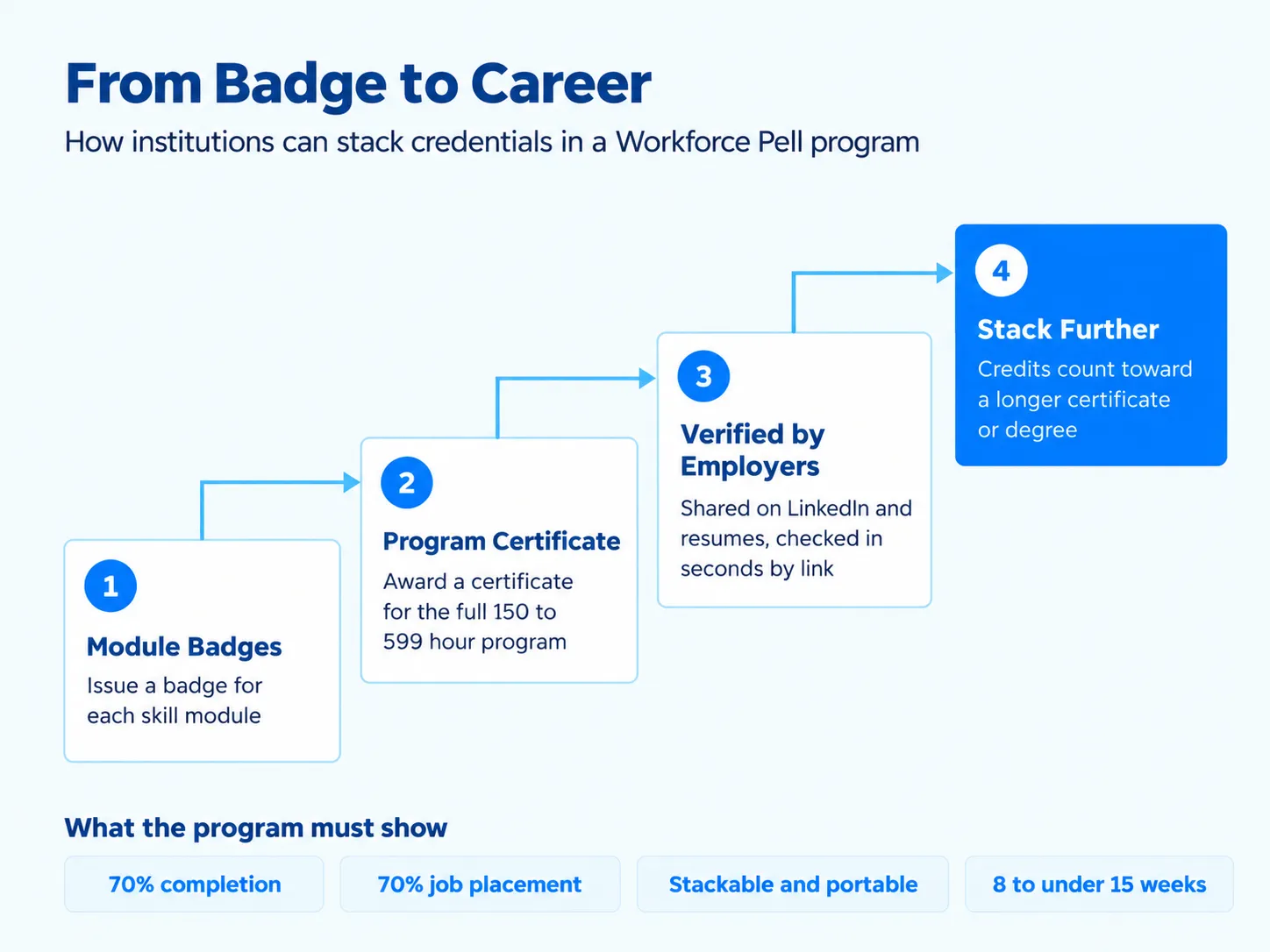
Five Ways Credentials Help Programs
- 1
Make Stackable Pathways Easy to See
Break each program into modules and issue a badge for each one, then a certificate when the full program is complete. When a learner moves into a credit program, your academic departments can see exactly what was covered. Our guide to competency vs completion badges can help your faculty decide which badge type fits each step.
- 2
Prove Portability to Every Employer
Graduates can add them to LinkedIn, attach them to resumes, or share a link in job applications, and employers can confirm authenticity in seconds without contacting your registrar's office.
- 3
Keep Completion Records in Order
When every credential is issued from one dashboard, your team gets a clean, dated record of who completed what and when. You can also edit or void a credential if a record changes. That makes supporting documentation for completion numbers easier to gather.
- 4
Make Job Placement Follow-Up Easier
The 70% placement rule means your institution needs to stay connected with completers after they leave. A credential worth sharing keeps them engaged, and engagement data shows you which credentials are being opened and shared. These eight ways to get learners sharing their credentials work well here.
- 5
Show Skills Beyond Seat Time
Employers want to know what someone can do. According to NACE, almost two-thirds of employers now use skills-based hiring. A badge listing the skills your faculty assessed speaks their language.
A quick note: digital credentials won't file your state or federal reports for you, but they make the story behind your numbers easier to verify.
Bringing Credit and Noncredit Together
Achieving the Dream notes that the stackable and portable requirement means breaking down silos between noncredit and credit divisions. A shared approach to credentials is a practical place to start:
- Agree on badge standards: Use common naming, criteria, and skill descriptions so a continuing education badge means the same thing to an academic department.
- Give each department its own space: Separate workspaces with role-based access let each team issue under one institutional brand.
- Show where each badge leads: List in the credential's criteria which certificate or degree it counts toward.
- Involve employers early: Ask your industry advisory board which skills matter, then build them into badge criteria.
Getting Started With Wauld Today
If you're looking for a digital credential management platform built for institutions, Wauld for higher education lets your teams design, issue, and track certificates and badges in one place. You can:
- Design quickly: Start from 1,200+ certificate and badge templates, then add your institution's branding.
- Issue at scale: Send credentials to a whole cohort at once.
- Organize by department: Manage multiple workspaces with role-based access.
- Verify instantly: Every credential gets a unique verification link, aligned with Open Badges 3.0 and W3C Verifiable Credentials.
- Track engagement: See who opens, downloads, shares, and adds credentials to LinkedIn.
Comparing tools? See our roundup of the top digital badge platforms to find the best digital credential management software for your institution.
Bringing It All Together
Workforce Pell opens federal aid to thousands of learners in short, career-focused programs, but institutions only keep that funding by showing their programs deliver. Digital credentials make each step visible and verifiable to states, employers, and partner institutions.
Start small. Pick one program, map its modules, and issue a credential for each step. You'll build a clearer record for Workforce Pell and a stronger bridge between your workforce and academic programs.
Make your workforce programs easy to verify
Issue stackable, portable, verifiable certificates and badges for every program you run, all from one platform built for institutions.
FAQs on Workforce Pell
What is Workforce Pell?
Workforce Pell is an expansion of the federal Pell Grant that covers short, job-focused programs of 150 to 599 clock hours lasting 8 to under 15 weeks. Programs need state and federal approval and must meet completion, placement, and earnings standards.
Which institutions can offer Workforce Pell programs?
Only accredited institutions that are eligible for federal student aid. Each program must have run for at least one year and be approved by both the state governor and the Secretary of Education.
Does a digital badge count as a recognized postsecondary credential?
Not by itself. The recognized credential comes from the approved program. A digital badge or certificate is a verifiable way to issue and share that credential, plus the smaller milestones that lead to it.
What makes a credential stackable and portable?
A stackable credential counts toward a longer certificate or degree. A portable credential is recognized by more than one employer. Verifiable digital credentials help show both.
Is Workforce Pell the same as a state workforce credential grant?
No. Workforce Pell is federal aid. Some states run their own programs, like Virginia's Workforce Credential Grant, which subsidizes approved short-term training at participating community colleges. Depending on your state, your institution may offer programs under both.