Online Phlebotomy Certification: A Guide for Providers

What Online Phlebotomy Certification Means
Online phlebotomy certification means the classroom portion of a phlebotomy program is delivered over the internet, while the hands-on portion still happens at a clinic, lab, or draw site. No legitimate certifying agency in the United States awards a phlebotomy credential to someone who has never stuck a real arm. If a program claims otherwise, treat it as a warning sign.
This guide is for the people on the other side of the desk. You run a phlebotomy school, a college program, or a workforce training center. You want classroom hours online without wrecking your students' exam eligibility.
So this post covers operations rather than eligibility: how to split a curriculum, how to size a cohort against clinical placement, what to put on the certificate, and how to issue it. For the student's side of the story, including exam costs, timelines, salary data, and licensure detail, read our companion guide on how to get phlebotomy certification. The two posts are designed to be read together, and this one assumes you already know the basics covered there.
Where Online Programs Go Wrong
Last spring my cousin Rachel called me from her kitchen table in Columbus. She runs a small phlebotomy school, fourteen students to a cohort. She had just moved her lectures online and was thrilled, right up until a student emailed to say her exam application was rejected.
The teaching was not the problem. The completion certificate was: a Word file exported to PDF, with no ID number and no way for the agency to confirm it came from a real program. Rachel spent two evenings digging through email to reissue it.
That call is why I wrote this. The online part is the easy part. The proof at the end is where providers get burned.
What You Can Teach Online
The line is cleaner than most people expect. Anything cognitive can move to a screen. Anything involving a needle and a human being cannot.
| Moves online well | Must stay in person |
|---|---|
| Anatomy, physiology, and medical terminology | Venipuncture on live individuals |
| Order of draw and tube additives | Capillary and heel sticks |
| Infection control and bloodborne pathogen safety | Supervised patient identification at the chair |
| Specimen handling, labeling, and transport | Handling a fainting or hematoma event in real time |
| Patient communication and difficult-draw scenarios | Signed clinical hour logs from a supervisor |
| Exam prep, practice tests, and test-plan review | Basic Life Support skills check-off |
Because of that split, most providers run a hybrid model. Students complete their didactic hours through your learning platform, then report to a partner clinic for the externship. The teaching gets flexible. The record-keeping gets stricter.
One trade-off is worth naming honestly. Online cohorts are easier to fill and harder to place. If enrollment outgrows your clinical partnerships, students stall at the externship stage and completion rates drop.
What Certifying Agencies Want From You
Here is the reframe that saves providers the most time. Certifying agencies do not reject online phlebotomy certification programs for being online. They reject gaps in documentation. Your job is to produce records that match the agency's eligibility form field for field.
| Agency | Classroom hours online? | What you must be able to produce | Useful for online cohorts |
|---|---|---|---|
| NHA CPT | Yes | Proof of training, plus a log of 30 venipunctures and 10 capillary sticks on live individuals | Offers live remote proctoring, so students can test from home |
| ASCP PBT | Yes, through an approved structured program | Structured route: 40 classroom hours and 100 clinical hours, including 100 venipunctures | Several eligibility routes, including one for NAACLS graduates |
| AMT RPT | Yes, through an approved program | Program completion records or documented supervised work experience | A work-experience route suits career changers already in a lab |
| NCCT NCPT | Yes, through an approved program | Program completion records or documented experience | Common with career and technical schools |
Notice what the middle column shares. Every route ends in paperwork you generate. If your platform tracks completions but your draw log lives in a supervisor's notebook, you have a gap.
NAACLS approval opens the widest set of exam pathways, so it is worth the effort if you plan to grow. For the student-facing comparison of which credential to chase, our step-by-step certification guide covers renewal cycles and employer recognition per agency.
Does Your Program Need Approval?
Most providers ask the wrong version of this question. It is not whether your students need a license. It is whether your program needs approval in the states where you enroll.
California is where online phlebotomy certification programs most often go wrong. The California Department of Public Health approves training programs directly, and a CPT I candidate must finish an approved program with 40 classroom hours and 40 clinical externship hours. Online didactic delivery can be approved. The externship cannot be waived, and approval belongs to your school, not your student.
Therefore, do three things before accepting out-of-state enrollments:
- Publish your approval status by state on the enrollment page, in plain language.
- Ask where the student intends to work on your application form.
- Route unapproved states to a waitlist rather than taking tuition and hoping.
The third one feels like leaving money on the table. It is cheaper than a refund plus a complaint. Which states license phlebotomists at all is covered in the licensure section of our certification guide.
Running a program across several states? Wauld lets you keep separate credential templates per state in one workspace, so the right wording lands on the right certificate.
Build Your Program in Five Steps
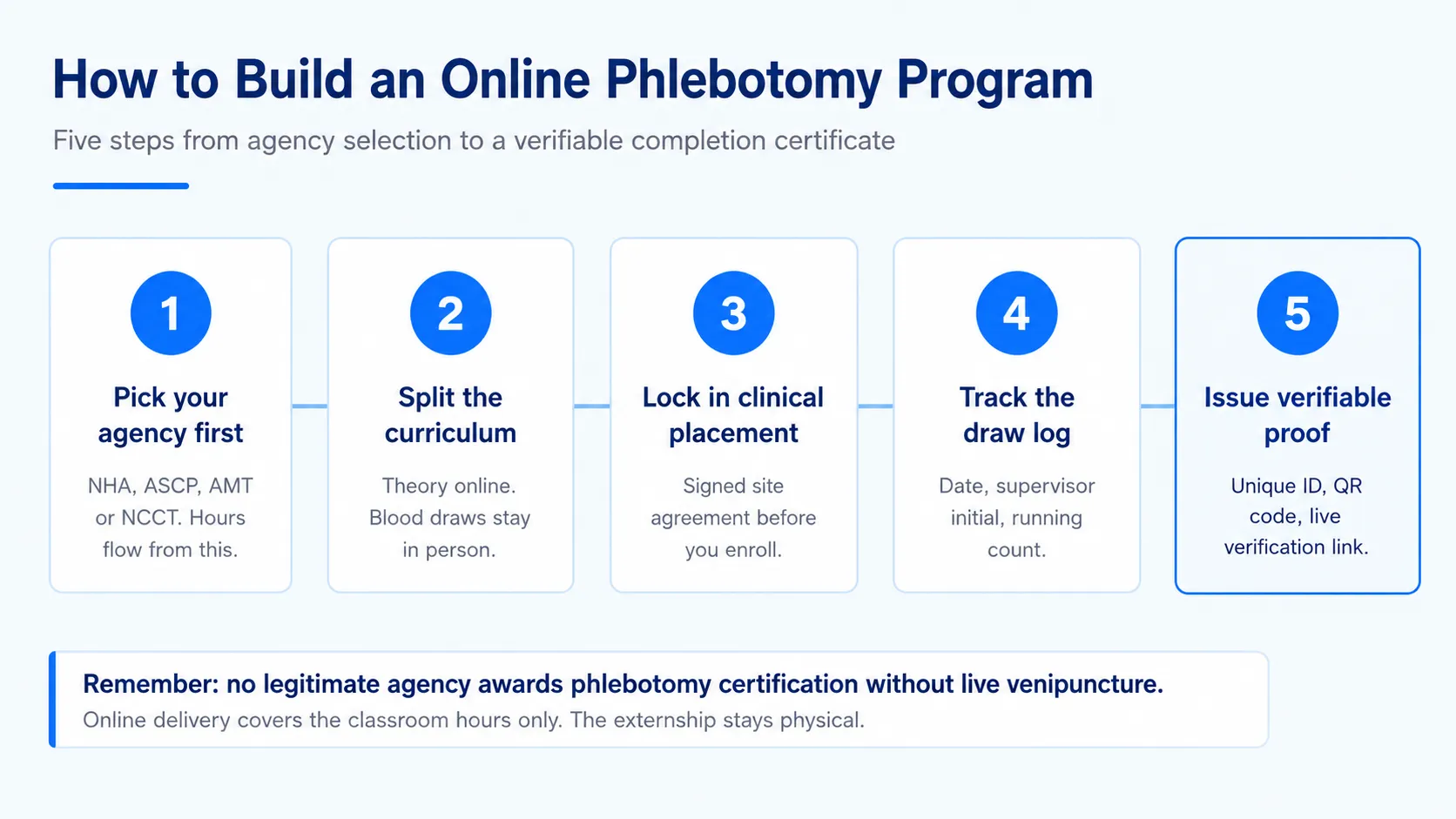
- Pick your agency first. Hour counts, draw counts, and record-keeping all flow from the agency's eligibility rules, so choosing after you build the course means rebuilding it.
- Split the curriculum honestly. Map every objective to "screen" or "chair," and do not stretch the online column, because an overstretched claim turns a happy student into a complaint.
- Lock in clinical placement. Get the site agreement in writing, with a named supervisor and a student capacity, then publish that capacity as your cohort cap.
- Track every draw log. Every venipuncture needs a date, a supervisor initial, and a running count, because a lost paper log means a rejected exam application.
- Issue proof that lasts. Your completion certificate travels to an exam board, a hiring manager, and sometimes a state licensing office, so it has to be findable a year later.
What Your Certificate Must Prove
For a phlebotomy program, the certificate is evidence, not a souvenir. Here is the minimum it should carry.
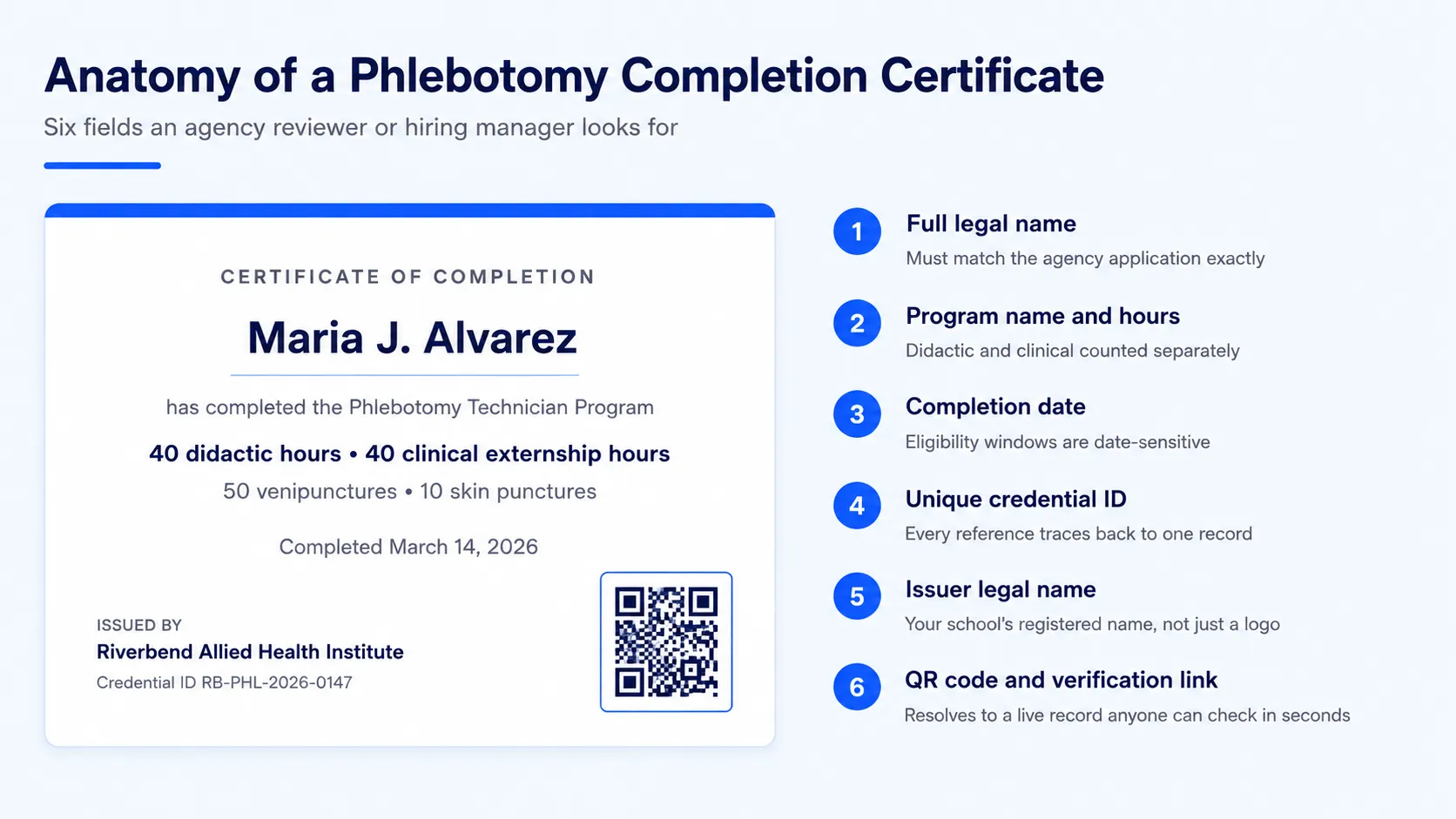
- Student's full legal name, matching their agency application exactly. Nicknames cause rejections.
- Program name and hours completed, split into didactic and clinical where the agency requires it.
- Completion date, because eligibility windows are date-sensitive.
- A unique credential ID, so any reference traces back to one record.
- An issuer identity, meaning your school's legal name, not just a logo.
- A verification method, ideally a link and a QR code that resolves to a live record.
That last point does more work than it looks. Fake allied health certificates are a known problem, and forged documents can be made to look convincing, complete with logos, seals, and invented accreditation. A certificate an employer can check in five seconds beats one that merely looks official.
A verifiable digital credential does not just help the student. It protects your school's name from appearing on documents you never issued.
Credentials built on open standards carry structured data behind the image. Open Badges 3.0 and W3C Verifiable Credentials define how that data is packaged, so a badge you issue stays readable in other systems.
Turn Renewals Into Repeat Enrollments
Every credential your students earn has an expiry date attached. Most providers treat that as the student's problem. It is actually the cheapest enrollment pipeline you will ever have, because you already hold the email addresses and the expertise.
The renewal rules are covered in the credential maintenance section of our certification guide. What that guide does not cover is how to build the offer.
- Map alumni by expiry month, not graduation date. Someone who passed in March renews in March two years later.
- Build short modules, not courses. One hour on order-of-draw errors sells better than a twelve-hour refresher, because CE is counted in credits.
- Issue a dated credential for each module, so students have something concrete to upload.
- Follow the 90-30-7 rule. Send a reminder 90 days out, again at 30 days, once more at 7 days, and a final note on the day the credential expires. That cadence, covered in our guide to certificate expiry management, gives alumni real runway without tipping into spam.
- Confirm acceptance before promising credit. Agencies set content standards for what counts, so check the NHA's renewal guidance or your target agency's equivalent rather than assume.
That last point is where providers overreach. You can issue a certificate of completion for your own module. Whether the agency counts it toward renewal is their call, not yours. Say so plainly in your marketing.
Rachel built four one-hour refresher modules, issued a badge for each, and emailed her alumni list once. About a third of her past cohort signed up in the first month. If you run several, continuing education tracking software keeps the spreadsheet from becoming the bottleneck.
Issue Phlebotomy Certificates With Wauld
Once the teaching is sorted, credentialing should be the simple part. Wauld is built for the handoff between a finished cohort and a credential someone else has to trust.
- Keep one template per state and per program, so California wording never lands on an Ohio certificate. All 1000+ templates are customizable, including medical and healthcare designs.
- Issue the whole cohort in one action, straight from your completion spreadsheet or form responses, instead of exporting fourteen PDFs by hand.
- Give every certificate a unique verification link and QR code, so an agency reviewer or hiring manager confirms it without contacting you.
- See which alumni actually added the credential to LinkedIn, which tells you whether your certificate is working as a career asset or sitting in an inbox.
- Reissue a misspelled name and void anything sent in error, without rebuilding the design or emailing the whole class again.
- Issue module badges as students progress, so the online portion feels rewarding before the externship even starts.
Wauld credentials align with open credentialing standards including Open Badges 3.0 and W3C Verifiable Credentials. You can read how the security side works in the Wauld Trust Center.
Ready to issue credentials your students will keep? Start free with Wauld. No onboarding fees, and 1000+ templates waiting.
Conclusion
Online phlebotomy certification works when you are honest about the boundary. Theory belongs on a screen. Needles belong in a supervised room with a real patient and a signed log. Build to the agency you target, check whether your program needs state approval, and publish your clinical capacity before selling a seat.
Then treat the certificate as part of the product. Your students carry it into an exam application and a first interview. Make it something a reviewer can confirm in seconds. That choice separates a program people recommend from one they have to explain.
FAQs on Online Phlebotomy Certification
Can you get phlebotomy certification completely online? No. The classroom portion can be online, including anatomy, safety, specimen handling, and exam prep. However, every recognized certifying agency requires supervised blood draws on live individuals. A program advertising 100 percent online phlebotomy certification with no clinical component will not make a student eligible for the NHA CPT or ASCP PBT exam.
Is online phlebotomy certification legitimate? Yes, when the program pairs online coursework with a real clinical externship and prepares students for a recognized national exam. Look for NAACLS or state approval, a named clinical partner site, and a clear statement of which exam it prepares you for. A program that cannot say where your blood draws will happen is not worth enrolling in.
How many students can an online phlebotomy cohort actually hold? Your clinical partner sets the ceiling, not your learning platform. Add up the supervised student slots your partner sites confirmed in writing, then make that your cohort cap. Enrolling beyond it creates a queue at the externship stage, which shows up later as poor completion rates and refund requests.
What should a phlebotomy certificate of completion include? At minimum: the student's full legal name, your program's legal name, hours completed, completion date, a unique credential ID, and a verification link or QR code. Agencies and state licensing offices often ask for the hour breakdown, so split didactic and clinical hours where required.
How do employers verify a phlebotomy certificate? Most check the certifying agency's public verification tool for the national credential. For your program's completion certificate, they rely on whatever you provide. A verifiable digital credential lets them scan a QR code and see a live record in seconds, which beats calling your office.
How should a provider store clinical draw logs? Keep a digital copy you control, with the student name, date, procedure type, supervisor initial, and a running count. Paper logs held only by the student go missing, and a missing log means a rejected exam application that lands back on your support inbox. Export a copy at the end of every rotation rather than at the end of the program.
Can a completion certificate say "certified phlebotomist"? No, and this wording causes real trouble. Your document certifies completion of your program. Only the NHA, ASCP, AMT, or NCCT can confer the national credential, and only a state can issue a license. Use precise language such as "has completed 40 hours of didactic instruction and 40 hours of clinical externship," then let the digital credential carry the detail in its metadata.
Proof that travels as well as the training did
Design it on brand, issue the whole class in one go, and let any employer verify it with a single scan. No onboarding fees. 1000+ templates ready to customize.