Competency vs Completion Badges: How They Work and Differ

When you issue digital badges, you make a choice at the start. Will you badge the act of finishing something? Or will you badge the ability to do something well? That choice shapes the entire badge program.
A completion badge says: "You finished." A competency badge says: "You can do this." The difference matters more than you might think. It changes how your recipients feel about their achievement, how employers view the badge, and how much trust it builds. Understanding this distinction is crucial for building an effective digital credentialing strategy.
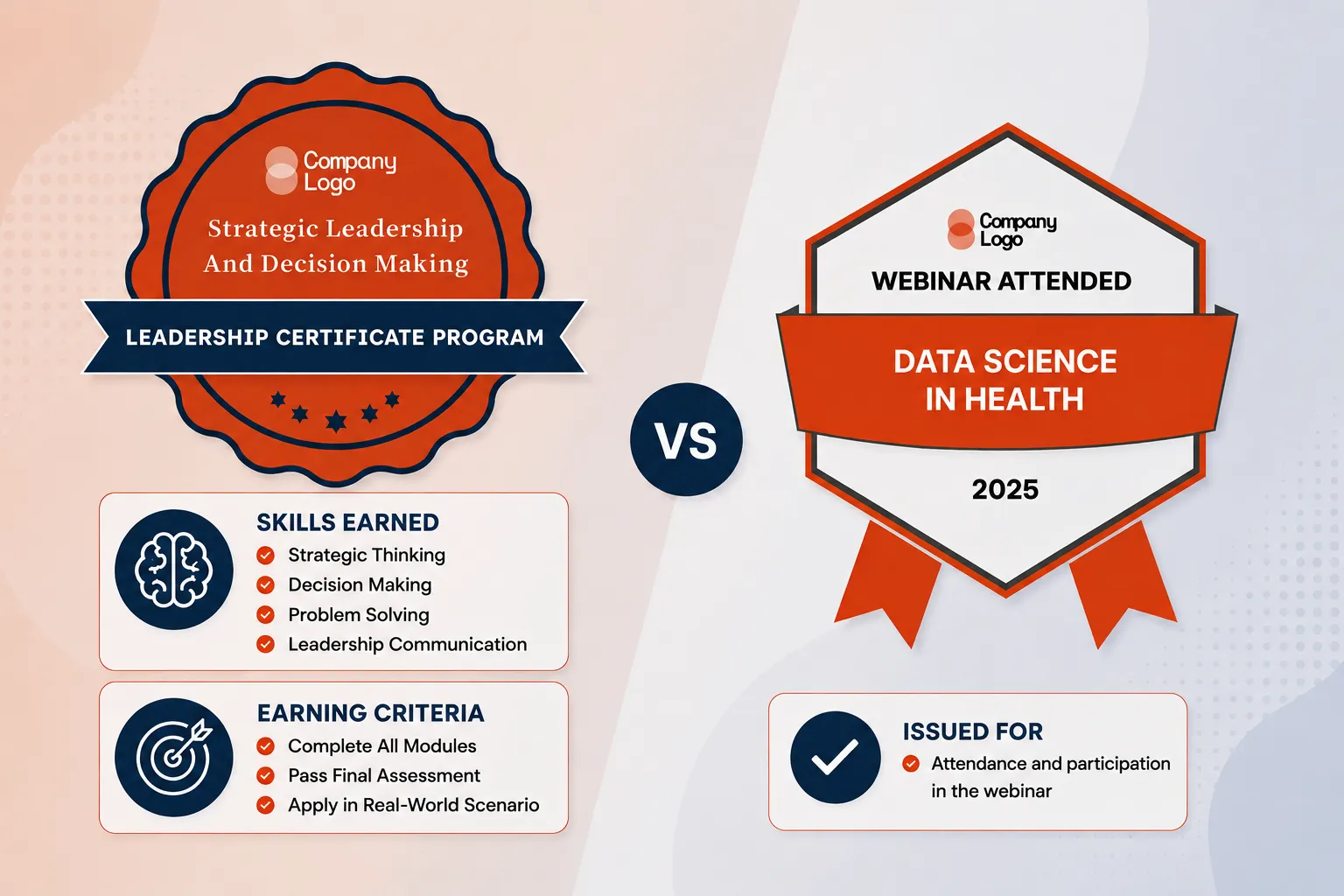
This guide breaks down both badge types. It explains how each one works, what they measure, and when to use them. By the end, you will know which badge type fits your program best.
What Is a Completion Badge?
A completion badge recognizes that someone finished a task, course, or program. It marks the end point, not the skill level. When you earn a completion badge, it means you showed up and crossed the finish line.
Completion badges are straightforward. They have one clear rule: if you complete the thing, you get the badge. No test. No skill check. No hidden criteria. Just proof that you were there and you did the work.
How Completion Badges Work
The process is simple and fast:
- Define the task. Pick what needs to be done. A course module. A webinar. A training session. A chapter you read.
- Track completion. Monitor when the person finishes. This happens automatically in most learning platforms.
- Award the badge. The moment they cross the finish line, they get the badge. No delays.
- No skill check needed. There is no test or evaluation. Completion is the only criterion.
Examples of Completion Badges
Completion badges show up in many places:
- Finishing an online course or bootcamp
- Attending a live workshop or webinar
- Reading a full training module
- Completing a one-day event or conference
- Watching all videos in a series
- Submitting a required assignment
Why Use Completion Badges?
Completion badges have real value in certain scenarios:
- Engagement and motivation. Getting a badge for finishing feels like progress. It encourages people to complete more. This is why 15 professional badge templates work so well for training programs.
- Low friction. There is no test, no evaluation, no wait. Fast badges mean fast motivation.
- Proof of participation. You need proof that someone attended. A completion badge shows they were there.
- Accessibility. Everyone who starts can finish. There is no gatekeeping based on skill.
- Volume and scale. Issuing completions is simple and automatic. You can badge thousands at once.
What Is a Competency Badge?
A competency badge recognizes that someone can do something well. It measures a skill or ability, not just effort. When you earn a competency badge, you have proven you know your stuff.
Competency badges are harder to earn. They require evidence that you have the skill. A test, a project, an assignment reviewed by an expert. The bar is higher, so the badge means more.
How Competency Badges Work
The process has more steps and more evaluation:
- Define the skill. State exactly what skill or ability the badge represents.
- Set clear criteria. Write down what proof of skill looks like. What must you do to show you have it?
- Design an assessment. Create a way to test the skill. A practical exam. A coding challenge. A portfolio review.
- Evaluate the work. Grade or review what they produced. Check if it meets the criteria.
- Award the badge. Only award if they pass. If they fall short, they can try again later.
Examples of Competency Badges
Competency badges recognize specific abilities:
- Passing a certification exam in project management
- Building a working app or software tool
- Writing and defending a research paper
- Demonstrating fluency in a programming language
- Showing proficiency in graphic design through a portfolio
- Passing a technical interview or skills assessment
- Proving mastery of a business process or framework
Why Use Competency Badges?
Competency badges have different strengths:
- Real skill proof. The badge means the person actually knows the skill. Employers trust it.
- Higher perceived value. Because the bar is higher, earning it feels like a bigger win.
- Career impact. A competency badge on your resume means something. Employers take notice.
- Quality assurance. You control the standard. Every badge holder meets the same bar.
- Stackable credentials. Competency badges stack together to show growing expertise. Read more about digital badge platforms that support this model.
Completion Badges vs Competency Badges: Side-by-Side
Here is how they compare across key dimensions. For a deeper dive into digital badges and how they work, check out our comprehensive guide:
| Aspect | Completion Badge | Competency Badge |
|---|---|---|
| Measures | Finishing a task or course | Ability to perform a skill |
| How earned | Show up and finish | Pass an assessment or test |
| Evaluation | Automatic, no grading | Expert review or scored test |
| Time to earn | Fast, at the end date | Variable, depends on readiness |
| Effort to issue | Low, fully automated | Moderate to high, requires review |
| Difficulty for learner | Easy, most can finish | Harder, not everyone passes |
| Employer view | Shows participation | Shows proven ability |
| Best for | Volume, engagement, tracking attendance | Career growth, job readiness, skill proof |
| Risk of badge inflation | Higher (many earn it) | Lower (higher bar) |
Key Differences in Practical Terms
Three core differences separate completion and competency badges in the real world.
#1. What Matters Most
A completion badge measures presence and persistence. Did you show up? Did you stick with it? If yes, you get the badge.
A competency badge measures performance and proof. Can you actually do it? Do you meet our standard? If yes, you get the badge.
#2. Who Can Earn It
With a completion badge, almost anyone who enrolls can earn it. The barriers are low. Completing the course is the only hard part, and most people can do that with time.
With a competency badge, only some people earn it. The skill bar is real. Some may need to try multiple times. Some may not reach the standard at all. That scarcity gives the badge weight.
#3. How Long It Takes
A completion badge arrives on a fixed date. You finish the course on Friday, you get the badge that day. The timeline is set when you design the program.
A competency badge arrives when someone is ready. One person passes the exam on day five. Another takes three weeks to prepare. Each person's timeline is their own. The badge waits for mastery, not a calendar.
When to Use Completion and Competency Badges
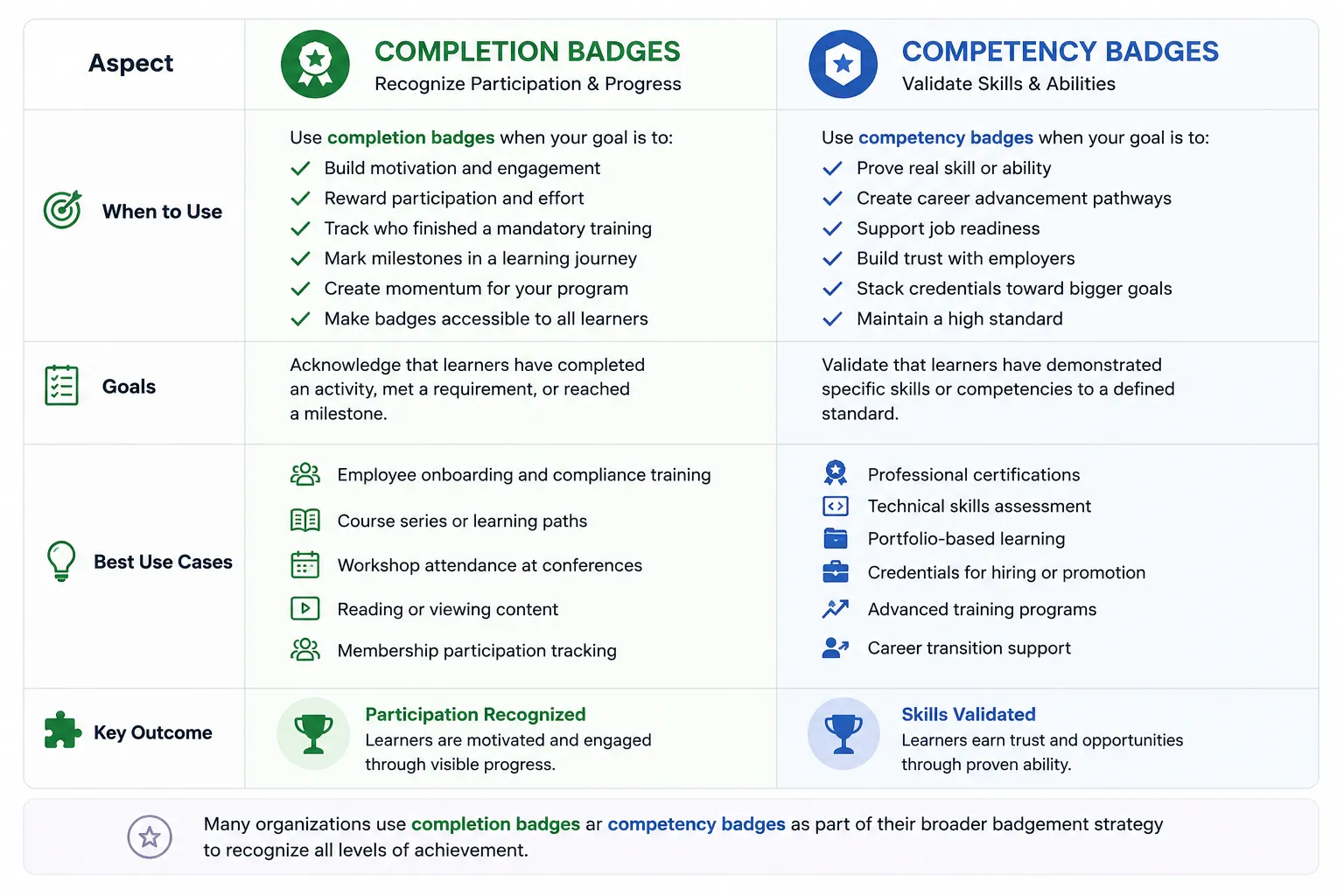
Can You Use Both Together?
Yes, many programs use both. A strong strategy might combine them like this:
A student takes an online course (completion badge at the end). Then they complete a real-world project or pass a practical test (competency badge). They end up with two badges that tell different stories.
The completion badge shows they learned the fundamentals. The competency badge proves they can apply what they learned. Together, they build a complete picture of the learner's growth.
This layered approach works well for organizations building credential flywheels that support:
- Professional development programs that combine training and testing
- Academic programs that mix coursework and capstone projects
- Apprenticeships that track both progress and demonstrated skill
- Career pathways that build on each other over time
This strategy aligns with how digital badges are most effectively used in modern learning programs.
Start Issuing Badges Today
At Wauld, you can create both completion and competency badges and manage them in one unified account. Whether your goal is to drive engagement or prove real skill, we make it simple:
- Design badges fast with 600+ customizable templates
- Issue in bulk with automated workflows
- Verify instantly with Open Badge 3.0 compliance
- Track results with real-time analytics and engagement data
Stop thinking of badges as nice-to-have decorations. Make them the backbone of your credential strategy. Whether you badge completion, competency, or both, turn every achievement into a verifiable, trusted credential that actually moves careers forward.
Ready to launch your badging program? Create your first badge in minutes or explore how Wauld supports your credentialing goals.
FAQs on Competency vs Completion Badges
1. Can someone fail to earn a competency badge?
Yes. With a competency badge, there is a real bar. If someone does not meet the criteria on their first try, they do not earn the badge. Many programs let them try again after more study or practice. This is normal and expected. The badge only goes out when they actually meet the standard.
2. Do employers prefer competency or completion badges?
Employers trust competency badges more. A completion badge shows you finished a course. A competency badge shows you can do the job. For career advancement, competency matters more. But for compliance or mandatory training, a completion badge serves a real need. Use the right badge type for your purpose.
3. What if I want high engagement but also high standards?
Layer your badges. Use completion badges to build engagement early, then offer competency badges to those who want to go deeper. Some people will earn both. That progression keeps everyone motivated while maintaining your quality bar.
4. What is the difference between using competency and completion badges together?
Using both creates a powerful two-tier credentialing system. Start with a completion badge to recognize participation and build momentum. Then advance motivated learners to competency badges that prove real skill. This approach maintains accessibility while rewarding excellence. For example, completion badges might mark course attendance, while competency badges require passing a final assessment or completing a capstone project. Together, they create a complete learning pathway that motivates participation at every level while building trust through demonstrated ability. Learn more about stackable credentials in our guide on micro-credentials.
Choose the Right Badge for Your Program
The choice between completion and competency shapes your entire credentialing strategy. Completion badges drive participation and engagement. Competency badges drive skill proof and career impact.
Many successful programs use both. Start with your goal. What do you want your badge to say? What do you want it to mean to employers, learners, and the public?
Once you know that, the badge type you choose will follow. Design your criteria, set your bar, and issue with confidence.
Ready to Build Your Badging Program?
Don't let your credentials go unrecognized. Whether you need completion badges to drive engagement or competency badges to prove real skills, Wauld makes it simple to create, issue, and manage both.
Get started today:
- Design professional badges in minutes with 600+ templates
- Issue badges in bulk to hundreds or thousands of learners
- Verify credentials instantly with Open Badge 3.0 compliance
- Track engagement and impact with real-time analytics
Create Your First Badge Now or Learn More About Wauld's Credential Platform