How Digital Verification Helps Detect Forged Identity Documents

A forged certificate does not have to be well made. It only has to be hard to check. Digital verification removes that gap by moving the proof off the document and onto the issuer's own record, so confirming a credential takes one click instead of a week of unanswered emails.
This guide is for the people who issue credentials, and for anyone who has to trust them: colleges, training providers, HR and L&D teams, and recruiters. Below, you'll see why paper and PDF certificates are so easy to fake, how big the credential fraud problem actually is, exactly how digital verification catches a forgery, and what issuers can do about it this week.
What Is Digital Verification?
Digital verification is the process of confirming that a document, credential, or identity is real. You check it against a trusted digital record held by the organization that issued it. You do not judge the document by how it looks.
That is the whole idea, and it is simpler than the phrase sounds.
Most credential checks today work the other way. Someone hands you a certificate, or a PDF, which is just a certificate that has not been printed yet. You look at the logo. You look at the signature. It seems fine, so you approve it.
Digital verification changes the question. It stops asking, "does this document look real?" It starts asking, "does the issuer actually have a record of this?"
The second question is far harder to fake. It is also much faster to answer.
A Story From Placement Week
I studied at a college with a strong reputation. Placement week was a big deal. Companies flew in, and the offer list went up on a board in the corridor.
I remember sitting outside the interview rooms with a friend. She had spent two years on a research project. Real lab hours. A real supervisor. A real write-up. She also had certificates from three weekend workshops she had genuinely attended.
The person who got her role had a thicker folder. More certificates. Bigger names printed on them. An internship at a company that, as far as anyone could tell, had never heard of him.
Here is the part that still bothers me. We all knew. Half the batch knew which certificates came from the print shop near the back gate. There was a going rate. There was a guy who did the seals.
However, the company did not know. Nobody questioned it either, because questioning it meant accusing a candidate to their face. Then it meant a week of chasing an administrator who might never reply. So the recruiter looked at a nice PDF, nodded, and moved on. My friend did not get that role.
I did not have a name for the missing piece back then. I do now. The missing piece was digital verification.
Why Paper Certificates Fail
Forging a certificate is easier than most people assume. Understanding why matters, because it shows what a real fix must do.
- The document carries its own proof. Every piece of evidence sits on the certificate itself. Copy the printing, and you have copied the evidence.
- Fancy design is decorative, not protective. Gold foil, embossed seals, and ornate borders can all be reproduced. They only feel like security features.
- PDFs are trivial to edit. Anyone can change a name, a date, or a grade. The reader cannot see what the original said.
- Almost nobody checks. Manual verification means finding the right office and waiting for a reply. Recruiters with fifty candidates and a Friday deadline usually skip it.
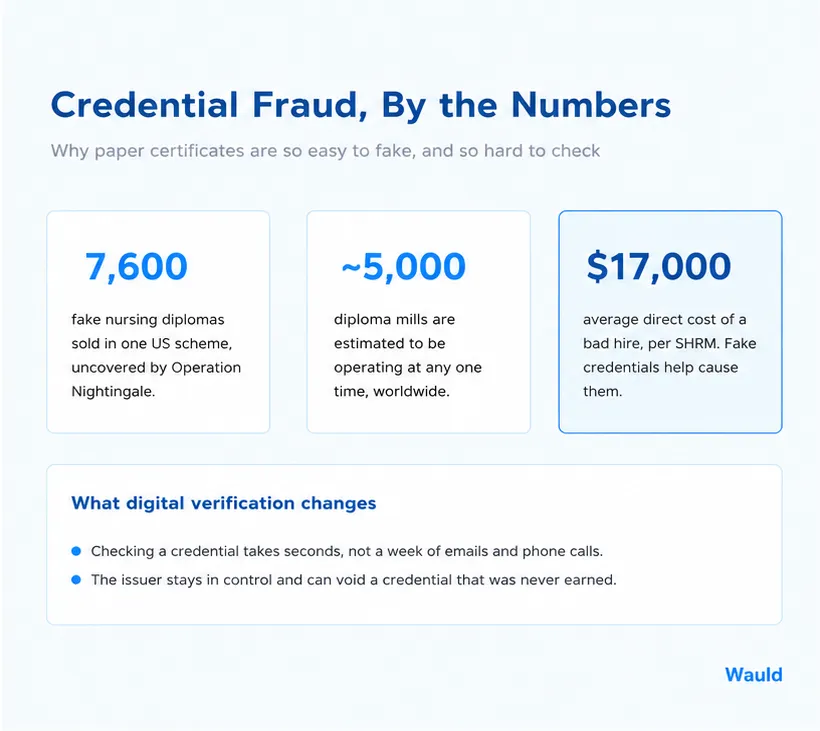
The market for fakes is real, too. Researchers estimate that roughly 5,000 diploma mills operate at any one time. Their documents look every bit as official as the genuine article.
How Big Is Credential Fraud?
I used to think my college was unusual. It was not.
In 2023, US federal agencies uncovered a scheme in Florida nursing programs. Investigators found more than 7,600 fake diplomas and transcripts had been sold. Buyers paid roughly $10,000 to $17,000 and skipped the clinical hours entirely. About 2,500 of them passed the licensing exam and worked as nurses.
Thousands of people held paperwork that looked completely legitimate. It took a federal investigation to catch what working digital verification would have caught on day one.
The hiring side tells the same story. The Society for Human Resource Management puts the average direct cost of a bad hire near $17,000. That figure ignores team disruption and reputational damage. Education is one of the most commonly exaggerated parts of an application. Therefore credential fraud is a quiet, expensive, and very avoidable problem.
How Verification Catches a Forgery
Here is what actually happens when a credential is issued digitally.
Step 1: The Issuer's Record
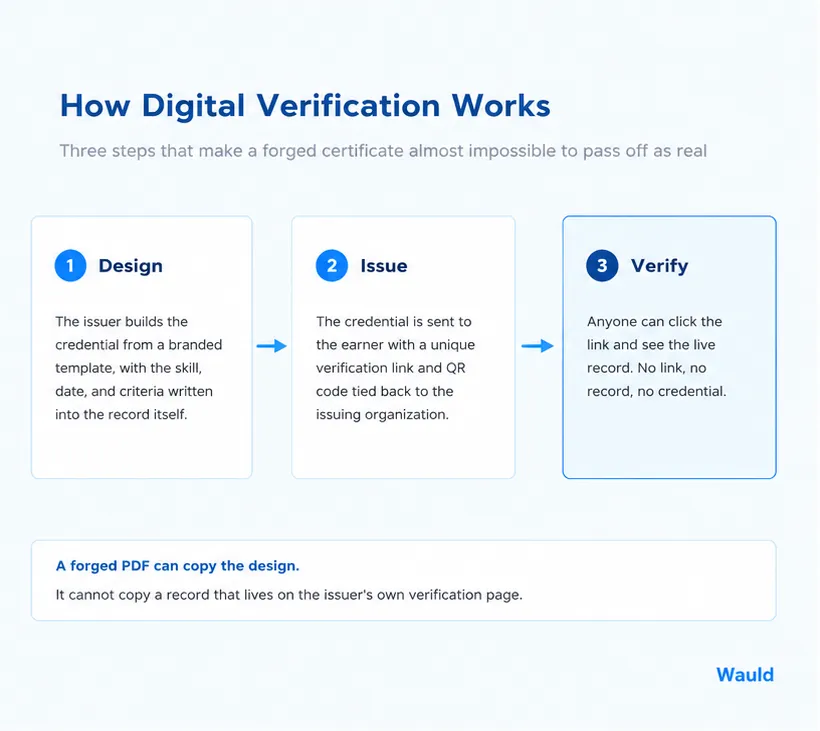
The real credential is a record inside the issuer's platform. What the recipient shares is a link to that record. If no record exists, there is nothing to see. A forger can copy a badge image easily. However, they cannot create an entry in someone else's system.
Step 2: A Verification Link
This is the part that changes a recruiter's day. They click a link or scan a QR code. A page opens showing the issuer, the recipient, the program, and the issue date. It takes about four seconds instead of four days.
Step 3: Data Inside Credentials
A verifiable credential carries structured data. It names the issuing organization, the recipient, the skill, the issue date, and often the criteria assessed. For example, "Certificate of Excellence" stops being a vague phrase. It becomes a specific claim you can inspect.
Step 4: Tamper-Evident Standards
Two standards matter here. Open Badges 3.0 comes from 1EdTech. It is built on the W3C Verifiable Credentials data model. Together they make credentials tamper-evident and cryptographically checkable. In plain English: if someone edits a credential, verification fails. It does not quietly pass.
Step 5: Instant Revocation
You cannot recall a printed certificate. You can void a digital one. If a credential was issued in error, or a certification lapsed, the issuer voids it. The verification page updates right away.
Paper vs. Digital Credentials
| Paper or PDF certificate | Verifiable digital credential | |
|---|---|---|
| Where the proof lives | On the document | On the issuer's record |
| Time to verify | Days of emails and calls | Seconds, via link or QR code |
| Can it be edited? | Yes, easily | Editing breaks verification |
| Can it be revoked? | No | Yes, instantly |
| Works across platforms | No | Yes, via Open Badges and W3C standards |
| Shareable on LinkedIn | As an image only | As a linked, checkable credential |
What Issuers Should Do Next
You are not just a certificate printer. You are the trust layer. Whatever you issue is what employers use to judge your people.
Here is a practical checklist:
- Give every credential a permanent verification link. If an employer cannot check it without emailing you, it is not verifiable.
- Add a QR code to anything printed. Some settings still need paper. A QR code gives you both.
- Write real detail into the credential. Include the program, hours, skills, and dates. Vague credentials are the easiest to copy.
- Choose standards-based credentials. Open Badges and W3C support means your badges stay checkable anywhere.
- Make sharing simple. When earners add credentials to a LinkedIn profile in one click, plain PDFs start to look odd.
- Watch your analytics. Verification activity shows you which credentials employers actually check.
If you issue academic credentials, Wauld's digital credentials for universities and colleges shows what this looks like in practice.
Where Digital Verification Falls Short
I want to be honest here, because no tool fixes everything.
Digital verification proves that a specific issuer issued a specific credential. It does not prove the issuer is reputable. A diploma mill can run its own verification page. Therefore employers still need to check that the issuing body is accredited.
It also does not confirm identity on its own. It confirms that the credential was issued to a named person. Matching that person to the candidate in the room is a separate step. ID checks and background checks handle that part.
Finally, adoption takes time. Although verification is instant, employers only benefit once issuers move away from plain PDFs. That shift starts with issuers, not recruiters.
How Wauld Simplifies Verification
I joined Wauld a while after all of this. My first reaction was mild irritation. This had been a solvable problem the whole time.
Wauld is a digital credentialing platform. Organizations use it to design, issue, manage, and verify digital certificates and badges in one place. The lifecycle has three steps: Design, Issue, Track.
Here is what that means day to day:
- Design. Build certificates and badges from over 1,000 customizable templates. Match your brand, including the QR code and the email.
- Issue. Send credentials one at a time or in bulk, including straight from form responses. A program with 900 graduates stops being a data entry project.
- Track. See who opened, downloaded, and shared a credential. Watch LinkedIn additions and verification counts.
- Verify. Every credential gets a unique verification link. Wauld credentials align with Open Badges 3.0 and W3C Verifiable Credentials, so they stay checkable across platforms.
There is an Issuer Portal for your team and a Recipient Portal where earners store and share credentials. Wauld is free to start, with no onboarding fees. It was named a SourceForge Top Performer for Digital Credential Management.
A platform will never fix human dishonesty. People will still try. However, digital verification changes the odds. It turns "trust me, this is real" into "here, check it yourself."
Here is that check, start to finish. One click on a Wauld credential confirms the recipient, the issuer, and the credential ID against the live record.
Conclusion
Those certificates in the corridor were not clever. They were simply unverifiable. Unverifiable is all a forgery needs to be. When checking something takes a phone call nobody has time for, the fake wins by default.
Digital verification closes that gap quietly. One link. One record. One click. It accuses nobody. It just makes an honest credential easy to confirm and a fake one impossible to sustain.
My friend deserved that role. Somewhere right now, a student is in the same position with the same real work behind them. As an issuer, you decide whether checking is hard or effortless. That is real power, and it is worth using well.
FAQs On How Digital Verification Helps Detect Forged Documents
What Is Digital Verification?
Digital verification confirms that a document, credential, or identity is genuine. It checks the item against a trusted digital record held by the issuer. For certificates and badges, you click a verification link or scan a QR code. The live record opens instantly.
How Does Digital Verification Detect Forged Documents?
It removes the forger's advantage. The proof lives with the issuing organization, not on the document. Therefore, a copied or edited certificate has no matching record to point to. Standards like Open Badges 3.0 and W3C Verifiable Credentials also make credentials tamper-evident. Any edit causes verification to fail.
How Can I Verify a Certificate Online?
Ask for the verification link or QR code that came with the certificate. Open it, then check that the page sits on the issuing organization's own domain. Confirm the recipient name, program, and issue date match the copy you were given. If there is no link, contact the issuing institution directly.
How Do Employers Detect Fake Degree Certificates?
Employers usually combine two checks. First, they verify the credential itself through a verification link or a direct request to the institution. Second, they confirm the institution is properly accredited, because diploma mills can issue convincing paperwork. Digital verification makes the first check almost instant.
Can a Digital Certificate Be Faked?
Someone can copy the image of a digital certificate. They cannot copy the underlying record. Without a working verification link that opens the issuer's own page, a copied credential fails a five-second check. This is why the verification link matters more than the visual design.
What Are Open Badges and W3C Verifiable Credentials?
Open Badges is an open standard from 1EdTech for portable digital badges that carry their own data. W3C Verifiable Credentials is a specification for issuing tamper-evident credentials that can be checked cryptographically. Open Badges 3.0 is built on the W3C model, so credentials stay verifiable across different platforms.
Do Training Providers Need Special Software?
Yes, you need a credentialing platform that supports verification links and open standards. A platform like Wauld handles design, bulk issuing, tracking, and verification together. Therefore you do not need separate tools or an in-house development project.
Ready to make your credentials impossible to fake?
No onboarding fees, 1000+ templates, and digital verification built into the very first credential you send.