7 Interview Questions for Hiring a Credentialing Specialist

Key Takeaways
The short version
A credentialing specialist owns credentials from end to end. What that means depends entirely on your industry.
In HR and learning and development, they design certificates and digital badges, keep recipient data clean, issue credentials at scale, and make sure an outsider can verify each one years later.
In healthcare, they verify that clinicians are who they say they are and are permitted to practice. They chase down primary sources, keep licenses and certifications current, get providers enrolled with payers, and keep files ready for an accreditation audit.
The two roles share a temperament and almost nothing else. So this guide gives you two sets of seven questions. Use the set that matches the job you are filling.
Below you will find each question, what a strong answer sounds like, and the red flag to watch for.
Two jobs, one job title
Before you write the job description, decide which role you are hiring. The overlap is smaller than the shared title suggests.
| HR and L&D | Healthcare | |
|---|---|---|
| What they credential | Learners, employees, members | Physicians, nurses, allied health providers |
| Core daily work | Design, issue, track, verify | Verify, enroll, monitor, re-verify |
| Who they answer to | L&D, marketing, program owners | Medical staff services, compliance, revenue cycle |
| The standards that matter | Open Badges 3.0, W3C Verifiable Credentials | NCQA, The Joint Commission, URAC, CMS |
| What failure costs | Embarrassment, a dead program | Denied claims, failed audits, patient safety risk |
| Typical adjacent title | Credential program manager, L&D operations | Medical staff coordinator, payer enrollment specialist |
If your posting attracts candidates from the wrong track, that is usually a sign the description is vague about which of these two columns the job sits in.
Why this role matters now
Employers keep saying they hire for skills instead of degrees. The follow-through is thinner than the promise.
Researchers at Harvard Business School and the Burning Glass Institute found that fewer than 1 in 700 hires actually benefited when companies dropped degree requirements.
Skills-based hiring is mostly a proof problem. Employers cannot act on a skill they cannot verify.
Therefore someone has to build that proof. That someone is your credentialing specialist. For example, IBM built one of the largest corporate badge programs in the world. Its scale came from clear criteria and careful issuance, not from good luck.
Healthcare has the same problem with harder consequences. A provider who is not properly credentialed and enrolled cannot bill, and an unverified credential in a file is exactly what an auditor is looking for. The proof has to exist before the work does.
What the HR and L&D job actually covers
Get clear on scope before you interview anyone. Most HR and L&D credentialing roles cover four stages.
| Stage | What they own | What to ask about |
|---|---|---|
| Design | Branded certificate and badge artwork, earning criteria, metadata, naming rules | How they set criteria before design |
| Issue | Clean recipient data, bulk issuance, delivery emails, reissues and voids | Their process for a 3,000-person batch |
| Track | Opens, downloads, shares, LinkedIn profile adds, renewal reminders | Which numbers they report to leadership |
| Verify | Verification links, QR codes, Open Badges 3.0, W3C Verifiable Credentials | How an outsider checks a credential |
Use this table as a listening guide. A candidate who lights up on one stage only is not a bad hire. It simply tells you where they will need support.
The 7 HR and L&D credentialing specialist interview questions
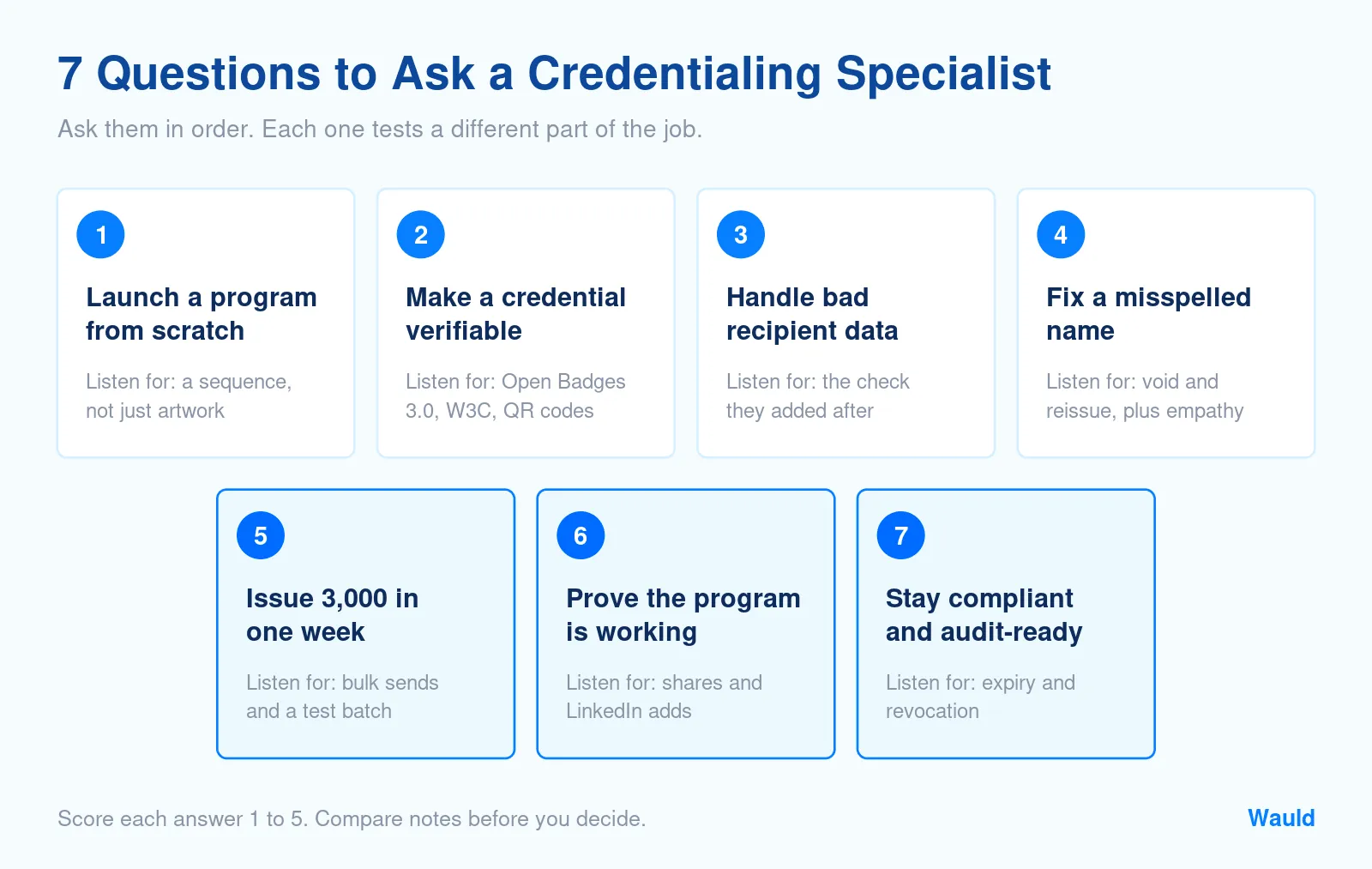
1. "Walk me through how you would launch a credential program from scratch."
Start here, because this question shows structure fast. You are not looking for a perfect plan. You want to hear a sequence.
A strong answer covers these points:
- Who the credential is for. The audience shapes everything else.
- What someone must do to earn it. Clear criteria come before artwork.
- What the credential says. Title, issuer, date, and skills.
- How recipients receive it. Email, portal, or both.
- How success gets measured. A number, agreed up front.
Red flag: they jump straight to design. Pretty certificates with vague criteria are the most common way credential programs fail.
2. "How do you make sure a credential is genuinely verifiable?"
A certificate nobody can check is just a nice PDF. Therefore this question separates people who understand digital credentials from people who understand graphic design.
A strong answer mentions a unique verification link or QR code for every credential. It also covers metadata attached to the credential itself, such as issuer, recipient, criteria, issue date, and expiry.
Listen for open standards by name. Open Badges 3.0 is the digital credential specification from 1EdTech. It is built as a profile of the W3C Verifiable Credentials Data Model. That model became a W3C Recommendation in May 2025.
Credentials built to those standards stay readable on other platforms and in digital wallets.
Red flag: "we email a PDF." That is fine as a delivery format. On its own, however, it gives a future employer no way to confirm anything.
3. "Tell me about a time recipient data went wrong."
Every credentialing professional has a story here, because the data always goes wrong eventually. Duplicate rows. Swapped columns. Two hundred certificates addressed to "FIRSTNAME."
A strong answer explains how they caught it, how fast they told people, and how they fixed it. The last part matters most: what check did they add so it could not happen again?
Red flag: they blame whoever sent the spreadsheet. Cleaning messy data is the job, not an interruption to it.
4. "A learner says their name is misspelled on a certificate they already shared. What now?"
This small scenario tests three things at once. It shows their technical process, their tone, and their judgment under mild pressure.
A strong answer includes four steps:
- Apologize quickly and plainly. No defensiveness.
- Void or reissue the credential. The wrong version should not stay live.
- Confirm the correct spelling. Ask the recipient rather than guessing.
- Check the rest of the batch. One error often means several.
Red flag: they treat it as a trivial complaint. For the recipient, this is their name in public, attached to something they earned.
5. "How would you issue 3,000 credentials in a week?"
Volume is where good process shows. Ask this if you run large cohorts, annual compliance training, or event credentials.
A strong answer mentions bulk issuance from a spreadsheet or connected form. It also covers dynamic fields that fill in names and dates automatically. Experienced candidates will describe a small test batch before the full send. They will also have a plan for bounced emails.
Red flag: they describe a fully manual process. Sending 3,000 credentials by hand is not diligence. It is a bottleneck.
Are you building this workflow now? Wauld issues certificates in bulk from a CSV or form response. Dynamic fields fill in each recipient's details for you.
6. "How would you tell us whether our credential program is working?"
Plenty of people can send credentials. Fewer can prove the program earned its budget. Therefore this question separates a coordinator from a program owner.
A strong answer covers these numbers:
- Open and download rates. Did recipients collect the credential?
- Share rates and LinkedIn profile adds. Did they show it off?
- Verification clicks. Did anyone outside check it?
- Completion rates. Did the training behind it land?
The best answers connect those numbers to a business goal. For example, course enrollment, membership renewal, or compliance coverage.
Red flag: "we track how many we sent." Sending is an activity, not an outcome.
7. "How do you keep credentials compliant and audit-ready?"
Someone will eventually ask you to produce records. This is true in financial services, safety training, and continuing education.
A strong answer covers expiry dates, renewal rules, and a clear record of who received what and when. It also covers how to revoke a credential and how to handle personal data carefully.
Red flag: no mention of expiry or revocation. Credentials that never expire and can never be pulled back become a compliance problem later.
Green flags and red flags for an HR and L&D hire
Keep this table open during the interview and mark each row as the candidate talks.
| Green flag | Red flag |
|---|---|
| Describes a repeatable process, step by step | Tells heroic stories with no system behind them |
| Names Open Badges 3.0 and W3C by name | Thinks an emailed PDF is a verifiable credential |
| Adds a check after every mistake described | Blames whoever sent the spreadsheet |
| Measures shares, verifications, and LinkedIn adds | Reports only how many credentials went out |
| Talks about expiry, renewal, and revocation | Never mentions what happens when a credential expires |
What the healthcare job actually covers
Healthcare credentialing is a different animal. The specialist is not producing credentials. They are proving that someone else's credentials are real, current, and sufficient for the privileges being requested.
| Stage | What they own | What to ask about |
|---|---|---|
| Verify | Primary source verification of education, training, licensure, board certification | Which sources they contact and how they document it |
| Screen | NPDB queries, exclusion and sanction checks, malpractice history, work history gaps | What they do when something comes back adverse |
| Enroll | Payer applications, CAQH profiles, Medicare and Medicaid enrollment, effective dates | How enrollment delays affect billing |
| Monitor | Expirables tracking, recredentialing cycles, ongoing sanction monitoring | Their reminder cadence and escalation path |
Two vocabulary notes that will help you listen. Credentialing is verifying that a provider's qualifications are genuine. Privileging is granting that provider permission to perform specific procedures at your facility. They are related but separate, and they are approved by different bodies. Candidates who blur them have usually only worked one narrow slice of the process.
The 7 healthcare credentialing specialist interview questions
These questions are deliberately specific. A strong healthcare credentialing candidate will recognize every one of them as something they did last month.
1. "Walk me through your primary source verification process for a new physician."
This is the foundation of the job. You want to hear the mechanics, not the concept.
A strong answer names the sources directly: the medical school or residency program, the state licensing board, the certifying board for board certification status, and prior employers or facilities for work history. It describes verifying with the issuing source rather than accepting copies the provider supplied. It also describes documenting each verification with the date, the method, and who performed it.
Listen for an awareness that verifications go stale. Most accreditation frameworks expect verifications to be current at the time the file goes to committee, not simply completed at some point.
Red flag: they accept provider-supplied photocopies of a diploma or license as verification. That is a document, not a verification, and it is one of the most common audit findings.
2. "A provider's application shows an unexplained eight-month gap in work history. What do you do?"
Gaps are routine. How the candidate handles one tells you whether they document or assume.
A strong answer says they request a written explanation from the provider, in the provider's own words, and place it in the file. They know their organization's gap threshold and apply it consistently. They also treat the explanation as something to be verified where possible, not simply filed.
Red flag: "I'd ask them about it on the phone and move on." A verbal answer that never reaches the file does not exist as far as an auditor is concerned.
3. "How do you track expirables so nothing lapses?"
This is the question that predicts whether you will get a surprise phone call at 7am about a provider who cannot see patients today.
A strong answer covers the full set: state license, DEA registration, board certification, malpractice insurance certificate, and any facility-required life support certifications. It describes staged reminders well in advance rather than a single warning, a named escalation path when a provider does not respond, and a defined consequence when a credential does lapse.
The best answers connect this to operations. A lapsed license means a provider comes off the schedule and claims get held. Someone has to tell scheduling and billing, not just the provider.
Red flag: "a spreadsheet I check when I get a chance." Volume plus manual memory is how lapses happen.
4. "A payer set our new provider's effective date three months after their start date. What do you do?"
This question tests whether the candidate understands that credentialing is a revenue function, not just a paperwork function.
A strong answer explains that they would request a retroactive effective date where the payer's policy allows it, escalate through the provider representative, and work with the billing team to hold rather than drop the affected claims. They can articulate roughly how much revenue sits at risk during a gap like that.
Strong candidates will also mention prevention: starting enrollment well before the provider's start date, because payer turnaround is measured in months.
Red flag: they treat it purely as an administrative fix and never mention claims, billing, or revenue.
5. "How do you keep a credentialing file ready for an NCQA or Joint Commission audit?"
Accreditation readiness is a habit, not a project you start when the audit is scheduled.
A strong answer covers a consistent file structure, verification dates documented alongside the source, the credentialing committee's review and the date of approval, and a defined recredentialing cycle. Under NCQA standards, recredentialing is generally expected at least every 36 months, and a good candidate will know their organization's cycle without looking it up.
If you use delegated credentialing arrangements, ask how they handle roster submissions and delegation oversight audits. That is a distinct skill set and worth confirming directly.
Red flag: no mention of committee approval or time-limited verifications. Those two things are where audits usually find problems.
6. "What is the difference between credentialing and privileging, and who approves each?"
A short definitional question that reliably separates depth from exposure.
A strong answer explains that credentialing verifies qualifications while privileging grants permission to perform specific clinical procedures based on training, current competence, and often case volume. It describes the approval chain: medical staff services prepares the file, a credentials committee reviews it, the medical executive committee recommends, and the governing board grants. Candidates with hospital experience will mention evaluating a provider's performance after new privileges are granted, and ongoing performance review thereafter.
Red flag: they use the two words interchangeably. It usually means they have worked only in payer enrollment and have not touched the hospital medical staff side, which may be fine — but you should know it before day one.
7. "How do you screen for sanctions and adverse actions, and how often?"
Screening once at onboarding is not screening.
A strong answer covers the National Practitioner Data Bank for malpractice payments and adverse actions, the OIG List of Excluded Individuals and Entities, federal debarment records, state Medicaid exclusion lists, and state licensing board disciplinary actions. Crucially, it describes a recurring cadence — exclusion screening is commonly run monthly — rather than a one-time check at hire.
Then ask the follow-up that matters: what do they do when something comes back positive? You want to hear escalation to compliance and medical staff leadership, not a judgment call made alone.
Red flag: they screen at onboarding and again at recredentialing, with nothing in between. A provider can be excluded in month four of a three-year cycle.
One bonus question for either track
Ask this last: "What is the least interesting part of this job, and how do you stay on top of it?"
Credentialing involves a lot of patient follow-up. Chasing missing details. Re-sending emails. Calling a residency program for the fourth time. An honest answer here predicts month nine better than any polished launch story.
Green flags and red flags for a healthcare hire
| Green flag | Red flag |
|---|---|
| Verifies with the issuing source and documents date and method | Accepts provider-supplied copies as verification |
| Puts every explanation in writing in the file | Resolves questions verbally and moves on |
| Runs exclusion screening on a recurring cadence | Screens only at hire and recredentialing |
| Connects enrollment delays to held claims and revenue | Treats enrollment as pure paperwork |
| Distinguishes credentialing from privileging cleanly | Uses the two terms interchangeably |
| Knows their recredentialing cycle without checking | Cannot describe what happens after initial approval |
How to score the answers
Interviews get slippery when every candidate sounds fine. A simple scorecard fixes that. Rate each person 1 to 5 on six traits, whichever track you are hiring for:
- Process thinking. Repeatable steps, or one-off heroics?
- Data care. Do they build checks before anything goes out?
- Standards knowledge. Can they explain verification in plain English?
- Recipient empathy. Do they treat earners and providers as people, not rows?
- Measurement. Do they think in outcomes?
- Follow-through. Can they stay with a slow, dull task?
Score independently first. Then compare. This small habit makes disagreements between interviewers far more useful.
A better test than any question
Give a short, paid work sample. It tells you more than an hour of conversation. Pick the one that matches your track.
For HR and L&D: send a messy 40-row recipient list. Include duplicates, inconsistent name formats, and one invalid email address. Ask the candidate how they would issue certificates from it, and what they would fix first.
For healthcare: send a redacted provider application with three planted problems — a work history gap with no explanation, a malpractice certificate that expired last month, and a name on the medical school record that does not match the license. Ask them what they would flag, in what order, and who they would contact.
Either takes about 30 minutes. Meanwhile, you learn exactly how they think.
Set your new hire up to succeed
Here is something worth being honest about. Much credentialing frustration is a tooling problem, not a people problem.
Picture a new HR or L&D specialist inheriting a folder of design files, a spreadsheet, and a mail merge. They will spend six months rebuilding plumbing. They will not build a program.
Give them one place to design, issue, track, and verify instead. Wauld offers over 1,000 customizable certificate and badge templates. It handles bulk issuance, shows engagement analytics, and supports verification aligned with Open Badges 3.0 and W3C Verifiable Credentials.
Wauld is free to start with no onboarding fees. Therefore your new hire can run a pilot in week one, rather than waiting on procurement.
Healthcare teams run their provider files in dedicated credentialing software, and that is the right tool for primary source verification and payer enrollment. Wauld sits alongside it for the credentials your organization issues rather than verifies — internal competency badges, compliance training certificates, and continuing education records.
Conclusion
Hiring a credentialing specialist means deciding that proof deserves a real owner.
Decide which of the two jobs you are filling first. Then ask the seven questions that match it. You learn about a candidate's accuracy, standards knowledge, and care for the people behind the records. Those things decide whether a credential program lives or dies, and whether an audit goes quietly.
Ask the questions in order. Score them against a simple rubric. Pay more attention to the small scenarios than the big résumé stories.
Then give your new hire a platform worth their time. Our complete guide to digital badges covers how modern digital credential programs are built.
Give your credential program a proper home
Design branded certificates and digital badges, issue them in minutes, and track every share and verification from one dashboard.
Frequently Asked Questions
What does a credentialing specialist do?
It depends on the industry. In HR and L&D, a credentialing specialist owns the full lifecycle of an organization's digital credentials — designing certificates and badges, keeping recipient data accurate, issuing in bulk, handling corrections, and making sure each credential can be verified. In healthcare, the same title usually means verifying provider qualifications with primary sources, enrolling providers with payers, and keeping files current for accreditation.
What skills should I look for in a credentialing specialist?
Both versions need careful attention to detail, comfort with spreadsheets and systems, and clear written communication. For HR and L&D, add familiarity with credentialing platforms and open standards like Open Badges 3.0. For healthcare, add primary source verification experience, payer enrollment exposure, and familiarity with NCQA or Joint Commission expectations. Program-level thinking separates the strongest candidates in either track.
What is the difference between a credentialing specialist and a credentialing coordinator?
The titles overlap and vary between organizations. Coordinator roles usually focus on daily processing, data entry, and follow-up. Specialist roles tend to include more ownership of process, standards, and reporting. In hospitals you will also see medical staff coordinator and medical staff specialist used for closely related work. Define the scope in your credentialing specialist job description rather than relying on the title alone.
What is the difference between credentialing and privileging?
Credentialing verifies that a provider's qualifications are genuine and current — their education, training, licensure, and board certification. Privileging grants that provider permission to perform specific clinical procedures at your facility, based on their training and demonstrated competence. Credentialing comes first, and privileging depends on it. A candidate who treats the two as the same thing has usually worked only one part of the process.
Should I hire someone from healthcare credentialing for a digital badge program?
Yes, in many cases. Healthcare credentialing trains people in documentation, verification, and persistent follow-up. All of those habits transfer well. However, they may need to learn badge design, open standards, LinkedIn sharing, and engagement analytics. Use question 2 from the HR and L&D set to see how quickly they pick up that vocabulary.
How do I test a credentialing specialist's skills before hiring?
Give a short, paid work sample. For HR and L&D, a messy 40-row recipient list with duplicates, inconsistent name formats, and one invalid email works well. For healthcare, a redacted provider application containing a work history gap, an expired malpractice certificate, and a name mismatch works better. Thirty minutes of their work reveals more than an hour of interview answers.
Do we need a credentialing specialist if we only issue a few hundred certificates a year?
Probably not a full-time one. At that volume, give the responsibility to one named person on your L&D or operations team. Then equip them with a platform that handles design, bulk issuance, and verification. Revisit the decision when volume, program count, or compliance requirements grow. Our guide to micro-credentials explains how small programs usually grow.