AQF Framework Explained: A Simple Guide to Levels

The Short Version First
Picture a student with two course offers open on a laptop. One says "Certificate III" and the other says "Diploma," and there is no obvious way to tell which one ranks higher. "Is a three better than a four?" is a fair question, and most people have never had it explained.
That confusion is exactly why the AQF framework exists. AQF stands for the Australian Qualifications Framework, the national system that ranks every recognized qualification on a single scale. Think of it as a shared measuring stick. By the end of this guide, you will know all 10 levels, what certificate 1, 2, 3, and 4 in Australia means, and why it matters to you.
What The AQF Framework Is
The AQF framework is Australia's official policy for regulated qualifications across schools, vocational training, and universities. It was introduced in 1995 to fix a real problem. Before it, a qualification from one state did not always line up with one from another, so employers were left guessing.
So the country built one scale with 10 levels. Every level is defined by learning outcomes, and each outcome describes three things: the knowledge you gain, the skills you can perform, and how you apply both. Higher levels simply mean deeper knowledge and more independence. You can read the official descriptors on the Australian Qualifications Framework site.
The Ten AQF Framework Levels
Here is the whole ladder in one place. The aqf framework levels move from basic and supervised work at the bottom to original research at the top, as the infographic below lays out.
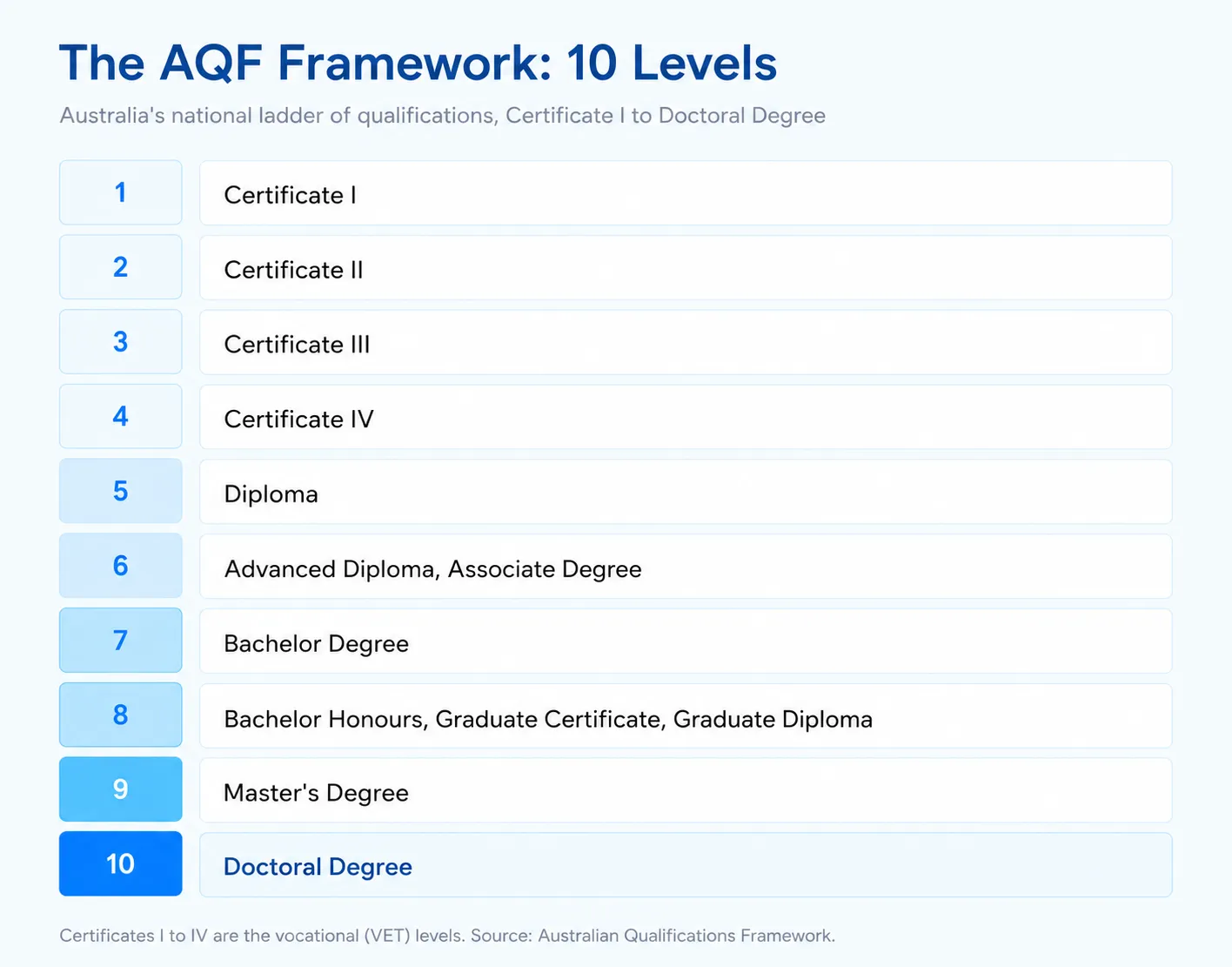
A Diploma sits at Level 5, one full step above a Certificate IV. So the higher the number, the higher the qualification. That settles the Certificate III versus Diploma question in one line.
Certificate 1, 2, 3, and 4 in Australia
The first four rungs are the vocational education and training (VET) certificates, usually delivered by a registered training organisation (RTO). Here is what each one covers, because the differences are genuinely useful to know.
- Certificate I (Level 1). Basic skills for entry-level work and further study. Graduates handle simple, routine tasks with supervision.
- Certificate II (Level 2). Broader practical knowledge for skilled operational work. This often takes six to twelve months.
- Certificate III (Level 3). The classic trade qualification. Think carpentry or electrotechnology, where you work with real independence.
- Certificate IV (Level 4). More theory and responsibility. Graduates often plan their own work and supervise others.
For example, the TAE40122 Certificate IV in Training and Assessment is the qualification trainers themselves need before they can teach and assess in VET. It is a Level 4 credential doing a very specific job.
Because these levels build on each other, they create natural pathways. A learner can move from Certificate III to Certificate IV to a Diploma, often with credit for finished work. That progression is one of the framework's quietest strengths.
Why The AQF Framework Matters
You might think this is only paperwork for schools. It is not. The AQF framework does real work for three groups.
- Students get clarity. You can compare courses honestly and see where each one can lead.
- Employers get confidence. A Diploma holder in Adelaide meets the same benchmark as one in Sydney, so hiring is fairer.
- Training providers get consistency. Everyone builds courses against the same yardstick.
It also keeps qualifications portable, which matters in a country where people move states for work. If you build courses around these levels, Wauld can turn each completion into a polished, verifiable certificate.
Who Governs The AQF Framework
The AQF is administered nationally by the Australian Government's Department of Education, with the states and territories involved too. Two regulators keep standards tight. The Australian Skills Quality Authority (ASQA) oversees VET, and the Tertiary Education Quality and Standards Agency (TEQSA) oversees higher education.
The framework is not frozen, either. A national review reported in 2019 and recommended clearer qualification types and formal recognition of shorter courses. Since then, the National Microcredentials Framework has added standards for microcredentials. However, the AQF remains the overarching system it all sits within.
Issuing AQF-Aligned Digital Credentials
Here is the part people forget. Sorting a course into the right level is only half the story. At the end, someone still has to hand the learner proof they earned it. For years that meant a paper testamur that fades in a drawer.
A digital credential does the same job, but better. It is verifiable, easy to share, and hard to fake. That is where Wauld fits in. Wauld lets training providers, colleges, and coaches design, issue, and track digital certificates and badges from one place, with over 1,000 templates to start from.
The lifecycle is three simple steps: Design, Issue, Track. You brand a certificate to match your course, send it in bulk to a whole cohort, then see who opened, downloaded, and added it to their LinkedIn profile. Every credential carries a unique verification link and aligns with open standards like Open Badges 3.0, so a badge you issue verifies across other platforms too.
How Wauld Supports AQF Providers
The AQF tells you what level a course sits at, but it does not hand your learner the proof. That final step, turning a completion into a credential someone can show an employer, is exactly what Wauld is built for. It sits alongside the framework, picking up right where the accreditation ends.
Wauld is an end-to-end credentialing platform, so everything from designing a certificate to issuing and verifying it lives in one place, with no separate tools to stitch together. RTOs, colleges, and independent trainers and coaches can brand a certificate or digital badge, send it to a whole cohort at once, and track how learners share it on LinkedIn afterwards.
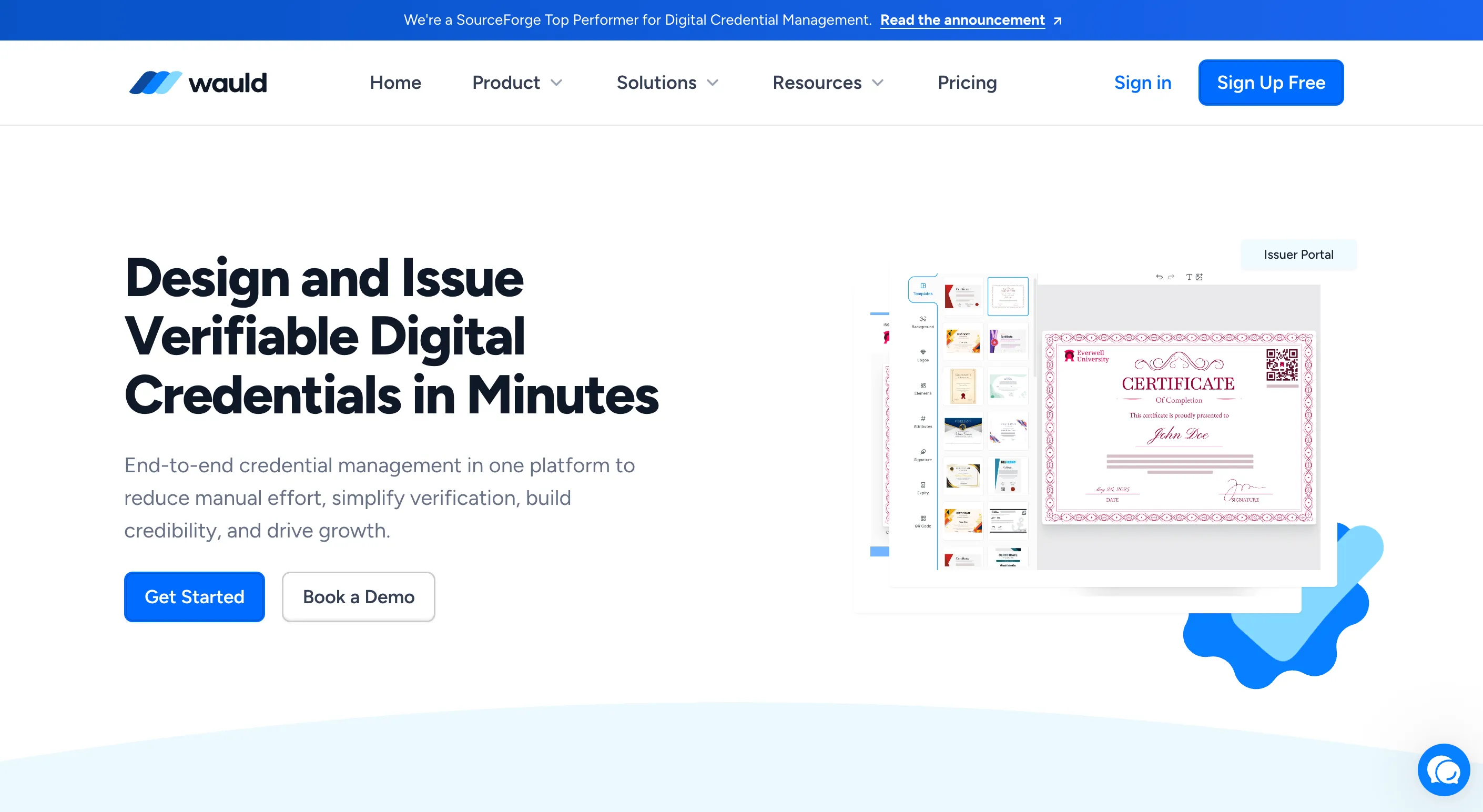
Because AQF qualifications are meant to be portable and trusted right across the country, a verifiable digital credential is a natural fit. Each one carries the issuer, the learner, and the date on a single tamper-proof link, so a Certificate III earned in Perth proves itself just as easily to an employer in Brisbane.
Conclusion
The AQF framework is really just a shared language for learning. Ten levels, from Certificate I to a Doctoral Degree, so everyone reads a qualification the same way. Once you know the ladder, choosing a course, hiring a graduate, or building a program all get simpler.
And once your learners cross the finish line, give them proof worth holding onto. A verifiable credential turns a completed course into something they can share with pride.
Issue certificates your learners will actually keep
Design, issue, and track verifiable digital certificates and badges from one place. Start free with over 1,000 templates.
FAQs On The AQF Framework
These are the questions students, employers, and training providers ask most about the AQF framework and its levels.
What is the AQF framework in simple terms? The AQF framework is Australia's national system for ranking qualifications. It places every recognized certificate, diploma, and degree on one scale of 10 levels, so a qualification means the same thing everywhere in the country.
How many levels does the AQF framework have? The AQF has 10 levels. They start at Certificate I (Level 1) and rise to a Doctoral Degree (Level 10), with each level defined by the knowledge, skills, and application expected of graduates.
What is the difference between certificate IV and a diploma? A Certificate IV sits at Level 4 and a Diploma sits at Level 5, so the Diploma is one level higher. A Diploma expects broader knowledge and more independent judgment than a Certificate IV.
What does certificate 1, 2, 3, and 4 in Australia mean? Certificates I to IV are the four vocational (VET) qualifications at the bottom of the AQF, Levels 1 through 4. Each one builds on the last, with Certificate III being the traditional trade qualification.
Who regulates the AQF framework? The Department of Education administers the AQF nationally. ASQA regulates vocational education and training, while TEQSA regulates higher education providers and universities.
Can I issue AQF-aligned certificates digitally? Yes. Platforms like Wauld let you design, issue, and track verifiable digital certificates and badges for any course. Every credential gets a unique verification link and aligns with open credentialing standards.