What Is a Product Academy? Benefits, Examples, and Setup

Let's Talk Product Academies
Many customers don't leave a product because it's bad. They leave because nobody showed them how to use it well.
A product academy fixes that. It is an online learning hub where your customers learn your product, step by step. Think short videos, simple courses, quick quizzes, and a certificate at the end.
You may also hear it called a customer academy or a customer education program. The name changes, but the idea stays the same. You teach customers how to get real value from your product, so they stay longer.
A product academy is not the same as a help center. A help center answers one question at a time. A product academy teaches a full skill, in the right order, from beginner to expert.
If you lead customer education or manage an academy, this guide is for you. You'll find the key benefits, real examples with data, and a simple, practical way to start your own.
Key Benefits of a Product Academy
A product academy is not a nice extra. It moves the numbers your leadership team cares about. In fact, a Forrester study commissioned by Intellum found that 96% of customer education programs see a positive ROI.
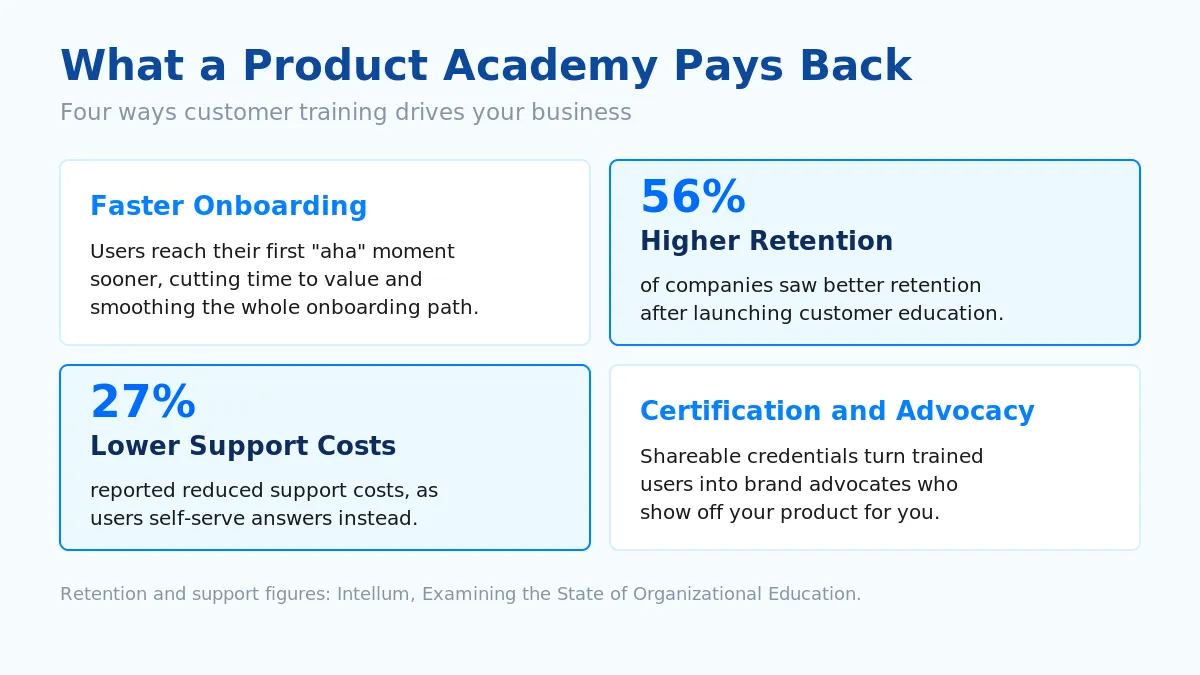
Faster Onboarding for New Users
A guided path helps new users reach their first "aha" moment quickly. That shortens time to value and cuts early drop-off. LearnWorlds makes this point in its guide to customer product training. The goal isn't just account activation. It's users who stay and become power users.
Higher Retention and Feature Adoption
Trained users do more with your product, and that keeps them subscribed. A TSIA survey of 2,800 learners found that 68% use a product more after training, and 56% use more of its features. Meanwhile, in Intellum's survey of education leaders, 56% saw better customer retention after launching an education program.
Lower Support Costs Over Time
An academy works as self-service. Users find answers on their own instead of opening a ticket. The same TSIA survey found that 87% of trained customers can work more independently. And in Intellum's survey, 27% of companies reported lower support costs.
Valuable Certification and Advocacy
Certificates give users proof of their skills that they can share. When a user posts your badge on LinkedIn, your brand reaches their whole network for free. That is a big part of why course certificates matter so much, and it's why certification is so popular. In Skilljar's 2022 benchmark report, certifications were the most-used engagement strategy, and offering a certificate was the most common format (58%). Badges also keep learners coming back. One company reported to TSIA that 87% of its badge earners felt more engaged and motivated to learn more.
Product Academy Examples to Learn From
There's no reliable count of how many companies run a product academy. However, the list of well-known ones keeps growing, and they come in every size. Here are a few worth studying.
| Company | Academy | What stands out | Source |
|---|---|---|---|
| HubSpot | HubSpot Academy | Courses and certifications across marketing, sales, and service | Intellum |
| Gusto | Gusto Academy | Launched in six months with 85 videos and 12 hours of content | Intellum |
| MongoDB | MongoDB Academy | 15 certifications, free for everyone | Intellum |
| Asana | Asana Academy | Courses by role and use case, plus live training in several languages | Skilljar |
| Miro | Miro Academy | Short lessons, earnable badges, and office hours | Intellum |
The Gusto example is a useful benchmark for planning. According to Intellum, Gusto built its full academy in about six months, and it went on to win a 2022 ACE award for customer education.
You don't need a huge budget, either. Notice the pattern across these academies: short lessons, clear paths by role, and a certificate or badge at the end. Those are things a small team can copy.
How to Start Your Product Academy
You can start small and grow over time. Here's a practical path that works for most teams.
- Pick one clear goal. Choose one result you can measure, such as fewer support tickets or faster onboarding. Gainsight's advice is to focus on one goal at a time before adding more.
- Mine your support queue. List the five questions your support team answers most often. Each one becomes a short lesson.
- Reuse what you already have. Help articles, webinar recordings, and demo videos make a great first draft. As Gainsight notes, customer education programs can start as a one-person band.
- Keep lessons short. Aim for two to five minute videos, each followed by a quick quiz. If you want to stack those lessons into something learners can collect, our guide to micro-credentials covers how that works.
- Add a certificate at the end. A certificate gives learners a reason to finish and something to share.
- Measure and improve. Compare trained and untrained users on usage, retention, and tickets. Skilljar found only 41% of teams track usage, revenue, and satisfaction metrics, so doing it from day one puts you ahead.
How Wauld Helps
Step five is where Wauld comes in. Wauld is a platform where you design, issue, manage, and verify digital certificates and badges in one place. That means the certification part of your academy is handled end to end.
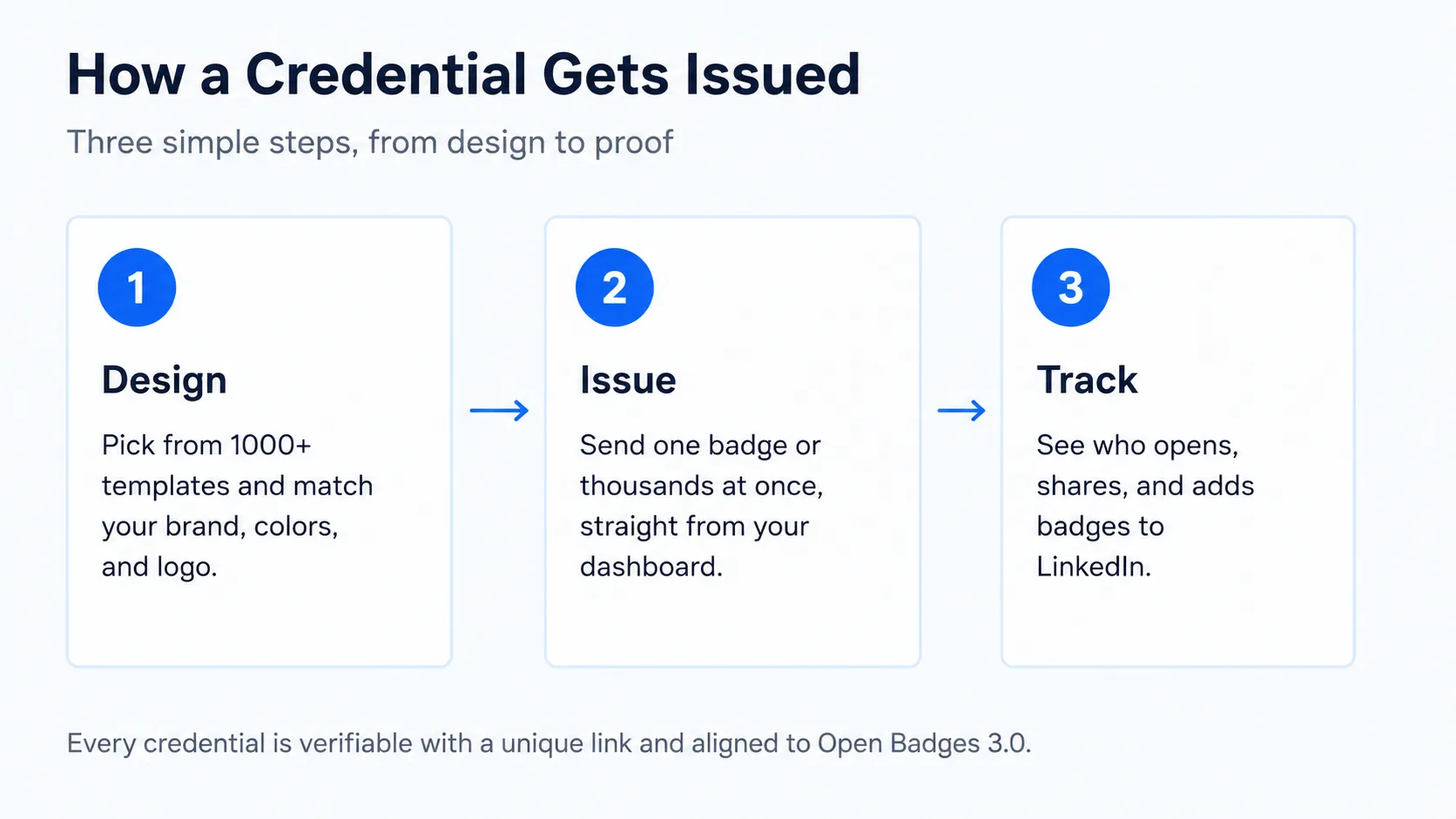
- Design on brand. Start from 1,000+ templates and add your logo and colors.
- Issue at any scale. Send one credential or thousands, including bulk issuing from form responses.
- Let anyone verify. Every verifiable digital badge gets a unique verification link and follows the Open Badges 3.0 standard.
- Track engagement. See who opens, downloads, and shares, including LinkedIn adds.
Curious how yours could look? Browse the template gallery to picture your brand on a certificate.
Wrapping It All Up
A product academy turns your product's learning curve into a clear, guided path. Customers onboard faster, use more features, open fewer tickets, and share your brand when they earn a certificate they're proud of.
The data backs it up, and companies from HubSpot to Gusto show it works. Start with one goal and a handful of short lessons. Add a certificate, then measure what changes. Before long, your academy becomes one of your strongest retention tools.
Issue your first product certificate with Wauld
Design on brand, issue at any scale, and give every learner a unique verification link. Wauld is free to start, with over 1,000 templates.
FAQs on Product Academy
What is a product academy in customer education?
A product academy is an online learning hub that teaches customers how to use your product. It usually includes short courses, videos, quizzes, and a certificate. The goal is faster onboarding, deeper product adoption, and fewer support tickets.
Do product academies really improve retention?
Yes, and there's data behind it. A TSIA survey found 68% of customers use a product more after training. In Intellum's survey, 56% of education leaders saw better retention after launching a program.
How long does it take to build a product academy?
It depends on scope. Gusto launched its academy in about six months with 85 videos, according to Intellum. However, you can launch a small version in a few weeks by turning your top support questions into short lessons.
Should a product academy offer certificates?
Yes. Certificates give customers a reason to finish and proof they can share on LinkedIn. In Skilljar's benchmark report, certifications were the most-used engagement strategy for customer education teams.
How do I measure the success of a product academy?
Compare trained and untrained customers. Look at product usage, feature adoption, renewal rates, and support ticket volume. Also track course completion and how often learners share their certificates.
What tools do I need to run a product academy?
You need a place to host courses and a way to issue credentials. Many teams pair a learning platform for content with a credentialing tool like Wauld for certificates and badges. Look for verification, analytics, and easy branding.