How Universities Protect a University Diploma from Forgery

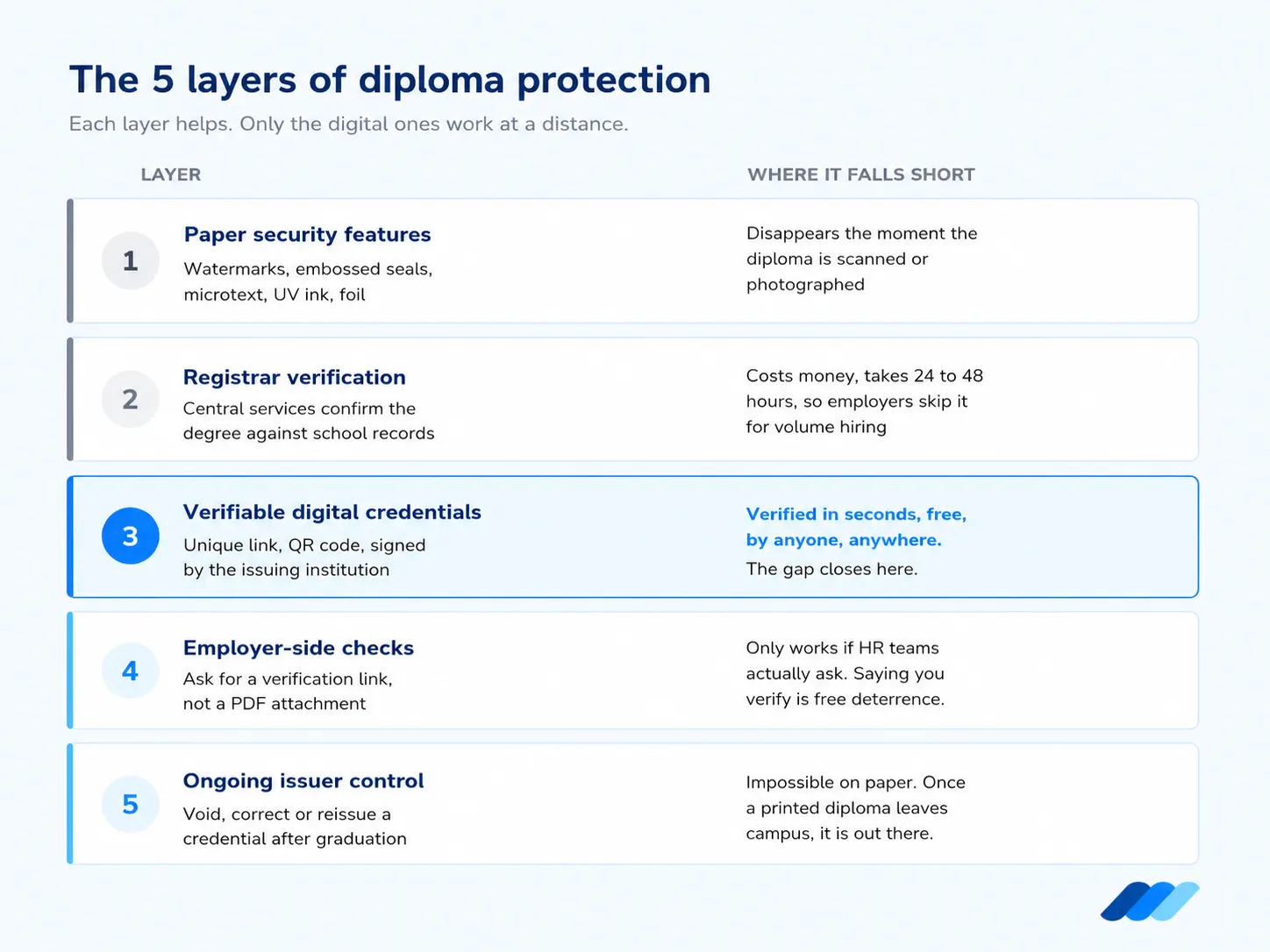
Universities protect a university diploma in five layers. Security paper and embossed seals. An authoritative registrar record. Verifiable digital credentials. Employer-side checks. And the power to void a credential later.
The first two layers are old and solid. However, the paper defenses vanish the moment the diploma becomes a scan on a recruiter's screen, and the registrar record only helps someone who stops to ask. That is where forgery happens today.
The Problem Nobody Names
A university diploma is supposed to be proof. In practice, it is usually just a picture of proof.
Think about how a degree travels. A graduate scans it into a PDF. A recruiter opens the file, glances at the seal, and moves to the next of two hundred applications. Nobody calls the university. The document gets trusted because it looks trustworthy.
That gap is large, and it is widening. Digital forgeries made up 57% of all document fraud in 2024, overtaking physical counterfeits for the first time and marking a 244% jump in a single year, per the Entrust Cybersecurity Institute's 2025 Identity Fraud Report. That figure covers every kind of document, not just diplomas. Academic records sit squarely inside the trend: SHRM ranks education among the most misrepresented resume items, and Parchment traces the money moving through diploma mills.
I saw a small version of this in my own placement season. A few classmates showed certificates they had never earned. They got shortlisted ahead of people who did the work, because nobody called to check.
So the real problem is not that fakes exist. It is that the system has no fast, free way to tell the difference. This guide walks through each defense layer and where it breaks.
Why Diploma Fraud Keeps Working
A university diploma is a high-value document that is cheap to forge. That combination drives the whole market.
- The payoff is big. A degree decides interviews, visas, and promotions.
- The tools are cheap. Design software and a template produce something that passes a glance.
- Verification is optional and paid. Nobody is required to check, and whoever does check pays for the privilege.
- Diploma mills sell the story. Fake institutions run websites and phone lines that will "confirm" your degree.
- Nobody owns the gap. The employer assumes someone else already checked.
Most fake diplomas are never caught. They are simply never checked.
Universities do fight back, in layers. Here is the full picture before we walk through each one.
Layer 1: Physical Security Features
Universities have defended the printed university diploma for decades. Hold your own degree to the light and you will spot a few of these.
- Security paper and watermarks. Specialty stock with a mark that shows against light and blurs in a photocopy.
- Embossed seals and foil. A raised impression you can feel, plus metallic foil that is costly to imitate.
- Microtext. Tiny text that reads under magnification and smudges when copied.
- UV-reactive ink. Elements that only appear under ultraviolet light.
- Control numbers and void pantographs. A unique serial tied to a registrar record, and hidden patterns that print "VOID" on a photocopy.
These features protect a university diploma well in person. However, they only protect the document in the room. A recruiter three time zones away sees a scanned PDF, and every paper defense disappears in that scan.
Layer 2: Registrar Verification Services
The second layer is institutional. The university holds the authoritative record for every university diploma it awards.
In the United States, most requests run through the National Student Clearinghouse, which covers roughly 97% of postsecondary enrollment. Where the institution is on electronic data exchange, DegreeVerify answers immediately. Where the record needs manual confirmation from a registrar, the request goes pending and the wait stretches to 24 to 48 hours. The UK and India run their own registries.
This layer is accurate, but it sits behind a toll gate:
- It costs money. Employers pay per check, so they skip it for high-volume hiring.
- It is not self-serve. The checker needs a verifier account and the graduate's details, which a recruiter screening 300 applications today will not stop to arrange.
- Coverage is uneven. International degrees and older records often fall outside the system, and those are exactly the ones that go pending for a day or two.
- It buries registrar staff. Confirming a 2011 graduate is time not spent on current students.
So the truth exists. It is just gated and costly enough that people skip it.
Layer 3: Self-Verifying Digital Diplomas
This layer changes the math for the university diploma. It is also the one that would have stopped my classmates.
A digital diploma is not a PDF of a diploma. A PDF is a picture, and pictures can be edited. A digital credential carries its own proof: a unique verification link, a cryptographic signature tied to the issuer, and a public page showing who earned what and when.
The practical difference is huge. For example, a recruiter scans a QR code and gets a definitive answer in three seconds. Free, and without emailing anyone.
MIT moved early here. In 2017 it began issuing tamper-evident digital diplomas next to the paper ones. Digital credentials have since spread across universities, professional bodies, and corporate training teams.
Paper Diploma vs Digital Diploma
| Paper diploma | Digital diploma | |
|---|---|---|
| Verification time | Instant to 48 hours | About 3 seconds |
| Verification cost | Paid, per request | Free for the checker |
| Who can check | Verifier account holders | Anyone with the link |
| Survives a scan | No | Yes |
| Can be revoked later | No | Yes |
| Shareable to LinkedIn | Screenshot only | Native, with a live link |
Standards That Make Diplomas Trustworthy
Two open standards do the heavy lifting, and both are worth knowing by name.
W3C Verifiable Credentials is the data model for credentials that anyone can check cryptographically, independently of the issuing platform.
Open Badges 3.0, from 1EdTech, builds on that model for education. Although badges came first, the 2024 standard now covers degrees, certifications, and licenses too.
Standards also prevent vendor lock-in. A credential issued today stays verifiable even if your institution switches platforms later.
Layer 4: How Employers Spot Fakes
Universities can only do half the job. The other half sits with the people reading resumes.
- Ask for a verification link, not a scan. Add one line to your application form. Real candidates supply one happily.
- Always verify high-stakes roles. Clinical, financial, and regulated roles deserve a check every time.
- Check the institution, not just the certificate. A quick accreditation check catches most diploma mill cases.
- Issue your own credentials properly. Editable PDF certificates from your L&D team feed the same problem.
- Say publicly that you verify. Deterrence is free. Candidates think twice when a posting says credentials are checked.
Layer 5: Control After Issuance
Issuance is not the end of the story. Institutions sometimes need to correct a name, reissue after a legal name change, or revoke a credential awarded in error. Paper makes that nearly impossible, because a printed diploma never comes back.
Digital credentials keep the issuer in control. A revoked credential stops confirming on its verification page. Anyone who checks sees the current status, not the status from graduation day.
Therefore authenticity is not a one-time stamp. It is an ongoing state.
Where Wauld Fits In
When I joined Wauld, what struck me was how unglamorous the fix is. Credentials just need to carry their own proof. Building that should not need a research lab or a big budget.
Here is what Wauld does for institutions issuing a university diploma, a course certificate, or a badge.
- Design credentials that look like yours. A generator for certificates, badges, QR codes, and emails, with 1000+ customizable templates.
- Issue at scale. Bulk issuance for a whole cohort, including from form responses and tools like Google Forms.
- Built on open standards. Credentials align with Open Badges 3.0 and W3C Verifiable Credentials, so they stay interoperable.
- Verification anyone can use. Every credential has a unique link, shareable to LinkedIn, resumes, and portfolios.
- Full lifecycle control and analytics. Issue, edit, and void credentials from one dashboard, and see who opened, shared, and verified them.
Two portals keep it simple. The Issuer Portal creates, sends, and tracks credentials. The Recipient Portal lets graduates store and share them.
Wauld is free to start, with no onboarding fees, so one department can pilot digital diplomas before an institution-wide rollout. See pricing for what happens as volume grows.
Conclusion
The counterfeit university diploma survives on one weakness: nobody checks. Paper security is excellent craft, but it defends a document that spends its life as a scan. Central verification is accurate, but paid and gated enough that people skip it. Digital, standards-based credentials close that gap.
When a degree check is free and takes three seconds, forgery stops being a smart bet. The people who lose most from a weak system are the ones who did the work honestly. Every institution that moves to verifiable credentials makes their diploma mean a little more.
Ready to issue verifiable diplomas?
Design them with your branding, send them to a whole cohort, and give every graduate a credential that proves itself in one click.
FAQs on University Diploma Forgery
- How can I tell if a university diploma is fake? Start with the institution, not the paper. Confirm the school is accredited by a recognized body, because diploma mills often run convincing websites. Then verify the degree with the registrar or the National Student Clearinghouse. If the credential is digital, just open its verification link. Warning signs include misspellings, mismatched fonts, and dates that do not fit the program length.
- Do employers actually verify university diplomas? Many do not. Traditional degree verification costs money and requires a verifier account, and any record that needs manual confirmation takes 24 to 48 hours, so employers skip it for junior and high-volume roles. Regulated industries like healthcare and finance verify far more consistently. That inconsistency is the main reason fake diplomas keep working.
- What is a digital diploma, and how is it different from a PDF? A PDF is an image of a diploma, and anyone can edit it in design software. A digital diploma is a verifiable credential with a cryptographic signature and a unique verification link. Anyone can confirm the institution issued it, to that person, on that date. The proof travels with the credential.
- How do you verify a degree online for free? If the graduate holds a digital credential, open the verification link or scan the QR code. The answer is free and takes seconds. With only a paper university diploma, you fall back to the registrar or a paid service, and neither is free to the checker. That gap is why more institutions issue digital diplomas.
- What are Open Badges 3.0 and W3C Verifiable Credentials? W3C Verifiable Credentials is the open data model for credentials anyone can verify cryptographically, independent of the issuing platform. Open Badges 3.0, from 1EdTech in 2024, builds on that model for education and now covers degrees, certifications, and licenses. Together they keep credentials portable.
- Is it expensive for a university to issue digital diplomas? Not necessarily. Platforms like Wauld are free to start, with no onboarding fees. One department can pilot verifiable credentials before a full rollout, and costs scale with volume.