How to Get Forklift Certification: Costs, Steps, and Rules

The Short Version
To get forklift certification, you complete formal instruction, practice on a real forklift under supervision, and pass a hands-on evaluation at your workplace. Your employer then signs a written record with your name and the dates. That record is your certification. Most people finish in a single day for under $200.
The confusing part is the wording. Job ads ask for a "forklift license," which does not exist as a government document. No DMV issues one. OSHA puts the responsibility on the employer instead.
My cousin Danny learned this the slow way. He got hired at a distribution center outside Columbus and watched a 45-minute safety video on his first morning. His supervisor told him he was good to go. Eight months later an internal audit flagged him, because nobody had ever evaluated him on the reach truck he drove every shift. He redid the whole thing on unpaid time. This guide is the version I wish someone had handed him.
What Is Forklift Certification, Exactly?
Forklift certification is your employer's written confirmation that you were trained and evaluated on a specific type of forklift in a specific workplace. It is not a card you buy. It is a record, and it must name you, the training date, the evaluation date, and whoever signed off.
Two words get mixed up constantly:
- Training is the learning part, whether in a classroom, on a screen, or in the yard.
- Certification is the documentation that both the training and the evaluation happened.
A training provider can teach you and hand you a certificate of completion. Only your employer can finish the certification, because only your employer can evaluate you on your own floor.
Is There Such a Thing as a Forklift License?
No. There is no federal or state forklift license in the United States. When a job posting says "forklift license required," the hiring manager means current OSHA forklift certification.
You do not need a driver's license either. You do need to meet the age rule. Federal child labor rules set 18 as the minimum age in most non-agricultural workplaces, with a narrower exception for some agricultural work at 16.
How to Get Forklift Certification in 6 Steps
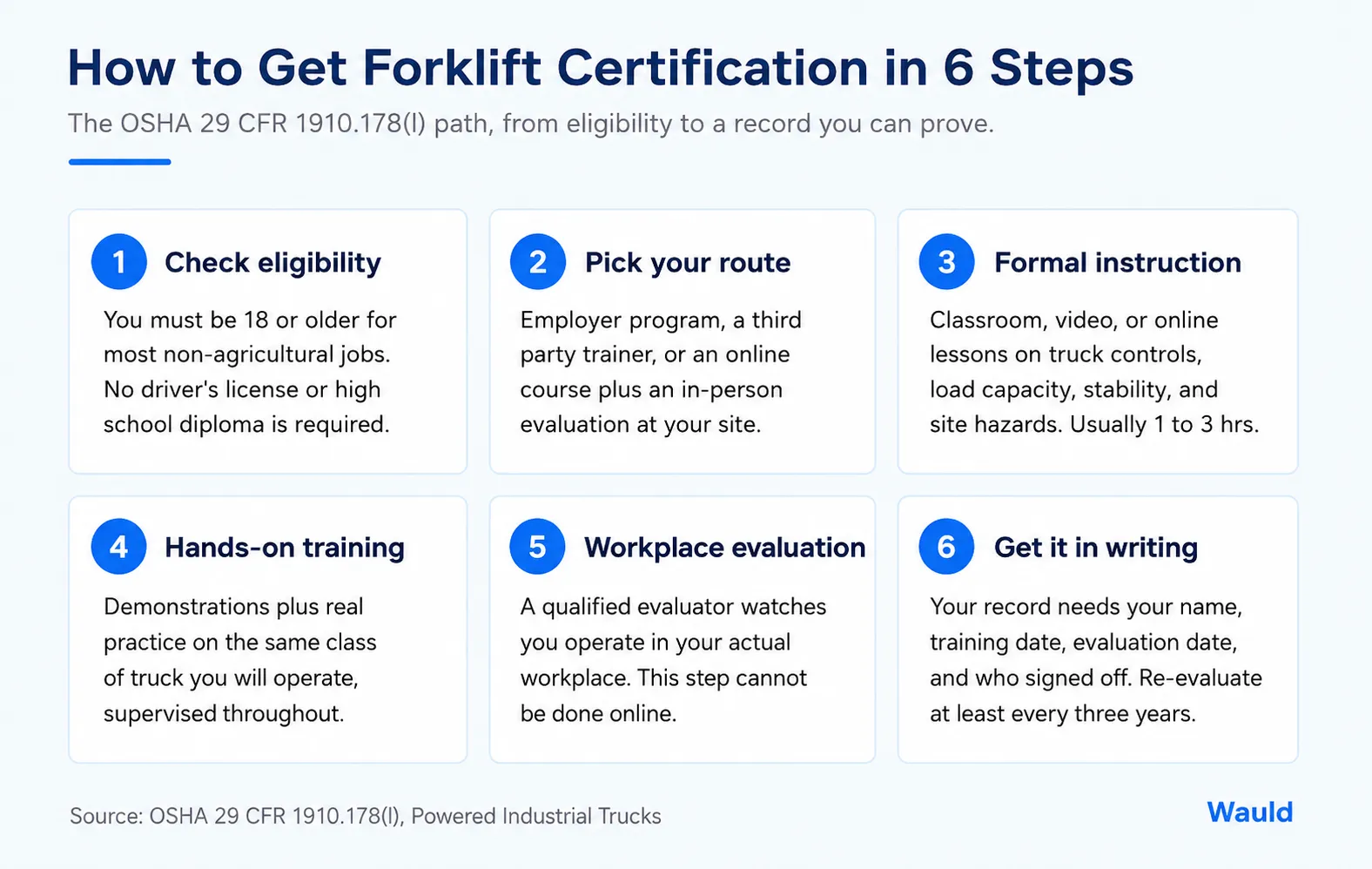
Step 1: Check That You Are Eligible
Start here, because it is short. You need to be 18 for most warehouse, manufacturing, and construction roles. You do not need a diploma, a driver's license, or prior experience. You do need to operate the controls comfortably and see well enough to work around pedestrians.
Step 2: Pick Your Training Route
You have three realistic options.
- Your employer's in-house program. The most common route, and usually free to you. Ask during your interview whether they train new hires.
- A third-party trainer or dealer. Forklift dealers, community colleges, and safety consultants run open-enrollment classes. Useful if you want the credential before you job hunt.
- An online course plus an in-person evaluation. You do the classroom portion at home, then arrange the practical evaluation on site.
Ask one question before you pay: does this include the hands-on evaluation, or only the classroom part? Many low-cost online listings cover the classroom alone. That is legitimate, but it is not the full package.
Step 3: Complete the Formal Instruction
This is the knowledge half, and it usually takes one to three hours online. A good course covers:
- The truck itself: controls, the data plate, load capacity, and pre-shift inspections.
- Physics: stability, the load center, and what makes a forklift tip.
- Your surroundings: pedestrian traffic, ramps, docks, and narrow aisles.
- Power and fuel: safe refueling or battery charging.
Pay close attention to the stability triangle. It explains why a forklift tips, and tip-overs hurt operators more than any other incident type.
Step 4: Do the Hands-On Training
Now you get on the machine. You watch a demonstration, then practice under supervision until the movements stop feeling awkward. Reversing, stacking at height, and judging fork placement take the longest to click.
Train on the same class of truck you will actually drive. A sit-down counterbalance forklift and a stand-up reach truck handle nothing alike, and your certification is equipment-specific.
Step 5: Pass the Workplace Evaluation
A qualified person watches you operate on your real floor and confirms you are competent. This is the step online courses cannot replace, and the step Danny's employer skipped. OSHA cares about your site, not a generic warehouse: your aisle widths, your dock, your floor surface, your foot traffic.
Expect the evaluator to check your pre-operation inspection, your speed and horn use at blind corners, your load handling, and how you park and shut down.
Step 6: Get the Certification in Writing
Ask for a copy of the record before you leave. It must include your name, the training date, the evaluation date, and who performed each. Save the file somewhere permanent, not just in your work email.
Also confirm which truck classes and attachments you are cleared for. That detail matters when you change jobs.
If your employer issues a digital credential, verification takes seconds instead of a phone call. Anyone scanning the code lands on a verification page that confirms who earned it, what they were evaluated on, and when.
Running the training side of this? Wauld lets you issue every operator a branded, verifiable certificate the moment they pass, instead of chasing paper.
Which Forklift Class Are You Certified On?
OSHA sorts powered industrial trucks into seven classes. Your certification only covers the classes you trained and were evaluated on.
| Class | What it covers | Typical setting |
|---|---|---|
| Class I | Electric motor rider trucks | Indoor warehouses |
| Class II | Electric narrow aisle trucks, including order pickers and reach trucks | Tight racking |
| Class III | Electric hand trucks and walkie pallet jacks | Short moves, docks |
| Class IV | Internal combustion trucks, cushion tires | Smooth indoor floors |
| Class V | Internal combustion trucks, pneumatic tires | Yards and mixed surfaces |
| Class VI | Electric and internal combustion tractors | Towing and tugging |
| Class VII | Rough terrain forklifts, including telehandlers | Construction sites |
Class I and Class V together cover most everyday warehouse and yard work. Ask your employer to evaluate you on more than one class if the equipment is there. It costs them almost nothing and makes you more useful.
How Much Does Forklift Certification Cost?
Plan for $50 to $300, and often nothing at all.
- Employer-provided training: usually free, because OSHA puts the obligation on the employer.
- Online formal instruction: commonly $50 to $200, covering the classroom portion only.
- In-person courses through a trainer or dealer: typically $100 to $300 per person.
Prices move, so confirm the figure before you enroll. Be skeptical of any site promising complete forklift certification in 30 minutes with no evaluation. That is not a shortcut, it is an incomplete record.
How Long Does Forklift Certification Take?
Faster than most people expect. The classroom portion runs one to three hours. Hands-on training and the evaluation add two to four more. Many employers run the whole thing in a single shift.
If you train online at your own pace, the bottleneck is scheduling the in-person evaluation. Book that first and work backward.
How Long Does Forklift Certification Last, and How Do You Renew It?
Your certification does not expire like a passport. However, OSHA requires your employer to re-evaluate you at least once every three years. Most workplaces treat that mark as the renewal date.
Refresher training comes sooner in several situations:
- After an accident or a near miss involving a forklift.
- After you are observed operating unsafely, or an evaluation finds a gap.
- When you are assigned a different type of truck.
- When workplace conditions change, such as new racking, a new surface, or a redesigned traffic route.
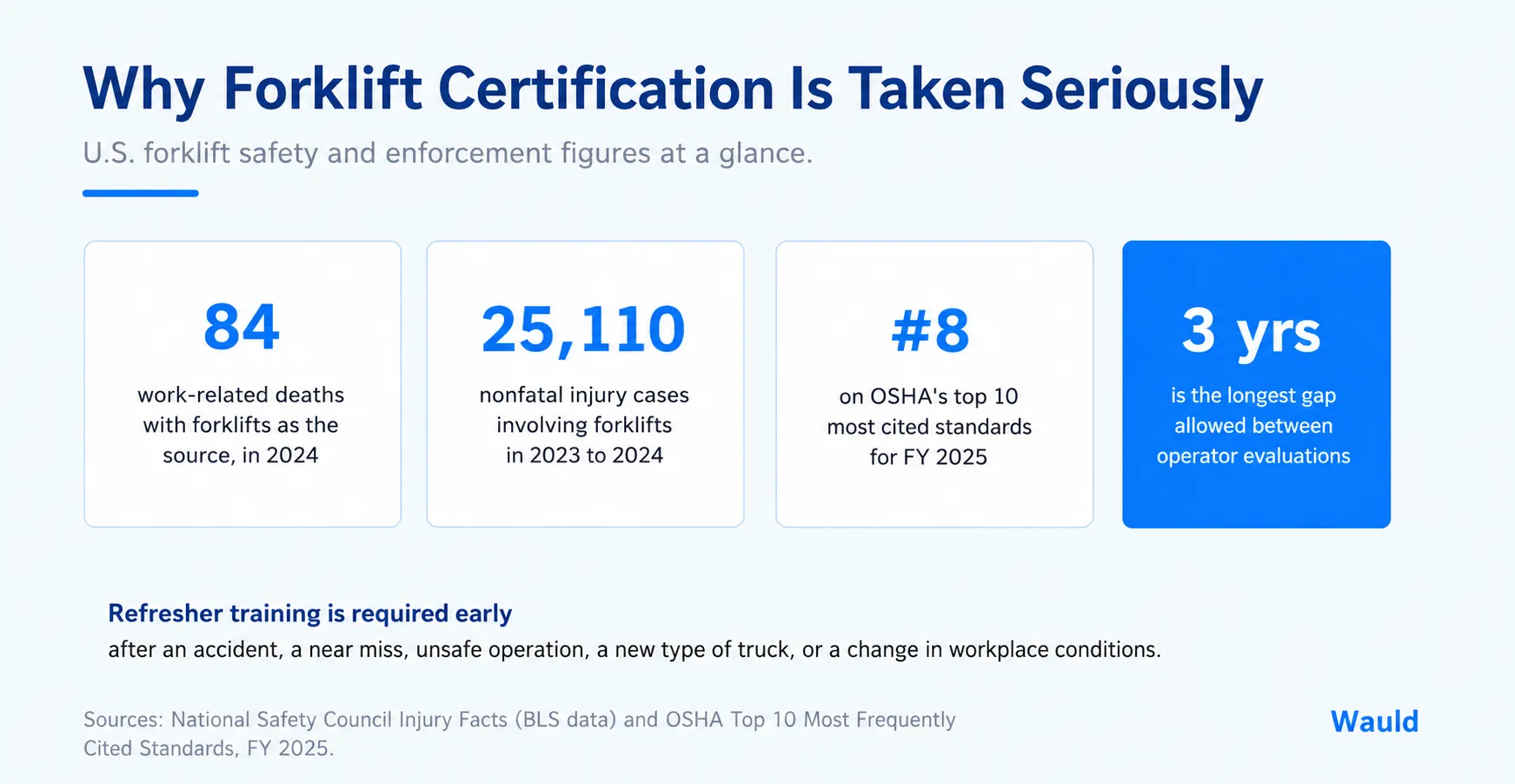
The numbers explain the strictness. Forklifts were the source of 84 work-related deaths in 2024 and 25,110 nonfatal injury cases in 2023 to 2024, according to the National Safety Council. Powered industrial trucks also ranked eighth on OSHA's top 10 most cited standards for fiscal year 2025.
Put your re-evaluation date in the calendar the day you pass, with a reminder 90 days out. A lapsed operator record is one of the easiest compliance gaps to avoid.
For Employers: Make the Record Easy to Prove With Wauld
Here is the part that bit Danny's employer. Their training was fine. Their paperwork was not. When the auditor asked who evaluated whom and when, nobody could produce it quickly.
A signed PDF in a shared drive technically satisfies the rule. It just fails the moment someone needs to check it fast. A digital certificate fixes that, because verification stops depending on whoever holds the folder. With Wauld you can:
- Design on brand in minutes using 1000+ customizable templates, including ready-made forklift certificate templates.
- Issue in bulk to a whole cohort at once, including straight from form responses.
- Let anyone verify instantly through a unique link and a QR code, with no account needed.
- Track engagement, including opens, downloads, shares, and LinkedIn additions.
- Void or reissue any credential from one dashboard when an operator retrains.
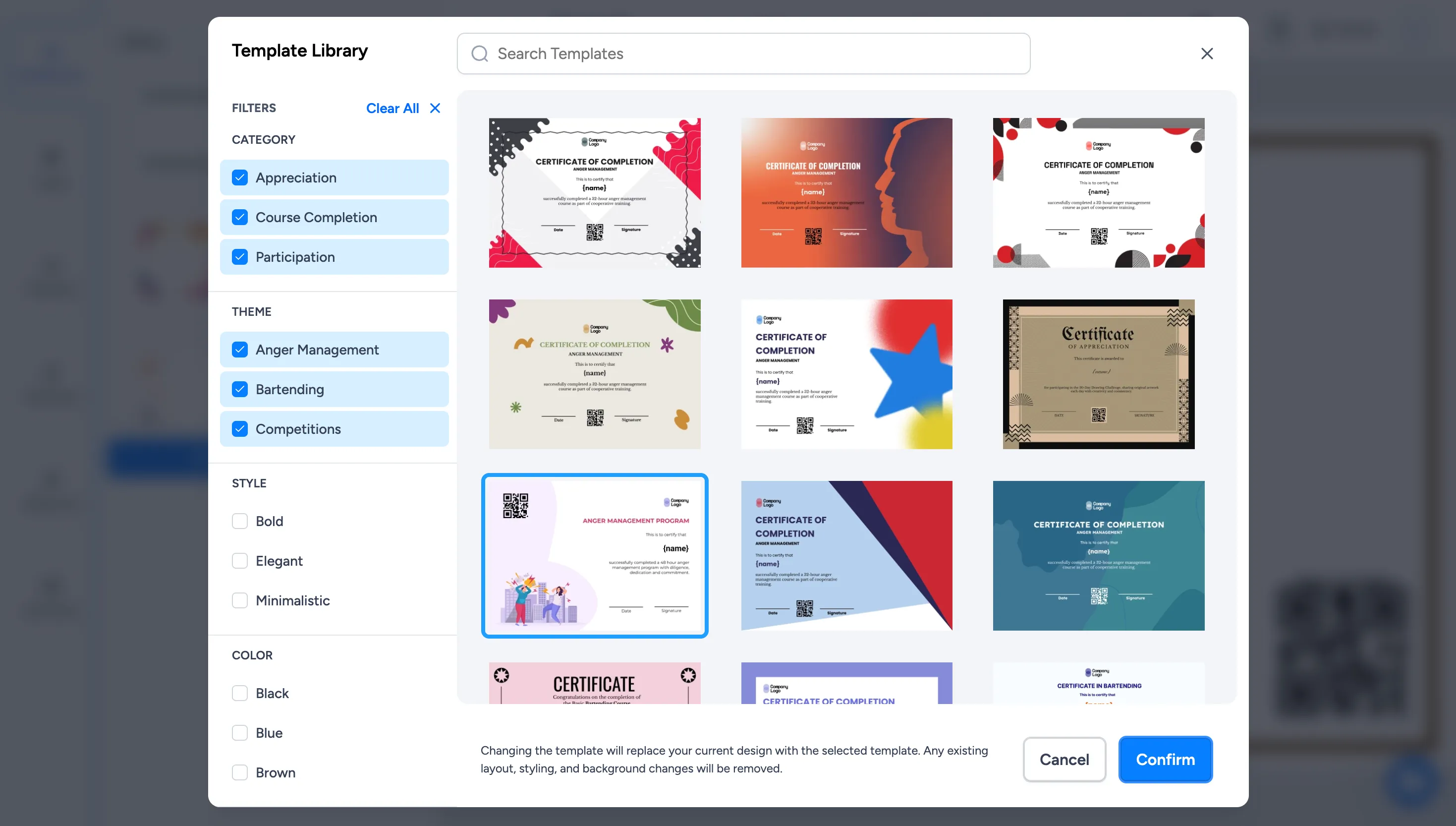
Start from a template, swap in your logo and your OSHA wording, and the same design covers every operator you certify. Because each credential carries its own verification link, a new hire can forward proof of training before their first shift instead of hunting for a scanned PDF.
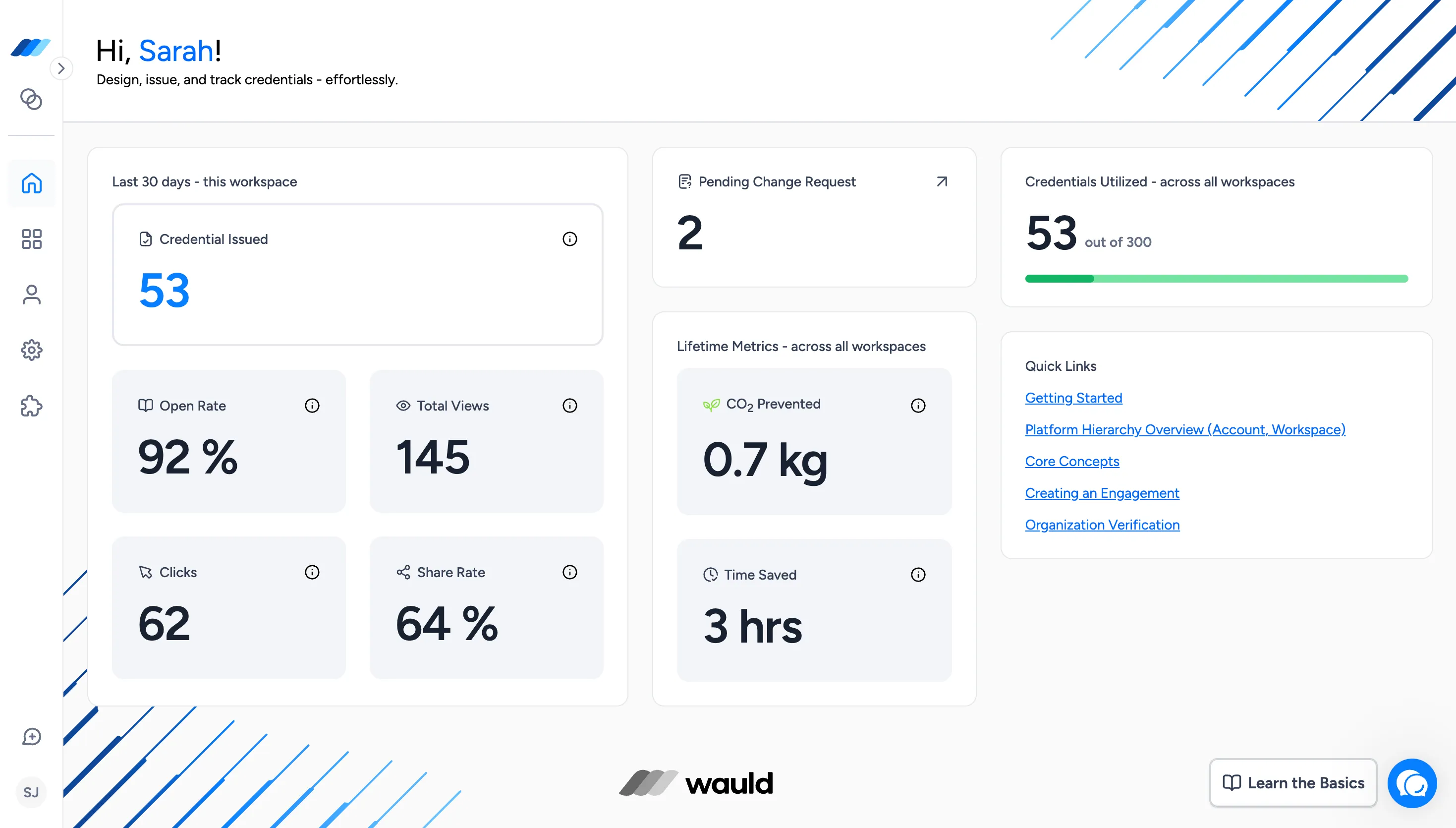
The dashboard is the part safety managers tend to like most. You can see how many operator credentials went out, how many were opened, and which ones are still sitting unclaimed, which is usually the first sign that someone's record needs a follow-up.
Wauld credentials align with open standards including Open Badges 3.0 and W3C Verifiable Credentials. If you issue other safety records too, our roundup of compliance certificate templates is a useful next stop.
One honest trade-off: digital records make verification easier, but they do not replace the evaluation. Someone still has to stand on the floor and watch the operator work.
Conclusion
Forklift certification is one of the shortest, cheapest credentials in the skilled trades. It opens real doors in warehousing, manufacturing, and construction. Learn the theory, get real seat time, pass the evaluation on your own site, and keep the paperwork.
Then treat the record as a working asset. Save it where you can find it in 30 seconds, note your three-year date, and ask to be evaluated on extra truck classes when the chance comes up. If you run the training, give operators a credential that proves itself without a phone call.
Issue Forklift Credentials Your Operators Can Actually Prove
Design them on brand, issue them in bulk, and let auditors verify with one scan. Free to start, no onboarding fees, and 1000+ templates ready to customize.
FAQs on Forklift Certification
How Long Does Forklift Certification Last?
Certification stays valid as long as your employer re-evaluates you at least once every three years. Most workplaces treat that point as the renewal date. Refresher training is required sooner after an accident, a near miss, unsafe operation, a new type of truck, or changed workplace conditions.
Can You Get Forklift Certified Online?
Only partly. Online courses cover the formal instruction, which is the classroom half of OSHA's requirement. However, no legitimate program can skip the hands-on practice or the workplace evaluation. Both happen in person. Treat any site advertising complete forklift certification online with no evaluation as incomplete.
How Much Does Forklift Certification Cost?
Expect $50 to $300 in total. Online formal instruction usually runs $50 to $200. In-person courses through a trainer or dealer run about $100 to $300 per person. Many workers pay nothing, because OSHA places the training obligation on the employer.
Do You Need a License to Drive a Forklift?
No. There is no government-issued forklift license in the United States. You do not need a driver's license either. What employers mean by "forklift license" is current forklift certification: documented training plus a workplace evaluation by a qualified person.
How Old Do You Have to Be to Operate a Forklift?
You must be at least 18 in most non-agricultural workplaces under federal child labor rules. A narrower exception allows some agricultural work from age 16. Individual employers may set a higher minimum or require experience.
Does Forklift Certification Transfer Between Employers?
Your training records travel with you and are worth keeping. Certification itself is site-specific, so a new employer must still evaluate you in their own workplace before authorizing you. Bringing documented training usually shortens that process.
What Happens if My Forklift Certification Expires?
You lose authorization to operate until your employer retrains or re-evaluates you. Operating on a lapsed record exposes both you and your employer. Renewal is normally quicker than initial certification, because the classroom material is already familiar.