How to Create a Rubric for Microcredential Evaluation

Microcredentials have transformed how learners build and demonstrate expertise. Unlike traditional degrees that measure progress over years, skills-based badges recognize focused, measurable competencies. But here's the challenge: if you can't measure it consistently, you can't credibly award it.
A well-designed rubric does more than assess, it communicates what excellence actually means. It tells learners what to aim for, helps reviewers make fair decisions, and most importantly, ensures that every badge issued carries real weight in the job market.
The question isn't whether you need a rubric. The question is: how do you build one that captures the full picture of what your learners can actually do?
Understanding the Learning Journey: The Microcredential Pyramid
Before designing your rubric, you need to understand how learning happens. The microcredential learning pyramid shows us that competency isn't built in a single leap, it's constructed through progressive stages:
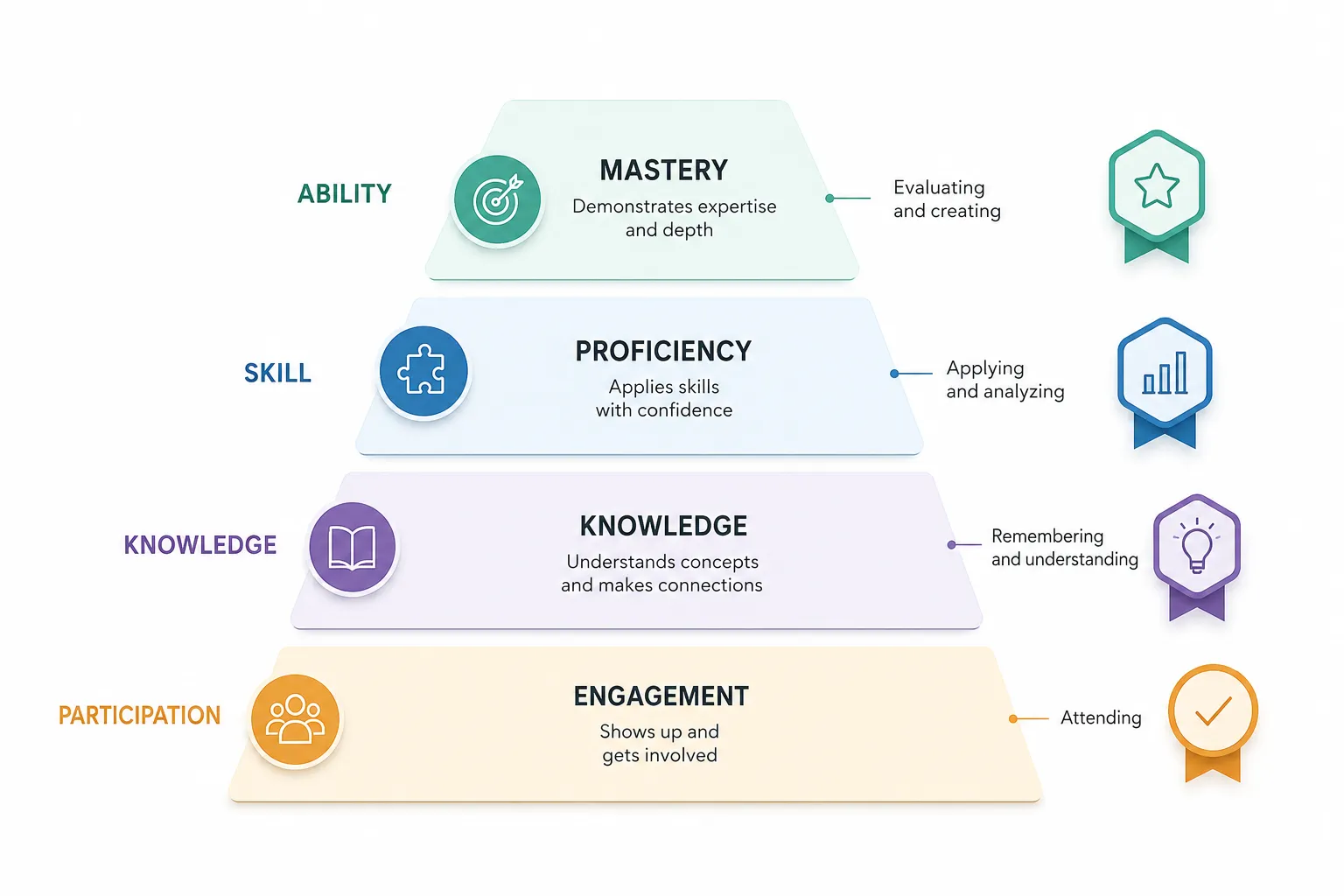
From bottom to top:
- Engagement (Participation) - Shows up and gets involved
- Knowledge - Understands concepts and makes connections
- Skill - Applies knowledge with confidence
- Ability (Mastery) - Demonstrates expertise with depth
This pyramid is your guide. Your rubric should reflect this journey, measuring not just whether someone completed a task, but how well they can apply what they've learned in real-world contexts.
Why a 4-Point Scale Works Best
A 4-point scale sits in the sweet spot for evaluation:
- Too few points (2-3) collapse meaningful differences. Is someone "proficient" because they barely passed, or because they excelled?
- Too many points (5+) create analysis paralysis. Reviewers struggle to distinguish between adjacent levels.
- 4 points maps cleanly to the learning pyramid, creates clear distinctions, and forces reviewers to make deliberate choices.
The 4-Point Rubric Framework for Microcredentials
Here's how to structure your evaluation across four progressive levels, aligned with both the learning pyramid and real-world competency standards:
Level 1: Emerging (Engagement + Foundation)
What it means: The learner has participated and begun to understand foundational concepts.
| Dimension | Evidence of Emerging Performance |
|---|---|
| Technical Skills | Completes assigned tasks with guidance; demonstrates basic understanding of core tools or processes; needs support to apply learning |
| Soft Skills | Communicates ideas with some clarity; participates in group work but requires direction; shows willingness to learn |
| Domain Knowledge | Recalls key concepts; understands "what" but not yet "why"; can identify correct answers in controlled settings |
Example: A learner in a data analysis course can run pre-built queries and describe what the output shows, but cannot design queries independently.
Reviewer consideration: Does the learner have the foundation to progress, or are there significant gaps?
Level 2: Developing (Knowledge + Early Skill Application)
What it means: The learner demonstrates solid understanding and can apply skills in familiar, structured contexts.
| Dimension | Evidence of Developing Performance |
|---|---|
| Technical Skills | Applies skills consistently in expected scenarios; solves problems with minimal guidance; demonstrates reliable competency with standard tools and processes |
| Soft Skills | Communicates clearly and persuasively; collaborates effectively with peers; takes initiative in group settings; handles feedback constructively |
| Domain Knowledge | Explains concepts accurately; connects ideas to practical applications; asks clarifying questions; shows conceptual reasoning |
Example: The same learner can now write SQL queries to extract specific data and explain why their approach works, though more complex nested queries still require reference materials.
Reviewer consideration: Can this learner work independently on routine tasks? Would you trust them with responsibility?
Level 3: Proficient (Skill Mastery + Confident Application)
What it means: The learner applies skills with confidence across varied contexts and begins to show independent judgment.
| Dimension | Evidence of Proficient Performance |
|---|---|
| Technical Skills | Solves complex problems independently; adapts techniques to novel situations; troubleshoots issues effectively; demonstrates mastery of advanced features or methods |
| Soft Skills | Leads or facilitates discussions; mentors less experienced peers; communicates with nuance and adapts messaging to audiences; seeks feedback proactively |
| Domain Knowledge | Synthesizes information across topics; applies theoretical knowledge to solve real problems; identifies limitations and edge cases; challenges assumptions thoughtfully |
Example: The learner now writes optimized queries for complex business questions, explains query performance trade-offs, and suggests database design improvements.
Reviewer consideration: Could this person contribute meaningfully to a team project? Could they help others learn?
Level 4: Mastery (Demonstrated Expertise + Strategic Depth)
What it means: The learner demonstrates expert-level competency, showing depth, innovation, and the ability to guide others.
| Dimension | Evidence of Mastery |
|---|---|
| Technical Skills | Creates innovative solutions; anticipates edge cases; optimizes for performance and scalability; knows when and how to break conventions effectively; teaches others advanced techniques |
| Soft Skills | Leads with vision and integrity; builds consensus across perspectives; communicates with clarity and impact; shapes team culture and helps others grow |
| Domain Knowledge | Demonstrates deep conceptual mastery; makes connections across disciplines; anticipates industry trends; contributes original insights or new approaches |
Example: The learner designs database schemas, mentors junior analysts, and presents findings to executive stakeholders with strategic recommendations grounded in data.
Reviewer consideration: Would you hire this person or promote them into leadership? Could they represent your organization as an expert?
How to Use This Rubric in Practice
For Instructors:
Communicate expectations upfront. Share the rubric before learning begins. Learners who know they need to reach "Proficient" will engage differently than those uncertain of standards.
Use rubric checkpoints. Evaluate progress at midpoint and end. This isn't just about a final grade, it's about showing learners their trajectory.
Provide specific feedback. Instead of "Good job!" say: "You're at Developing level for technical skills because your analysis works but doesn't address edge cases. Here's what Proficient looks like…"
For External Reviewers:
Calibrate together. Before evaluating a cohort, reviewers should assess the same sample work and discuss ratings. This prevents one reviewer from being systematically harder.
Look for evidence, not feelings. The rubric asks: "What can this learner do?" not "Do I like this learner?" or "Did they try hard?" Stay evidence-focused.
Consider portfolio depth. One strong project might indicate Proficient; a breadth of strong work across different contexts suggests Mastery.
For Badge Design:
Badge Progression Across Competency Levels
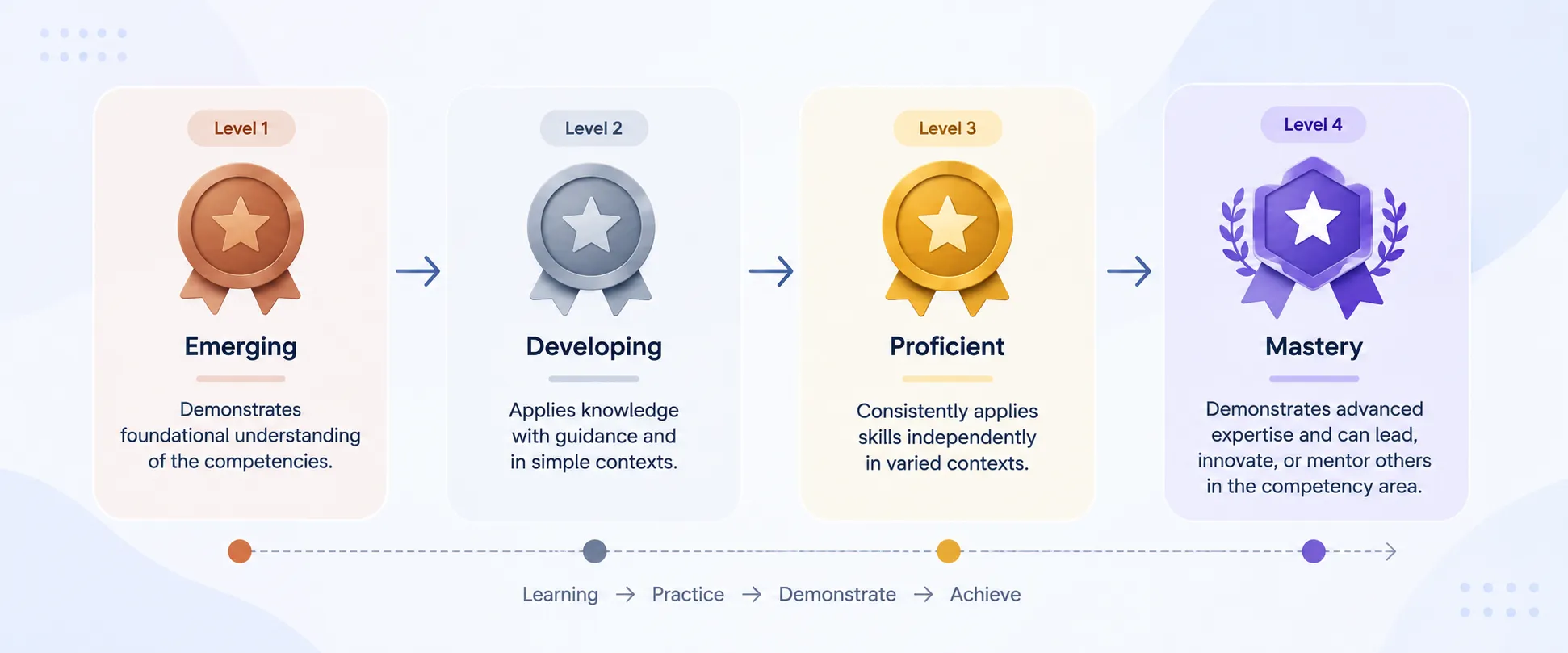
Your badge design should visually reflect achievement level. Consider:
- Different badge tiers (Bronze/Silver/Gold) for Emerging/Developing/Proficient/Mastery
- Visual complexity that mirrors competency growth
- Clear descriptions on the badge that map to rubric levels
This way, an employer seeing a "Proficient Data Analysis Badge" immediately understands: This person can independently solve real business problems using data.
The Holistic Advantage: Why This Rubric Works Across Roles
Notice the rubric doesn't separate "technical" from "soft" from "domain knowledge" - it assesses them together. This is critical because:
- A brilliant developer who can't communicate with stakeholders isn't truly proficient
- A charismatic speaker without technical foundation is just good at talking
- Someone who memorized facts without understanding can't adapt to novel problems
By evaluating all three dimensions at each level, you're assessing actual competency - the ability to deliver value, not just check boxes.
Common Mistakes to Avoid
1. Making levels too granular. Adding a 5th level ("Approaching Mastery") often creates confusion without adding clarity.
2. Focusing only on technical skills. In the real world, soft skills and judgment matter enormously. Include them.
3. Ignoring domain knowledge. You can't be truly proficient with a tool if you don't understand why you're using it.
4. Skipping calibration. If your reviewers don't agree on what "Proficient" means, your badges lose credibility fast.
5. Forgetting to communicate rubric changes. Once learners are midstream, rubric shifts feel unfair. Lock your standards and only adjust between cohorts.
Making Your Rubric Live
A rubric sitting in a shared doc is just theater. To make it real:
- Train your reviewers - one session isn't enough. Make rubric calibration an ongoing practice.
- Track rating patterns - if most learners land in two levels, your rubric boundaries might need adjustment.
- Collect learner feedback - do learners feel the assessment was fair? If not, why?
- Update annually - as your field evolves, your rubric should too. Just communicate changes clearly.
The Bigger Picture: Why Rigor Matters
Every badge you issue is a promise to employers: We assessed this person carefully, and they can do X at this level.
That promise only holds weight if your rubric is rigorous, consistently applied, and actively used to drive evaluation - not just written down and forgotten.
When you invest in building a strong rubric:
- Learners know what mastery looks like and have a clear roadmap
- Instructors evaluate fairly and give targeted feedback
- Reviewers make consistent decisions
- Badges become trustworthy signals that actually move careers forward
The microcredential learning pyramid shows us that mastery isn't magic - it's progression through intentional stages. Your rubric is the tool that makes that progression visible, measurable, and meaningful.
Start with these four levels. Use them. Refine them based on what you learn. And remember: the best rubric is one that actually gets used to develop people, not just sort them.
Wauld's multi-page document feature allows microcredential creators to display their rubric on a dedicated page, ensuring badge recipients understand exactly how they were evaluated and what their achievement means. This transparency builds trust and demonstrates the rigor behind each credential issued.
Design and issue credentials with confidence
Create rubrics, evaluate learners, and issue verifiable badges backed by clear evaluation standards.