


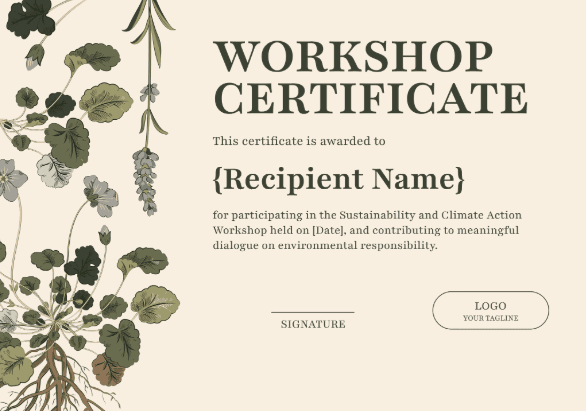

Every time you receive a certificate, diploma, or badge, there’s a hidden environmental cost. From producing the paper to transporting the document, each certificate leaves behind a measurable carbon footprint. Multiply this by the hundreds of millions of certificates issued worldwide each year, and the impact is staggering.
At Wauld, we believe digital certificates aren’t just about security, convenience, and verification - they’re also about sustainability. Let’s break down the numbers.
The Hidden Carbon Footprint of a Paper Certificate
A peer-reviewed study in the Journal of Cleaner Production (ScienceDirect) found that an A4 sheet of office paper carries a life-cycle carbon footprint of 4.29 to 4.74 g CO₂ equivalent per sheet.
But that’s only the paper itself. Add printing, packaging, and shipping, and the emissions grow significantly.
Source of Emissions | Estimated CO₂ (grams per certificate) |
Paper (A4 sheet) | 4.3 to 4.7 g for 80 GSM |
Printing (ink & machine use) | 1 to 3 g 2.5 gram for laser printer per officer paper |
Packaging & distribution | 5 to 15 g |
Total Physical Certificate | 10 to 20 g |
Note: This comparison focuses only on the certificate-related processes. General office energy use (like staff computers, lighting, or office operations) is excluded, as it applies equally to both paper and digital methods.
Bottom Line: A single office paper certificate (80 GSM) releases approx 15 g CO₂ on average.
The Carbon Footprint of a Digital Certificate
Some argue that digital certificates also consume energy: electricity powers the software, cloud servers host the data, and users access them online. That’s true, but the impact is far smaller.
What contributes to a digital certificate’s footprint?
A digital certificate’s carbon footprint primarily comes from the energy used across its lifecycle, including the following areas:
Let’s do the maths for these components across lifecycle of the certificate…
Activity | Estimated CO₂ Emissions |
Storage (1 year for one certificate file) | 0.2 g |
Certificate generation | 0.02 g |
Access & verification (2–3 visits) | 1 to 1.5 g |
Total Digital Certificate | 1.2 to 1.8 g |
Note: CO₂ emissions from blockchain integration are not included here. They are part of our enterprise offering and available only for customers who specifically request blockchain integration.
That’s a reduction of 85–95% compared to physical certificates. And when hosted on renewable-powered cloud platforms (like Google Cloud’s 100% renewable claim), the footprint drops closer to net-zero.
The Per-Certificate Math for CO₂ Saved
The below table compares CO₂ Saved via digital certificates and explains the real world equivalent examples to understand the impact…
Certificates Issued | CO₂ Saved (vs Paper) | Real-World Equivalent |
1 certificate | ~15 g | |
1,000 certificates | 15 kg | Driving 60 km in an average car |
100,000 certificates | 1,500 kg | Charging a smartphone 180,000 times |
1,000,000 certificates | 15,000 kg | Binge-watching Netflix for 1,800 years straight |
The Global Perspective
The education, training, and professional learning industries issue hundreds of millions of certificates each year. Let’s deep dive to empathise with these assumptions.
Scale | CO₂ Saved (if digital) | Equivalent Impact |
100M digital certificates | 1,500 metric tons | Avoiding 6 million km of car travel (150 trips around Earth) |
100M digital certificates | 1,500 metric tons | Equal to 25M plastic bottles’ carbon footprint |
The environmental impact of switching to digital certificates is not just operationally smarter. It’s environmentally urgent!
Real Examples & Industry Trends
Universities and public credential networks: Higher-ed systems have started moving towards digital documents. For example: My eQuals in ANZ, European Digital Credentials to speed delivery, reduce reprints, and cut environmental impact.
Enterprise learning programs: Large companies that swapped printed training certificates for digital badges report higher completion rates and zero mailing needs (IBM’s digital badges program has issued millions since 2016), implying both cost and CO₂ equivalent savings (IBM Skills program overviews, 2018–2023).
Digital infrastructure efficiency: While data centers consume ~2% of global electricity, efficiency gains continue to lower per‑transaction footprints (IEA, 2024). For certificates, the marginal digital footprint is tiny compared with paper and post.
Here’s the bottom line: If your current process relies on cardstock, envelopes, and mail, especially international, you can likely save tens of grams of CO₂ per certificate by going digital.
Cut Emissions with Digital Credentials
At Wauld, we enable organizations to design, issue, manage, and verify certificates digitally. While also tracking the CO₂ saved, giving their sustainability mission a measurable and positive boost. That means:
No paper, no ink, no shipping
Lower carbon footprint, higher efficiency
Every certificate contributes to a greener future
Beyond sustainability, digital credentials improve:
Speed: Instant delivery. No waiting for mail.
Verification: Tamper-proof certificates with built-in metadata (issuer, criteria, date, evidence) to reduce fraud.
Shareability: Recipients can add them to LinkedIn, resumes, and internal profiles.
Cost: Lower print and postage costs at scale.
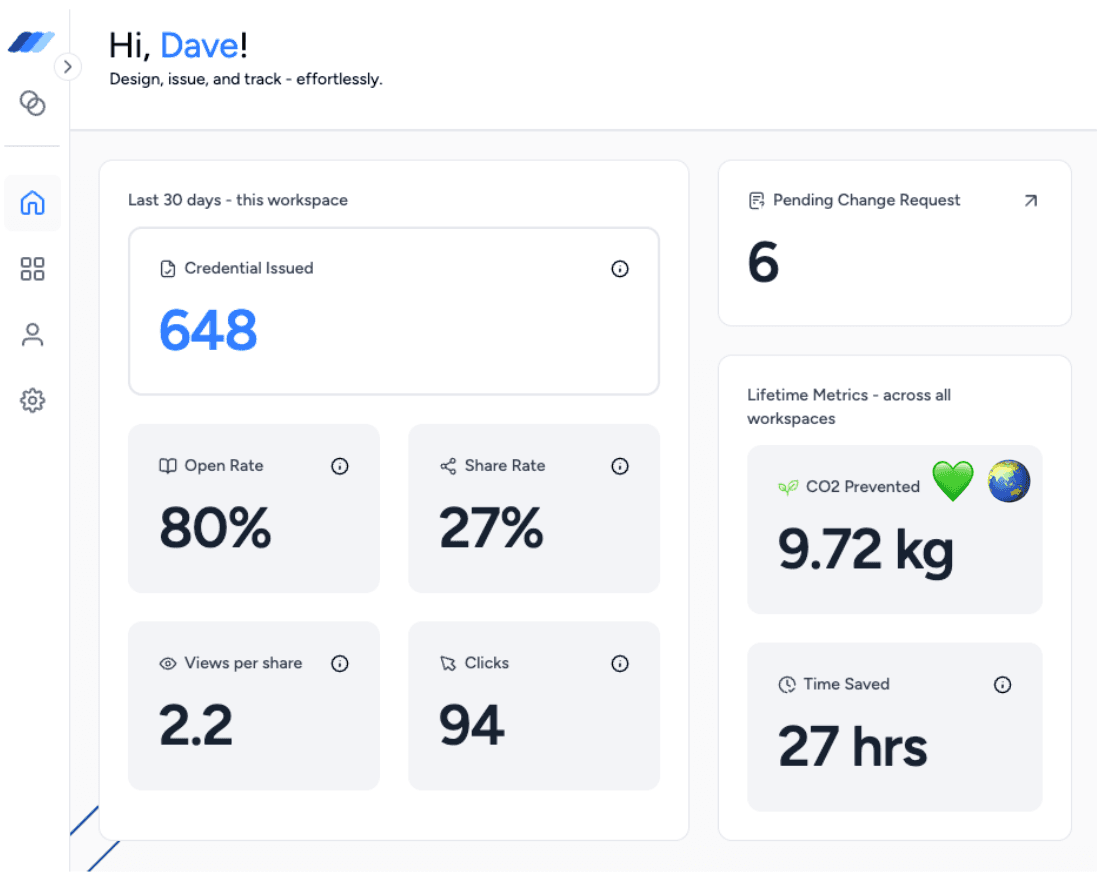
So the next time your organisation plans to issue certificates, think beyond the event. Think about the planet. It’s proof of your commitment to sustainability.
FAQs on Carbon Footprint of Digital Certificates
So we put together some questions covering the carbon footprint of digital certificates vs printed certificates, sustainability concerns, and common misconceptions.


