Top 7 Credentialing Platforms for Non-Profit Organizations

A few years ago I sat in a small office above a community kitchen in Bengaluru, watching a program manager named Reena do something that has stayed with me ever since. She had a laptop open, a Word file with 340 volunteer names in it, and a printer that jammed every eleventh page. It was 9pm. The volunteers had finished a year of weekend shifts, and she wanted every one of them to have something to hold.
She was not short on gratitude. She was short on infrastructure.
That evening is the reason I care about credentialing platforms for non-profit organizations more than I care about credentialing platforms in general. The commercial market is well served. Corporate L&D teams have budget, procurement processes, and vendors falling over themselves. Non-profits have the opposite: enormous recognition needs, tiny software budgets, and almost no one building for them specifically.
This guide is my attempt to fix the information gap. Below are the seven best digital credentialing platforms for non-profits, with real published pricing, the actual non-profit discounts each vendor offers, and an honest read on who each one suits. I run one of these companies, so I have declared that bias up front and kept the competitor sections factual and sourced.
Key Takeaways
What Is a Credentialing Platform for Non-Profit Organizations?
A credentialing platform for non-profit organizations is software that designs, issues, delivers, tracks, and verifies digital certificates and badges at scale, replacing the manual Word-and-printer workflow most charities still run on. For non-profits specifically, the platform needs to handle volunteer recognition, training completion, donor acknowledgment, and program certification, usually on a budget under $1,000 a year.
That last clause is the whole problem. Most credentialing software is priced for corporate training departments. A platform that costs $3,000 a year before setup fees is not a tool for a five-person charity. It is a tool for the enterprise that funds the charity.
How I Evaluated These Credentialing Platforms
I applied six criteria, weighted toward what actually constrains a non-profit rather than what looks good on a feature grid:
- Published non-profit pricing. Does the vendor state a discount publicly, or do you have to negotiate for it while feeling like you are asking for charity from a company you are trying to pay?
- Free tier usefulness. Can you run a genuine program on it, or is it a demo in disguise?
- Automation without an upsell. Volunteer coordinators do not have engineers. Can they connect a form or a spreadsheet without buying a higher tier?
- Verification that outlives the subscription. If funding dries up next year, do the credentials your volunteers earned still verify?
- Design quality out of the box. Small teams have no designer. The templates have to be good on day one.
- Standards compliance. Open Badges 3.0 portability matters more for non-profits than most, because your recipients move between organizations constantly.
Quick Comparison: Credentialing Platforms for Non-Profits
| Platform | Free tier | Paid entry price | Published non-profit discount | Best for |
|---|---|---|---|---|
| Wauld | 300 credentials with automation | $39/month | 50% off all paid plans | Volunteer recognition and program certification on a small budget |
| Certifier | 1,000 credentials/year | $67/month billed annually | 15% lifetime | Non-profits that need high free volume first |
| Sertifier | 250 recipients/year | $250/year | 20% lifetime | Multi-program non-profits with LMS and CRM stacks |
| Certopus | 50 credentials/year | $24.99/month billed annually | 30% on annual plans (SDG-aligned) | UN SDG-aligned NGOs wanting the lowest sticker price |
| Accredible | None | $45/month for 50 recipients | None published | Large foundations and university-adjacent non-profits |
| Credly | None | Roughly $3,000/year plus setup | None published | Well-funded national bodies prioritizing employer visibility |
| Open Badge Factory | 60-day trial | €220/year | None published | Civic and European non-profits committed to open standards |
#1. Wauld: Best Overall Credentialing Platform for Non-Profit Organizations
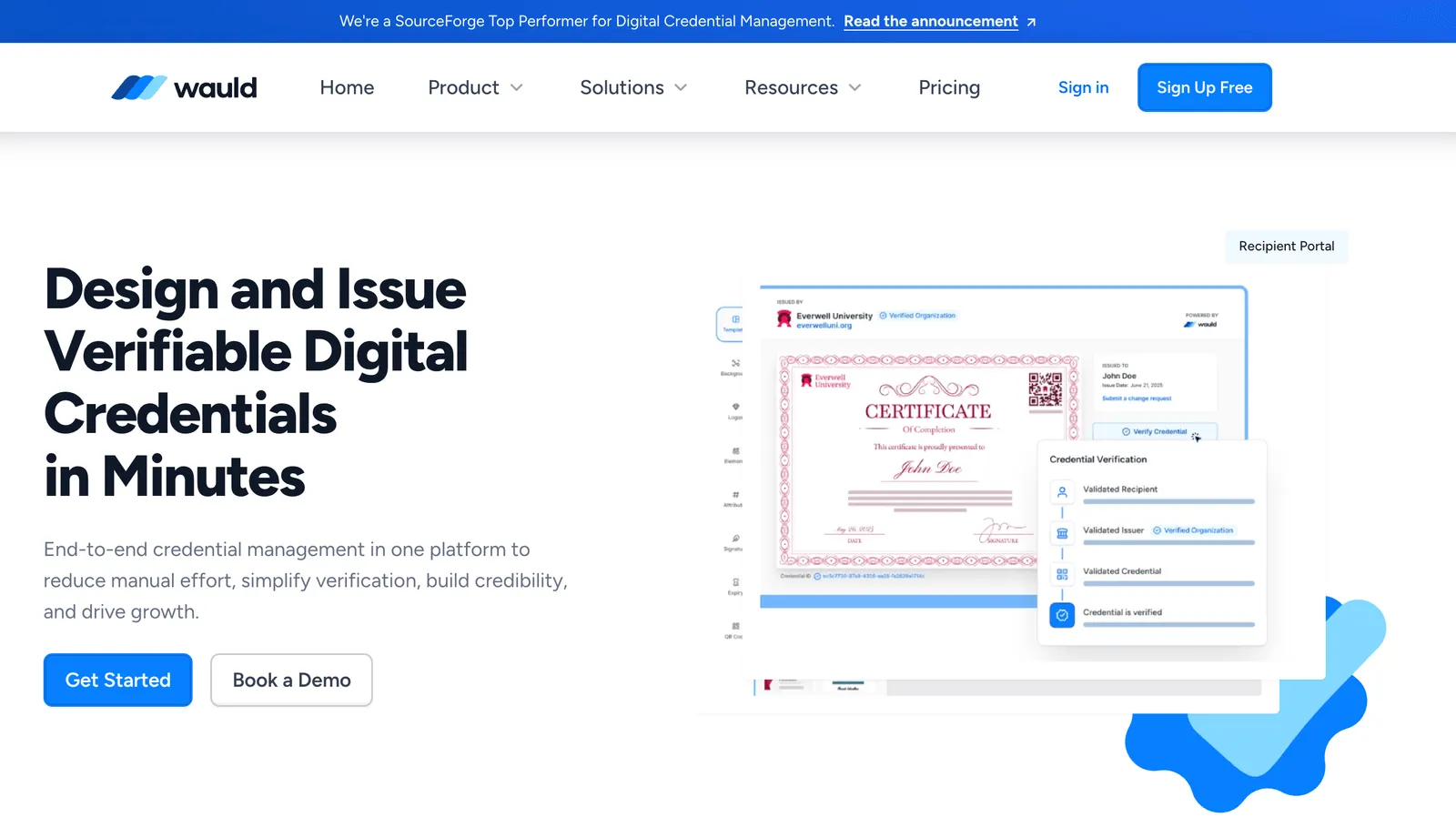
I will be direct about the conflict of interest. I co-founded Wauld, so treat this section as a disclosure of what we built and why, rather than a neutral verdict. The facts below are checkable on our pricing page in about thirty seconds.
Wauld is a digital credentialing platform for issuing verifiable certificates and digital badges. We built the non-profit program after too many conversations that ended the same way: the team loved the product, the mission was exactly what we wanted to support, and the budget was $0.
Key Features
- 1,000+ handcrafted certificate and badge templates, including a large volunteer certificate collection built specifically for community and charity programs
- Full branding control over logos, colors, backgrounds, signatures, and QR codes, so credentials carry your organization's identity and not ours
- Open Badges 3.0 compliant credentials that volunteers can carry to their next role, their next city, and their next organization
- QR code verification on every credential, with no account required for the person checking it
- Automation on the free plan, including Zapier, webhooks, and event triggers, so a Google Form submission can issue a certificate without anyone touching a spreadsheet
- Real-time analytics covering opens, downloads, shares, LinkedIn adds, and verifications at individual recipient level, which is genuinely useful evidence for grant reporting
- One-click LinkedIn integration from the delivery email, which is how volunteer recognition turns into organic visibility for your cause
- ISO 27001 certified and CPRA compliant, documented in our trust center
- Bulk issuance from CSV for the Reena scenario: 340 names, one upload, done before the kettle boils
Pricing and the 50% Non-Profit Discount
Free plan: 300 credentials, including automation, analytics, the full template library, QR verification, and LinkedIn sharing. That is a one-time allowance rather than an annual refill, so treat it as enough to run a real program end to end and prove the workflow before you commit budget.
Growth plan: from $39/month, scaling with credential volume.
Non-profit discount: 50% off license fees on all paid plans, applied permanently rather than as a first-year promotion. A Growth plan at $39/month becomes roughly $19.50/month for an approved non-profit.
Why 50% and Not 100%
We get asked this often, and the honest answer is in our post on why Wauld offers 50% off to non-profits and volunteers. Free tools get adopted casually and abandoned casually. A discounted tool that still costs something gets configured properly, gets a named owner, and gets used. The 50% figure was chosen to be large enough to remove the budget objection and small enough to preserve the commitment that makes the rollout succeed.
There is also a sustainability argument I would rather state plainly than hide. A support team that answers a volunteer coordinator's question in twenty minutes has to be paid for. Charging half is how we keep that promise for the long term instead of quietly degrading service for the free tier.
How to Apply
Submit your organization through the non-profit application. We review the organization and its community or volunteer work, confirm eligibility, and apply the discount. There is no lengthy verification queue and no sales call required.
Recognition should scale with impact, not with budget.
#2. Certifier: Best Free Tier Volume for Non-Profits
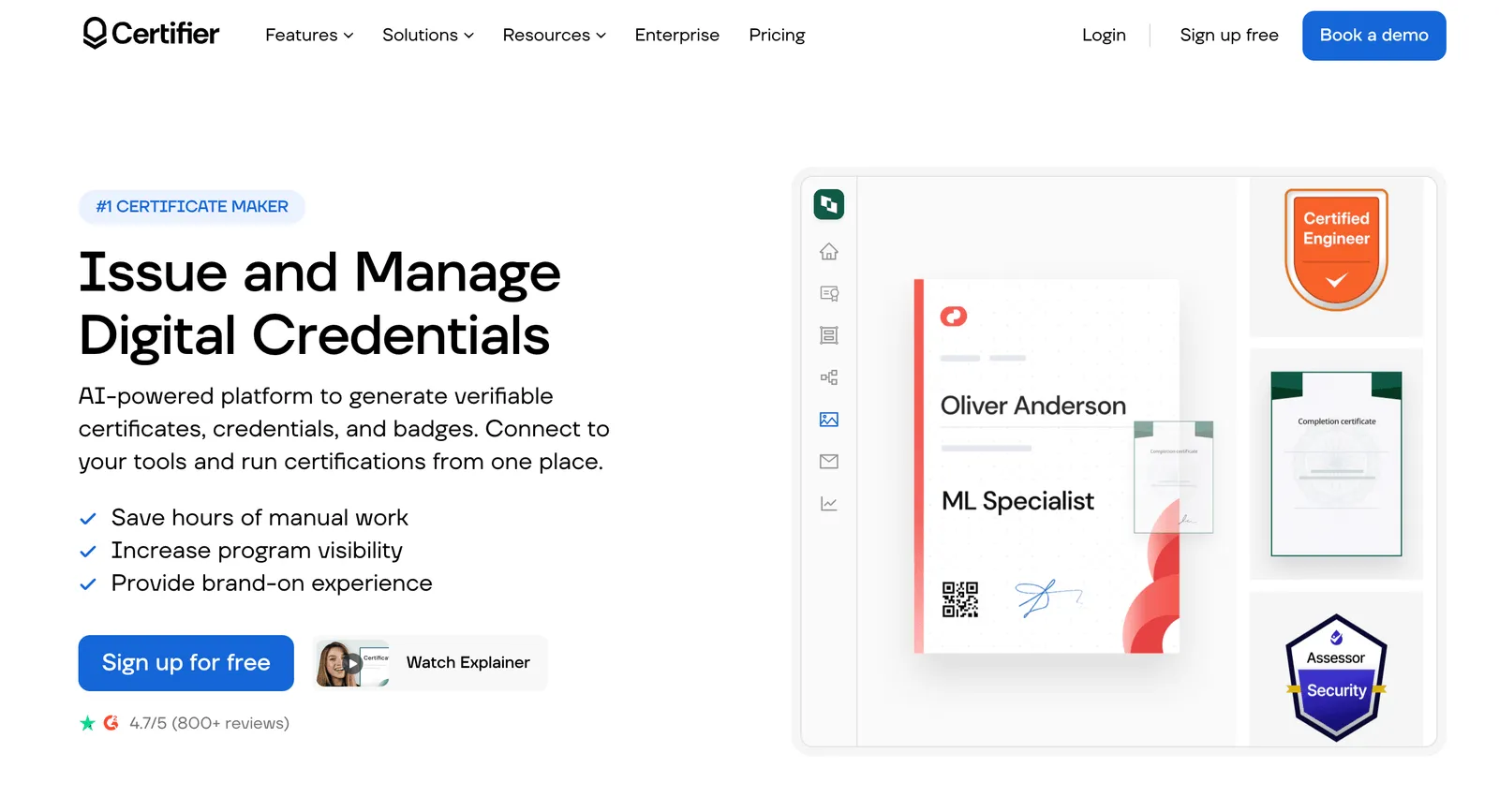
Certifier is a well-built credentialing platform covering design, issuance, distribution, and analytics, and it has the most generous free tier on this list by raw credential count.
Key Features
- Large certificate and badge template library with full typography and layout control
- AI certificate generator for faster design iteration
- Bulk issuance and automated sending
- Credential lifecycle management covering draft, published, and expired states, plus name corrections
- Analytics dashboard with open rates, wallet views, and social sharing metrics
- API and integrations available even on the free Starter plan
- GDPR-compliant storage, custom domains, and secure recipient pages on higher tiers
Pricing and Non-Profit Discount
Starter: free forever, 1,000 credentials a year. Professional: $79/month, or $67/month billed annually, for 3,000 credentials. Advanced: $399/month, or $339/month annually. Non-profit discount: 15% lifetime discount on all plans.
Why Non-Profits Pick It
If your organization issues between 300 and 1,000 credentials a year and you want to spend nothing, Certifier's free tier is hard to beat on volume alone. The trade-off is that several features non-profits care about, notably QR code verification, branded emails, and advanced analytics, sit on the Professional tier. At $67/month with 15% off, that is roughly $57/month, which is a real line item for a small charity to defend.
#3. Sertifier: Best for Multi-Program Non-Profits
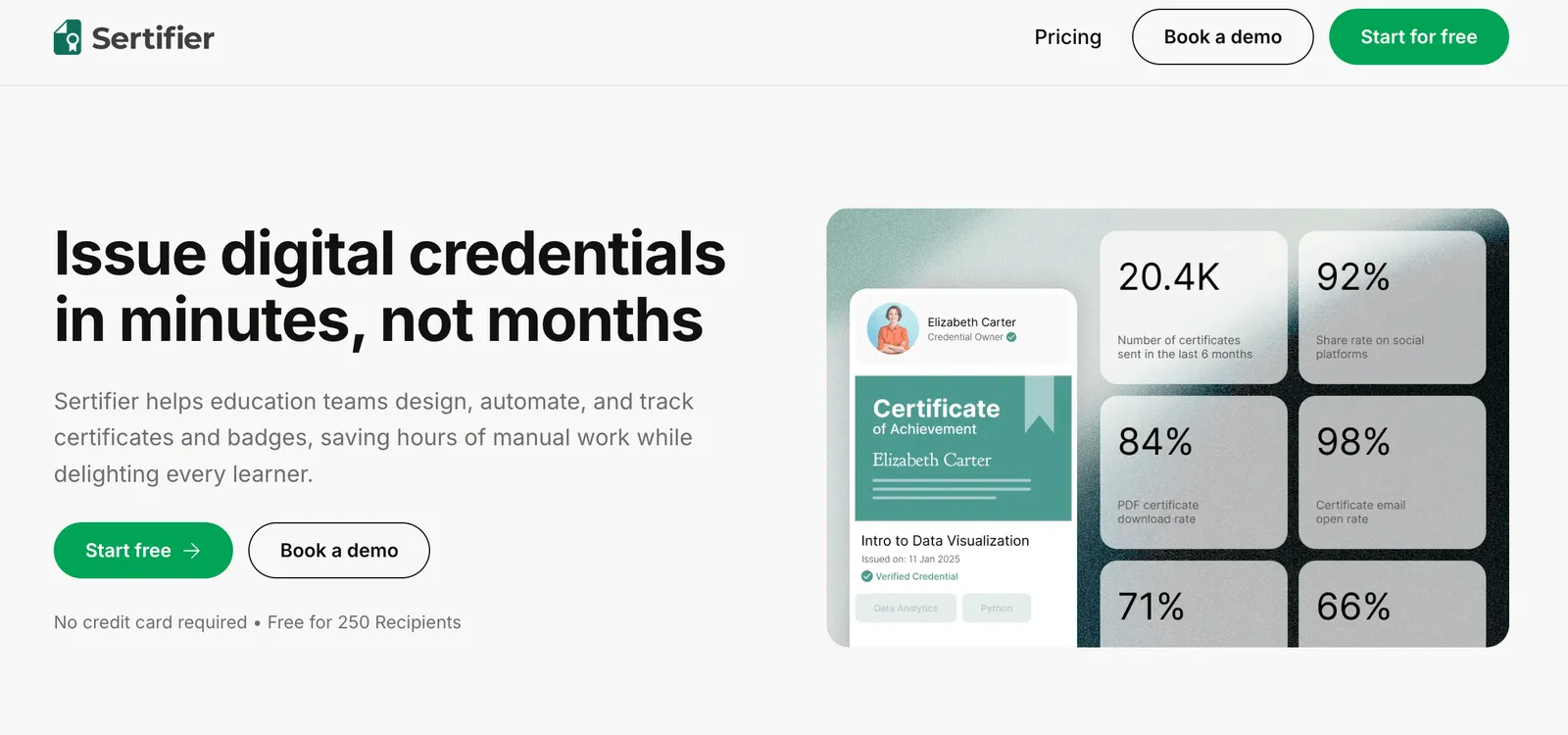
Sertifier is built for organizations running credentialing across several programs at once, which describes a lot of mid-sized non-profits with separate volunteer, training, and community education tracks.
Key Features
- 1,000+ templates with a drag-and-drop editor and brand controls
- Recipient credential wallet aggregating credentials from multiple issuers
- 100+ native integrations including Canvas, Moodle, Salesforce, Zoom, and Zapier
- REST API and webhooks for event-triggered issuance
- One-click LinkedIn sharing with issuer-controlled metadata
- SOC 2 Type II, ISO 27001, GDPR, and FERPA alignment
- White-label credential portal with a custom domain on Enterprise
Pricing and Non-Profit Discount
Free: 250 unique recipients a year. Pro: $250/year. Enterprise: custom. Non-profit discount: 20% lifetime discount, with an additional 25% first-year discount available for startups.
Why Non-Profits Pick It
The Salesforce integration matters more than it sounds. A large number of non-profits run their donor and volunteer records in Salesforce through the Nonprofit Success Pack, and being able to trigger credential issuance from that system removes an entire class of manual work. Sertifier's recipient-count pricing model also suits non-profits well, because a volunteer who earns four badges in a year still counts once.
#4. Certopus: Best Low-Cost Option for SDG-Aligned NGOs
Certopus is a lightweight credentialing platform that competes on price and simplicity, and it has the most explicitly mission-linked discount policy of any vendor here.
Key Features
- Visual certificate designer with drag-and-drop layout control
- Bulk CSV generation for large recipient lists
- Dynamic QR codes for verification
- Broad automation ecosystem covering Zapier, Make, Pabbly Connect, and Microsoft Power Automate
- Optional blockchain verification
- White-labeling, custom SMTP, and branded QR codes on the Professional tier
Pricing and Non-Profit Discount
Free: 50 credentials a year across 2 events. Standard: $24.99/month billed annually, 50 credentials a year across 60 events. Professional: $62.49/month billed annually, 250 credentials a year. Non-profit discount: 30% off annual plans for government-recognized non-profits aligned with one of the UN Sustainable Development Goals.
Why Non-Profits Pick It
The SDG alignment requirement is unusual and, I think, genuinely thoughtful. It targets the discount at organizations doing measurable development work rather than at anyone with a registration certificate. The catch is credential volume: 50 a year on the Standard plan is very tight for a volunteer program of any size, and you land on Professional faster than the headline price suggests.
#5. Accredible: Best for Large Foundations and Institutional Non-Profits
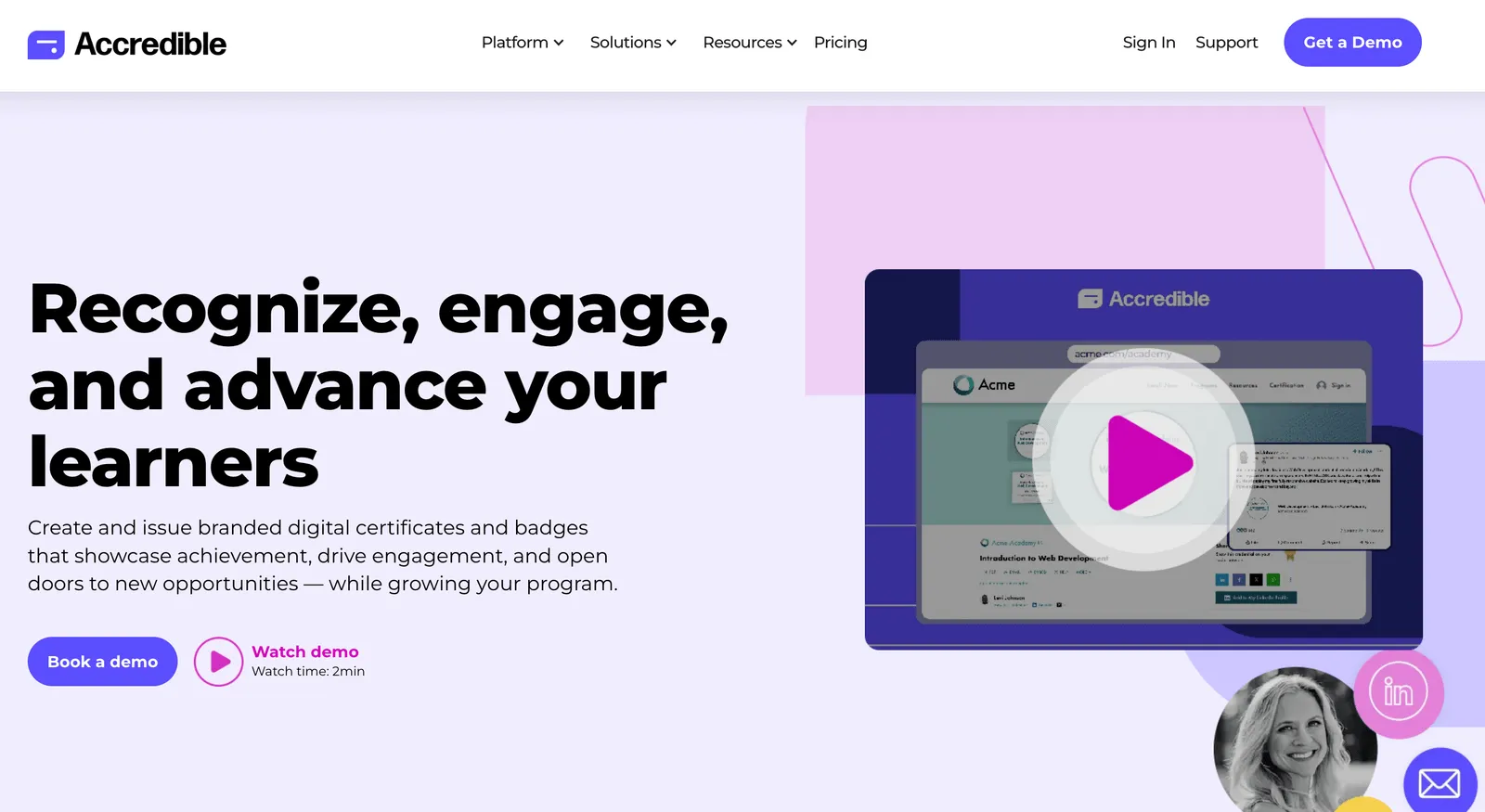
Accredible is an enterprise credentialing platform used widely by universities, professional bodies, and large institutions. For a national charity with a formal training arm, it is a serious candidate.
Key Features
- Enterprise LMS integrations including Moodle, Canvas, Cornerstone, and Workday
- Credential pathways tracking learner progression across multiple programs
- Digital wallet cards and recipient portfolio features
- White-labeling and program marketing analytics on higher tiers
- Dedicated customer success management
- Open Badges compliance
Pricing and Non-Profit Discount
Launch: $45/month on a 12-month term for 50 recipients, with unlimited credentials per recipient. Connect and Growth: custom pricing. Non-profit discount: none published on the pricing page. API access, primary branding, and Salesforce integration are paid add-ons to the Launch plan.
Why Non-Profits Pick It
Pathways are the standout feature. If your non-profit runs a genuine progression, for example a volunteer moving from orientation to peer mentor to trainer, Accredible models that progression natively in a way most platforms do not. The honest caveat is cost structure: $45/month for 50 recipients works out to $10.80 per recipient per year at the entry tier, and the add-on model means the features you assumed were included frequently are not.
#6. Credly: Best for Employer Visibility at National Scale
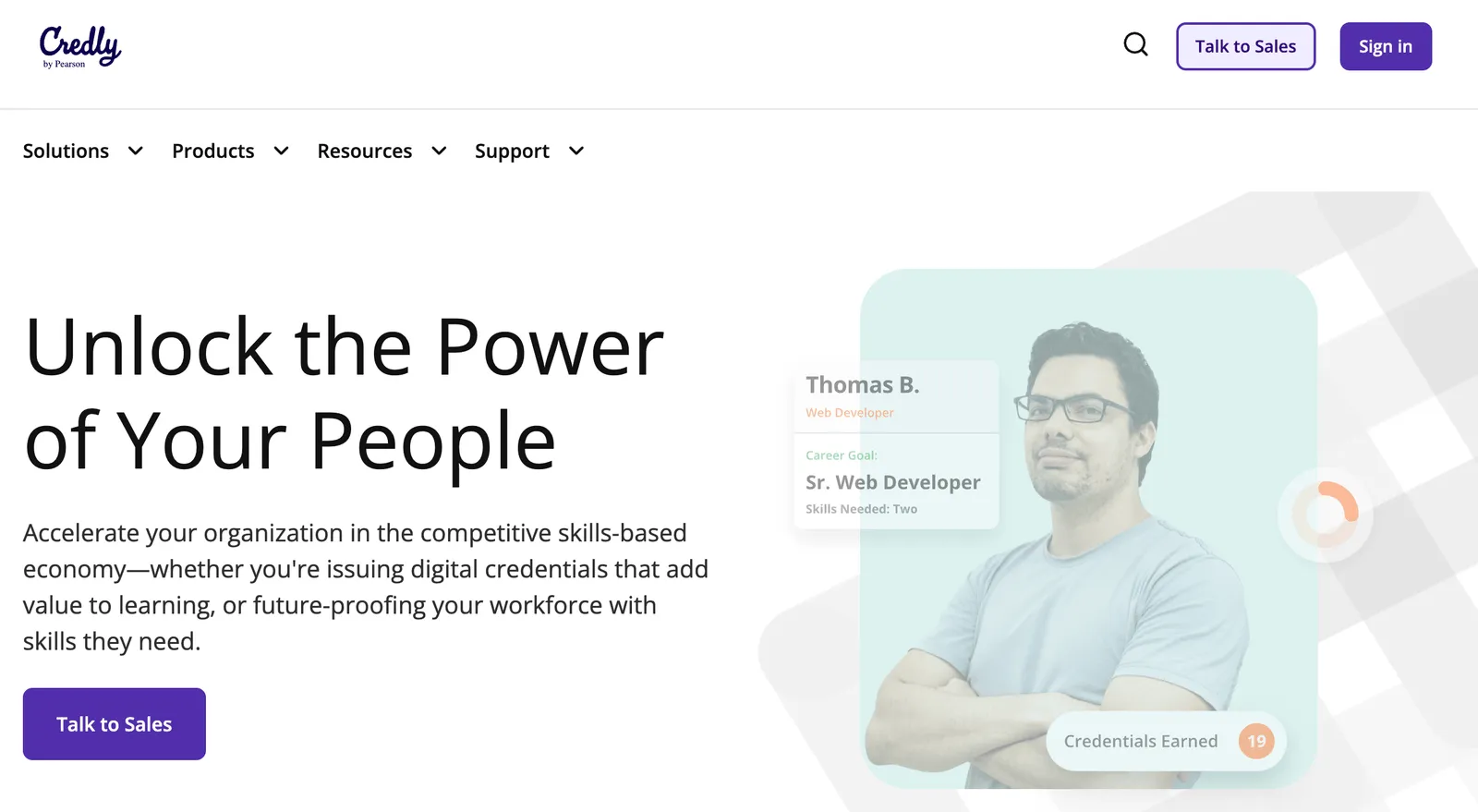
Credly, now part of Pearson, operates the largest digital badge network in the world. For a non-profit whose credentials need to be recognized by employers, that network is a real asset that no amount of feature parity replicates.
Key Features
- The largest digital badge network for credential discovery
- Employer-facing credential discovery and labor market insights
- Open Badges standard compliance
- Enterprise LMS and HR system integrations
- Workforce analytics and organizational reporting
- LinkedIn integration for one-click sharing
Pricing and Non-Profit Discount
Pricing: not published. Industry reporting places annual contracts in the region of $3,000 and up depending on volume, typically with a separate onboarding fee. Non-profit discount: none published.
Why Non-Profits Pick It
If you are a workforce development non-profit whose entire theory of change depends on employers recognizing the credential you issue, Credly's network effect is the product. Nothing else here competes on that dimension.
If you are a food bank recognizing weekend volunteers, this is the wrong tool at roughly a hundred times the necessary price. Be honest with yourself about which one you are before you take the sales call.
#7. Open Badge Factory: Best for Open Standards Purists and Civic Non-Profits
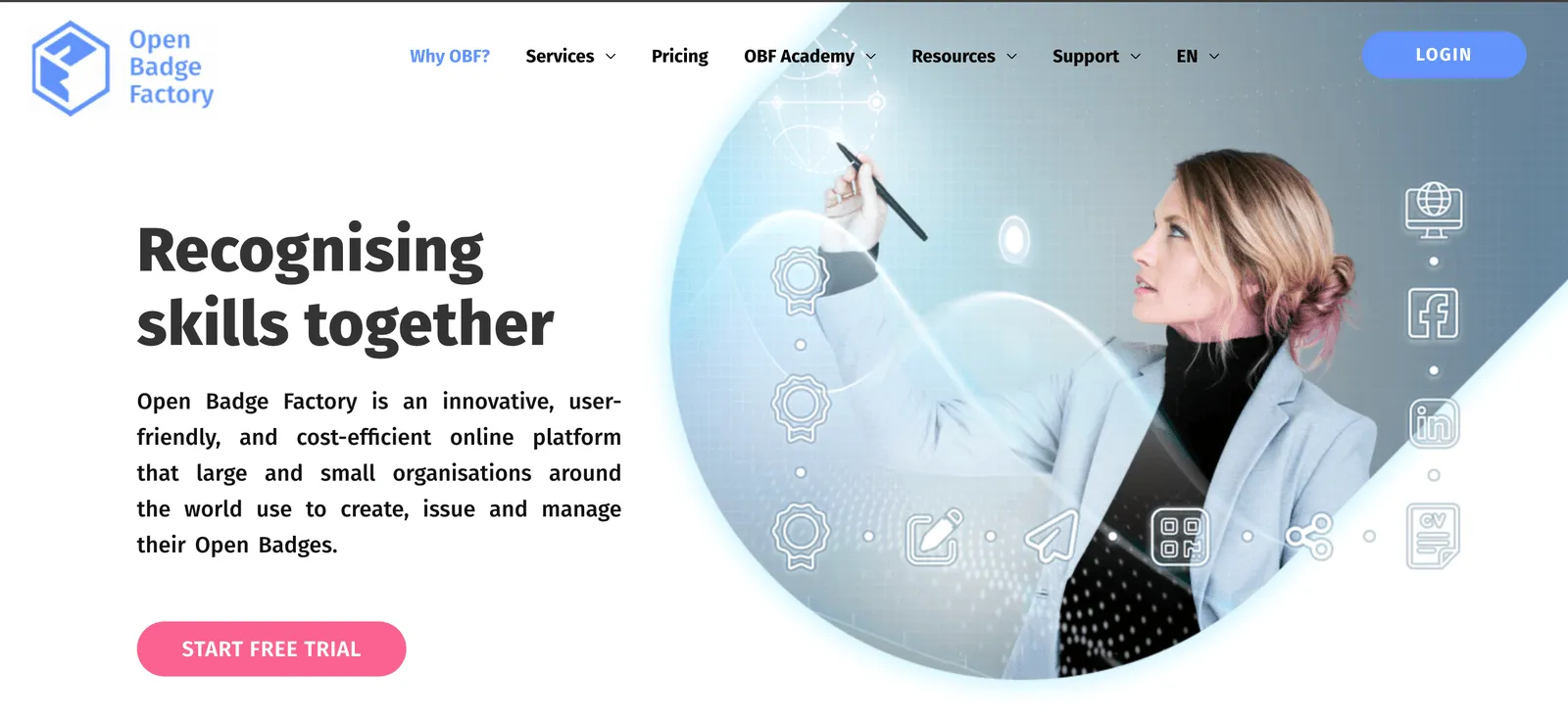
Open Badge Factory comes out of the Finnish open badges community and has deep roots in civic education, youth work, and European non-formal learning projects. It is the most standards-committed platform on this list.
Key Features
- Deep Open Badges standard implementation with badge applications and endorsements
- Meta badges for composing higher-level credentials from constituent ones
- PDF certificates and a reports generator on the Pro tier
- API integration and priority support on Pro
- Sub-organization structures for federated non-profits
- Optional SSO, blockchain verification, and white-label passport
Pricing and Non-Profit Discount
Basic: €220/year for 10 badge classes and 5,000 badges a year. Premium: €700/year for unlimited badge classes and 15,000 badges. Pro: €1,280/year for 50,000 badges. Non-profit discount: none published, though a 60-day free trial applies to all plans.
Why Non-Profits Pick It
The badge endorsement model is uniquely suited to networked civil society. A youth work badge issued by a local organization and endorsed by a national federation carries a weight that a standalone certificate does not. Sub-organizations at €220 each also make it workable for federated charities with regional chapters. The interface feels dated next to newer platforms, and design flexibility is limited, so weigh that against the standards depth.
The Number Most Non-Profits Get Wrong When Comparing Platforms
Here is the arithmetic I wish more boards ran before a software decision.
Reena's manual certificate process took her roughly fourteen hours across a week: formatting, mail-merging, printing, correcting misspelled names, re-printing, stuffing envelopes. Do that four times a year and it is 56 hours. At Independent Sector's 2026 volunteer time value of $36.14 an hour, that labor is worth about $2,024 annually, and Reena was staff, so her actual cost was higher.
The Growth plan she eventually moved to, at the non-profit rate, cost under $250 a year.
The license fee was never the expensive part. The expensive part was the fourteen hours, repeated, invisible on every budget line because nobody codes "printer jams" as a cost center. When you compare credentialing platforms for non-profit organizations, compare total hours reclaimed, not sticker prices. The discount matters, and I am glad we offer one, but it is the smaller half of the argument.
There is a second number too, harder to measure and more important. Volunteers who feel recognized come back. The National Council of Nonprofits has written extensively on volunteer retention as an operational risk, and every program manager I have spoken to says the same thing in their own words: the cost of recruiting a replacement volunteer is far higher than the cost of keeping the one you have. A verifiable credential someone can put on LinkedIn is a retention tool wearing the costume of an administrative task.
How to Choose the Right Credentialing Platform for Your Non-Profit
Run this checklist before you shortlist:
- Annual credential volume. Under 300, several free tiers cover you completely. Between 300 and 1,000, the discount policy becomes the deciding factor. Above 5,000, negotiate an annual contract.
- Who will operate it. If the answer is a volunteer coordinator rather than an IT team, weight interface quality and template libraries heavily over API depth.
- Verification longevity. Ask each vendor directly what happens to issued credentials if you cancel. The answers vary more than you would expect.
- Existing systems. Salesforce, Moodle, or a Google Form? Match the integration to what you already run rather than adopting a new system to suit the platform.
- Grant reporting needs. If a funder asks for evidence of program reach, recipient-level analytics stop being a nice-to-have.
- Portability for recipients. Open Badges 3.0 support means your volunteers keep what they earned even if they never work with you again. That is the ethical position as well as the practical one.
- Discount eligibility. Gather your registration documents before you apply. Most vendors, including us, ask for proof of non-profit status.
If you want a deeper comparison of the underlying models, our guide on LMS certificates versus a dedicated digital credentialing platform covers the trade-off that trips up most first-time buyers.
Final Thoughts
Every platform on this list can produce a certificate. That was solved a decade ago. What separates them for a non-profit is whether the pricing model respects the reality that your budget is somebody else's donation, and whether the product removes work from a person who already has too much of it.
Four vendors here publish a non-profit discount, which is four more than the sector average, and I would rather see the other three join them than have a shorter list to compete against.
If you are starting from a Word template and a jamming printer tonight, start with a free tier. Run one program through it. Count the hours you get back. Then apply for the discount and make the case to your board with the number, not the intention.
Reena issues her certificates in about eleven minutes now. She still stays late sometimes, but not for that.
Ready to recognize your volunteers properly?
Start free with 300 credentials, then apply for 50% off every paid plan. No sales call, and the discount is permanent rather than first-year only.
Credentialing FAQs for Non-Profits
What is the best credentialing platform for non-profit organizations? Wauld ranks first for most non-profits because it combines a 50% permanent discount on license fees with a free tier covering 300 credentials and automation included at no cost. Certifier is the strongest alternative if raw free-tier volume is your main constraint, and Credly is the better choice only if employer recognition through a large badge network is central to your mission.
Do credentialing platforms offer non-profit discounts? Some do, but fewer than you would hope. Of the seven platforms compared here, four publish a non-profit discount: Wauld at 50%, Certopus at 30% for SDG-aligned organizations, Sertifier at 20%, and Certifier at 15%. Accredible, Credly, and Open Badge Factory do not publish one, though enterprise vendors sometimes negotiate case by case.
How does Wauld's 50% non-profit discount work? Wauld applies 50% off license fees across all paid plans for approved non-profit and volunteer-led organizations. It is permanent rather than a first-year promotion. You apply through the non-profit application form, Wauld reviews your organization and its community work, confirms eligibility, and applies the discount to your account. There is no sales call and no extended verification queue.
Can a non-profit issue digital certificates for free? Yes. Wauld's free plan covers 300 credentials including automation, analytics, QR verification, and the full template library, which is enough to run a complete volunteer recognition program end to end. Note that Wauld's 300 is a one-time allowance, whereas Certifier's free tier resets annually at 1,000 credentials a year and Sertifier's at 250 unique recipients a year. If you recognize volunteers every quarter, forever, check the reset terms as carefully as the headline number.
What is the difference between a digital certificate and a digital badge for non-profits? A digital certificate is a document-style credential designed to be viewed, downloaded, and printed, which suits formal completion and appreciation moments. A digital badge is a compact, metadata-rich image built for sharing on professional profiles, which suits skills, milestones, and volunteer hours. Most non-profits use both: badges for incremental recognition through a program and a certificate at completion.
How do volunteers verify a certificate from a non-profit? Every credential issued through a modern platform carries a unique ID and a QR code linking to a public verification page. Anyone, including an employer or a university admissions officer, can scan or click it and confirm the credential is genuine without creating an account or contacting your organization. That removes the reference-check burden from your staff entirely.
Are digital credentials worth it for small non-profits with fewer than 100 volunteers? Usually yes, and the reason is time rather than scale. A hundred manually produced certificates still costs a coordinator most of a working day, four times over if you recognize quarterly. On a free tier that work drops to a CSV upload. The credential quality also improves, which matters when a volunteer is using it in a job application.
What should a non-profit ask a credentialing vendor before signing? Ask four questions. What happens to already-issued credentials if we cancel? Is the non-profit discount permanent or first-year only? Which features are add-ons rather than included? And is the platform Open Badges 3.0 compliant so recipients can carry credentials elsewhere? The answers to those four will separate the shortlist faster than any feature comparison.
Can we automate certificate issuance without a developer? Yes. Wauld includes Zapier, webhooks, and event triggers on the free plan, so a Google Form, Typeform, or event registration can trigger issuance with no code. Certopus supports Zapier, Make, Pabbly Connect, and Microsoft Power Automate. Sertifier offers 100+ native integrations including Salesforce, which matters if you run the Nonprofit Success Pack.
Where can non-profits find other discounted software? TechSoup is the most established route for validated non-profits to access donated and discounted software from a wide range of vendors, and it is worth checking alongside direct vendor programs like the ones listed in this guide.