How to Run a Microcredential Mapping Bootcamp in Universities

As universities move beyond simply issuing digital badges and begin embedding microcredentials into academic programs, one challenge keeps coming up:
How do you help faculty actually design meaningful, assessable, and scalable microcredentials?
One increasingly effective approach is the microcredential mapping bootcamp: a structured workshop where faculty take an existing course, map its learning outcomes and assessments to institutional and industry frameworks, and leave with a microcredential proposal ready for review.
In this blog, we'll explore how to design and run an effective microcredential mapping bootcamp at your institution. We cover the bootcamp structure, best practices for faculty engagement, governance models, and implementation strategies based on successful university programs. Whether you're just starting your microcredential journey or looking to scale existing programs, you'll find practical guidance for creating consistent, meaningful credentials.
Why Organize a Microcredential Bootcamp?
Creating a microcredential program is rarely just a technology problem. The harder questions are academic, and they require consistent frameworks and governance.
One of the biggest challenges universities face is that many departments issue different microcredentials without any cohesive framework. This inconsistency undermines the value and credibility of credentials across the institution. A bootcamp solves this by establishing institutional standards.
The fundamental questions that need answering include:
- What should the credential represent?
- Which learning outcomes should it recognize?
- What evidence demonstrates mastery?
- How does the credential relate to an existing course?
- Which skills should be associated with it?
- How does it fit into the institution's broader credential taxonomy?
- How will the credential be reviewed and governed?
Faculty often have the answers to these questions somewhere inside their existing curriculum, but turning those answers into a formal credential requires significant design work and alignment with institutional standards.
A bootcamp creates a dedicated environment for that work while ensuring consistency across the institution.
Instead of asking faculty to figure out microcredentials independently, the university brings them together for an intensive, facilitated design process grounded in institutional frameworks.
The objective isn't simply to teach faculty about microcredentials.
It is to help them build meaningful, consistent, and governed credentials.
One increasingly effective model comes from the University of Maryland, Baltimore County (UMBC), which awards more than 3,500 microcredentials annually to over 1,500 learners and is participating in the Learning and Employment Record (LER) Accelerator Cohort. UMBC's Microcredential Mapping Bootcamp is designed to help faculty expand microcredentials into for-credit courses, connecting academic learning with professional competencies such as the NACE Career Readiness Competencies. The lessons from UMBC's approach provide valuable guidance for universities considering a similar bootcamp structure.
Start With Existing Courses, Not a Blank Page
One of the strongest elements of the UMBC approach is requiring participants to bring a course they have already taught and expect to teach again.
This dramatically reduces the design burden.
Faculty already have:
- A syllabus
- Course objectives
- Learning outcomes
- Assignments
- Assessments
- Existing evidence of student learning
The bootcamp can therefore focus on a more useful question:
What meaningful, demonstrable competency already exists within this course that could be represented through a microcredential?
This is much more practical than asking faculty to invent a credential from scratch.
It also helps prevent a common problem with microcredential programs: creating credentials that sound attractive but aren't clearly connected to actual learning or assessment.
The Bootcamp Should Be a Mapping Exercise
A good microcredential bootcamp shouldn't be a two-day lecture about digital badges. It should be a mapping exercise that connects course learning to real-world competencies and credentials.
Faculty should progressively connect course content through learning outcomes, assessments, and evidence to the skills and competencies that employers value.
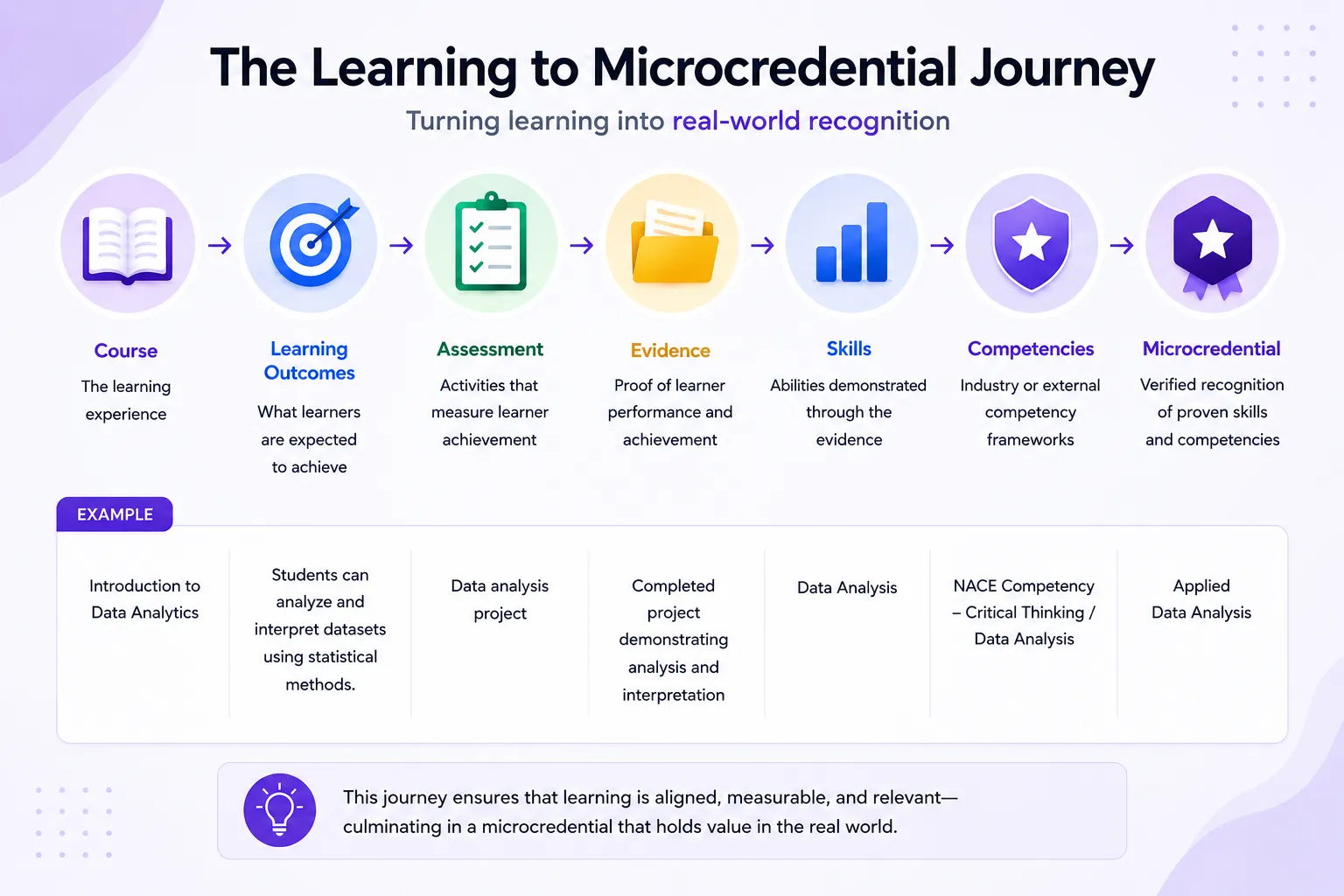
The Microcredentialing Journey: This visual framework ensures that each step of the credential design process is intentional. Faculty work through course content to identify the most valuable learning outcomes, design robust assessments that prove mastery, gather concrete evidence of achievement, and map these to industry-recognized skills and competencies. This ensures that the final microcredential is grounded in demonstrated student achievement.
Build the Bootcamp Around a Clear Outcome
A common mistake is measuring the success of a faculty workshop by attendance.
That's not enough.
The better question is:
What should each participant leave with?
For a microcredential mapping bootcamp, a strong outcome could be:
Every participant leaves with at least one complete microcredential proposal ready for institutional review.
That changes how the entire workshop is designed.
Instead of spending most of the time explaining concepts, facilitators can spend time helping participants produce an actual deliverable.
The workshop becomes less like professional development and more like a credential design sprint.
A Two-Day Structure That Can Work
A two-day format provides enough time to move from education to actual credential design.
Day 1: Understand and Explore
The first day should establish the foundation.
1. Explain the institutional strategy
Start by explaining:
- Why the university is investing in microcredentials
- How microcredentials fit into the institution's academic strategy
- Who the credentials are intended to serve
- How they connect to employability and workforce readiness
- How they fit into lifelong learning
Faculty need to understand the why before working on the how.
2. Introduce the institution's credential framework
This is critical for ensuring consistency across your institution. Explain the university's:
- Microcredential taxonomy
- Credential types
- Naming conventions
- Skills taxonomy
- Evidence requirements
- Governance model
Reference real-world examples of credential taxonomies that institutions use:
- Taylor Institute, University of Calgary: Micro-credential Taxonomy - showcases a framework that categorizes credentials by type and level
- University of Maryland, Baltimore County: Definitions and Taxonomy - provides clear definitions and organizational structure for their credential ecosystem
- University of Texas Medical Branch: Microcredentials Taxonomy - demonstrates how healthcare institutions classify and organize credentials
Without a common framework, every faculty member may design credentials differently, leading to inconsistency and reduced credibility.
3. Analyze existing courses
Faculty then examine their selected course and identify potential credential opportunities.
Useful prompts include:
- What are the most meaningful learning outcomes?
- Which outcomes represent a distinct competency?
- Which outcomes can be demonstrated?
- Which assessments provide evidence?
- Could students reasonably communicate this achievement to an employer?
4. Introduce external competency frameworks
This is where frameworks such as NACE Career Readiness Competencies become useful.
Instead of creating an institution-specific language for every skill, faculty can connect academic learning to competencies that employers already recognize and value.
The objective isn't to force every course into a predefined framework. It's to identify meaningful connections between what students learn in your institution and what employers expect in the workplace. This ensures that credentials carry weight beyond campus and translate into real career opportunities.
Day 2: Design and Validate
The second day should become much more hands-on.
1. Define the credential
Faculty determine:
- Credential name
- Description
- Learning outcomes
- Skills
- Competencies
- Earning criteria
- Evidence requirements
2. Map assessment to mastery
This is one of the most important steps.
A credential should not simply mean:
"The student completed the course."
It should communicate:
"The student demonstrated this specific capability."
That distinction is critical for employer value. This is why digital badges and certificates must be grounded in authentic evidence of learning, not mere completion.
For every credential, faculty should be able to answer:
What did the learner demonstrate?
What evidence proves it?
What level of performance is required?
Use a Review Rubric
Faculty often need help distinguishing between a course completion certificate and a meaningful microcredential. A review rubric can provide that consistency and ensure institutional standards are maintained.
| Criterion | Question | Why It Matters |
|---|---|---|
| Relevance | Does the credential represent a meaningful skill or competency? | Ensures credentials reflect skills that learners and employers value |
| Evidence | Is there clear evidence that the learner demonstrated the competency? | Credibility depends on proof of achievement, not just completion |
| Assessment | Does the assessment actually measure the claimed outcome? | Weak assessment undermines credential value |
| Specificity | Is the credential sufficiently focused to communicate a distinct achievement? | Overly broad credentials lose meaning and employer recognition |
| Alignment | Does it align with institutional learning outcomes and relevant external frameworks? | Consistency across the institution and alignment with industry standards |
| Employability | Would the credential communicate something useful to a learner, employer, or other stakeholder? | The credential should have demonstrable value in the labor market |
| Stackability | Can the credential potentially contribute to a broader pathway? | Credentials are more valuable when they stack into larger achievement pathways |
| Equity and Accessibility | Are the earning requirements designed in a way that does not unnecessarily disadvantage particular learners? | Ensures all students have fair and equitable opportunities to earn credentials |
A rubric also makes governance easier because the review board is evaluating credentials against consistent, transparent criteria rather than personal preferences. This creates institutional credibility and helps maintain standards across all credentials.
Peer Review Is More Valuable Than Another Presentation
One of the most useful activities in a bootcamp can be peer review.
Faculty can exchange proposals and ask:
What does this credential tell you about the learner?
Is the skill immediately understandable?
Does the evidence support the claim?
Is the assessment sufficient?
Would an employer understand its value?
Is the credential too broad or too narrow?
This creates a useful feedback loop before proposals reach the formal review process.
It also helps faculty see microcredentials from the perspective of someone who didn't design the underlying course.
Don't Forget Governance
A bootcamp should not operate separately from the university's credential governance process.
Faculty need to understand:
- Who approves credentials?
- What criteria does the review board use?
- What information must be submitted?
- How long does approval take?
- Who owns the credential?
- Who maintains it?
- What happens when the underlying course changes?
- How are credentials revoked or updated?
- Who is responsible for issuing them?
This is where the Microcredential Review Board model becomes particularly useful.
The bootcamp can effectively become the front end of the governance pipeline.
Faculty design.
Peers review.
The board evaluates.
The institution issues.
Incentives Matter
Faculty are being asked to do additional curriculum design work.
Universities should recognize that.
UMBC's model includes a $1,500 stipend for successful completion, tied not simply to attending the workshop but to completing the broader process, including proposal approval, issuing credentials to students, and sharing outcomes externally.
That structure is interesting because the incentive is tied to implementation rather than attendance.
For other institutions, the exact amount may vary.
Other incentives could include:
- Professional development credit
- Teaching innovation grants
- Conference funding
- Recognition at faculty events
- Research or scholarship opportunities
- Support for publishing outcomes
- Course development funding
The principle is simple:
Reward faculty for creating and implementing meaningful credentials, not simply for sitting through a workshop.
Provide Support After the Bootcamp
The workshop shouldn't end when participants leave the room.
Faculty will inevitably encounter questions during implementation:
- How should the credential be named?
- Does the assessment provide sufficient evidence?
- Which skills should be tagged?
- How should the credential be issued?
- How should students be informed?
- What happens when the course changes?
- How should the credential be represented in an LMS?
- How can students share it externally?
Ongoing support from credentialing staff and members of the review board can dramatically improve implementation.
A good model therefore looks like:
Bootcamp → Proposal → Review → Revision → Approval → Issuance → Evaluation
rather than:
Bootcamp → Proposal → Done
Think Beyond the Badge
Perhaps the biggest opportunity for universities is to avoid treating the bootcamp as a badge-creation exercise. The real objective is to build a skills infrastructure around existing academic learning.
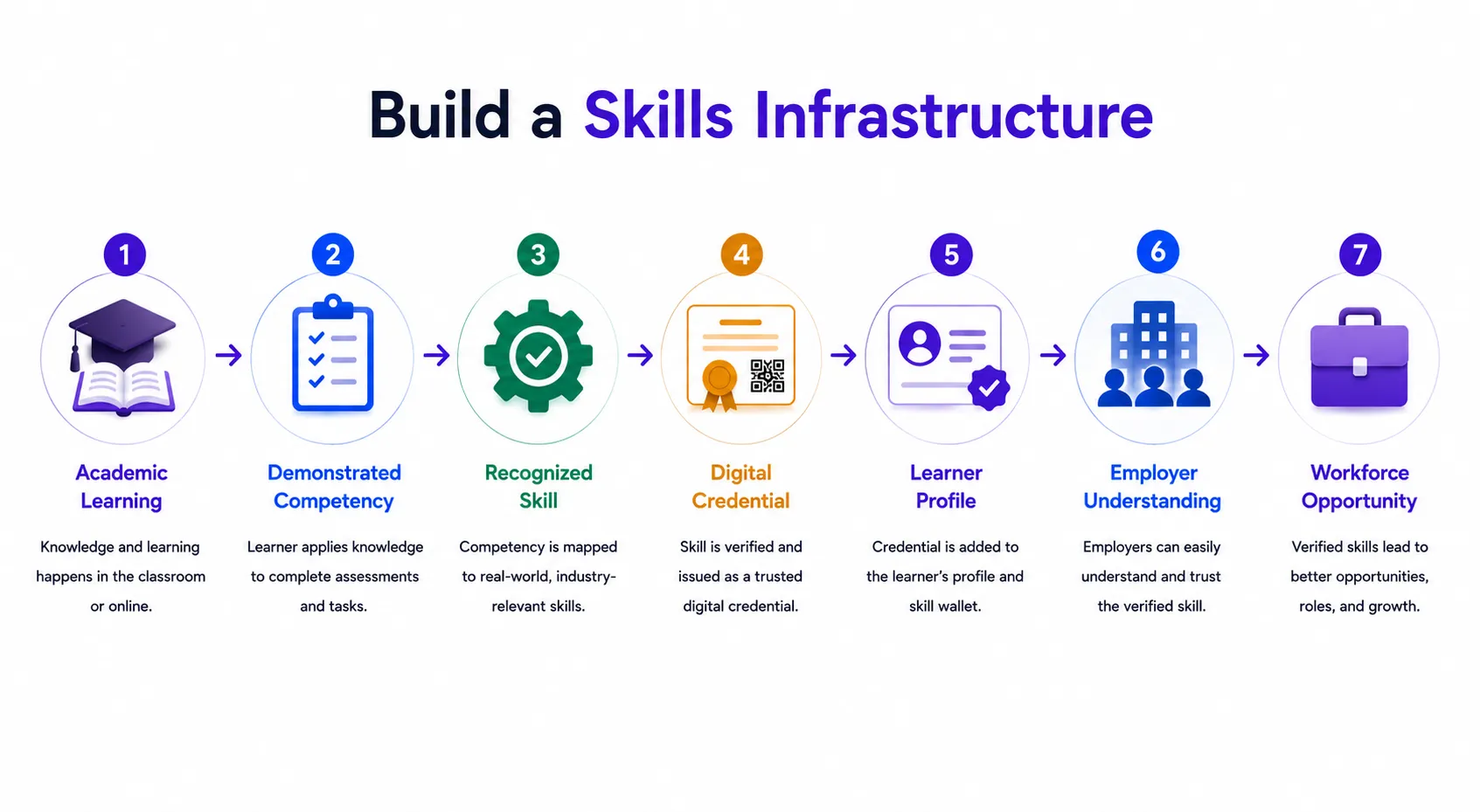
Building a Skills Infrastructure: A well-designed microcredential system connects seven critical elements. It transforms academic learning into demonstrated competency, maps competencies to recognized industry skills, issues verifiable digital credentials, adds credentials to learner profiles, helps employers understand verified skills, and ultimately creates workforce opportunities. This infrastructure approach is where microcredentials become much more than digital badges. They become a bridge between academic learning and career success.
This is where your institution becomes more than a degree-granting body. You become a skills validator and career enabler.
A Practical Blueprint for Your Own Bootcamp
If you're planning a microcredential mapping bootcamp, a useful structure is:
| Stage | Faculty Activity | Output |
|---|---|---|
| 1. Context | Understand institutional strategy | Shared understanding |
| 2. Course selection | Identify a suitable existing course | Selected course |
| 3. Curriculum mapping | Analyze outcomes and assessments | Learning map |
| 4. Competency mapping | Connect learning to skills/frameworks | Competency map |
| 5. Credential design | Define credential and criteria | Draft credential |
| 6. Evidence design | Identify proof of mastery | Evidence model |
| 7. Peer review | Critique and refine proposals | Improved proposal |
| 8. Governance | Apply institutional rubric | Submission-ready proposal |
| 9. Approval | Review board assessment | Approved credential |
| 10. Implementation | Issue and evaluate credentials | Live credential |
This structure can be adapted to different institutional contexts, whether you're building microcredentials for for-credit courses, continuing education, workforce programs, or co-curricular experiences.
The Most Important Lesson
The technology is not the hardest part.
Universities can buy credentialing software.
They can issue badges.
They can create beautiful credential designs.
But none of that answers the most important question:
What does this credential actually prove?
A successful microcredential program starts with that question and works backwards.
That's why a well-designed mapping bootcamp can be so valuable.
It brings faculty, credentialing staff, assessment experts, and governance teams into the same room and turns existing academic learning into specific, assessable, and meaningful credentials.
And ultimately, that's what makes a microcredential valuable.
Not the badge.
Not the platform.
The evidence behind the claim.
How Wauld Can Help
Running a successful microcredential mapping bootcamp requires more than just a blueprint. It requires strategic planning, expert facilitation, and institutional design.
Many universities struggle with:
- Defining clear credential taxonomies that work across departments
- Creating assessment rubrics that are both rigorous and fair
- Implementing governance processes that scale as your credential programs grow
- Ensuring consistency while allowing faculty autonomy
- Communicating credential value to employers and learners
Wauld provides consultative services to help colleges and universities design and implement microcredential bootcamp programs. We work with your team to:
- Design institutional credential taxonomies and frameworks
- Develop strategic approaches to credential governance
- Create faculty training and bootcamp curricula
- Build skills infrastructures that connect learning to employment
- Implement systems that ensure quality, consistency, and institutional credibility
Whether you're just starting your microcredential journey or looking to scale existing programs, Wauld brings expertise in credential design, assessment, governance, and learner-centered credentialing to help you build a world-class microcredential ecosystem.
Ready to issue your first credential?
Design, issue, and verify certificates and badges in minutes — free for up to 300 credentials, no credit card required.
FAQs About Microcredential Mapping Bootcamps
Q: What exactly is a microcredential mapping bootcamp?
A: It's an intensive workshop where faculty take an existing course and design a microcredential around it. Participants work through curriculum mapping, assessment design, competency alignment, and governance requirements, leaving with a proposal ready for institutional review.
Q: Does Wauld provide microcredentials?
A: Yes. Wauld is a digital credentialing platform that enables institutions to design, issue, and manage microcredentials at scale. Beyond just providing the technology, Wauld helps universities establish the frameworks, governance processes, and quality standards needed to make microcredentials meaningful and valuable. Through our platform, institutions can create beautiful, verifiable credentials that learners can share on professional profiles and employers can trust.
Q: How long should a microcredential mapping bootcamp be?
A: A two-day intensive format works well for most institutions. Day 1 focuses on strategy, frameworks, and curriculum analysis, while Day 2 emphasizes hands-on credential design, mapping, and peer review. However, some institutions extend this to three days or spread it across multiple sessions depending on their needs and faculty availability.
Q: Can a bootcamp credential program work for online or hybrid courses?
A: Absolutely. The mapping process works regardless of course delivery mode. The key is that the assessment and evidence of learning are clear and measurable, whether courses are delivered online, in-person, or in a hybrid format.
Q: What happens after the bootcamp? How do credentials actually get approved and issued?
A: After the bootcamp, proposals go through your institutional review process (often a Microcredential Review Board). Once approved, credentials are designed in your credentialing platform, and then issued to learners who meet the earning criteria. Ongoing support and periodic review ensure credentials remain relevant and valuable.