How to Develop a Training Program for Employees (Step-by-Step Guide)

There is a conversation I heard about once. A new manager was asked what the most useful training she had ever received was. Her answer was a two-hour conversation with a colleague who had held the same role for five years. No slides. No workbook. Just honest, specific guidance grounded in real experience.
That story is not an argument against structured employee training programs. It is an argument for designing them the way that conversation worked: relevant, purposeful, and built around what employees actually need. Research backs this up. Companies with comprehensive employee training programs report 218% higher income per employee than those without structured learning. The challenge is that most organizations design training around what they already have, not around what their people genuinely need to grow.
This guide walks through how to develop a training program for employees from the ground up, with clear objectives and outcomes you can measure.
Why Most Employee Training Programs Fall Short
Most corporate training programs fail before they start. They begin with a solution, a new LMS, a third-party facilitator, a library of pre-packaged courses, and then work backward to justify the purchase. Employees sit through sessions they did not ask for, covering skills they may already have, while the real gaps go unaddressed.
The result is training that produces compliance on paper but does not change behavior on the job. Developing an effective training program for employees means starting from the opposite direction: a clear, evidence-based picture of what your people cannot yet do and what the business needs them to be able to do.
Step 1: Conduct a Training Needs Assessment
A training needs assessment (TNA) is the foundation of any effective employee training program. It identifies the gap between where employees are today and where the organization needs them to be.
A thorough TNA looks at three levels:
- Organizational: What capabilities will the business need in the next 12 to 24 months? Where are the current performance gaps?
- Role-level: What competencies does each position require? Which are underdeveloped or missing?
- Individual: Where does each employee stand relative to those requirements?
Useful data sources include performance reviews, exit interview themes, direct employee surveys, and manager observations. The Association for Talent Development (ATD) recommends involving both managers and employees in the assessment process so the findings reflect real-world experience, not just top-down assumptions. This is what separates a training program that closes real gaps from one that fills a calendar.
Step 2: Define Clear Learning Objectives
Once the gaps are identified, each one becomes a specific, measurable learning objective. A good objective answers one question: what will the employee be able to do differently after this training program?
Vague objectives produce vague results. Compare "improve communication skills" with "sales team members will handle a pricing objection using a three-step framework, demonstrated in a live role-play." The second version tells you exactly what to teach and how to measure success.
Well-written learning objectives also determine your measurement strategy, which is how you justify continued investment in employee development to leadership.
Step 3: Choose the Right Training Methods
The method should match the objective. This is straightforward in principle but frequently overlooked in practice.
Some skills develop best through instructor-led practice with real-time feedback. Others suit self-paced e-learning for scalable knowledge transfer. Many durable skills come from on-the-job learning, mentoring, or structured peer coaching.
Effective employee training methods to consider:
- Instructor-led training (ILT): Strong for soft skills, leadership development, and anything that benefits from live discussion and practice
- E-learning and video courses: Scalable and consistent for compliance, product knowledge, and foundational skills
- Blended learning: Combines digital content with live facilitation for higher engagement and flexibility
- Mentoring and coaching: Most effective for professional development and building leadership capability
- Job shadowing and cross-functional exposure: Often underused, and among the fastest ways to build empathy and organizational knowledge
Step 4: Build Training Content That Sticks
With objectives confirmed and methods selected, content development begins. Adult learning research is consistent on what makes training content effective.
Keep sessions short. Learners retain more from focused, modular content than from long, unbroken sessions. Aim for 20 minute segments. Michael Allen, e-learning pioneer at Allen Interactions, recommends breaking courses into short modules, rarely requiring more than 20 minutes to complete. His microlearning approach emphasizes focused content and spaced practice.
Use real scenarios. Case studies and worked examples grounded in your actual business context make training feel immediate, not theoretical. Dave Meier, Center for Accelerated Learning, advocates authentic activities and experiences that connect learning to what employees actually need to do on the job, rather than relying on abstract instruction.
Build in practice. Passive learning must be balanced with active application through role plays, assessments, group discussions, or practical assignments that require employees to apply skills, not just receive information. Donald Kirkpatrick, Kirkpatrick Partners, recommends incorporating role-play and skill practice into training. For example, learners can rotate through coach, trainee, and observer roles to practice coaching skills.
Step 5: Deliver, Recognize, and Certify
Delivery is only part of what happens at this stage. Recognition matters just as much. Research from SHRM consistently shows that employees who receive formal acknowledgment of their learning are significantly more likely to apply new skills and continue developing over time.
When employees complete a training program, issuing a verifiable certificate does more than mark an endpoint. It creates a professional record, motivates continued engagement with learning, and strengthens your credibility as a training provider internally and externally.
Related: HR Training Certification: Build Skills That Move You Forward
Step 6: Measure Training Effectiveness
A training program that cannot demonstrate its impact will not survive the next budget cycle. The Kirkpatrick Model remains the most widely used framework for evaluating training effectiveness at four levels:
- Reaction: Did employees find the training relevant and useful?
- Learning: Did employees acquire the intended skills or knowledge?
- Behavior: Are employees applying what they learned on the job?
- Results: Has the training produced measurable business outcomes?
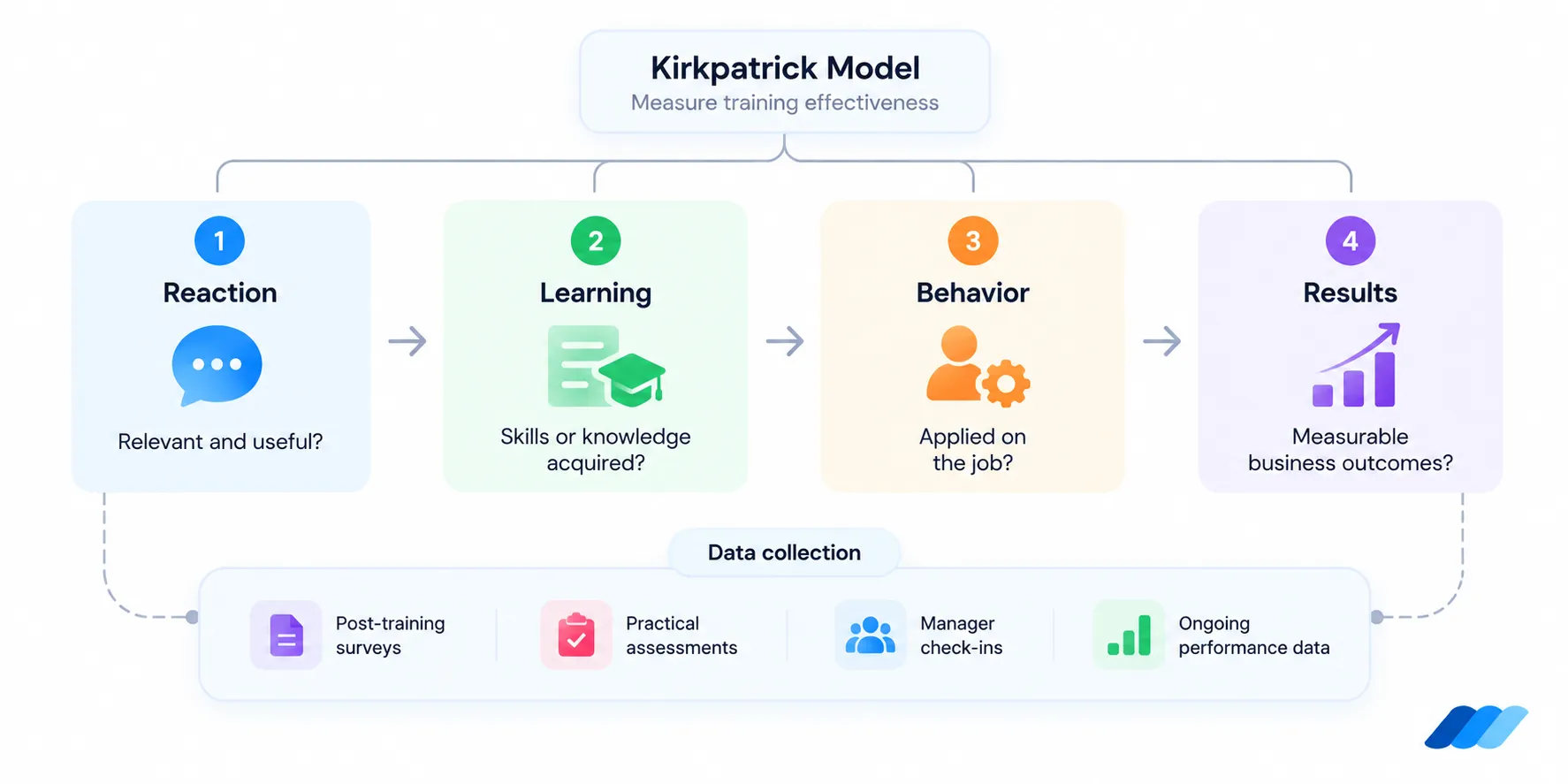
Build data collection into the program design from the beginning, not as an afterthought. Post-training surveys, practical assessments, manager check-ins at 30 and 90 days, and ongoing performance data together give you a clear picture of what is working and where future programs need to be refined.
How Wauld Completes Your Training Program
Designing an employee training program is one challenge. Recognizing and certifying learners at scale is another, especially when teams are distributed or multiple cohorts run in parallel.
Wauld is a digital credentialing platform built for this. Training leaders use Wauld to issue professionally designed, verifiable certificates and badges for every program type, from onboarding and compliance training to leadership development and professional upskilling.
Key capabilities:
- Over 1,200+ certificate templates fully customizable with your organization's branding, available in the certificate builder
- Bulk issuance from a CSV file so you can certify an entire cohort in minutes
- Automated certificate delivery connected to your LMS via API or webhook
- A centralized dashboard to track who holds which credential and when it was issued
- One-click LinkedIn sharing so employees can showcase their growth publicly
For organizations that take employee development seriously, the credential at the end of a program is not a formality. It is proof of progress. Start issuing verifiable employee training certificates with Wauld today.
FAQs on developing a training program
What is the first step in developing a training program for employees? The first step is conducting a training needs assessment. Before designing content or choosing delivery methods, identify the gap between current employee performance and what the organization requires. Without this foundation, you risk building training that does not address the actual problem.
How long does it take to develop an employee training program? It depends on scope. A single focused training module can take two to four weeks to design, build, and pilot. A comprehensive onboarding or leadership development program may take three to six months. The needs assessment and learning objective phase is where the most meaningful planning time should go.
What are the most effective training methods for employees? The most effective method depends on the objective. Instructor-led training works well for soft skills and anything requiring practice with feedback. E-learning suits scalable knowledge transfer for compliance and product training. Blended learning often produces the strongest outcomes. Mentoring and job shadowing are most effective for leadership and cross-functional development.
How do you measure the success of an employee training program? Use the Kirkpatrick Model as your measurement framework. Evaluate learner reaction, learning outcomes, on-the-job behavior change, and business results. Build your measurement approach into the program design from the start rather than adding it as an afterthought at the end.
How do you keep employees engaged during training? Keep content modular and focused (15 to 30 minute sessions), use real business scenarios, and balance passive learning with active practice. Recognition also drives engagement significantly. Employees who receive a verifiable certificate or badge on completion are more motivated to take training seriously and participate in future programs. Related: How to Re-Engage Learners and Increase Student Engagement
How do I issue certificates for completed employee training? Wauld makes this straightforward. Upload a CSV of completions, customize a certificate template with your branding, and issue credentials in bulk in minutes. Each certificate includes a unique QR code for instant verification and can be shared directly to LinkedIn. You can also automate delivery by connecting Wauld to your LMS via API or webhook. Start with a free Wauld account.
What is the difference between an employee training program and a development program? Training programs address specific skill gaps tied to a current role or immediate performance need. Development programs are broader and forward-looking, building competencies that prepare employees for future roles and greater responsibility. Effective organizations combine both: targeted training for today's gaps and structured development for tomorrow's requirements.