ESA Certification: What It Is and How to Get It

"ESA certification" is one of the most searched, most misunderstood phrases in the emotional support animal world, largely because the thing it describes does not exist the way the marketing implies. This guide untangles it in two parts: what ESA certification actually is (and is not), and how to get the one document that genuinely matters, including what changed in federal policy in 2026.
What Is ESA Certification? The Short Answer
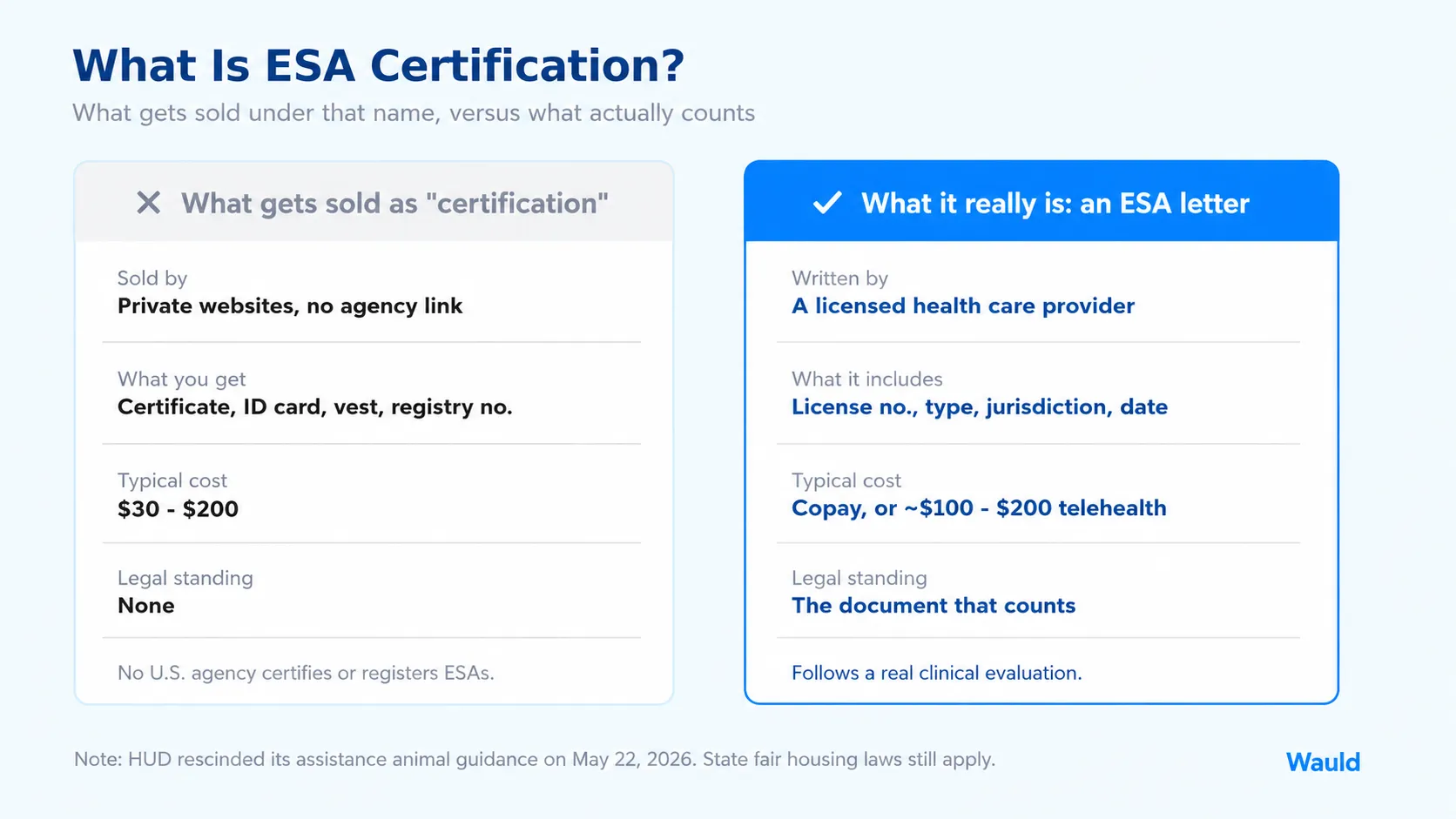
If you came here looking for an official body that issues ESA certification, here is the honest answer: it does not exist. There is no federal registry, no national database, and no government agency that certifies emotional support animals in the United States.
What does exist is an ESA letter. That is a written recommendation from a licensed health care professional saying you have a disability and that an animal helps with it. When people say "ESA certification," this letter is the only thing they could reasonably mean. Everything else sold under that name is a novelty product.
This guide answers both halves of that question. First, what ESA certification is: what an emotional support animal actually is, why the certification industry exists, and what changed in federal policy in 2026. Then, how to get it: the real process, what your letter must include, what it should cost, and the mistakes to avoid. By the end you should not need to search again.
What an Emotional Support Animal Actually Is
An emotional support animal, or ESA, is an animal whose presence helps someone manage a disability. Think anxiety, depression, PTSD, or another condition diagnosed by a clinician. The animal provides comfort simply by being there. It does not need training, and it does not need to be a dog.
That last point matters, because it is exactly what separates an ESA from a service animal.
Under the Americans with Disabilities Act, a service animal is a dog individually trained to perform a task tied to a person's disability. Guiding someone who is blind. Alerting to a seizure. Interrupting a panic attack with a specific trained behavior. As the Department of Justice puts it plainly, if the dog's mere presence provides comfort, it is not a service animal.
ESA vs. Service Animal vs. Therapy Animal
| Feature | Emotional Support Animal | Service Animal | Therapy Animal |
|---|---|---|---|
| Training required | No | Yes, individually trained tasks | Basic obedience plus handler certification |
| Species | Any | Dogs (miniature horses in limited cases) | Usually dogs |
| Public access rights | No | Yes, under the ADA | Only where invited |
| Documentation | Letter from a licensed provider | None required | Program registration through a therapy organization |
| Who it helps | Its owner | Its handler | Other people (hospitals, schools, care homes) |
Read that table once and a lot of the confusion online disappears. Most "ESA certification" marketing works by blurring the first two columns.
What "ESA Certification" Websites Actually Sell
Search the term and you will find dozens of sites offering instant ESA certification, registration numbers, ID cards, vests, and framed certificates. Some charge $50. Some charge $200. Many promise approval in minutes.
Here is the problem. These are private companies. Their databases are not connected to any government agency, and no landlord is required to recognize them. A registration number from a private site proves only that you paid a private site.
California went so far as to legislate on this. Under AB 468, any business selling a certificate, ID tag, vest, leash, or harness for an emotional support animal must hand the buyer a written notice, in 12-point bold type, stating that the item does not grant the animal any of the rights given to a service dog. That requirement exists because so many people were sold the opposite impression.
The Department of Justice is equally direct about service dogs: they are not required to be certified, registered, or to wear a vest. If certification is not required for a trained service dog, it was never going to be required for an untrained ESA.
A common mistake
Sarah rents a small apartment in Sacramento and has been in treatment for generalized anxiety for two years. When her building announced a no-pets rule, she panicked and paid $89 for an "ESA certification kit" she found through an ad. It arrived in three days: a glossy certificate, a registry number, and a blue vest for her cat.
Her property manager asked one question she could not answer. Who is the licensed provider that evaluated you?
Sarah brought it up at her next therapy appointment. Her therapist, who had been treating her for two years, wrote a one-page letter on letterhead with her license number and jurisdiction. It cost nothing extra. The accommodation was approved that week. The $89 kit stayed in a drawer.
Her mistake is the most common one in this whole category. She bought the artifact instead of the assessment.
A real story
Consider Ashley, who shared her experience with Pettable. She describes herself as a high-functioning, type-A overthinker living with anxiety and mild depression, and two panic attacks were what finally pushed her to seek help. Around the same time, she adopted Maui, a Chihuahua-Dachshund mix whose previous owner had passed away. The problem: her apartment capped tenants at two pets, and she already had two dogs. Maui made three.
Desperate to keep him, she applied to an ESA provider and was turned away. In her words, "I was told I wasn't 'ill enough' to qualify because I'm high functioning." The rejection hit exactly the nerve she was trying to protect: "I immediately started crying. The dread and panic came back. My heart was breaking."
On her wife's suggestion she tried again, this time completing a real clinical questionnaire that was reviewed by a licensed provider. She was approved and received a legitimate ESA letter. Her takeaway cuts to the heart of the whole category: "Even though I may be high functioning, I'm still struggling."
Ashley's story is a useful reminder of two things. A valid ESA letter rests on a genuine clinical evaluation, not on how visibly "ill" you look, and the document that does real work is the one a licensed provider stands behind, not a certificate you buy off a shelf.
What Changed in 2026, and Why It Matters
This is the part most ESA certification pages have not caught up on, so read it carefully.
For over a decade, HUD guidance told housing providers that untrained emotional support animals were assistance animals, not pets, and that pet fees generally could not be charged for them. On May 22, 2026, HUD's Office of Fair Housing and Equal Opportunity permanently rescinded that guidance and adopted a new enforcement standard, as Holland & Knight summarized.
Under the new posture:
- HUD will find reasonable cause only for trained animals. The animal must be individually trained to do work or perform tasks tied to your specific disability.
- Untrained ESA requests are no longer presumptively reasonable. Housing providers are no longer expected to categorically waive pet policies or fees.
- Species is not the limit; training is. Unlike the ADA, HUD's new standard still allows animals other than dogs, as long as the animal is trained.
- Open cases are being reviewed one by one under the new standard.
What did not change
Plenty, actually. The Disability Rights Education & Defense Fund lays this out well:
- The Fair Housing Act itself is unchanged. Congress did not amend it, and the statute contains no training requirement.
- You can still sue. HUD deciding not to pursue your complaint is not the end of the road. The Fair Housing Act lets you take a housing provider to court yourself, separately from any HUD action. That private right of action survives the 2026 change, and you generally have up to two years from the discriminatory act to file. In practice this means that even when HUD declines a case involving an untrained ESA, a court may still rule in your favor under the statute.
- Section 504 of the Rehabilitation Act is untouched. That matters for public and federally assisted housing.
- State and local law is untouched. California's Fair Employment and Housing Act protects assistance animals without a training requirement, and it is enforced by the state Civil Rights Department, not HUD.
So the practical takeaway is this. A federal complaint is a weaker path than it was a year ago. Your state law, your documentation, and a private claim are now doing the heavy lifting.
How to Get ESA Certification: The Real Process
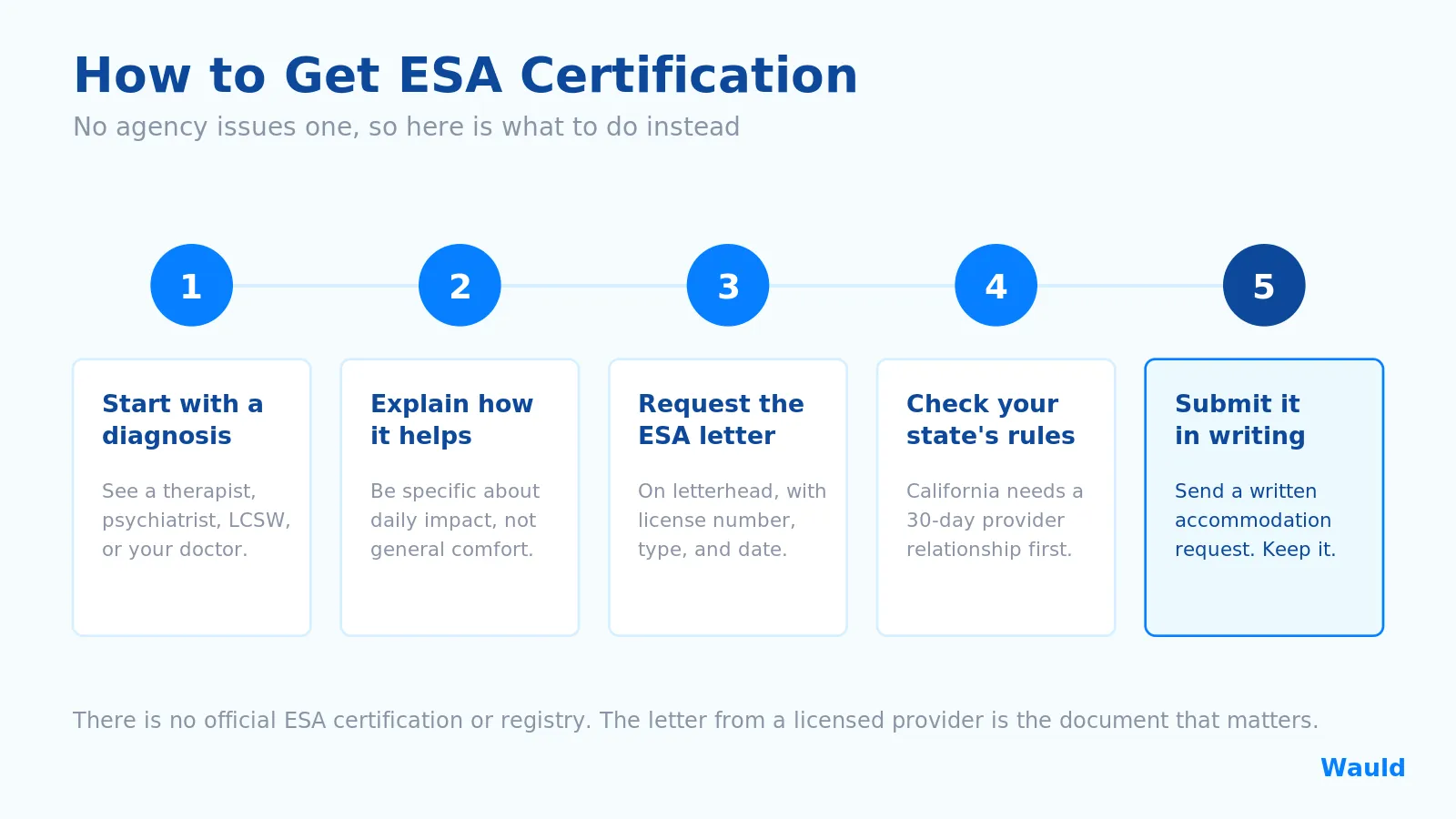
Now the second half of the question. Since no agency issues ESA certification, "getting certified" means one thing in practice: getting a valid ESA letter from a licensed provider. Skip the certification products. This is the actual process.
- 1
Start with a real diagnosis.
An ESA letter documents a disability. If you are already seeing a therapist, psychologist, psychiatrist, primary care doctor, or licensed clinical social worker, start there.
- 2
Have the conversation.
Explain how the animal helps. Be specific. "She wakes me during nightmares and gets me out of bed on bad mornings" is far more useful than "he calms me down."
- 3
Ask for a written recommendation.
Most providers know the format. If yours does not, share what the letter needs to include (next section).
- 4
Check your state's rules.
California requires the provider to hold a valid active license and to have had a client-provider relationship with you for at least 30 days before writing the letter. Other states have their own wrinkles.
- 5
Submit it as a reasonable accommodation request, in writing.
Email is fine. Keep a copy. Ask for the response in writing too. Documentation is your best asset if there is ever a dispute.
If you do not have a provider, telehealth is legitimate, as long as the clinician is licensed in your state and actually evaluates you. What is not legitimate is a two-minute web form with a guaranteed approval.
What Your ESA Letter Must Include
| Element | Why it matters |
|---|---|
| Provider's letterhead and signature | Shows a real practice stands behind it |
| License type, number, and jurisdiction | Lets anyone confirm the provider is licensed |
| Effective date | Many housing providers ask for a letter under 12 months old |
| Statement that you have a disability | No need to name the diagnosis |
| Statement that the animal helps with it | This is the core of the recommendation |
| Provider contact details | Allows verification |
Notice what is missing: a registry number, a photo ID, and a certificate. None of those belong on the list.
What ESA Certification Should Cost
| What you are paying for | Typical range | Worth it? |
|---|---|---|
| Appointment with your existing provider | Often covered by insurance or a standard copay | Yes |
| Telehealth evaluation with a licensed clinician | Roughly $100 to $200 | Usually |
| "ESA certification" or registry listing | $30 to $200 | No |
| ID card, vest, tag, framed certificate | $20 to $100 | Optional novelty only |
The rule of thumb is simple. If you are paying for clinical time, the money is doing something. If you are paying for a printed object, it is not.
Common Mistakes to Avoid
- Buying certification before seeing a provider. The evaluation is the product. Everything else is packaging.
- Calling your ESA a service animal. In California this can trigger civil penalties of up to $2,500 for repeat violations, and it makes life harder for people with trained service dogs.
- Assuming ESA rules apply on flights. They do not. The Department of Transportation's 2020 final rule, effective January 11, 2021, limits in-cabin access to trained service dogs.
- Letting the letter go stale. Refresh it annually if you are likely to move.
- Making the request verbally. Put it in writing and keep the thread.
- Ignoring state law. Since the 2026 federal shift, your state's fair housing law may be your strongest protection.
What Real Verification Looks Like
There is a broader lesson buried in the ESA certification industry. A document only means something when someone credible stands behind it and anyone can check it.
That is the difference between a printable certificate and a genuine credential. Real credentials have a named issuer, a record that can be looked up, and a verification link that does not depend on trusting the holder's word. Training providers and professional bodies use platforms like Wauld to design and issue verifiable digital certificates and digital badges that anyone can check in one click.
Emotional support animals are not credentialed that way, and they should not be. But if you run a training program, an animal-assisted therapy course, or a professional development track, the contrast is worth sitting with. Verifiable beats decorative every time.
How to Get ESA Certification: The Five Steps at a Glance
Conclusion
So, what is ESA certification and how do you get it? The short answer to both: certification in the way it is advertised is not real, and the way you "get" it is by getting a letter instead. No agency grants it, no registry confers it, and no landlord is obligated to honor a purchased one. The document that matters is a letter from a licensed provider who has evaluated you, and the protection that matters increasingly comes from your state rather than from HUD.
The 2026 federal shift makes preparation more important, not less. Get a real evaluation. Keep your letter current. Put every request in writing. Learn your state's rules, because after May 2026 they may be the strongest thing standing behind you.
And if you are on the other side of this, building programs and issuing credentials of your own, take the lesson from the ESA certification industry. Make the thing verifiable, or it does not count.
Design and issue credentials that verify in one click
Create a free Wauld account and start building certificates and badges people can trust, using 1000+ ready-made templates.
FAQs on ESA Certification
Is ESA certification a real thing? No. There is no official ESA certification, registration, or license in the United States. No federal or state agency certifies emotional support animals. The only document with real standing is an ESA letter written by a licensed health care professional who has evaluated you.
How do I get ESA certification? In practice, you get an ESA letter instead. Talk to a licensed provider who knows your situation, whether that is a therapist, psychiatrist, psychologist, licensed clinical social worker, or your doctor. Explain how the animal helps with your condition and ask for a written recommendation on letterhead including their license number, license type, jurisdiction, and the date.
How much does an ESA letter cost? If you already see a provider, it may cost nothing beyond a normal appointment. A telehealth evaluation with a licensed clinician typically runs about $100 to $200. Be cautious with any site charging under $50 with instant approval, since that usually means no real evaluation took place.
Do landlords still have to accept ESA letters in 2026? The federal answer changed. On May 22, 2026, HUD rescinded its assistance animal guidance and now pursues complaints only where the animal is individually trained for a disability-related task. However, the Fair Housing Act still allows private lawsuits, and many state laws, including California's Fair Employment and Housing Act, protect untrained assistance animals independently of HUD.
Can I fly with my emotional support animal? Not as an ESA. The Department of Transportation's rule effective January 11, 2021 limits in-cabin animal access to trained service dogs, so airlines may treat emotional support animals as ordinary pets and charge standard pet fees. A trained psychiatric service dog is treated differently.
What is the difference between an ESA and a psychiatric service dog? Training. A psychiatric service dog is individually trained to perform a specific task, such as interrupting dissociation, retrieving medication, or applying deep pressure during a panic attack. An ESA provides comfort through presence alone. Under both the ADA and HUD's 2026 standard, that training distinction is what determines access rights.
Do ESA vests and ID cards do anything? No. They carry no legal weight for emotional support animals, and they are not required for service dogs either. California law requires sellers of these items to disclose that in writing. They may help start a conversation with a neighbor, but they change nothing legally.
This article is general information, not legal advice. ESA rules vary by state and are changing quickly. For your specific situation, consult a fair housing organization, a disability rights group, or an attorney.