Certificate of Achievement vs Completion vs Attainment

Same Paper, Very Different Meaning
Picture three learners from your latest workshop. All three walk away with a certificate. One sat through every session. One passed your final assessment. One topped the class. On paper, the certificates look almost identical. To an employer, a client, or a professional body, they say three very different things.
That's why the certificate of achievement vs certificate of completion question matters more than it seems. The title at the top of the page tells the reader what the learner actually did. Pick the wrong one, and you either undersell your learners or promise more than they earned.
In this guide, we'll walk through what each certificate means, where a certificate of attainment fits in, and a simple way to decide which one to issue for your next course, coaching program, or workshop.
What Is a Certificate of Completion?
A certificate of completion confirms that someone finished a course or program. It tells the reader the learner stuck with it from start to finish, whether that meant watching every module, attending every session, or turning in every required task.
What it usually doesn't confirm is how well they did. Many completion certificates are issued without a final test. For longer programs, some providers award one to participants who meet a minimum attendance rate.
That doesn't make it any less useful. A certificate of completion works well for:
- Self-paced online courses, where finishing is the main goal
- Onboarding and compliance training that staff simply need to complete
- Short coaching programs, where the value lies in the sessions themselves rather than a final score
Just keep the wording honest. If there was no assessment, skip phrases like "has demonstrated mastery of" and stick to "has successfully completed."
What Is a Certificate of Achievement?
A certificate of achievement recognizes performance. Instead of saying "this person finished," it says "this person did something worth noting," like passing an exam with a strong score, completing a tough challenge, or standing out in a cohort.
The exact meaning can shift depending on where you are. At many US community colleges, it is a formal credential. At Porterville College, for example, a certificate of achievement is a credit certificate that can appear by name on a student's transcript and covers at least 12 units of coursework. In coaching and corporate training, people use the term more loosely to celebrate excellence or a milestone.
A certificate of achievement is a great fit when you want to:
- Reward top performers, such as the highest scorer in a sales training cohort
- Mark a milestone, like a client hitting a 90-day fitness goal
- Recognize a passed assessment in programs where you grade the work
Because "achievement" signals effort beyond showing up, it carries more weight. That's also why it shouldn't be handed out by default.
Where a Certificate of Attainment Fits
A certificate of attainment sits between completion and achievement. It confirms that a learner met a specific standard or set of learning outcomes, usually after an assessment. The focus is on what they can now do, not how they ranked against others.
You'll often see it in professional training. Graduates who pass Exemplar Global recognized auditor courses, for instance, receive a certificate of attainment they can use as evidence when applying for personnel certification. In Australia, a similar document called a statement of attainment lists the units of competency a student completed within a nationally recognized course.
There's one more cousin worth knowing: the certificate of attendance, also called a certificate of participation. It simply confirms that someone was present, without any assessment of what they learned.
The Four Certificate Types Compared
Here's how all four certificate types compare side by side, so you can see exactly what each one tells the reader.
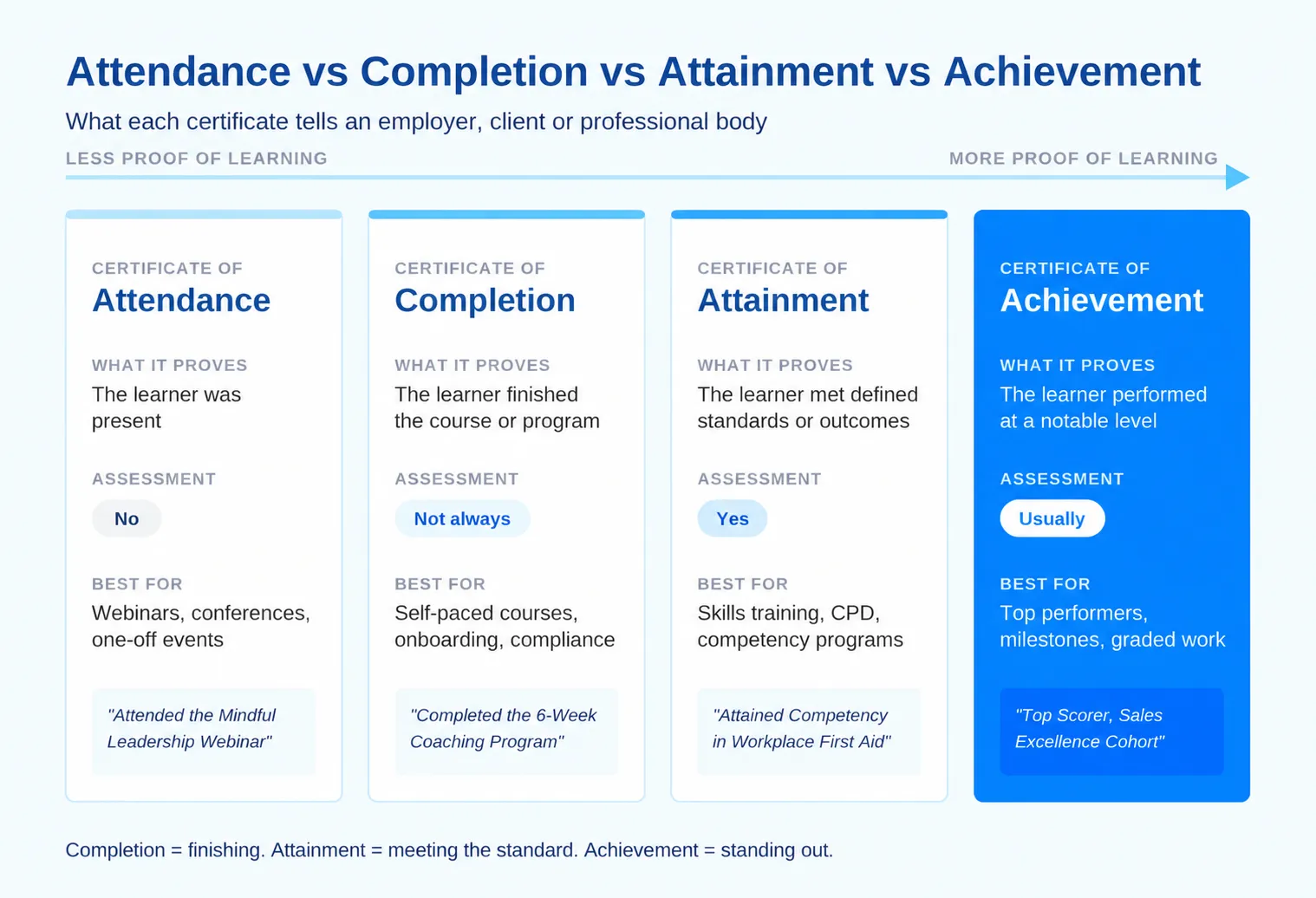
| Certificate type | What it proves | Assessment needed? | Best for | Example title |
|---|---|---|---|---|
| Attendance or participation | The learner was present | No | Webinars, conferences, one-off events | Attended the Mindful Leadership Webinar |
| Completion | The learner finished the course or program | Not always | Self-paced courses, onboarding, compliance training | Completed the 6-Week Confidence Coaching Program |
| Attainment | The learner met defined standards or outcomes | Yes | Skills-based training, CPD, competency programs | Attained Competency in Workplace First Aid |
| Achievement | The learner performed at a notable level | Usually | Top performers, milestones, graded programs | Top Scorer, Sales Excellence Cohort |
The easiest way to remember it: completion is about finishing, attainment is about meeting the standard, and achievement is about standing out.
A single course can also offer more than one. You might give every finisher a certificate of completion and save a certificate of achievement for your top three learners. Both are honest, and both mean something.
How to Pick the Right One
Still not sure which title to use? Ask yourself three quick questions.
- Did you assess the learner? If not, stick with attendance or completion. If you did, attainment or achievement is fair game.
- Will they show it to someone who needs proof? Employers, clients, and professional bodies care about outcomes. A certificate of attainment that lists the skills or units met gives them something concrete to go on.
- Are you recognizing the many or the few? Everyone who meets the standard earns attainment. Achievement is for the learners who go beyond it.
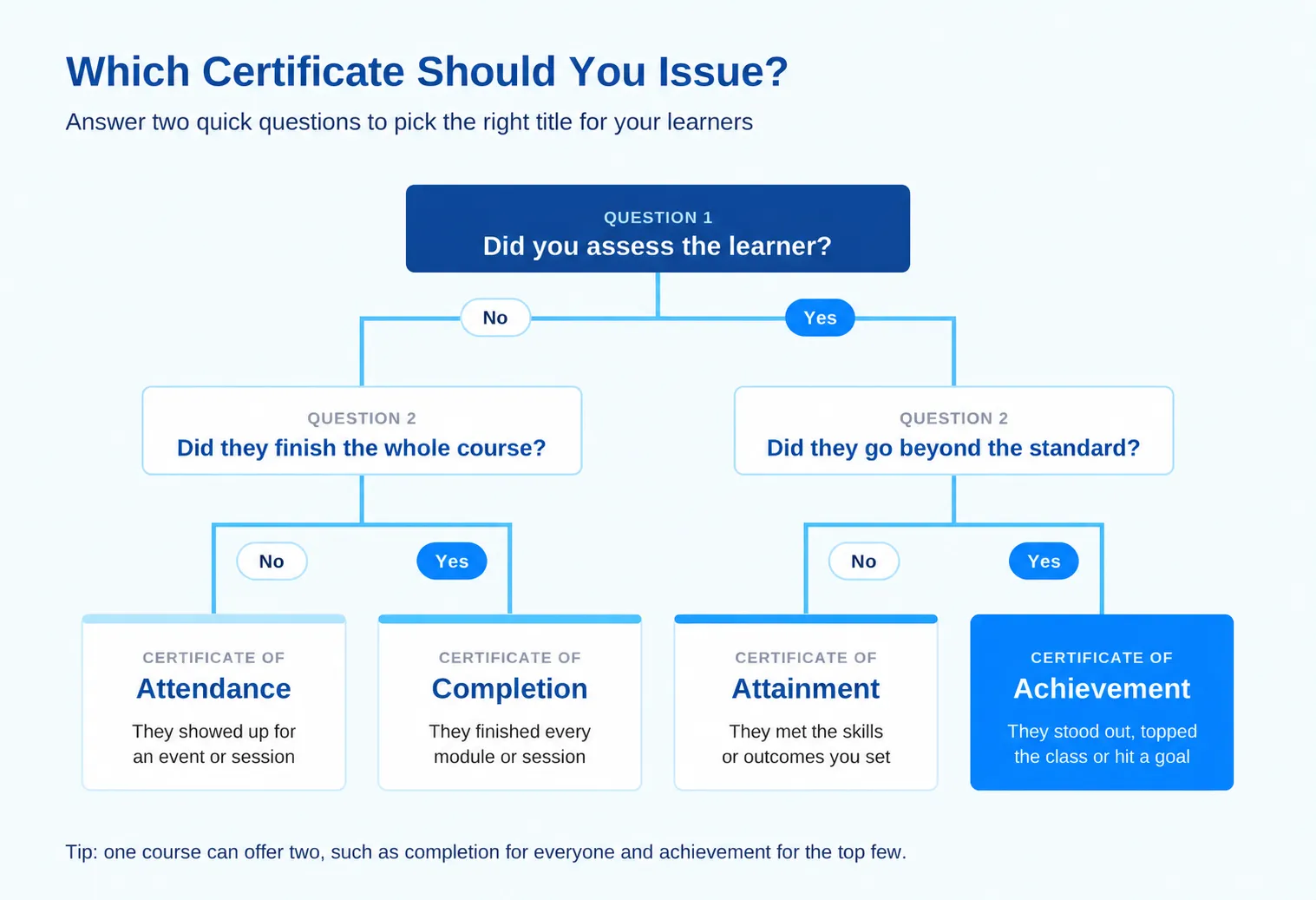
Here's how that plays out in real life:
- A life coach running a six-week mindset program with no final test issues a certificate of completion.
- A corporate trainer delivering a cybersecurity course with a pass mark issues a certificate of attainment that names the topics covered and the assessment date.
- A fitness instructor whose client hits a strength goal issues a certificate of achievement to celebrate the milestone.
If you want your certificates to carry real weight with employers, it helps to tie them to skills the industry actually values. Our guide on how to create industry-aligned credentials walks you through it step by step.
Make Every Certificate Easy to Verify
Whichever title you choose, a certificate only helps your learner if other people can trust it. A PDF that anyone can edit doesn't count for much on a LinkedIn profile or in a job application.
That's where digital credentials help. With Wauld, you can pick from 1200+ certificate and badge templates, add your own branding, and issue certificates to a whole cohort at once. Every certificate gets a unique verification link, so an employer or client can confirm it's genuine in seconds. You can also see who opened, downloaded, and shared their certificate.
Need some design inspiration first? Browse these 20 certificate design ideas for online course completion. Once your certificates are out in the world, these 8 ways to get more learners to share their credentials online will help them reach more people.
Choose the Certificate That Fits
The title on a certificate is a small detail that does a lot of work. A certificate of completion says your learner showed up and finished. A certificate of attainment says they met the standard. A certificate of achievement says they went further. When the title matches what really happened, your learners get proof they can share with confidence, and your programs earn a reputation for meaning what they say.
Issue certificates that mean what they say
Pick your certificate type, choose a template, and send verifiable certificates to your whole cohort in minutes.
FAQs on Certificate Types
Is a certificate of completion the same as a certificate of achievement?
No. A certificate of completion confirms that someone finished a course. A certificate of achievement recognizes how well they performed, such as passing an assessment or reaching a milestone.
Which looks better on a resume, a certificate of completion or achievement?
A certificate of achievement or attainment usually carries more weight because it points to a result, not just participation. A completion certificate from a respected program is still worth listing, especially when it can be verified online.
Can one course offer more than one certificate type?
Yes. Many trainers give every finisher a certificate of completion and reserve a certificate of achievement for top performers. Just make the criteria for each one clear before the course starts.
Is a certificate of completion the same as a diploma?
No. A diploma is usually awarded for finishing a full academic program, like high school or a college course of study. A certificate of completion covers a shorter course, workshop, or training program.
What is a certificate of participation?
A certificate of participation, also called a certificate of attendance, confirms that someone took part in an event or session. It does not confirm that any learning was assessed.