Alternative Credentials: Types, Examples & Why They Matter (2026)

Last updated: October 2026
The job market has fundamentally changed. Alternative credentials are now transforming how skills are recognized and valued, offering a faster, more affordable path to career advancement than traditional degrees. Alternative credentials are verifiable, non-degree proofs of skills, such as digital badges, micro-credentials, and certifications. Instead of waiting years for a four-year degree, professionals can earn recognized credentials in weeks or months - and employers increasingly prefer candidates who can prove specific skills through these credentials rather than relying solely on degrees.
What Are Alternative Credentials?
Alternative credentials are formal proof of competency that exist outside the traditional degree system. Unlike a bachelor's degree that takes years to complete, alternative credentials - also called non-degree credentials or digital credentials - can be earned quickly in weeks or months and focus on specific, measurable skills. They include digital badges, micro-credentials, professional certifications, and competency-based credentials, each proving what someone can actually do rather than time spent in classroom learning.
Types of Alternative Credentials
- Digital Badges: Visual symbols representing achievements or skills. Shareable, verifiable, and recognized as legitimate proof of capability.
- Micro-credentials: Short, focused credentials proving mastery in narrow skill areas - stepping stones toward larger qualifications.
- Professional Certifications: Industry-recognized credentials from Google, AWS, Salesforce, and MIT MicroMasters, validated by industry experts.
- Bootcamp Certificates: Intensive training programs producing recognized certificates in coding, data science, and UX design.
- Competency-Based Credentials: Awards proving mastery of specific competencies - focused on "what you can do."
- Prior Learning Assessments (PLA): Formal recognition of knowledge gained through work experience, self-study, or informal training.
Stackable Credentials: Building Qualifications Step by Step
Stackable credentials allow learners to combine micro-credentials and individual digital credentials into a complete qualification pathway. For example, a learner might earn three micro-credentials in cloud computing fundamentals, AWS architecture, and DevOps practices - each recognized individually by employers - and have them stack toward an advanced cloud engineering certificate or professional credential. This approach provides flexibility: learners earn recognized value immediately with each micro-credential while building toward larger goals. Stackable credentials are particularly valuable for working professionals and career changers who need to demonstrate skill progression without pursuing a full degree program.
Verifiable Credentials and Open Badges
Verifiable credentials use cryptographic standards (like the Open Badges standard) to ensure their authenticity and prevent fraud. These digital credentials can be verified immediately without contacting the issuer. Open Badges standard verification includes cryptographic metadata about the earner, issuer, achievement, and evidence, making them trustworthy proof of skill. Verifiable credentials are essential as alternative credentials and digital credentials become more prevalent in hiring - employers need cryptographic assurance that a credential is genuine and hasn't been tampered with. When issuing digital credentials, always use the Open Badges standard to maximize employer confidence and credential portability.
Prior Learning Assessment: Recognizing Experience and Self-Study
Prior learning assessment (PLA) formally recognizes knowledge gained outside traditional classroom settings - through work experience, self-directed study, professional practice, and life experience. Instead of requiring learners to repeat training for skills they already possess, prior learning assessment allows them to demonstrate mastery through portfolios, projects, exams, or interviews and earn credit or alternative credentials. PLA is one of the most cost-effective alternative credentials because it acknowledges existing expertise without redundant training. This makes credentials more inclusive and accessible, particularly for career changers and working professionals who've developed relevant expertise outside formal training. Many universities and employers now accept prior learning assessments as equivalent to coursework when issuing micro-credentials or competency-based credentials.
Alternative Credentials vs. Traditional Degrees: A Comparison
When comparing alternative credentials vs. traditional degrees, the choice depends on your career timeline, budget, and learning style. Here's how alternative credentials stack up:
| Aspect | Alternative Credentials | Traditional Degrees |
|---|---|---|
| Time to completion | Weeks to months (micro-credentials: 2-8 weeks) | 2-4+ years |
| Cost | $100-$5,000 per credential | $20,000-$100,000+ |
| Focus | Specific, job-ready skills | Broad foundational knowledge |
| Flexibility | Online, self-paced, stackable | Fixed cohorts and schedules |
| Employer recognition | Growing; some employers prefer proven skills | Well-established; required for some roles |
| Career path | Specialized technical or niche roles | Broader entry options across industries |
| Prerequisites | Often none; sometimes experience-based | High school diploma required |
The truth? Alternative credentials vs. degrees isn't either/or. Many successful professionals combine traditional degrees with alternative credentials (micro-credentials, digital badges, professional certifications), creating a diverse portfolio of learning and achievement that demonstrates both breadth and specialized skill mastery.
Why Alternative Credentials Matter for Skills-Based Hiring
- 1
Speed and Affordability
Traditional degrees require significant time and financial investment. Alternative credentials can be earned in a fraction of the time for a fraction of the cost. Someone can earn a professional certification in 3-6 months for under $1,000, compared to $50,000+ for a bachelor's degree.
- 2
Skills-Based Hiring
The World Economic Forum's Future of Jobs Report shows employers increasingly prioritize skills over degrees. Alternative credentials directly demonstrate those skills, making candidates more attractive to employers.
- 3
Continuous Learning Culture
The shelf life of knowledge has shrunk dramatically. What you learned five years ago may be obsolete today. Alternative credentials enable continuous upskilling and reskilling throughout a career, not just once at the beginning.
- 4
Career Mobility
Alternative credentials create clearer pathways for career transitions. Someone from a non-technical background can earn a bootcamp certificate and pivot into tech. A customer service specialist can earn micro-credentials in leadership and move into management.
- 5
Inclusivity
Alternative credentials make credentials accessible to people who can't pursue traditional degrees due to cost, family obligations, or geographic constraints. They democratize access to career advancement.
By the Numbers: The Market Boom in Alternative Credentials
The alternative credentials market is experiencing explosive growth, signaling a fundamental shift in how skills are recognized and valued globally.
Market Size and Projections
According to Fortune Business Insights, the global alternative credentials market was valued at USD 18.83 billion in 2025 and is projected to reach USD 69.88 billion by 2034, representing a compound annual growth rate (CAGR) of 18.60%.
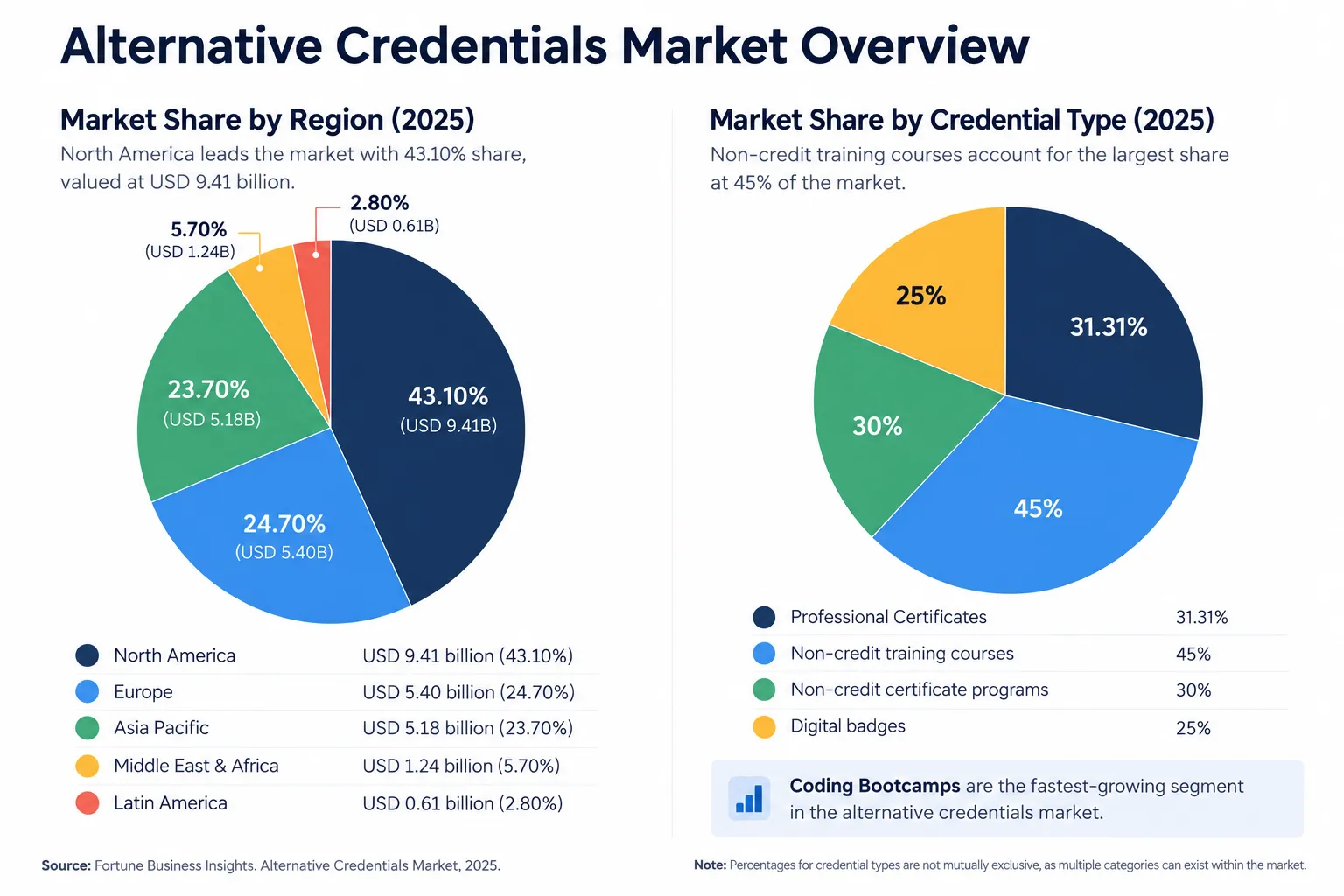
Global alternative credentials market overview: North America leads with 43.10% share, while non-credit training courses dominate the credential type market at 45% share.
How Organizations Are Using Alternative Credentials
- Employee Development: Companies use certifications and badges as part of professional development, encouraging continuous skill improvement.
- Recruitment and Talent Assessment: Progressive employers screen for credentials to identify candidates with proven, relevant skills.
- Internal Recognition: Organizations create credential systems with digital badges to motivate engagement and build learning cultures.
- Training Program Completion: Bootcamps and online platforms issue credentials as proof of mastery, often leading directly to employment.
- Apprenticeship Recognition: Programs combine work experience with formal credential recognition for hybrid learning pathways.
Challenges and Considerations
- 1
Credibility Concerns
Not all alternative credentials carry equal weight. A badge from a well-known platform like Coursera or LinkedIn Learning is widely respected. A certificate from an unknown source might not impress employers. The key is seeking credentials from recognized, industry-aligned providers.
- 2
Oversaturation
As more people earn credentials, the market may become saturated. To stand out, focus on credentials that are truly relevant to your career goals and in demand by employers.
- 3
Employer Education
Many traditional employers still prioritize degrees. Change is happening, but it's gradual. Alternative credentials work best when combined with a strong professional record and demonstrated results.
- 4
Verification and Standards
The lack of unified standards for alternative credentials means employers can't always verify legitimacy. Look for credentials that use standards like the Open Badges standard, which includes cryptographic verification.
Alternative Credentials in Higher Education
Universities are increasingly integrating micro-credentials, digital badges, stackable certificates, and prior learning assessments into their offerings to complement traditional degrees. This shift reflects growing demand for competency-based education, flexible pathways, and demonstrated skills.
Who Sets Standards for Alternative Credentials? UPCEA, OECD and Universities
Recognizing the transformative potential of alternative credentials, leading educational and professional organizations have established formal structures to guide their development and implementation:
UPCEA's Council for Credential Innovation and Alternative Credentials Network
The University Professional and Continuing Education Association (UPCEA) has taken a leadership role by establishing two complementary bodies in 2021:
Council for Credential Innovation: A strategic body comprising senior institutional leaders and thought leaders from nonprofit and corporate partners, this council focuses on "leveraging the strategic potential of non-degree credentials and non-credit education" to transform higher education and the talent marketplace. Each UPCEA member institution can designate a representative to participate in this influential body.
Alternative Credentials Network: A practice-focused community open to all UPCEA members, emphasizing the exchange of best practices and emerging trends. The Network concentrates on "innovative and entrepreneurial programs to serve the needs of diverse learners" through non-degree or non-credit credentials.
Foundation for Quality Frameworks
These initiatives build upon proven research, including UPCEA's "Hallmarks of Excellence in Credential Innovation," a quality framework for non-degree credentials, and the benchmark study "Shifting Paradigms," which demonstrated how alternative credentials help institutions "align higher education programming with the needs of learners and the labor market."
As UPCEA leadership notes, credential innovation parallels online education's trajectory 15-20 years ago - initially operating peripherally with questioned quality. UPCEA's century-plus history serving adult learners positions it uniquely to advance this emerging field and establish credibility and standards.
University-Level Guidelines
Leading universities have developed comprehensive guidelines for alternative credential programs. These institutional frameworks address:
- Program design and development standards
- Quality assurance and accreditation considerations
- Learning outcomes alignment with labor market demands
- Credential portability and stackability
- Assessment and evaluation methodologies
- Student support services and success metrics
Such guidelines ensure that alternative credentials maintain rigor comparable to traditional credentials while maintaining their unique advantages in flexibility and speed.
International Recognition and Standards
The OECD has actively studied alternative credentials as part of its broader work on future skills and education systems. Their research emphasizes the importance of:
- Clear competency frameworks
- Employer engagement in credential design
- Transparent quality standards
- International portability and recognition
The Future of Alternative Credentials
The trajectory is clear: alternative credentials will become increasingly mainstream. Here's what's emerging:
- 1Standardization and Recognition:
Task forces like
UPCEA's Council for Credential Innovationare creating unified standards and quality benchmarks across providers.
- 2AI-Powered Skills Matching:
AI platforms will match credentials directly to job requirements, streamlining hiring and reducing time-to-hire.
- 3Credential Stacking:
Micro-credentials combine into recognized qualifications, creating flexible learning pathways that build toward higher qualifications.
- 4Employer-Led Credentialing:
Companies will create their own credential systems, certifying talent and driving market demand.
- 5Integration with HR Systems:
Credentials will be as standard in HR systems as degrees, integrated into applicant tracking and talent management.
- 6Global Recognition:
International standards will make credentials recognized worldwide, becoming a priority for education bodies.
Making Alternative Credentials Work for You
Whether you're an individual looking to advance your career or an organization seeking to recognize talent, alternative credentials are an invaluable tool. They offer flexibility, affordability, and relevance that traditional credentials often can't match.
For individuals: Don't wait for your next degree to prove you're growing. Start earning micro-credentials and alternative credentials today. Build a portfolio of digital badges and stackable credentials that directly demonstrate your value to employers. Examples: earn a Google Cloud certification (professional certification), then add micro-credentials in specific cloud services, then earn a digital badge for mentoring others.
For organizations: Recognize that alternative credentials show commitment to growth and specific skill mastery. Use micro-credentials, digital badges, and competency-based credentials to attract talent, develop employees, and build a culture of continuous learning. Tools like Wauld make it easy to create, issue, and track digital badges, micro-credentials, and verifiable credentials that motivate achievement and build pride in accomplishment.
The Path Forward
With market projections showing 18%+ CAGR through 2034, alternative credentials are no longer niche - they're mainstream pathways to career success. Organizations like UPCEA and the OECD are establishing quality standards, while employers increasingly recognize digital badges, micro-credentials, and competency-based credentials. The question isn't whether alternative credentials matter - it's whether you're ready to leverage them. Start earning credentials today, or issue them to recognize your team's growth.
Start issuing verifiable alternative credentials
Create, issue, and track digital badges, micro-credentials, and certificates that prove what your learners and employees can actually do.